US Banks Are Creating Their Own Blockchains, Will Crypto Be Eroded?
2026-08-27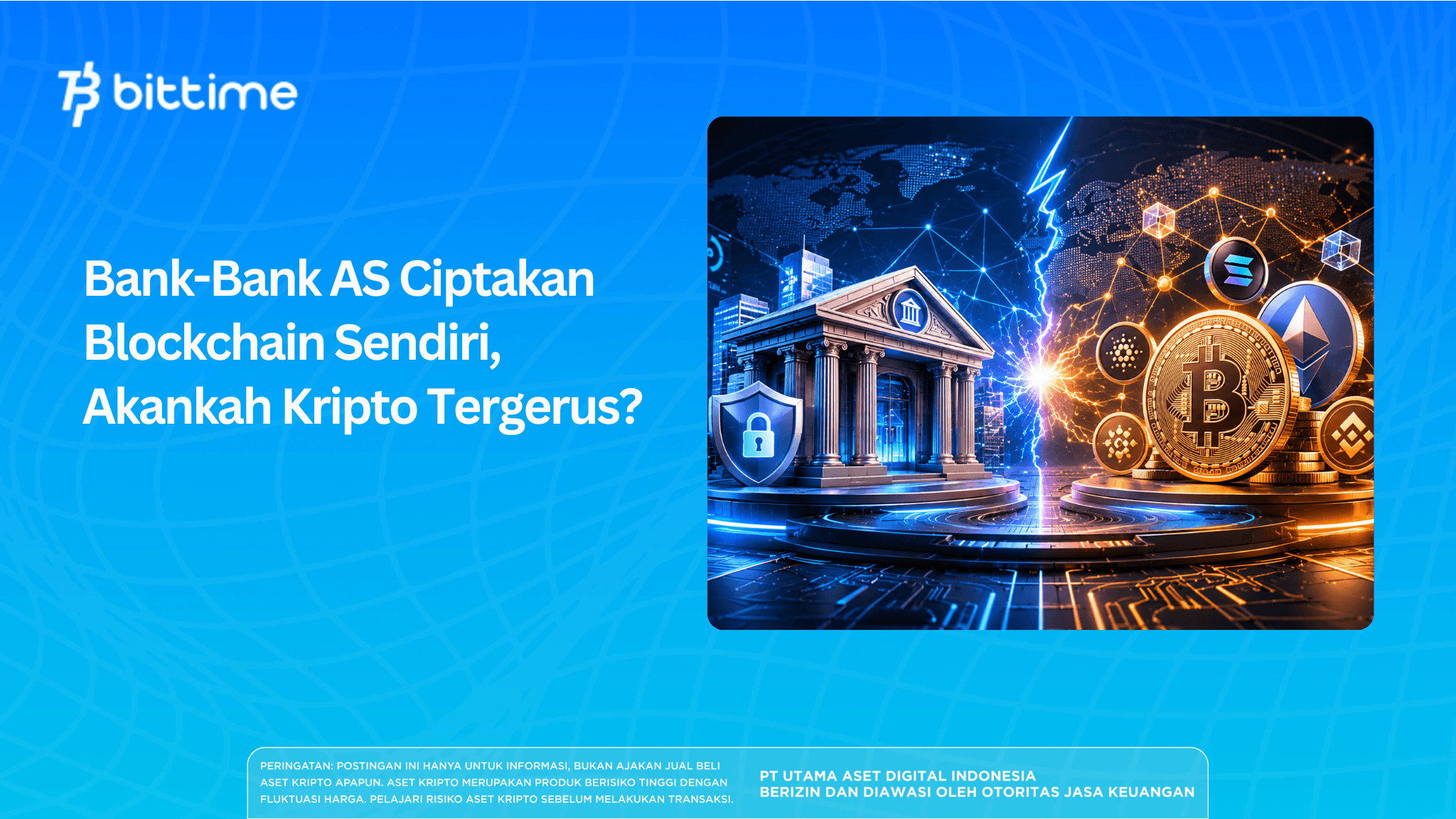
Several major U.S. banks are reportedly forming an alliance to build their own banking blockchain network. This move has raised a major question among investors: will public cryptocurrencies such as Bitcoin and Ethereum be eroded?
Key Takeaways
- U.S. Bank Alliance: Major banks are building a private blockchain to improve the efficiency of inter-institutional transactions.
- Not a Direct Competitor: Banking blockchains focus on interbank settlement, not on replacing public cryptocurrencies.
- Stronger Adoption: The rise of institutional blockchains could actually strengthen the legitimacy of the crypto industry.
Background of the U.S. Banking Alliance and Banking Blockchain
Several major U.S. banks are becoming serious about developing their own blockchain infrastructure. Their goal is not to compete with Bitcoin, but to create a faster and more cost-efficient settlement system.
Until now, interbank transfers have still relied on legacy systems that are slow and multi-layered. Blockchain offers near-instant and transparent settlement.
By forming an alliance, these banks aim to retain control over data and regulatory compliance. They are not using open public networks.
Read also: Ripple Partners with Jeonbuk Bank for Cross-Border Payments
What Is a Bank Blockchain Network?
A bank blockchain network is a private or consortium blockchain. Access is restricted to authorized institutions only.
Unlike public blockchains, which anyone can join, these networks place trust in known entities. This makes it easier to comply with anti-money laundering and know-your-customer requirements.
With a permissioned model, banks can still benefit from distributed ledger efficiency without losing control. This is the main reason major banks choose this approach.

Differences Between Banking Blockchains and Public Crypto
It is important to distinguish between two worlds that are often considered the same. Banking blockchains and public cryptocurrencies have very different characteristics.
Banking Blockchain
- Closed or consortium-based.
- Managed by financial institutions.
- Focused on efficiency and compliance.
- Does not require a public token.
Public Crypto
- Open to anyone.
- Decentralized and permissionless.
- Focused on transaction freedom and digital assets.
- Has native tokens such as BTC or ETH.
Both can coexist because they address different needs. Bank blockchains do not automatically eliminate the value of public cryptocurrencies.
Read also: Truth Coin Appears on Robinhood Chain, Is It Really Trump’s?
Why Are Major U.S. Banks Building Their Own Blockchains?
There are several compelling reasons why banks are creating their own blockchains.
1. Cost Efficiency
Cross-bank transaction settlement can take days. Blockchain can reduce the process to seconds.
2. Limited Transparency
Banks want transparency among participants, but not for the public. Consortium blockchains provide that balance.
3. Regulatory Compliance
With known participants, regulators can supervise more easily. This is a key requirement for adoption in the financial sector.
4. Avoiding Volatility
Banks do not want exposure to crypto-asset volatility. A blockchain without a public token provides the benefits of the technology without price risk.
Read also: Kalshi and Polymarket Draw CFTC Scrutiny, Could Trading Incentives Face Tighter Rules?
Impact on Bank Blockchain Adoption and the Crypto Industry
This move by U.S. banks is actually a positive signal for broader blockchain adoption. Technology once regarded as experimental is now being used by major financial institutions.
For the crypto industry, this strengthens the legitimacy of its underlying technology. Regulators and the general public are gaining a better understanding that blockchain is not merely a tool for speculation.
However, there are concerns that banks could create closed systems that displace the role of public networks. These concerns have not been proven, because the two serve different markets.
Read also: Crypto Wallet 2026: Review and How to Choose the Best One
Will Crypto Be Eroded by Bank Blockchains?
The main question in this article is whether crypto will be eroded. The answer: not in the near term.
Public cryptocurrencies have unique value that bank blockchains cannot replicate. Decentralization, full transparency, and censorship resistance are advantages that closed networks do not have.
As long as there is demand for permissionless assets and financial freedom, crypto will remain relevant. Bank blockchains could actually expand the market by drawing institutions into the digital-asset ecosystem.
The Future of Crypto Amid Institutional Blockchain Adoption
Rather than being eroded, public cryptocurrencies are likely to become increasingly connected with the traditional financial system. Bridges between private and public blockchains will become a key focus of future development.
Real-world asset tokenization, stablecoins, and cross-border payments are areas where these two worlds converge. Banks can use public blockchains to reach customers globally.
The future of crypto may actually be brighter as major institutions help build the infrastructure. However, investors still need to distinguish projects with strong fundamentals and real utility.
You can sign up for Bittime to monitor the latest crypto news and market movements. With real-time data, you can see how institutional sentiment affects the prices of your favorite digital assets.
Conclusion
U.S. banks creating their own blockchains are not a direct threat to crypto. Banking blockchains and public cryptocurrencies serve different needs.
In fact, this move accelerates the overall adoption of blockchain technology. Crypto still has a place because it offers decentralization and open access.
Keep track of these developments through a trusted platform such as Bittime. Do not miss opportunities amid the major transformation of the global financial system.

Bittime is a licensed Digital Financial Asset Trader (PAKD) platform regulated and supervised by Indonesia’s Financial Services Authority (OJK) — where you can buy Bitcoin in Indonesia and hundreds of other crypto assets starting from Rp10,000. Registration is fast, secure, and you can get started today.
Track the conversion of USDT to IDR and the real-time price movements of your favorite crypto assets. Everything is available in one crypto investment app that can be downloaded for free from the Play Store.
Ready to get started? Register now on Bittime and execute your investment strategy on a platform already trusted by millions of users in Indonesia.
FAQ
What Is the U.S. Bank Alliance for Blockchain?
This alliance is a group of major U.S. banks working together to build a private blockchain network to accelerate interbank transaction settlement.
Is a Bank Blockchain the Same as Crypto?
No. Bank blockchains are closed and managed by institutions, while public cryptocurrencies are open and decentralized, with native tokens.
Will Crypto Be Eroded by Banking Blockchains?
Not in the near term. Crypto offers decentralization and transaction freedom that cannot be replaced by closed networks.
What Are the Benefits of Blockchain for Banks?
The benefits include cost efficiency, faster transaction settlement, limited transparency, and easier regulatory compliance.
How Does This Affect Crypto Investors?
The impact tends to be positive because blockchain is gaining greater legitimacy. Investors should still focus on crypto projects with strong fundamentals.
Disclaimer: The views expressed belong exclusively to the author and do not reflect the views of this platform. This platform and its affiliates disclaim any responsibility for the accuracy or suitability of the information provided. It is for informational purposes only and not intended as financial or investment advice.

.png)