Aster vs Hyperliquid: Which Perpetual DEX Will Be More Profitable in 2026?
2026-06-19
Amidst the dominance of centralized exchanges, a number of decentralized exchange (DEX) which offer a fast trading experience without having to hand over control of assets to a third party.
The two most talked about names in this sector are Aster And Hyperliquid.
Both of them are focused on trade perpetual futures, but built with a different philosophy and approach.
Hyperliquid excels in scale with a market cap of $14.77 billion and a daily volume of $1.2 billion, whileAsteroffering innovative features with an aggressive buyback program and higher upside potential (74% below ATH).
This article will compare the two from various aspects: market cap, volume, buyback, revenue, features, and tokenomics.
Key Takeaways
Hyperliquid has the edge in scale: market cap $14.77 billion vs. Aster $1.68 billion. HYPE's 24-hour volume $1.2 billion vs. ASTER $210 million.
Buyback mechanism: Hyperliquid uses a 97% fee for HYPE buybacks (total $1.3M), Aster uses a 99% fee for ASTER buybacks with a supply target of 8M to 3M.
Aster is closer to ATH (-74%) than HYPE (-13.4%), indicating greater upside potential but also more volatility.
Register at Bittime now and start trading crypto with a fast, secure, and easy process in the app.
Aster vs Hyperliquid: Two Perpetual DEX Giants
Crypto derivatives trading continues to grow. Two of the most talked-about names in the perpetual DEX sector are Aster and Hyperliquid.
Both offer perpetual futures trading with very different approaches.
Read also:Hyperliquid Crypto and HYPE Coin: On-Chain Trading Platforms Targeted by Large Institutions
HYPE (Hyperliquid)
Hyperliquid is the dominant player with a market cap of $14.77 billion and a 24-hour volume of $1.2 billion.
The platform is built on a dedicated Layer-1 blockchain with an on-chain order book capable of processing transactions with ultra-low latency.
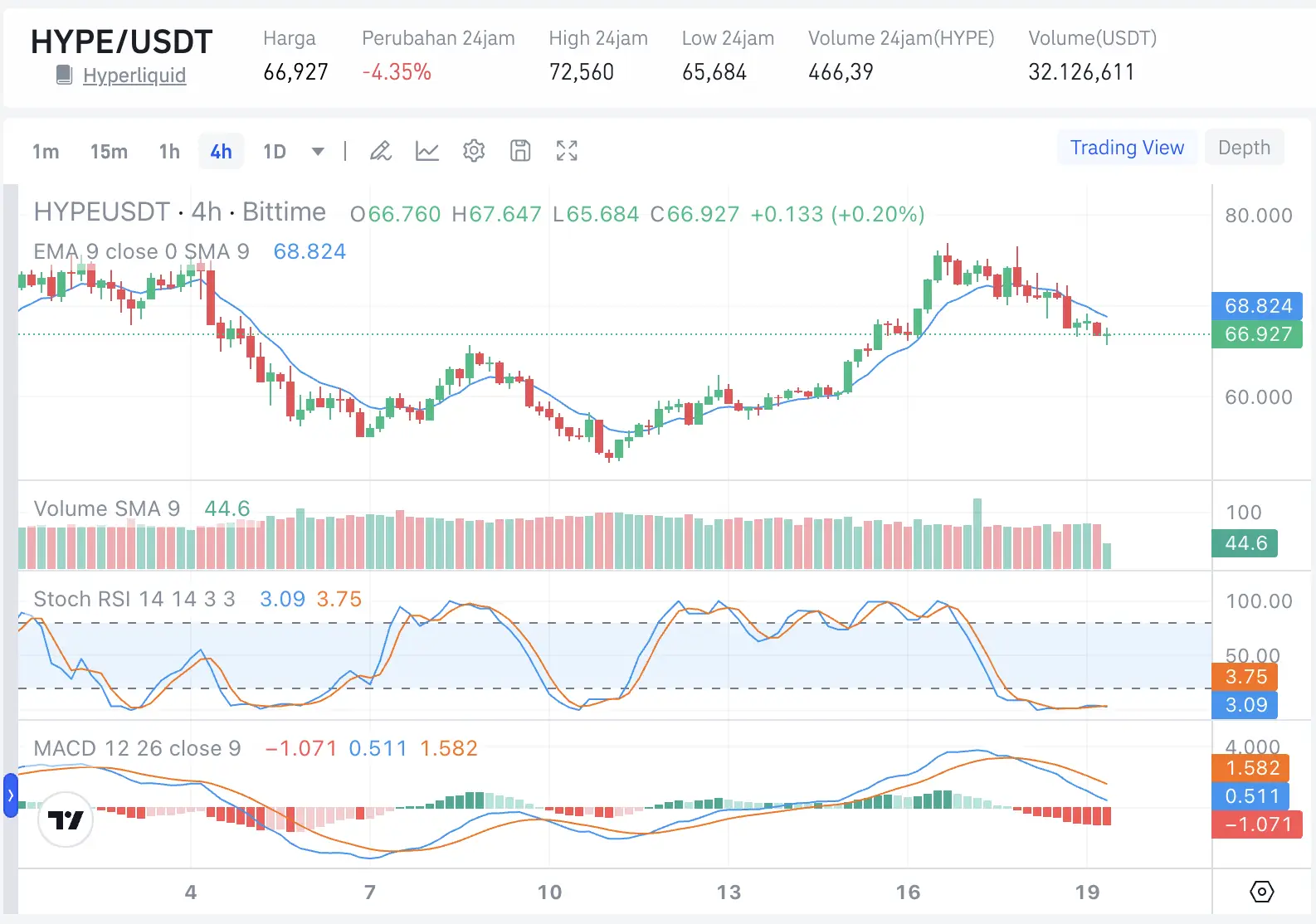
HYPE to USDT via Bittime Market
Read also:How to Buy Hyperliquid (HYPE)
Aster
Aster is a challenger with a market cap of $1.68 billion and a volume of $210 million. The platform offers innovative features such as hidden orders, multi-chain support, and the ability to use liquid staking tokens as collateral.
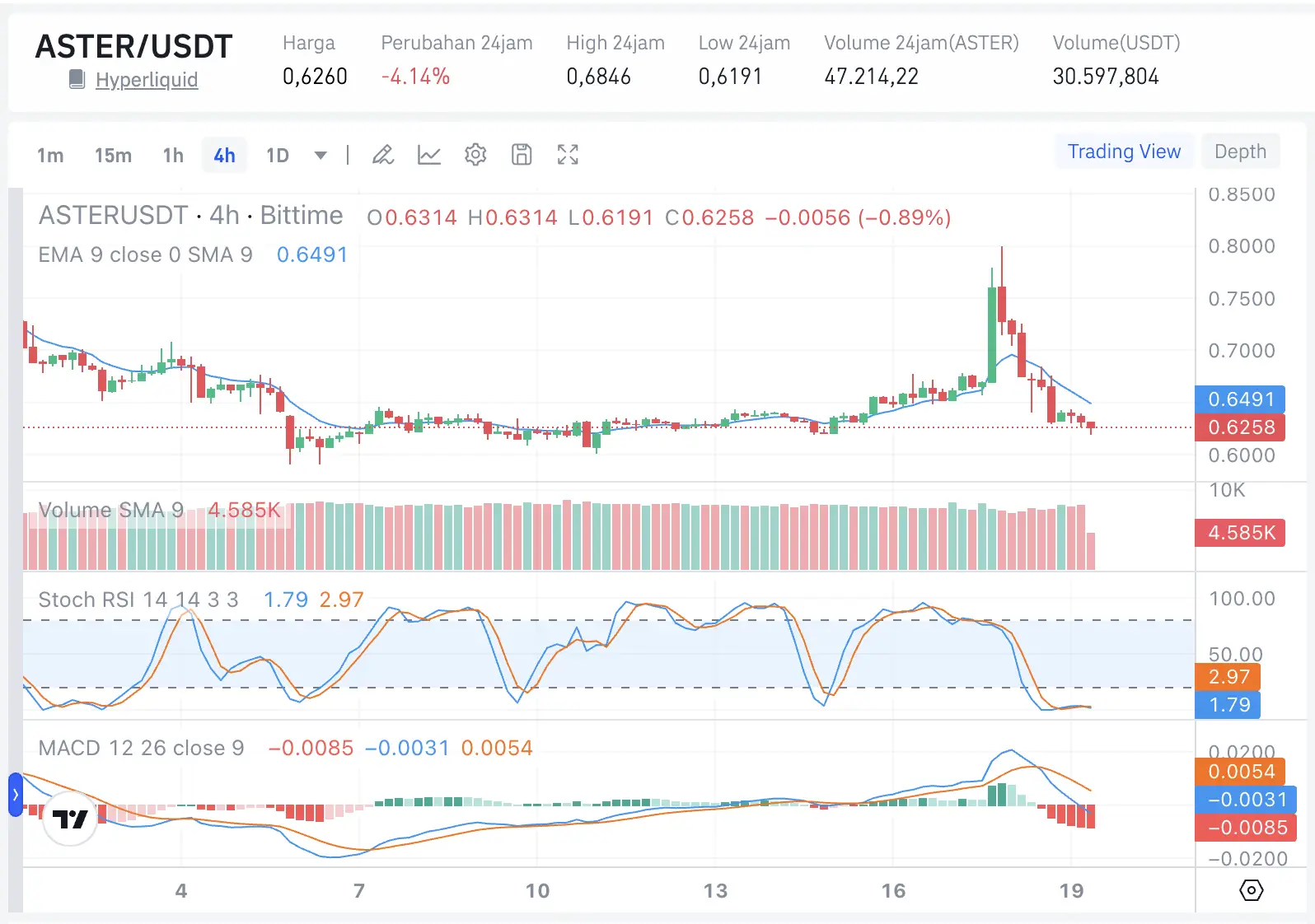
ASTER to USDT via Bittime Market
Read also:What is Aster (ASTER)? Tokenomics and Price Prediction
Market Cap and Volume Comparison
Data from Oak Research (June 19, 2026)
Aster vs Hyperliquid: Market Cap and Volume Comparison
Hyperliquid has a market cap nearly 9x larger than Aster, and HYPE's volume is also 5.7x higher.
However, Aster's volume/market cap ratio (12.55%) is higher than HYPE's (8.10%), indicating more intensive trading activity relative to its market size.
Read also:What is HyperLiquid Coin (HYPE)?
Comparison of Buyback and Revenue HYPE vs ASTER
Hyperliquid: The Biggest Buyback Engine in Crypto
Hyperliquid has the most aggressive buyback mechanism in the industry. The Assistance Fund uses 97% of trading fees to automatically purchase HYPE from the open market.
Total buybacks have exceeded $1.3 billion, with a daily average of around $1 million and a daily peak of $3.97 million.
The Assistance Fund currently holds approximately 28.5 million HYPE (worth $1.5 billion at its peak). The annual buyback rate is approximately 7% of the market cap, four to five times higher than Ethereum and BNB.
Hyperliquid has generated total cumulative revenue of $1.16 billion, with annualized revenue of approximately $881 million.
The platform processes approximately $4.7 trillion in cumulative perpetual volume. DeFiLlama confirmed that 99% of perpetual and spot fees are allocated to the Assistance Fund.
Read also:How to Buy ASTER on DEX: A Complete Beginner's Guide & Safety Tips
Aster: 99% Buyback Fee with a Target Supply of 3 Billion
Aster updated its tokenomics on June 17, 2026, directing 99% of daily platform fees to ASTER buybacks through an automated TWAP mechanism.
Purchased tokens are distributed to veASTER stakers as Loyalty Rewards.
For every ASTER purchased, an equal amount is burned from the reserve, starting from the team allocation.
This program continues every two weeks until the total supply drops from 8 billion to 3 billion.
Each permissionless listing on Aster Spot incurs a 50,000 USDT fee, which is also used for additional ASTER buybacks.
With a total supply of 8 billion and a 5% team allocation (400 million), Aster has the potential to burn up to 5 billion tokens.
Read also:How to Stake ASTER on Bittime in 4 Easy Steps
Feature Comparison: Innovation vs. Infrastructure
ASTER offers innovative features that set it apart:
Hidden Orders — allows traders to hide orders from the order book, reducing front-running and providing a competitive advantage.
Multi-Chain Support — available on BNB Chain, Ethereum, Solana, and Arbitrum.
Capital Efficiency — can use liquid staking tokens (asBNB) or yield-generating stablecoins (USDF) as collateral.
Dual Mode — Simple Mode for MEV-free one-click execution, Pro Mode for 24/7 stock perpetuals and grid trading.
HYPE excels in mature infrastructure:
Dedicated Layer-1 Blockchain — specifically designed for low latency trading activities.
On-Chain Order Book — all orders are recorded on the blockchain without sacrificing speed.
Deep Liquidity — $1.2 billion daily volume, tight spreads, low slippage.
Active Community — one of the largest perpetual DEXs with loyal users.
Tokenomics ASTER vs HYPE
ASTER:
- Circulating Supply:2.68 billion
- Max Supply: 8 billion
- Market Cap: $1.68 billion
- Rank: #49
- Buyback: 99% fee → buyback → burn → supply target 3M.
HYPE:
- Circulating Supply: 222.45 million
- Max Supply: 1 billion
- Market Cap: $14.77 billion
- Rank: #10
- Buyback: 97% fee → Assistance Fund → buyback HYPE (total $1,3M).
HYPE has a more controlled supply and a much larger market cap. ASTER has a larger supply with a significant reduction target through a buyback-burn program.
Who is Suitable for Using Aster?
Aster is suitable for traders who:
Looking for innovative features (hidden orders, multi-chain, liquid staking as collateral).
Want high upside potential (price 74% below ATH).
Interested in the aggressive buyback program and potential supply reduction.
Active on multiple blockchains (BNB Chain, Ethereum, Solana, Arbitrum).
Read also:How to Deposit and Withdraw on Aster DEX: A Complete Guide
Who is Suitable for Using Hyperliquid?
Hyperliquid is suitable for traders who:
Requires high liquidity and fast execution.
Professional traders who are familiar with advanced trading platforms.
Looking for experience approaching a centralized exchange.
If you want a platform with the largest buybacks in the industry and proven revenue.
Conclusion
Aster vs. Hyperliquid showcases two different approaches to perpetual DEXs. Hyperliquid excels in scale, liquidity, revenue, and the industry's largest buyback ($1.3M).
Aster offers innovative features and an aggressive buyback program with a target supply reduction of 5 billion tokens.
The best choice depends on your needs: HYPE for liquidity, revenue, and established buybacks; ASTER for innovation, upside potential, and an aggressive buyback-burn program.
Interested in trading HYPE? As well as the HYPE/USDT pair, Bittime also offers HYPE/IDR to support your trading and investment strategies.
Bittime is a licensed and regulated Digital Financial Asset Trader (PAKD) supervised by Indonesia’s Financial Services Authority (OJK) — where you can buy Bitcoin in Indonesia and hundreds of other crypto assets starting from just Rp10,000. The registration process is fast, secure, and you can get started today.
Track USDT to IDR conversions and monitor your favorite crypto assets in real time. Everything is available in one crypto investment app that you can download for free on the Play Store
Ready to start? Register now on Bittime and execute your investment strategy with a platform trusted by millions of users in Indonesia.
FAQ
What is the difference between Hyperliquid and Aster buybacks?
Hyperliquid: 97% fee → Assistance Fund → buyback HYPE (total $1,3M). Aster: 99% fee → buyback ASTER + burn → target supply down from 8M to 3M.
What is the total Hyperliquid buyback?
$1.3 billion with a daily average of $1 million and a peak of $3.97 million.
What is Aster's supply target after the buyback-burn program?
3 billion tokens from the current 8 billion (a reduction of 5 billion).
What is the Hyperliquid Assistance Fund?
A protocol fund that uses 97% of trading fees to automatically purchase HYPE from the market.
Does Hyperliquid buyback affect supply?
Yes. Purchased tokens are held in the Assistance Fund and not circulated on the market.
How much revenue does Hyperliquid generate?
Cumulative total $1.16 billion with annualized $881 million.
Disclaimer: The views expressed belong exclusively to the author and do not reflect the views of this platform. This platform and its affiliates disclaim any responsibility for the accuracy or suitability of the information provided. It is for informational purposes only and not intended as financial or investment advice.
.png)