Asian Market Opening Analysis: Why Is the KOSPI Under Pressure
2026-08-03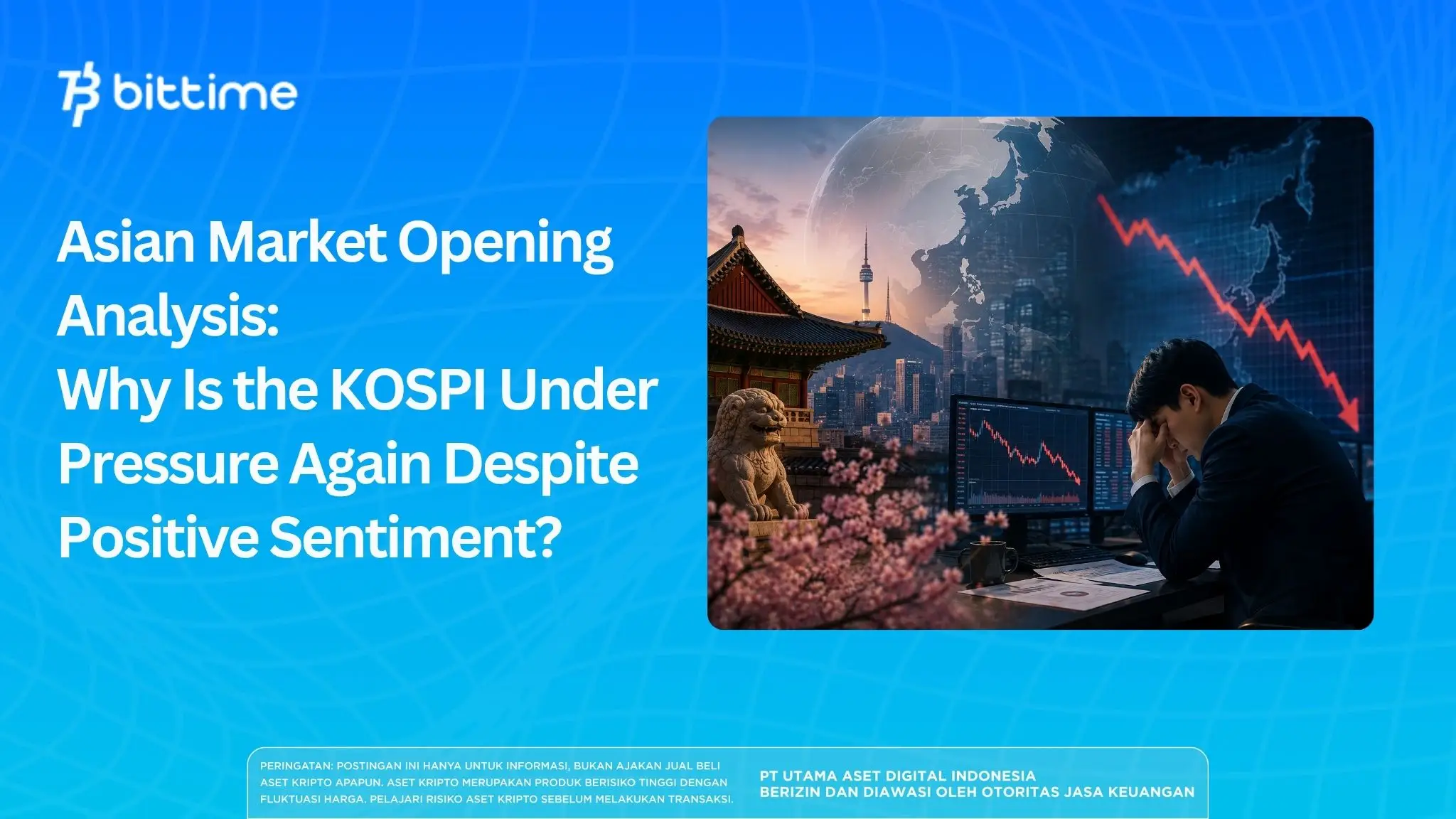
Asian stock exchanges opened trading on Monday, August 3, 2026, with a tendency to weaken.
South Korea's KOSPI was the index under the most pressure, even as the market received positive sentiment from US President Donald Trump's decision to delay escalating attacks on Iran.
This condition shows that easing geopolitical risks does not always immediately push all stock indexes up.
On the KOSPI, domestic factors and pressure on large-cap stocks are more dominant.
Samsung Electronics and SK Hynix fell about 8%, while LG Energy Solution also fell more than 4%.
With the index structure heavily concentrated in a few large issuers, a sharp correction in technology stocks could overshadow positive sentiment from abroad.
Key Takeaways
The KOSPI's decline was primarily driven by corrections in Samsung Electronics and SK Hynix, which together account for more than half of the index.
Profit-taking followed a strong rally in the previous session, fueled by selling by foreign and institutional investors.
Improved geopolitical sentiment has not been enough to lift the market, as investors continue to scrutinize technology valuations, leverage, and the sustainability of AI investments.
Why is the KOSPI Under Pressure Again?
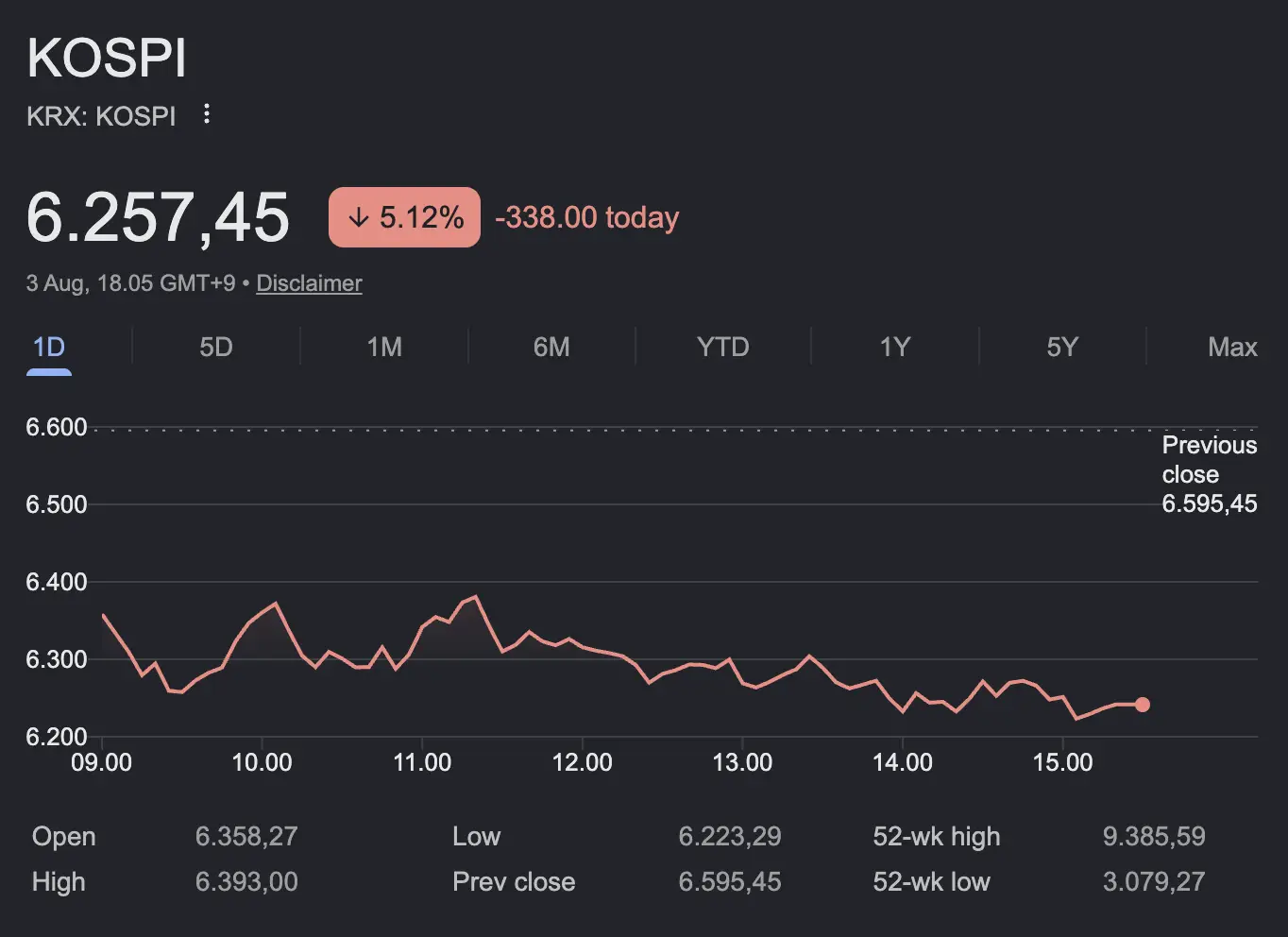
Source: Google Finance
In morning trading, the KOSPI fell 321.79 points, or about 4.88%, to 6,273.66. Samsung Electronics fell 8.19% to 241,000 won, while SK Hynix fell 7.92% to 1,582,000 won.
These two companies are not just ordinary members of the index. Samsung and SK Hynix together account for more than half of theh KOSPI large stock weight.
This means that when both of them fell nearly 8%, other stocks that were strengthening were not necessarily strong enough to withstand the decline in the index.
This is one of thecauses of decreased KOSPIthe most important.
Weighted index performancecapitalization is not determined by the number of shares that fall or rise, but by the size of the company that is moving.
As an illustration, a 2% rise in many small-cap stocks can be offset by a sharp decline in two companies that dominate the index.
Read Also:BUMI Shareholders: Complete List & 2026 Predictions
Profit-Taking Action After Extreme Rally
The pressure on the KOSPI also cannot be relieved from the extraordinary increase in the previous session.
South Korea's index reportedly surged more than 17% in a single day, with technology stocks the main driver of the recovery.
Very rapid increases usually create room for profit taking.
Investors who buy when the market is falling can choose to realize profits after prices rise again.
Want to gain exposure to US shares? Sign up to Bittime and start investing via tokenised stocks.
The subsequent correction does not necessarily indicate that the company's fundamentals have deteriorated immediately, but may be a process of price adjustment after an overly sharp rally.
Kiwoom Securities analyst Han Ji-young believes profit-taking and a reversal of market movements are likely to occur early in the week following the surge.
This explains why it is appropriatear showsfast market reactioneven though there is newspositive about Iran.
Market participants not only react to the latest news, but also consider existing positions and unrealized profits.
Read Also:How to Choose Potential IPO Stocks and Avoid the Risks for Beginners
Foreign and Institutional Sales Exaggerate Pressure
Fund flows also showed strong pressure. Foreign investors recorded net selling of around 1.11 trillion won, while institutional investors sold net selling of around 247.1 billion won. Retail investors, on the other hand, recorded net buying of around 1.32 trillion won.
This distinction is important because foreign and institutional investors typically transact in large amounts.
As they reduce their positions in Samsung, SK Hynix, and other major stocks, selling pressure can immediately affect the index.
Retail investor buying did help cushion the fall, but it wasn't enough to offset the dumping of shares by groups with larger capital capacities.
This pattern also shows the highmarket fluctuations South Korea.
When investorsWhile institutional and foreign investors reduce risk, individual investors often see dips as buying opportunities.
The final outcome depends on whether the selling pressure subsides or triggers a further correction.
Read Also:Samsung, SK Hynix, and Micron Face Lawsuits Over Alleged RAM Supply Manipulation
LG Energy Solution Shares Weigh Down the Index
Besides semiconductor stocks,saham LG Energy Solutiondown around 4.27%. The companyThe battery is a large-cap issuer on the KOSPI, so its movements also affect the index.
Pressure on LG Energy Solution added another dimension to the Korean market's decline. Investors not only dumped chip stocks but also reduced exposure to the electric vehicle battery sector.
Previously, LG Energy Solution reported second-quarter performance estimates that were below analysts' expectations due to weak demand for electric vehicles in key markets.
This condition adds to the caution regarding the prospects of the battery industry.
Read Also:Understanding Crypto Suspensions: How Do They Impact Investors?
Why Is Iran's Positive Sentiment Not Enough?
Trump's decision to delay escalation against Iran helped ease concerns about a wider conflict and disruption to energy supplies.
Typically, easing geopolitical risks can depress oil prices and increase appetite for riskier assets.
However, the influence of global sentiment is not always stronger than the internal factors of the index.
In the case of the KOSPI, investors faced three pressures at once: profit-taking after a sharp rally, a correction in the largest technology stocks, and net selling by foreign investors.
The market is also still questioning whether global companies' heavy spending on artificial intelligence will yield comparable returns.
Concerns about AI spending efficiency have previously weighed on chip stocks in Korea, Taiwan, Japan, and the United States.
Therefore, Iran sentiment only reduces one source of risk. The market must still assess valuations, the profitability of the technology sector, cash flows, and the stability of leveraged transactions.
Read Also:The Iran Conflict and Its Impact on the Global Economy and Oil Prices
Comparison with TAIEX and Straits Times Index
The movement of the Asian stock exchange that morning wasnot completely uniform.
TAIEX IndexTaiwan was one of the indexes that opened higher, whileStraits Times IndexSingaporemoving in the red zone.
This difference confirms thatAsian stock market sentimentnot translatedidentical by each country. Sector composition, valuations, currency conditions, foreign capital flows, and corporate news can produce different responses.
The TAIEX also has significant exposure to technology and semiconductors. However, its direction could diverge from the KOSPI if selling pressure on key Taiwanese stocks eases or if there are stronger local catalysts.
The Straits Times Index is composed more by banks, property, telecommunications and defensive companies.
Therefore, its response to chip sentiment is not always as large as the Korean or Taiwanese indexes.
Keep tracking other stock tokens such as AMZON, AMDON, and NFLXON as well as MSFTON, then you can start trading on the trusted exchange, only on Bittime.
Does the KOSPI's Decline Signal a Trend Reversal?
A drop of nearly 5% in a single session is significant, but it doesn't automatically indicate a reversal of the long-term trend. Some market participants view the correction as a cooling-off after an extreme rally, not a permanent fundamental change.
Further confirmation will come from the direction of Samsung and SK Hynix shares, the financial reports of US technology companies, and the ability of foreign investors to re-enter the Korean market.
Investors also need to monitor the volatility of leveraged products.
The Korean market previously experienced additional pressure from margin calls and forced selling of leveraged ETFs linked to large technology stocks. Such conditions could cause declines to accelerate faster than changes in company fundamentals.
Conclusion
The KOSPI's continued downward pressure wasn't due to the market ignoring the positive sentiment stemming from the postponement of the attack on Iran. This positive factor was outweighed by the corrections in Samsung Electronics, SK Hynix, and LG Energy Solution.
The heavy weighting of technology stocks led to a decline in several major issuers, which immediately dragged down the index. Profit-taking after the sharp rally, foreign investor selling, and concerns about tech valuations intensified the pressure.
The different movements of the TAIEX and the Straits Times also show that the opening of Asian markets should be analyzed based on the structure of each index, not just one global news story.

Gain exposure to shares in leading technology companies through tokenised stocks like TSLAX, MSFTON or GOOGLX only on Bittime!
Bittime is a licensed and regulated Digital Financial Asset Trader (PAKD) supervised by Indonesia’s Financial Services Authority (OJK) — where you can buy Bitcoin in Indonesia and hundreds of other crypto assets starting from just Rp10,000. The registration process is fast, secure, and you can get started today.
Track USDT to IDR conversions and monitor your favorite crypto assets in real time. Everything is available in one crypto investment app that you can download for free on the Play Store
Ready to start? Register now on Bittime and execute your investment strategy with a platform trusted by millions of users in Indonesia.
FAQ
Why is the KOSPI falling despite improving geopolitical sentiment?
The KOSPI's decline was triggered by sharp corrections in Samsung Electronics and SK Hynix, profit-taking, and net selling by foreign and institutional investors.
How much will the KOSPI decline at the opening on August 3, 2026?
KOSPI fell around 4.88% to 6,273.66 in morning trading.
Why do Samsung and SK Hynix influence the KOSPI so much?
Together, they account for more than half of the KOSPI, making their stock movements a significant influence on the index.
How is LG Energy Solution moving?
LG Energy Solution fell about 4.27% and added pressure on the South Korean index.
Are all Asian markets falling?
No. Asian markets were mixed. Taiwan's TAIEX was among the rising indices, while the KOSPI and Straits Times were in the red at the open.
Will the KOSPI correction continue?
This is not yet certain. Investors should monitor foreign flows, semiconductor stocks, leveraged product volatility, and the financial results of global technology companies.
Disclaimer: The views expressed belong exclusively to the author and do not reflect the views of this platform. This platform and its affiliates disclaim any responsibility for the accuracy or suitability of the information provided. It is for informational purposes only and not intended as financial or investment advice.

.png)