What Is Mistral AI? Get to Know the French AI That Can Rival OpenAI
2026-09-09 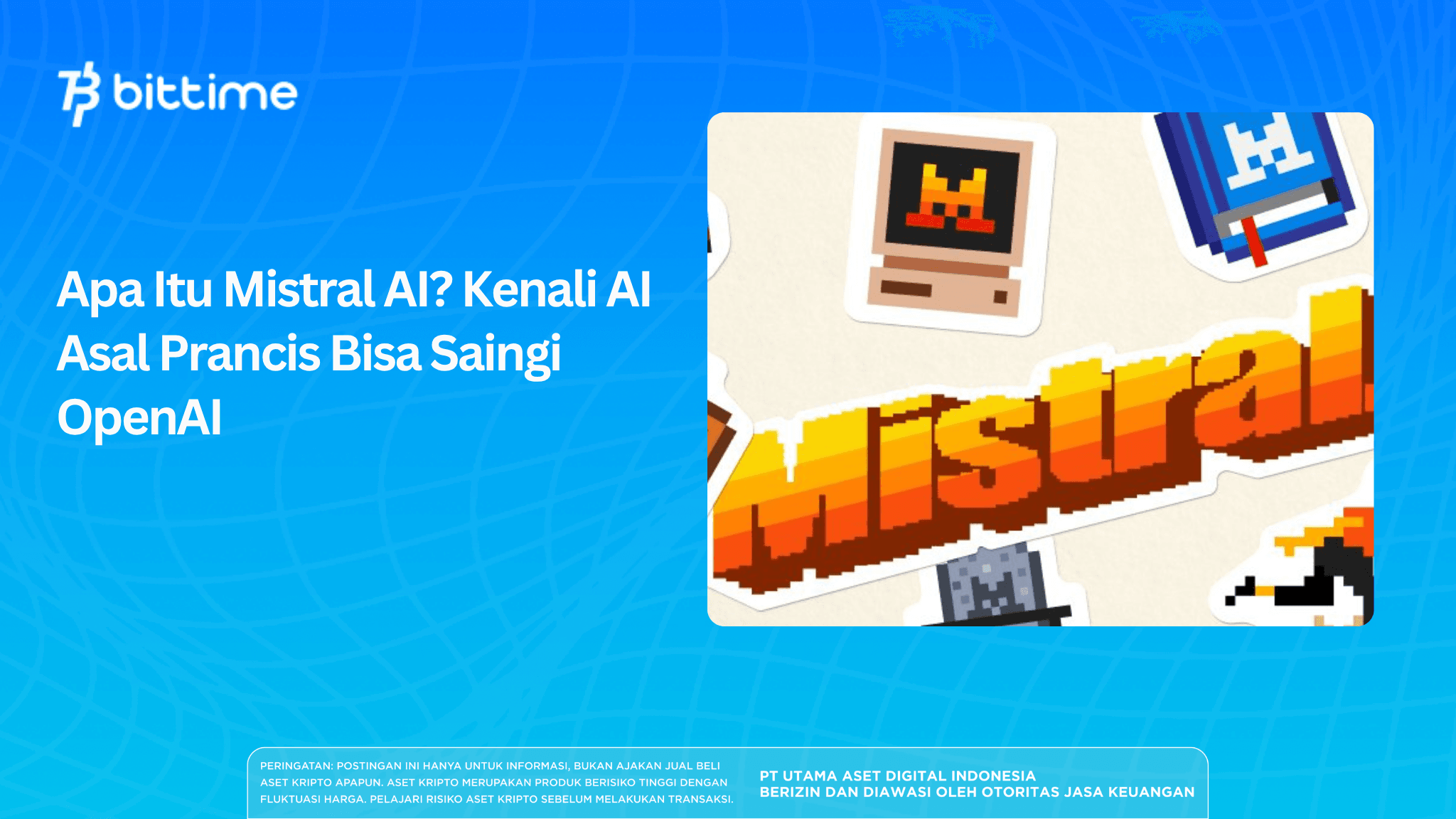
Samsung has just led a €3 billion funding round for a French AI startup, Mistral AI, which is not yet four years old — the largest equity round ever recorded by a European tech company.
Mistral AI is an open-weight language model that is now called a strong candidate to balance the dominance of OpenAI and Google in the global AI industry. If you are curious about what Mistral AI is and why tech giants like Samsung and ASML are willing to inject large funds, here is the full explanation.
Key Takeaways
- Mistral AI is a French AI startup known for its open-weight models and "sovereign AI" positioning for the European market.
- It has just secured a Series D funding of €3 billion (approximately $3.5 billion) led by Samsung, boosting its valuation to over €21 billion.
- Has a lineup of models from Mistral Large 3 to the consumer chatbot Le Chat, with enterprise clients like Airbus and HSBC.
What Is Mistral AI and Who Is Behind It?
Mistral AI is a French AI company founded in April 2023 by three former researchers from big AI labs: Arthur Mensch (ex-Google DeepMind), Guillaume Lample, and Timothée Lacroix (both ex-Meta). The three built Mistral with a vision to create more open and efficient AI models, unlike most major players that keep their models closed.
This positioning is what makes Mistral AI dubbed "sovereign AI" — its models and infrastructure are designed so that data, deployment, and control remain in the hands of the user, rather than relying on foreign providers. This strategy suits European companies and governments that have strict data sovereignty regulations.
Its biggest momentum came in early September 2026. Mistral AI announced a Series D of €3 billion (approximately $3.5 billion), led by Samsung Electronics along with co-leads Scaleup Europe Fund and PSG Equity, according to Euronews.
Read Also: MEDS Mask Stock: Getting to Know the Business of the Health Equipment Issuer and Its Products
Its valuation jumped to over €21 billion, nearly double the €11.7 billion during the Series C last year led by ASML.
CEO Arthur Mensch told CNBC that the funds will be used to build and own data centers, with a target for computing capacity to grow about 100% over the next five years. Mistral now operates in 20 countries with more than 125 enterprise clients, including Airbus, ASML, and HSBC.
The phenomenon of AI startups continually breaking funding records shows how strongly capital flows into the future technology sector.
If you are interested in taking part in the trend of digital asset investment that is also growing along with AI development, you can start with a verified account on Bittime, an OJK-licensed crypto exchange platform.
Mistral AI Models and Products, from Le Chat to Codestral
Mistral AI does not just have one model, but a complete lineup targeting different needs. Here are its flagship products:
- Mistral Large 3 — flagship model with Mixture-of-Experts architecture, supporting large context windows for long document analysis and complex reasoning. This model is closed-weight and only accessible via API.
- Ministral (3B, 8B, 14B) — lightweight model series for edge computing, can be run directly on laptops or mobile devices without cloud connection.
- Codestral and Devstral — specialized coding models, used for code completion, debugging, and refactoring across dozens of programming languages.
- Pixtral — multimodal model for processing images, documents, and charts.
- Voxtral — audio model for transcription and voice-based conversational agents.
- Le Chat — Mistral AI's consumer chatbot application, functioning similarly to ChatGPT but with hosting based in Europe.
Some models like Ministral and Codestral are released with an open-weight license, meaning they can be downloaded and run by developers themselves. Meanwhile, flagship models like Mistral Large 3 remain commercial API-only. This combination of open-weight and enterprise models is what makes Mistral AI attractive to businesses that need both flexibility and high performance.
Read Also: BIS Reveals New Potential of XRP Ledger for Digital Financial Systems
How Mistral AI Works and Its Comparison with OpenAI
Mistral AI's most prominent function lies in the application of Mixture-of-Experts (MoE) in its large models. Simply put, MoE activates only a small fraction of "experts" within the model for each request, rather than all parameters at once. The result is that the model still has large capacity but is much more compute-efficient than conventional dense models.
How Mistral AI works is also supported by Agents API that allow models to connect to web search, code execution, and integration via Model Context Protocol (MCP) to more than 20 third-party systems like Notion, GitHub, and Snowflake. This feature makes Mistral AI not just a chatbot, but can be used to build autonomous AI agents for business needs.
Compared to OpenAI, Mistral excels in lower inference costs and self-hosting flexibility through open-weight models. OpenAI and Anthropic still lead in top-tier reasoning benchmarks and more mature tooling ecosystems.
Read Also: 10 Free Bitcoin Mining and Faucet Sites in 2026, Which Are Legit?
Concrete proof of Mistral AI's solidity in the industrial sector is also seen from its new partnership with Samsung — Mistral Large is integrated into Samsung's entire semiconductor operations for on-premise AI models that detect production defects and optimize chip plant equipment, according to Samsung Newsroom.
This partnership was announced alongside the South Korea-France summit in Paris, and on the same day ASML also deepened chip lithography cooperation with Samsung and TSMC — a signal that the Europe-Asia AI-chip ecosystem is becoming more consolidated, according to Cryptopolitan.
Read Also: 10+ Best AI Coins 2026: Here's a List of Crypto with Artificial Intelligence Themes!
Conclusion
Mistral AI proves itself as a serious candidate to balance the dominance of OpenAI and Google through a combination of open-weight models, sovereign AI positioning, and massive capital backing from Samsung and ASML.
With a complete product lineup — from Le Chat for consumers to Codestral for developers — and strategic partnerships in the semiconductor sector, Mistral AI affirms its position as a European AI player to be reckoned with on the global stage, even though in valuation it still lags behind OpenAI and Anthropic.
After learning about AI developments, now is the time to check out AI-based crypto assets on Bittime such as the digital assets AI, AGI, RENDER, TAO, VVV, and many more AI coins.
Bittime is a licensed Digital Financial Asset Trader (PAKD) platform and supervised by the Financial Services Authority — where you can buy Bitcoin in Indonesia and hundreds of other crypto assets starting from Rp10,000. The registration process is fast, secure, and can be started today.
Monitor USDT to IDR conversion and the price movements of your favorite crypto assets in real-time. All available in one crypto investment app that can be downloaded for free on the Play Store.
Ready to start? Register now at Bittime and execute your investment strategy with a platform trusted by millions of users in Indonesia.
FAQ
What is Mistral AI?
Mistral AI is a French artificial intelligence company that develops open-weight and commercial language models, founded in April 2023 by former researchers from Google DeepMind and Meta.
Who are the founders of Mistral AI?
Mistral AI was founded by Arthur Mensch (CEO), Guillaume Lample, and Timothée Lacroix, three researchers who previously worked at Google DeepMind and Meta.
What is Mistral AI Le Chat?
Le Chat is Mistral AI's consumer chatbot application, functioning similarly to ChatGPT but with hosting and data residency based in Europe.
Is Mistral AI free to use?
Partly — models like Ministral and Codestral are released as open-weight and can be downloaded for free, while the flagship Mistral Large 3 model is paid via API schemes.
What is the difference between Mistral AI and ChatGPT?
Mistral AI excels in lower inference costs and self-hosting flexibility through open-weight models, while OpenAI's ChatGPT still leads in reasoning benchmarks and a broader tooling ecosystem.
Disclaimer: The views expressed belong exclusively to the author and do not reflect the views of this platform. This platform and its affiliates disclaim any responsibility for the accuracy or suitability of the information provided. It is for informational purposes only and not intended as financial or investment advice.

.png)