What Are Hood Stocks (HSTOCKS)? How They Work and the Risks
2026-07-20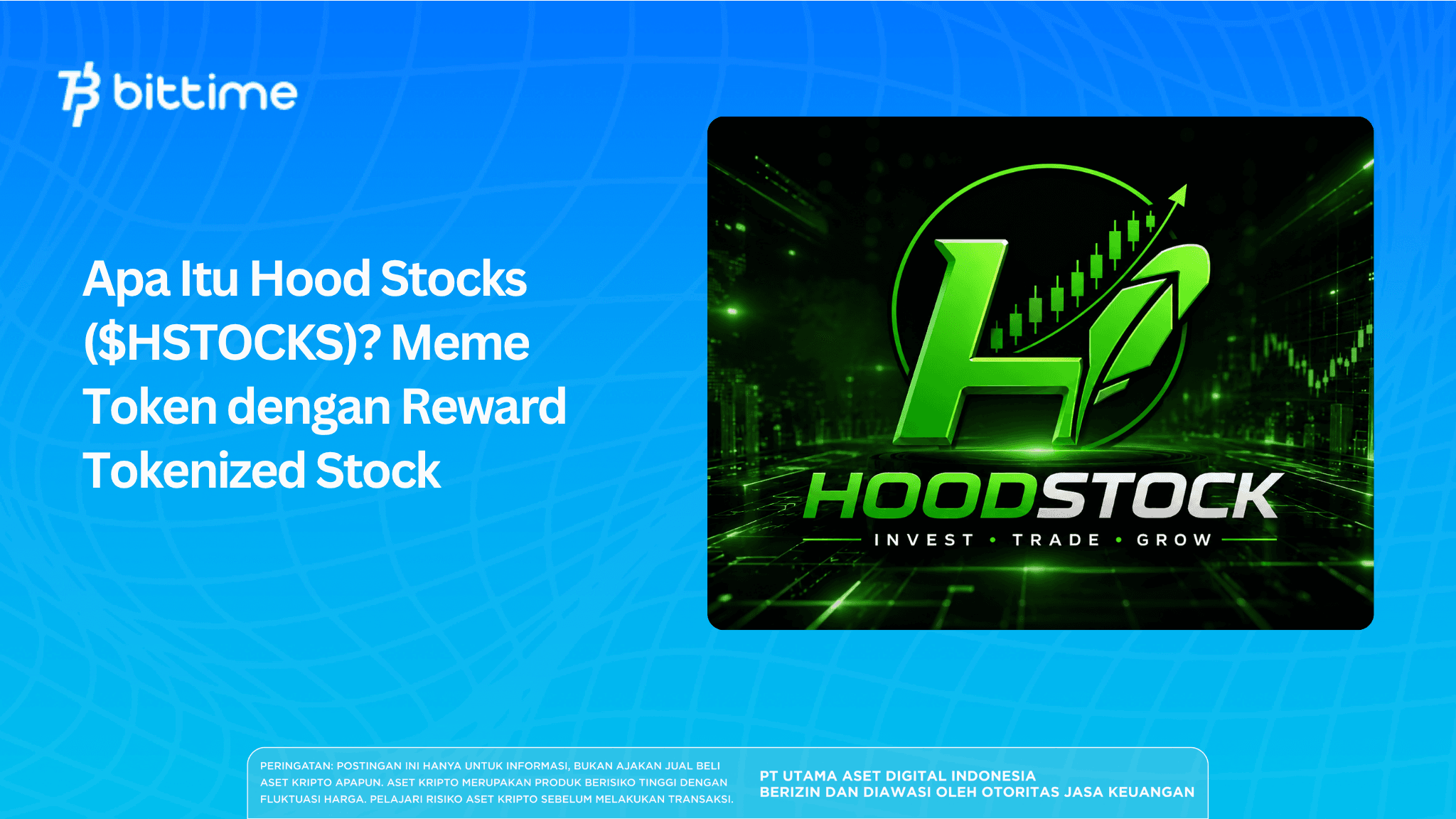
What is Hood Stocks? Hood Stocks, or $HSTOCKS, is a meme token that brings the stock market narrative into the crypto ecosystem.
The project offers the concept that token holders can earn rewards in the form of tokenized stock whose funds come from HSTOCKS trading activities.
Key Takeaways
- HSTOCKS combines the character of meme tokens with the narrative of tokenized stock rewards.
- Rewards are claimed to be derived from trading volume, but the distribution mechanism still needs to be thoroughly verified.
- The main risks include tokenomics transparency, limited liquidity, extreme volatility, and unclear official ties to the Robinhood brand.
What Are Hood Stocks ($HSTOCKS)?
Hood Stocks is an EVM-based meme token traded on a decentralized exchange (DEX). The token, symbolized by HSTOCKS, embraces the themes of stock trading, retail communities, and meme culture, which have long been synonymous with high-risk investment.
Source hoodstocks.site
Unlike meme coins, which rely solely on characters, images, or community trends, Hood Stocks attempts to add an economic function in the form of tokenized stock rewards. HSTOCKS holders are claimed to be able to acquire stock assets represented in the form of blockchain tokens.
This concept places HSTOCKS between two popular narratives:
- Community-based meme coin.
- Real-world assets or RWA in the form of tokenized shares.
However, the existence of a tokenized stock narrative does not automatically give HSTOCKS the fundamental value of a company's stock.
HSTOCKS remains a speculative crypto asset whose value depends heavily on liquidity, transaction activity, community trust, and the sustainability of the reward system.
Read also:What Is Alif Coin? An Indonesian DeFi, NFT, and Charity Social Project on BSC
Is HSTOCKS the Official Token of Robinhood?
Hood Stocks' name, design, and narrative may lead some users to associate it with Robinhood, an American financial services and stock trading company. However, the use of similar names or themes does not prove an official relationship.
Prospective buyers should distinguish between the following three things:
- Tokens that run on a specific network or ecosystem.
- Community tokens that use a brand's narrative.
- Official products launched or supported directly by the brand owner company.
Currently, the available project materials do not provide strong evidence of official cooperation, approval, investment, or support from Robinhood chain. Therefore, HSTOCKS should be treated as an independent project until there is a verifiable announcement from the relevant company.
This aspect is important because using a well-known company name often increases market attention. Investors who don't do their due diligence may assume the token has institutional backing, when in reality, this may not be the case.
Read also:Robinhood (FOX): A New Meme Coin on Robinhood Chain, What's Its Potential?
How Does HSTOCKS Work?
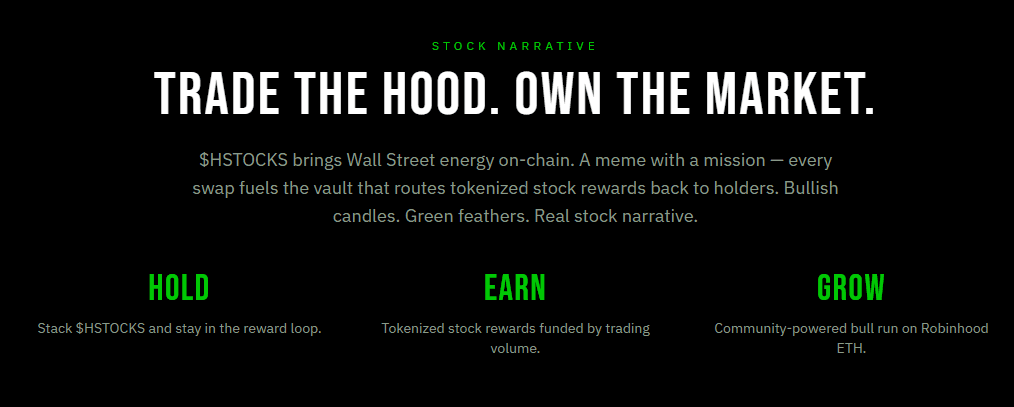
HSTOCKS operates on the basis of token trading. The project states that each transaction helps fund a vault, or pool of funds, that will be used to reward token holders.
In simple terms, the scheme offered can be described as follows:
- Users buy or sell HSTOCKS through DEX.
- A portion of the value or fees from the transaction are allocated to the reward system.
- Reward funds are collected in a vault.
- Holders who meet the requirements receive tokenized stock.
- The larger the trading volume, the greater the potential funds that will enter the reward system.
The mechanism sounds interesting, but some technical information is still needed before the system can be objectively assessed.
Reward Information to Check
Potential investors need to find answers to the following questions:
- What percentage of transaction fees goes to rewards?
- What tokenized stock will be distributed?
- Who is the issuer of the tokenized stock assets?
- Do tokenized stocks have real stock reserves?
- What is the distribution schedule?
- Are rewards distributed automatically or do they have to be claimed?
- What is the minimum number of HSTOCKS to have?
- Is there a minimum trading volume limit?
- Which countries can receive rewards?
- How are securities taxes and regulations treated?
Without such an explanation, rewards should still be viewed as project claims, not guaranteed income to token holders.
Take advantage of today’s opportunity to get started with investing. Sign up to Bittime and start building your portfolio.
Read also: What Is Pon (PONS)? The Robinhood Coin Meme That's Going Viral
What Are Tokenized Stock Rewards?
Tokenized stock is a digital representation of shares or stock price exposure issued on a blockchain. These assets can be designed to track a specific stock price, but their legal structure can vary by issuer.
Source hoodstocks.site
There are tokenized stocks that are actually backed by shares held through a custodian. There are also derivative products that simply track price movements without providing ownership of the underlying shares.
These differences determine the rights of token holders. Tokenized stock owners do not necessarily receive:
- Voting rights in shareholders' meetings.
- Direct dividend payment.
- Investor protection is the same as conventional shareholders.
- The right to claim against the company issuing the shares.
- Guaranteed conversion into original shares.
Therefore, the term "stock reward" requires further examination. Investors should determine whether the reward is tokenized shares backed by real assets, synthetic derivatives, community tokens, or simply crypto assets using the public company's symbol.
Read also: What Is HyperBull (HBULL)? How It Works and Its Potential Yield
Tokenomics HSTOCKS
Tokenomics explains how token supply, distribution, transaction fees, incentives, and ownership are designed. This section is crucial because it determines the extent of concentration risk and selling pressure.
Basic information that should be available includes:
- Total supply of HSTOCKS.
- Number of tokens in circulation.
- Allocation for developers.
- Marketing and community allocation.
- Team ownership.
- Lockup or vesting schedule.
- Liquidity percentage.
- Liquidity pool lock status.
- Purchase costs and selling costs.
- The percentage that goes to rewards.
- Burn mechanism if available.
Market data can show price, liquidity, volume, and diluted valuation. However, market figures alone aren't enough to assess the quality of tokenomics. Investors also need to examine token distribution across wallets.
If a few addresses control a significant portion of the supply, a single holder can suppress the price by selling large amounts of tokens. This risk is exacerbated when liquidity depth is low.
Read also: What is the Global Digital Water Reserve (GDWR) on Solana?
HSTOCKS Legit or Scam?
There's not enough evidence to conclude that HSTOCKS is a scam. Conversely, the existence of the website, community, token contract, and trading pairs are also not enough to declare this project completely safe or legitimate.
A more accurate assessment would be to place HSTOCKS as high-risk token memes that still require additional verification.
Indicators that Support the Existence of the Project
Several elements indicate that the project already has basic infrastructure:
- Token contracts can be found on blockchain networks.
- HSTOCKS has trading pairs on DEX.
- Price, volume and liquidity data can be monitored.
- The project has a website as well as a community channel.
- The concept of reward has been explained in general.
Factors That Remain a Warning
At the same time, there are several areas that need clarification:
- The team's identity and track record have not been clearly explained.
- Detailed technical documentation or whitepaper is not yet visible.
- The complete tokenomics has not been published transparently.
- The reward mechanism does not yet explain the distribution formula.
- The audit status of smart contracts cannot yet be considered definitive.
- An official relationship with Robinhood has not been proven.
- The issuer and underlying assets of the tokenized stock have not been explained.
- The complaint procedure or holder protection is not yet clear.
In conclusion, the question "Is HSTOCKS legit or a scam?" cannot be answered simply by looking at price increases or trading volume.
Legitimacy requires team transparency, contract security, reward documentation, treasury management, and proof that the project's promises are actually delivered.
Keep tracking other stock tokens such as AMZON, AMDON, and NFLXON as well as MSFTON, then you can start trading on the trusted exchange, only on Bittime.
Hood Stocks Investment Risks
1. Meme Token Volatility
Meme tokens can fluctuate rapidly. Prices often fluctuate based on sentiment, community promotion, social media trends, or the activity of a few large wallets, rather than business revenue.
2. Limited Liquidity
Liquidity determines how easily users can sell tokens. When liquidity is low, large transactions can cause extreme price swings or high slippage.
3. Risiko Smart Contract
Contracts can contain features that restrict sales, change transaction fees, mint new tokens, or otherwise give developers significant control. Automated checks aren't always capable of detecting all of these risks.
4. Risk of Ownership Concentration
Concentrated token distribution in a few wallets increases the likelihood of a major sell-off. Investors should review the holder list and separate liquidity pool wallets, burn addresses, treasuries, and personal wallets.
5. Reward Uncertainty
Rewards depend on transaction volume and vault sustainability. If volume drops, reward funding may also decrease. Rewards may even stop if the team doesn't have an automated and transparent system.
6. Risk Tokenized Stock
Tokenized shares may face territorial restrictions, service outages, custody issues, or regulatory uncertainty. Not all tokenized shares provide the same rights as real shares.
7. Brand and Affiliate Risks
Names that resemble well-known companies can lead to misunderstandings. Without proper authorization or official relationships, a project could face branding changes, trademark disputes, or even the termination of promotional channels.
Read also: What is HOOD4663? A Community Token Inspired by Robinhood Chain
How to Check HSTOCKS Before Buying
Before connecting a wallet and exchanging assets, perform the following checks:
- Match contract addresses from multiple official channels.
- Check whether the contract source code has been verified.
- Look for mint, blacklist, pause, and fee change functions.
- Check the percentage of ownership of the largest holder.
- Ensure the lock or burn status of liquidity.
- Learn the reward formula and distribution schedule.
- Identify the issuer of tokenized stock.
- Check if the team has an identity or track record.
- Avoid buying just because the price is rising sharply.
- Use funds that are ready to face full loss.
Users should also be wary of fake contracts. Tokens with the same name and symbol can be created by anyone. Avoid copying contract addresses from social media comments, private messages, or unverified groups.
Read also: What is Catwifhood (HOOD) that is in the spotlight after a hundred percent rally on PumpSwap?
Are Hood Stocks Good for Investment?
HSTOCKS is more categorized as a speculative asset than a fundamentals-based investment. This token may appeal to users who understand DEXs, are able to read on-chain data, and are willing to accept the risk of losing most or all of their capital.
HSTOCKS is less suitable for users who:
- Need a stable reward income.
- Think of tokens as the same as Robinhood stocks.
- Not understanding slippage and liquidity.
- Using basic needs funds.
- Expect protection like capital market investors.
- Unable to inspect blockchain contracts and transactions.
Potential profit shouldn't be the sole basis for decisions. In small-cap tokens, the potential for significant upside always comes with an equally extreme downside risk.
Conclusion
Hood Stocks, or HSTOCKS, is a meme token that offers a unique narrative in the form of tokenized stock rewards from trading activity.
This concept differentiates it from regular meme coins, but it isn't enough to prove the project's security, reward sustainability, or fundamental quality.
Investors should examine tokenomics, holder distribution, liquidity, contract audits, team identity, source of tokenized stock, and proof of official relationship with the brand. Don't judge a project solely on price increases or transaction volume.
Monitor developments, conduct independent research, and limit exposure according to your risk tolerance.

Gain exposure to shares in leading technology companies through tokenised stocks like TSLAX, MSFTON or GOOGLX only on Bittime!
Bittime is a licensed and regulated Digital Financial Asset Trader (PAKD) supervised by Indonesia’s Financial Services Authority (OJK) — where you can buy Bitcoin in Indonesia and hundreds of other crypto assets starting from just Rp10,000. The registration process is fast, secure, and you can get started today.
Track USDT to IDR conversions and monitor your favorite crypto assets in real time. Everything is available in one crypto investment app that you can download for free on the Play Store
Ready to start? Register now on Bittime and execute your investment strategy with a platform trusted by millions of users in Indonesia.
FAQ
What are Hood Stocks?
Hood Stocks is a meme token with the symbol HSTOCKS that carries a stock trading theme. The project claims to reward tokenized stock holders.
How do HSTOCKS holders earn rewards?
The project states that a portion of trading activity will fund the vault rewards. However, the formula, schedule, minimum holding amount, and distributed assets remain to be verified.
Is HSTOCKS official from Robinhood?
There is no solid evidence to suggest that HSTOCKS is published or officially endorsed by Robinhood Markets. Similarity in name and theme cannot be used as evidence of affiliation.
Is HSTOCKS safe to buy?
HSTOCKS carries high risks such as volatility, limited liquidity, smart contracts, holder concentration, and reward uncertainty. Perform on-chain checks before purchasing.
Are tokenized stocks the same as real stocks?
Not always. Token holders' rights depend on the issuer, custodial structure, asset reserves, and applicable legal provisions.
Disclaimer: The views expressed belong exclusively to the author and do not reflect the views of this platform. This platform and its affiliates disclaim any responsibility for the accuracy or suitability of the information provided. It is for informational purposes only and not intended as financial or investment advice.
.png)