What Is FDI? Purbaya Yudhi Sadewa's Explanation and Views
2025-10-08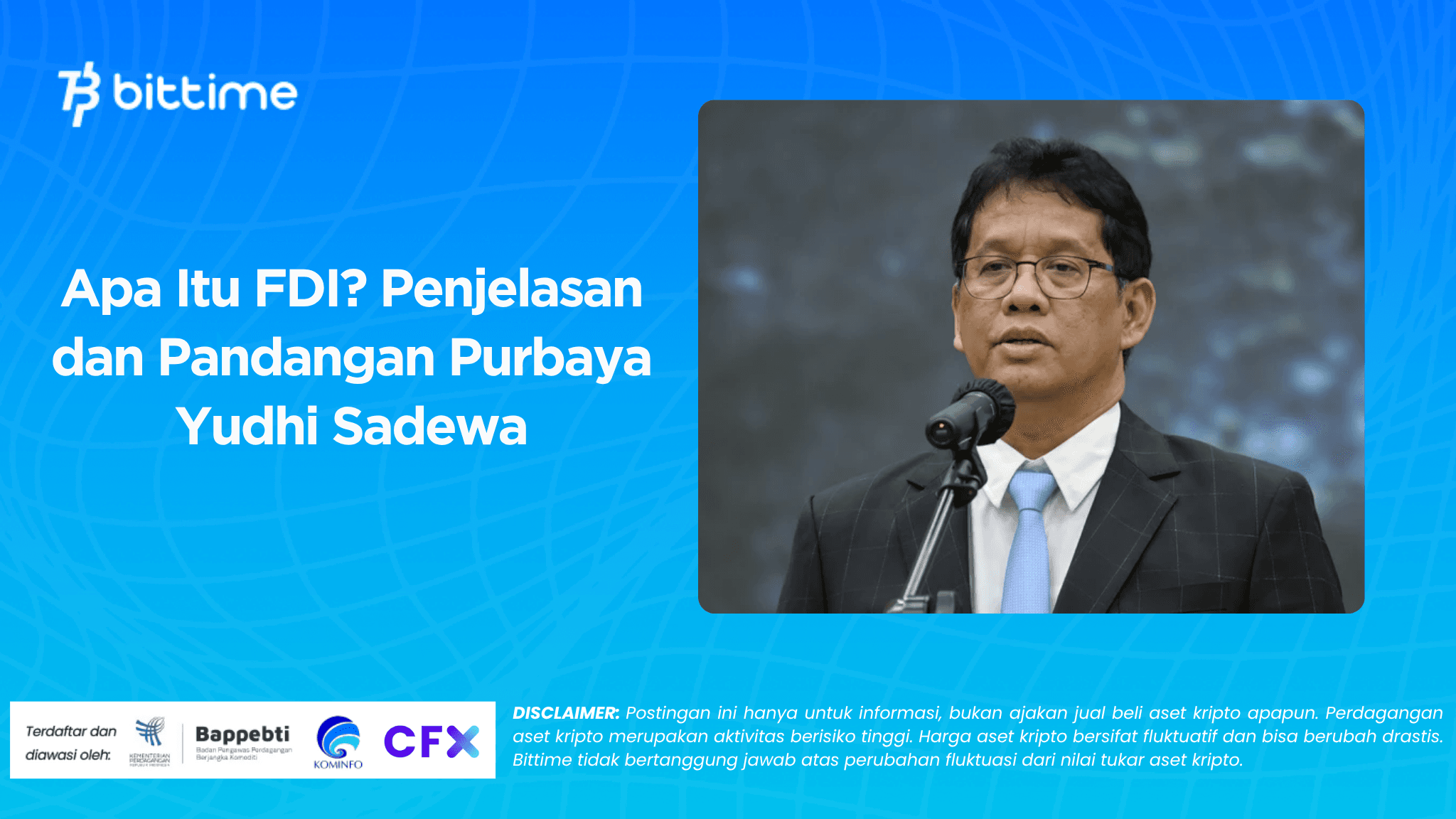
Bittime - Foreign Direct Investment (FDI) is frequently mentioned in economic discussions and government policy. Recently, Finance Minister Purbaya Yudhi Sadewa reaffirmed the government's commitment to FDI as a pillar of development financing, including for major projects like the Indonesian Capital City (IKN).
This article will explain what FDI is, from Purbaya's perspective, its types, its benefits, and how government policy utilizes FDI strategically for Indonesia's economic growth.

What is FDI and How Purbaya Responds to It
Definition of FDI (Foreign Direct Investment)
FDI is foreign direct investment, where investors from abroad invest capital in local companies with the aim of gaining profits.lasting interest—namely, owning shares, production facilities, or fixed assets that connect the investor to the management and operations of the company. FDI differs from portfolio investment because FDI involves control and a long-term relationship.
FDI According to Purbaya
While Purbaya hasn't specifically defined FDI in a single definition speech, several of his statements indicate that he views FDI as a crucial element in today's economic development strategy. For example, he mentioned that major projects like the new capital city (IKN) will utilize a mixed scheme involving FDI, along with the state budget and public-private partnerships (KPBU).
Also, in the context of liquidity and fiscal stimulus, economists say that Purbaya's policies could trigger foreign capital flows, including FDI, if the investment climate is deemed conducive.
READ ALSO: Yudo Sadewa's Profile: Son of Finance Minister Purbaya, a Crypto Scalper Expert
Benefits of FDI for Indonesia
Capital Increase and Development Funding:
FDI brings new capital that helps finance infrastructure, production facilities, and public projects that may be difficult to finance with domestic funds alone.
Technology and Knowledge Transfer:
Foreign investors typically bring more advanced technology, modern management methods, and higher operational standards, which can then be absorbed by local companies and their workforce.
Job Creation
With the establishment of factories, production facilities and foreign projects, new job opportunities will be created, both directly and indirectly.
Increasing Exports and International Trade
FDI-backed companies tend to be more export-competitive, due to access to global networks and better production capabilities.
Strengthening Competitiveness and Economic Stability
Well-managed FDI can contribute to economic stability, strengthen the exchange rate, and attract other foreign investors, whether in stocks, bonds, or direct investment. Purbaya expressed optimism that foreign capital will flow not only into the capital market but also into FDI.
Purbaya's Policy Supporting FDI
Mixed Scheme of APBN, PPP, and FDI for National Projects
One example of a policy Purbaya mentioned is the use of FDI as part of the IKN financing, rather than just relying on the APBN.
Positive Signals through Liquidity and Economic Stimulus
By placing government funds in banks (e.g., Himbara), the government hopes to increase liquidity, lower interest rates, and encourage businesses to borrow more. This could attract foreign investors due to the projected returns and increased efficiency.
Efforts to Maintain a Transparent Policy and Regulatory Climate
Although many challenges remain (such as fictitious credit risks, inconsistent regulations, and uneven distribution of benefits), Purbaya emphasized the importance of credible policies to ensure foreign investors are confident in the security and long-term potential of their investments.
READ ALSO: 5 Strategic Policies of Finance Minister Purbaya Yudhi for Indonesia's Economic Growth
Challenges and Important Notes According to Purbaya
Careful Distribution and Utilization of Funds
Even if substantial FDI funds are inflowed, it's crucial that they are channeled into productive and labor-intensive sectors. Otherwise, the impact on unemployment and growth could be less than optimal.
Risk of Foreign Dependence
There is concern that if FDI is too dominant, more control and profits may flow abroad (profit repatriation), while local impacts (community, environment, technology) may be less evenly distributed.
Supporting Infrastructure and Regulations
To attract FDI, the government must ensure adequate infrastructure (transportation, electricity, internet), clear regulations, easy licensing, and guaranteed investment security.
Transparency and Good Governance
The credibility of the government and business actors is important so that foreign investors can trust that their investments will not be affected by corruption, sudden changes in regulations, or detrimental practices.
READ ALSO: Finance Minister Purbaya Warns Gen Z: Crypto Is Not Gambling
Conclusion
What is FDI according to Purbaya? In short, FDI is foreign direct investment that establishes long-term interests in local companies, bringing capital, technology, and export opportunities. Purbaya views FDI as a crucial part of development strategies: from the new capital project to fiscal stimulus and macroeconomic restructuring.
The benefits are clearly significant, but the challenges are also significant. For FDI to have a maximum impact on Indonesia, transparent policies, supportive regulations, inclusive fund management, and a focus on productive and labor-intensive sectors are required.
How to Buy Crypto on Bittime

Want to trade sell buy BitcoinsLooking for easy crypto investing? Bittime is here to help! As an Indonesian crypto exchange officially registered with Bappebti, Bittime ensures every transaction is secure and fast.
Start by registering and verifying your identity, then make a minimum deposit of IDR 10,000. After that, you can immediately purchase your favorite digital assets!
Check the course BTC to IDR, ETH to IDR, SOL to IDRand other crypto assets to find out today's crypto market trends in real-time on Bittime.
Additionally, visitBittime Blogto get various interesting updates and educational information about the world of crypto. Find trusted articles on Web3, blockchain technology, and digital asset investment tips designed to enrich your crypto knowledge.
FAQ
What is the difference between FDI and portfolio investment?
FDI involves direct ownership and control of assets, not just buying shares for short-term profits.
How does FDI affect the rupiah exchange rate?
Foreign capital inflows can strengthen the rupiah, while capital outflows or uncertainty can weaken it.
Is FDI always profitable?
Not always; it depends on the sector, distribution of benefits, regulations, and how it impacts local businesses and the environment.
How can Indonesia attract more FDI?
By improving regulations, infrastructure, investment security, and providing clear and transparent incentives.
What is the impact of FDI on local MSMEs?
When combined with technology transfer and partnership policies, MSMEs can gain broader market access and increase production capacity.
Disclaimer: The views expressed belong exclusively to the author and do not reflect the views of this platform. This platform and its affiliates disclaim any responsibility for the accuracy or suitability of the information provided. It is for informational purposes only and not intended as financial or investment advice.

.png)