What is Allora Coin (ALLO)? How it Works and Tokenomics
2026-07-22
What is Allora Coin? Allora Coin, or ALLO, is the native token of a decentralized AI network that aggregates the results of various machine learning models. This token is used to purchase inferences, follow topics, stake, and pay rewards to network contributors.
Key Takeaways
- Allora coordinates multiple machine learning models, rather than building a single AI model that does all the work.
- ALLO is used for inference payments, participation fees, staking, delegation, and rewards for workers, reputations, and validators.
- ALLO's maximum supply is 1 billion tokens, with key risks being token unlock, network adoption, AI competition, and price volatility.
What is Allora Coin?
Allora was a decentralized artificial intelligence network designed to generate predictions or inferences through the contributions of many machine learning models.
This network attempts to avoid dependence on a single model by combining the results of multiple models with different approaches, data, and expertise.
Source allora.network
Its native token is called ALLO. The term “Allora Coin” is commonly used by investors to refer to this token, while the Allora Network is the network and protocol that serves as its infrastructure.
Allora is not a chatbot like generative AI products that directly receive user questions and generate long answers. Its primary function is to coordinate intelligence from various models to complete specific tasks.
Examples of outputs that a network can produce include:
- Asset price prediction.
- Volatility estimates.
- Analysis sentiment.
- Demand forecast.
- Risk assessment.
- DeFi strategy optimization.
- Supporting data for AI agents.
- Supervised and unsupervised learning outputs.
Allora calls itself a decentralized marketplace for intelligence. Application developers can use network inference results without having to build an entire machine learning system from scratch.
Read Also: What Is Allora (ALLO)? Decentralized AI
How Does Allora Coin Work?
To understand how Allora Coin works, it is important to distinguish the ALLO token from the AI mechanisms within the network.
ALLO doesn't directly run AI models. The token is used to coordinate participants, pay for intelligence, secure the system, and distribute rewards.
Sumber: AI Generated Image
The Allora network has several main types of participants.
1. Topic Creator Creates Market Intelligence
Activities in Allora are divided into topics. Each topic defines a task that the network must complete.
For example, one topic might ask for a Bitcoin price prediction for the next hour. Another topic might focus on ETH volatility, market sentiment, or the risk of a protocol being liquidated.
Topics usually determine:
- Types of predictions.
- Result format.
- Ground truth source.
- Predicted delivery interval.
- Error measurement method.
- Evaluation time.
- Parameter reward.
Creating a topic requires payment or a fee using ALLO. Workers and reps may also be charged a registration fee to participate in certain topics.
2. Inference Worker Sends Prediction
Inference workers run machine learning models and send prediction results to the network.
Each worker can use:
- Different models.
- Different datasets.
- Different indicators.
- Machine learning architectures are different.
- Own preprocessing strategy.
One worker might use historical price data, while another might use social media sentiment, blockchain activity, or macroeconomic data.
This distinction is important because one model may not always be superior in all market conditions. A model that is effective in a rising market may lose accuracy when volatility increases.
3. Forecast Worker Estimates Model Accuracy
Allora employs participants called forecast workers. Their job isn't just to predict the final outcome, but also to estimate which model is likely to have the lowest error rate under certain conditions.
Forecast workers generate loss or error estimates for inferences submitted by other workers.
This mechanism helps the network become more contextual. Allora doesn't simply average all predictions, but instead tries to determine which model deserves more weight in the current situation.
4. Reputation Checks Inference Quality
Reputers evaluate the quality of the results submitted by workers. They compare inferences with ground truth once the actual data is available.
For example, if a topic asks for a BTC price prediction for the next hour, the reputer can compare each worker's prediction with the actual price after one hour has passed.
The reputer then calculates the loss and reports its evaluation to the network. To fulfill its role, the reputer must stake ALLO.
Staking obligations have economic consequences. Reputants who provide quality evaluations can earn rewards, while network mechanisms are designed to discourage inaccurate reporting.
5. Allora Combines Multiple Predictions
After receiving the inference, forecast, and evaluation, the network performs inference synthesis.
In this process, each worker's predictions don't always receive equal weight. Models deemed to make unique and relevant contributions may receive greater weight.
The end result is a synthesized inference that can be used by applications or consumers. This eliminates the need for consumers to manually select a model.
The reward mechanism also assesses unique contributions. Workers are rewarded not only for making correct predictions, but also based on how much their predictions improve the quality of the network's aggregated results.
Keep track of developments regarding ALLO and other crypto assets by signing up to Bittime and following the latest market updates.
Simple Example of How Allora Network Works
Imagine there is a topic that predicts the price of ETH one hour in the future.
Three workers send predictions:
- Worker A predicts US$3,000.
- Worker B predicts US$3,050.
- Worker C predicts US$3,120.
The network doesn't directly calculate the usual average. The forecast worker will assess which model is likely to be most accurate based on the current conditions.
If the previous model B performed better when volatility was low, while the market was stable, Worker B's results could receive greater weight.
After an hour, the actual price is available. Reputer compares each worker's results with the ground truth and calculates the error.
This information is then used to:
- Determine the reward.
- Update contribution reputation.
- Improve the next combined result.
- Make the network more responsive to new conditions.
The term "self-improving" in Allora doesn't mean the blockchain trains the entire model automatically. Improvement occurs primarily because the network's mechanisms continuously assess, weight, and incentivize participants' performance.
What is the function of ALLO Coin?
ALLO is a utility token that supports the network economy. This token does not provide share ownership, company rights, or the promise of dividends.
Here are the main functions.
Purchasing AI Inference
Consumers can pay ALLO to acquire the intelligence generated by the network.
Allora applies the conceptPay-What-You-Wantor PWYW. Consumers can determine the amount of fees they are willing to pay for inference on a topic.
However, choosing zero fees has consequences. Topics that don't generate payments will lose weight and receive no ongoing reward allocation.
This mechanism aims to create price discovery based on real demand for intelligence.
Create a Topic
Users need ALLO to create new topics. This fee helps prevent spam and ensures the topic has financial commitment.
Topics that generate valuable intelligence can attract workers, reputation, and payments from consumers.
Register as a Worker or Reputer
Workers and reputers can pay a registration fee using ALLO to participate in a specific topic.
These costs may vary based on network parameters or topics.
Staking ALLO
Reputators and validators use ALLO for staking. Staking helps provide economic security for the network's evaluation and consensus processes.
Token holders who don't run nodes can also delegate ALLO to validators or reputers. Delegators receive a share of the rewards according to the network's rules but still face the risks associated with their chosen validator or reputer.
Paying Participant Rewards
ALLO is used to provide rewards to:
- Inference worker.
- Forecast worker.
- Reputer.
- Validator.
- Delegator.
The size of the reward is determined by contribution, performance, stake, consensus, and topic weight.
What are Workers, Reputators, and Validators?
The three participants have different functions.
Worker
Workers supply intelligence. They run models that produce inferences or forecasts.
A worker's reward is determined by the quality and unique contribution of their model. Submitting the same results as all other participants doesn't necessarily result in a large reward.
Reputer
Reputators assess worker performance based on ground truth. They help the network distinguish quality predictions from poor or manipulative results.
The size of the stake also influences the reputation process, but the protocol uses certain adjustments to reduce the risk of a single participant with the largest stake dominating the evaluation.
Validator
Validators process transactions and maintain the consensus of the Allora blockchain.
Validators receive a share of the network rewards based on the stake they own or delegate to them.
Read also:Allora (ALLO) Listing Date and Its Impact
Tokenomics Allora Coin
ALLO has a maximum supply of 1 billion tokens with 18 decimal places. The token is natively available on the Allora Chain and can be moved to other networks via supported bridge mechanisms.
The initial distribution of ALLO is:
- 31.05% for backers
- 21.45% for network emissions
- 17.50% for core contributors
- 9.35% for foundation
- 9.30% for community
- 8.85% for ecosystem and partnerships
- 2.50% for Allora Prime staking rewards
The initial circulating supply is set at 20.05% of the maximum supply. This means that most tokens will not be immediately available on the market at launch.
Backers and Core Contributors Unlock Schedule
Allocation of backers and core contributors uses a three-year lockup schedule.
Tokens are locked for the first 12 months. After that, 33% of the associated allocation is unlocked, while the remainder is released linearly over the next 24 months.
This structure is important because backers and core contributors combined receive 48.55% of the maximum supply.
Investors need to monitor the unlock schedule because an increase in circulating supply can create selling pressure if market demand does not grow at the same pace.
ALLO Token Emission
21.45% of the supply is allocated to network emissions. These tokens are used to reward workers, reputations, and validators.
Allora implements a gradually decreasing emission schedule. The model resembles Bitcoin's emission concept, but without sudden halvings on specific dates.
Fees from transactions and inference requests are used first for rewards. New tokens are then minted as needed by the emission mechanism.
If network activity and fee revenue increase, reliance on new emissions may decrease. Conversely, if usage is low, rewards will rely more heavily on token issuance than emissions allocation.
Read also:What Is RobinVista? Getting to Know the Fixed-Fee DEX on Robinhood Chain
When Will Allora Mainnet Launch?
Allora public mainnet and ALLO token launched on11 November 2025.
At launch, ALLO will be available on the Allora Chain and accessible through a number of crypto exchanges. The token is also designed to be multichain through bridges to Ethereum, Base, BNB Chain, and other supported networks.
The official contract addresses announced include:
- Ethereum: 0x8408D45b61f5823298F19a09B53b7339c0280489
- Base: 0x032d86656Db142138AC97d2c5C4E3766E8c0482d
- BNB Smart Chain: 0xCCe5F304fD043d6A4E8cCB5376A4a4Fb583B98d5
Contract addresses should always be verified before purchasing or bridging. Counterfeit tokens may use the same name, symbol, and logo.
ALLO Coin Price
On July 22, 2026, the price of ALLO was in the rangeRp8.600 per token, with a market capitalization of aroundRp1.73 trillionand 24-hour trading volume of aroundRp. 669 billion.
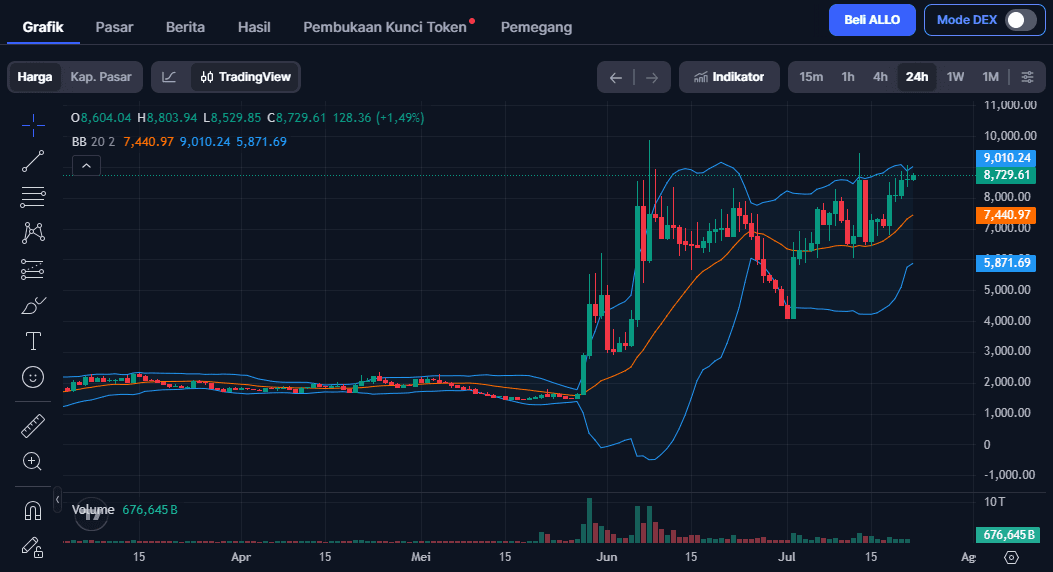
Sumber coinmarketcap | Allora
Aggregator data also indicates a circulating supply of approximately 200.5 million ALLO tokens, out of a maximum supply of one billion tokens. Prices and market data can change within minutes, so these figures should be updated before publication.
ALLO's price isn't just influenced by the quality of its technology. Its movement can also be influenced by:
- Crypto market conditions.
- Stock exchange listing and delisting.
- Unlock schedule.
- Token emission.
- Staking growth.
- Topic activities.
- Inference request.
- Integration with applications.
- AI crypto sector sentiment.
Read also:How to Buy Allora (ALLO) with Rupiah in Indonesia
Advantages of Allora Network
Combining Multiple AI Models
Allora doesn't force all applications to use a single model. Results from different models can be combined based on performance and context.
This approach has the potential to reduce dependence on a single source of predictions.
Contribution Based Incentives
Workers are rewarded based on unique contributions to synthesized inference, not simply for submitting output.
Models that add useful information can earn larger rewards than models that simply copy the consensus of other participants.
Context-Aware
Forecast workers help the network estimate which model is most appropriate under certain conditions.
The best model isn't always the same in every period. Market changes can cause a previously superior model to lose accuracy.
Open to Developers
Data scientists can contribute models, while application developers can consume network output via API or RPC.
This structure allows app developers to use intelligence without building all the AI components themselves.
Supports Multiple Types of Intelligence
Allora isn't limited to crypto price predictions. Its network can conceptually support sentiment analysis, prediction markets, AI agents, and a variety of other machine learning tasks.
Read also:Allora Price Prediction 2025–2030
Risk Then Coin
Intelligence Adoption Not Guaranteed
The economic value of a network depends on the existence of applications and users that require inference.
If intelligence demand is low, fee payments are also low and participant rewards are more dependent on token emission.
Complexity of Mechanism
Allora uses a complex system of workers, forecasts, reputations, ground truth, synthesis, and rewards.
Complexity can increase the risk of bugs, topic misconfigurations, or results that are difficult for ordinary users to understand.
Risiko Ground Truth
Reputation requires ground truth to assess the quality of inferences. Not all types of intelligence have easily measurable, objective answers.
Late, incomplete, or manipulated ground truth can impact the quality of the evaluation.
Stake Concentration Risk
Reputators and validators use staking. Participants with large holdings can have greater influence.
The protocol has adjustment mechanisms to reduce stake dominance, but the risk of centralization is not completely eliminated.
Unlock Token
Backers and core contributors get almost half of the maximum supply.
An unlock schedule after the lockup period may increase circulating supply and create selling pressure.
Emission and Inflation Risks
Network rewards come from fees and token emissions. If fee demand isn't high enough, issuing new ALLO can increase the circulating supply.
Crypto AI Competition
Allora competes with other decentralized AI networks, oracles, prediction markets, data providers, and machine learning platforms.
Good technology does not guarantee that a project will gain a large number of users and developers.
Bridge and Smart Contract Risks
ALLO is available on multiple networks. Using a bridge increases the risk of smart contracts, address errors, transaction freezes, or exploits.
Read also:Is Show Token (SHOW) Safe or a Scam? Check the Facts
Is Allora Coin Legit or Scam?
Allora has an active mainnet network, technical documentation, whitepaper, source code, tokenomics, validators, and auditable working mechanisms.
These factors show that Allora is not a token that only relies on promotional pages without technology.
However, a viable project doesn't automatically mean a safe or profitable investment. Its success still depends on user growth, intelligence quality, developer activity, network security, and ALLO demand.
A more accurate conclusion is:
Allora is an AI blockchain project with a working product and technology, but ALLO remains a high-risk crypto asset.
Investors should not use the term “legit” as the sole reason to buy.
How to Buy Allora Coin
In general, ALLO can be obtained through exchanges that provide trading pairs for the token.
The steps include:
- Choose a platform that supports ALLO.
- Create an account and complete identity verification.
- Deposit rupiah, stablecoins, or supported assets.
- Search ticker ALLO, not another token with a similar name.
- Check the network and contract address.
- Determine the purchase amount.
- Check prices, spreads and fees.
- Store ALLO on the platform or withdraw to a compatible wallet.
Before purchasing, check that ALLO deposits and withdrawals are active. Ensure the withdrawal network matches the destination wallet.
Now that you’ve learnt about the latest AI developments, it’s time to explore AI-based cryptocurrencies on Bittime, such as the digital assets AI, AGI, RENDER, TAO and many more AI coins.
How to Check ALLO Before Investing
Before buying Allora crypto, pay attention to the following indicators:
- Growth in the number of active topics.
- Number of workers and reputation.
- Total ALLO staked.
- Inference request.
- Fee income.
- Application integration.
- Validator distribution.
- Unlock schedule.
- Developer activities.
- Liquidity on the exchange.
- Bridge security.
- Tokenomics changes.
A rise in ALLO's price doesn't necessarily indicate increased network usage. Compare market movements with fundamental data and on-chain activity.
Is ALLO Coin Worth Buying?
ALLO may be attractive to investors who believe in the development of decentralized AI and coordination network models.
This token has utility linked to network activity, including inference payments, topic creation, participant registration, staking, delegation, and rewards.
However, ALLO is less suitable for users who:
- Expecting certain profits.
- Not understanding crypto volatility.
- Unable to bear the loss.
- Need assets with stable income.
- Don't want to face the risk of unlock.
- Don't understand staking and bridge.
- Buying just because of the AI narrative.
Investment decisions need to consider valuation, circulating supply, unlocks, adoption, and network fee growth.
Conclusion
Allora Coin, or ALLO, is the native token of a decentralized AI network that coordinates multiple machine learning models. The network uses workers to generate inference, forecast workers to estimate accuracy, reputation workers to evaluate results, and validators to maintain the blockchain.
ALLO is used to purchase inference, create topics, pay participation fees, staking, delegation, and provide rewards.
ALLO's maximum supply is one billion tokens, with an initial circulating supply of 20.05%. The large allocation to backers and core contributors makes the unlock schedule a crucial factor to monitor.
Allora offers an interesting approach to building collective intelligence. However, its prospects depend on real demand for AI results, application growth, network security, and the ability to retain quality contributors.
FAQ
What is Allora Coin?
Allora Coin is the name for ALLO, the native token of the Allora Network. The network combines the results of multiple machine learning models to generate more contextual intelligence.
What is the function of ALLO coin?
ALLO is used to purchase inference, create topics, register as a participant, stake, delegate, and receive rewards. The token does not provide share ownership or dividend rights.
What is the maximum supply of Allora Coin?
ALLO's maximum supply is one billion tokens. The initial circulating supply is set at 20.05% of the maximum supply.
Can ALLO be staked?
Yes. ALLO can be used for staking by validators and reputation holders, while other holders can delegate. Rewards and risks depend on the network's rules and the selected participants.
Is Allora Coin safe to buy?
While Allora has a vibrant network and technology, ALLO remains a high-risk crypto asset. Investors should be aware of volatility, unlocking, adoption, issuance, and smart contract risks.
Disclaimer: The views expressed belong exclusively to the author and do not reflect the views of this platform. This platform and its affiliates disclaim any responsibility for the accuracy or suitability of the information provided. It is for informational purposes only and not intended as financial or investment advice.

.png)