Why Did ETH Prices Fall in November?
2025-11-17
November 2025 has been a difficult month for many Ethereum holders. A simple question has been frequently asked in groups and on social media: why did ETH prices fall in November, even though the network fundamentals appear strong?
Throughout this month, ETH has been trading in the low three thousand dollar range after previously reaching a peak of nearly five thousand dollars in August. In early November, ETH even fell close to three thousand fifty dollars before rebounding to around three thousand three hundred dollars.

This article will discuss the causes of this decline in simple terms. We will look at technical, fundamental, macro, and even psychological market factors.
The goal is not to scare you, but to help you read the situation more calmly and rationally. This is not investment advice, but learning material to help you make more informed decisions in the future.
Baca juga : Ethereum Fusaka Upgrade December 3, 2025: Impact and Changes You Need to Know
ETH price trends and a brief overview of November 2025
Before getting into the details, we need to look at the big picture of ETH price movements in 2025 until November. This helps answer why the ETH price decline in November cannot be separated from the context of the previous few months.
In general, the pattern that occurred was as follows:
- End of August 2025
- ETH hit a new record high of around four thousand nine hundred and fifty-five dollars. The market was very optimistic, with a lot of euphoric narratives and many leveraged positions entering to chase the rise.
- September to October 2025
- After hitting its peak, ETH began to correct by around thirty percent. The price structure gradually shifted from an uptrend to a downtrend, but many traders still viewed it as a healthy correction.
- Early November 2025
- ETH dropped to around three thousand three hundred dollars, approaching the year's opening level. It even briefly touched the three thousand fifty dollar range intraday before rebounding. During this phase, large-scale liquidations of long positions began to emerge.
- Mid-November 2025
- Prices ranged between three thousand and three thousand two hundred dollars. Ethereum fell by about ten percent in one day to around three thousand one hundred seventy dollars when the crypto market weakened due to comments from US central bank officials.
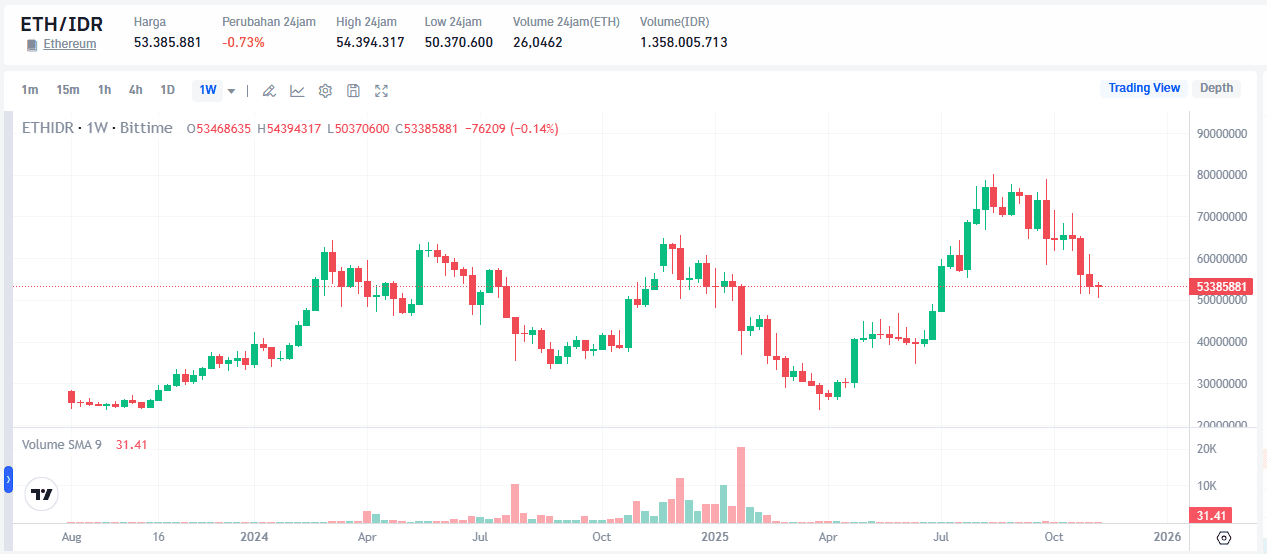
From this sequence, it is clear that the November decline was not a sudden event. November was more like a continuation of the correction that had begun since the August peak. The difference is that this month, pressure came from many sides: technical, fundamental, and macro.
Baca juga : Ethereum (ETH) Price Rises After Fed Speech: Will the Bullish Trend Continue?
Technical factors: downtrend, bearish pennant, and liquidation
Technically, the first answer to the question of why ETH prices fell in November is because the chart structure was already bearish.
Some important technical points visible on the chart include:
- Bearish pennant pattern and lower high
- After falling sharply from the nearly five thousand dollar area, ETH formed a narrowing triangle-like consolidation pattern. This pattern is commonly referred to as a bearish pennant and is often a continuation pattern of a downtrend.
- The price peaks formed throughout September to November were getting lower and lower. This is known as a lower high, a sign that every rise is always sold back by the market.
- Important support around three thousand three hundred to three thousand four hundred dollars was unable to hold. When this level was broken, the decline continued quite rapidly.
- Support and resistance that locked in movement
- The three thousand to three thousand one hundred dollar zone became a strong psychological area. Many analysts saw this area as the last bastion of the long-term uptrend.
- On the upside, the area around three thousand four hundred to three thousand seven hundred dollars became heavy resistance. During November, ETH repeatedly failed to close the daily price above this zone, so rebound attempts were always stifled.
- Selling volume and liquidation waves
- When support broke, selling volume surged sharply, far above the daily average. This indicates that not only retail traders were selling, but also large players.
- In the derivatives market, many leveraged long positions were liquidated. In a single day, the value of crypto positions that were forcibly closed out reached over a billion dollars, and about a hundred million dollars of that came from ETH long positions. This large liquidation data accelerated the price decline due to the chain effect when many positions were hit by margin calls.
- Oversold momentum indicators
- The RSI indicator fell to a very oversold area in the range of eighteen on a four-hour time frame, then slowly rose to the thirties. This level indicates that selling pressure was excessive, but not enough to reverse the trend to an uptrend.
- Several technical signals, such as the bullish harami candlestick pattern and the potential crossover of the MACD indicator, did appear. However, these signals only triggered a brief relief rally and were unable to break through key resistance levels.
In summary, from a technical perspective, the market is still dominated by sellers. The structure dominated by lower highs, failed support levels, and massive liquidations provide a strong basis for why ETH prices fell in November.
Trade more safely amid volatility with Bittime
In conditions like these, choosing the right trading platform is important. For Indonesian investors, Bittime could be an option because it is officially registered and supervised, and emphasizes security and regulatory compliance.
You can buy, store, and sell ETH in rupiah with a simple interface. Keep in mind that crypto trading is high risk and the decision to buy or sell is entirely up to you. If you are interested in learning and trying with funds that you are prepared to lose, you can create an account on Bittime and start setting up your strategy step by step.
Baca juga : Ethereum Fusaka Upgrade: What Are the Implications for Crypto?
Fundamental factors: long-term investor sell-offs, ETFs, and on-chain activity
Interestingly, even as prices decline, Ethereum's network fundamentals remain strong. However, in the short term, the fundamental factors weighing on prices are more dominant than the positive ones.
Some important events that occurred in November include:
- Long-term holders begin selling
- On-chain data shows that wallets holding ETH for three to ten years began actively selling since late August.
- An average of around forty-five thousand ETH per day moved from this group of long-term holders, the highest figure since around early 2021.
- Long-term holders are usually patient. When they start to sell off large amounts of assets, the market reads this as a signal of distribution and profit-taking after a long rally.
- Outflows from Ethereum ETFs
- Ethereum spot ETF products, which were previously the hope of many investors, have experienced large outflows.
- Since early November, the value of outflows from ETH ETFs has reached more than one point four billion dollars.
- When investors withdraw funds from ETFs, fund managers need to sell ETH on the market to cover unit redemptions. Large-scale sales like this add supply pressure to the spot market.
- Actual network fundamentals are improving
- Ethereum's network throughput, when combined with various Layer Two solutions, reaches tens of thousands of transactions per second. Average transaction fees tend to be more affordable than during the previous bull market peak.
- The transaction fee burn mechanism through EIP 1559 makes the ETH supply deflationary. The supply growth rate even becomes negative on an annual basis when network activity is high.
- The amount of ETH on exchanges is at its lowest level in several years, which means that many coins are being transferred to private storage and staking.
- Conflicting whale behavior
- On one hand, there are whales and institutions taking advantage of the price decline to increase their ETH holdings. Several reports note accumulations worth over $1.6 billion when ETH prices fell to the $3,200 range.
- On the other hand, there are also whales choosing to sell and cut losses, including some old addresses that have held ETH for years.
The combination of the above factors creates a mixed picture. In the long term, Ethereum's fundamentals appear healthy.
However, in November, the addition of supply from long-term holders and ETF outflows were stronger than the positive effects of deflation and whale accumulation. This is one of the reasons why the price of ETH fell in November despite positive technological news.
Baca juga: What is the Ethereum Fusaka Upgrade and When is it?
Macro factors and market sentiment: the role of the Fed, stocks, and fear
The next reason why the price of ETH fell in November comes from outside the world of Ethereum itself, namely the global macroeconomic environment and market psychology.
Some important triggers include:
- A more cautious stance by the US central bank
- The market had hoped that interest rate cuts would continue at the end of the year.
- However, several Fed officials signaled that the interest rate cuts that had already been made might be sufficient for the time being. The chances of further cuts have decreased.
- When high interest rates are expected to persist for longer, investors tend to reduce their positions in high-risk assets such as crypto and switch to assets that are considered safer.
- Tech stocks and risk assets also weakened
- Tech stock indices in the US experienced a correction due to concerns about valuations and the economic outlook.
- When tech stocks fall, crypto often gets dragged down with them because many market participants view both as speculative assets.
- On several important days, Bitcoin fell sharply and ETH fell even further, marking a simultaneous risk-off movement across various asset classes.
- ETF outflows and portfolio rotation in the crypto world
- Significant outflows were not only seen in Ethereum ETFs but also in Bitcoin. Over the course of a week, combined BTC and ETH ETFs saw outflows exceeding 1.7 billion dollars.
- Within the crypto market itself, many investors rotated funds from altcoins to Bitcoin or stablecoins. Bitcoin's dominance strengthened, while altcoins like ETH tended to decline further.
- The Crypto Fear and Greed Index and negative media narratives
- The crypto Fear and Greed Index has fallen into the extreme fear zone with a score of around ten, the lowest level in several months. This indicates that the majority of market participants are fearful and pessimistic.
- Mainstream media outlets are using headlines that highlight the sharp decline and the possibility of further corrections. Such narratives can easily trigger psychological effects on retail investors who are not accustomed to volatility.
- Concerned community discussions
- On social media, many analysts and influencers are discussing lower price targets for ETH. Some mention the potential for a decline to the two thousand two hundred dollar range if the three thousand dollar support level is truly broken.
- Although not all predictions are accurate, the flood of negative opinions reinforces the unease among investors. Ultimately, many people choose to sell simply because they do not want to endure the stress any longer.
The combination of high interest rates, weakening stocks, ETF outflows, and this fearful sentiment explains why the selling pressure in November felt so heavy. Not only for ETH, but for almost all major crypto assets.
Baca juga : Ethereum Layer 2: Comparison with Arbitrum, Optimism, zkSync, and Starknet
What lessons can be learned from the decline in ETH prices in November 2025?
After examining various aspects, we can formulate a more comprehensive answer to the question of why ETH prices fell in November. The cause is not singular, but a combination of factors:
- Technical structure that had already been declining since its August peak
- Selling pressure from long-term holders and outflows from ETFs
- A macroeconomic environment unfavorable for risky assets
- Market sentiment plunging into extreme fear territory
For investors and traders, there are several important lessons:
Don't focus on just one factor
Crypto prices don't move based on a single piece of news or indicator. Combining technical, fundamental, and macro analysis provides a more complete picture.
Risk management is more important than predictions
Markets can be more “crazy” than we imagine, both when they rise and when they fall. Determining your allocation, loss limits, and investment timeframe is often more important than trying to guess the bottom.
Strong fundamentals don’t always immediately reflect in prices
Ethereum continues to evolve technologically and as a network, but short-term prices can move in the opposite direction due to sentiment and capital flows. This is normal in a market heavily influenced by psychology.
Always remember that crypto is a high-risk asset
Prices can rise and fall very quickly. Use funds you’re prepared to lose and don’t force yourself just because you’re afraid of missing out.
Ultimately, corrections like the one in November 2025 are part of the market cycle. For some, this is a painful phase. For others, it's a time to learn a lot about risk and market behavior. The most important thing is to remain rational, avoid panic, and always remember that investment decisions are a personal responsibility.
How to Buy Crypto on Bittime

Want to trade sell buy Bitcoins and crypto investment easily? Bittime is here to help! As an Indonesian crypto exchange officially registered with Bappebti, Bittime ensures every transaction is safe and fast.
Start with registration and identity verification, then make a minimum deposit of IDR 10,000. After that, you can immediately buy your favorite digital assets!
Check the exchange rate BTC to IDR, ETH to IDR, SOL to IDR and other crypto assets to find out today's crypto market trends in real-time on Bittime.
Also, visit the Bittime Blog for interesting updates and educational information about the crypto world. Find reliable articles about Web3, blockchain technology, and digital asset investment tips designed to enrich your crypto knowledge.
FAQ
Why did ETH prices fall this November even though the Ethereum network is active?
Because selling pressure from long-term holders, ETF outflows, and global macro conditions are stronger than positive network factors in the short term.
Does this decline in ETH prices mean that Ethereum is no longer attractive?
Not automatically. The network's fundamentals are still growing, but market sentiment is negative, so prices do not yet reflect long-term potential.
Is this a sign that the bull market for ETH is ending?
There is no certainty yet. Technically, the short-term trend is indeed down, but final confirmation of the cycle requires longer price and macro data. A major correction can occur in the midst of a larger upward trend.
Is now the right time to buy ETH?
That really depends on each person's risk profile, time horizon, and strategy. The information in this article is not buy or sell advice, only analysis material.
Is it safe to trade ETH on local platforms such as Bittime?
Bittime is a platform that is registered and supervised in Indonesia. However, the risk of ETH price fluctuations remains high on all platforms, so personal risk management is still mandatory.
Disclaimer: The views expressed belong exclusively to the author and do not reflect the views of this platform. This platform and its affiliates disclaim any responsibility for the accuracy or suitability of the information provided. It is for informational purposes only and not intended as financial or investment advice.

.png)