Vietnam Crypto Market: New Regulations, Exchanges, and Tokenized Assets
2026-08-31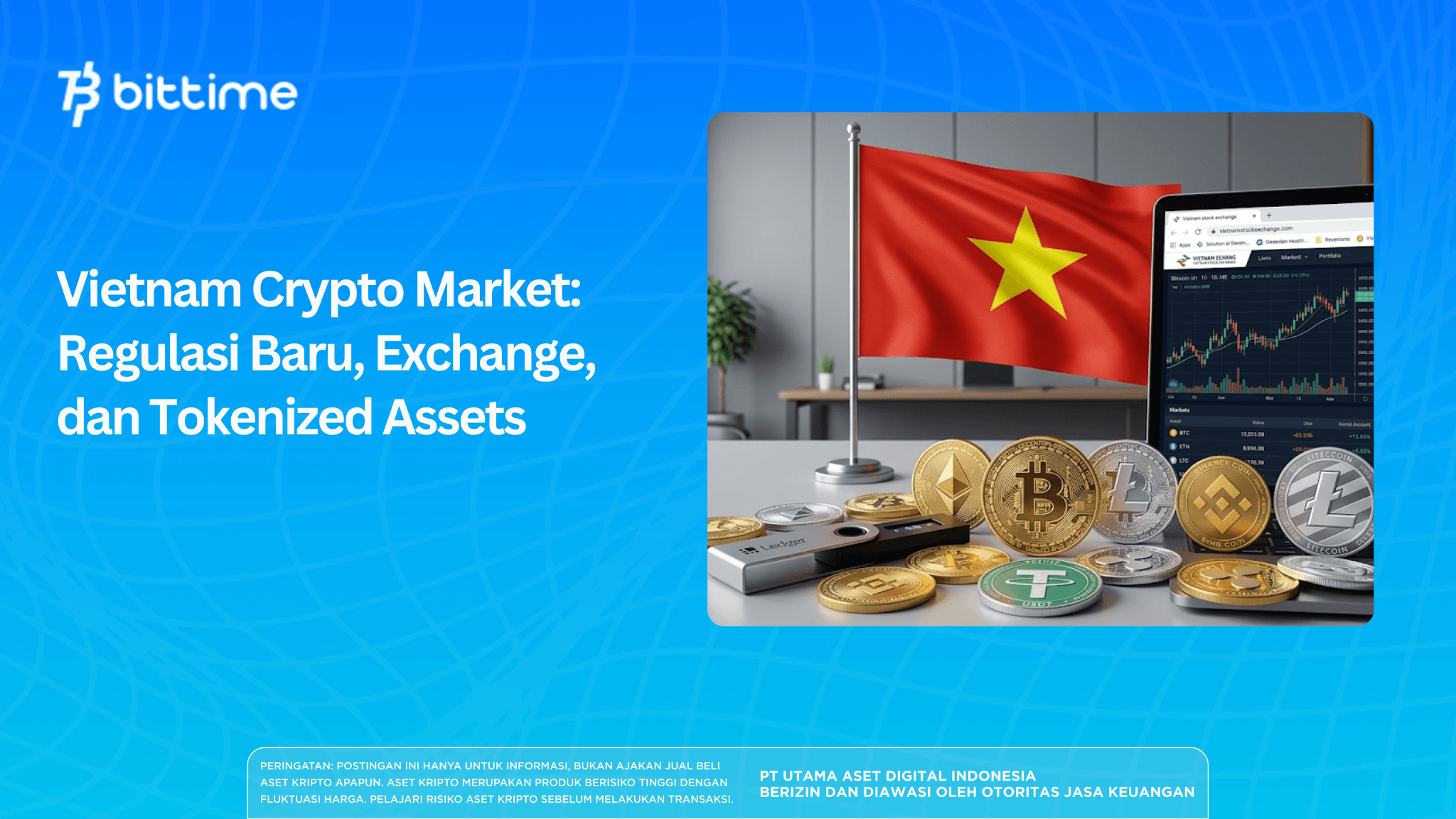
Vietnam crypto market enters a new phase after the government began implementing a regulatory framework for crypto assets on September 1, 2026. This regulation transforms the market from one that previously developed with limited oversight into a more structured and license-based ecosystem.
The five‑year pilot program places special emphasis on tokenized assets and real‑world assets (RWA). Five companies have also passed the initial review stage to become prospective crypto asset service providers, though full operational licenses are still awaiting final approval.
Key Takeaways
- Vietnam launches a five‑year pilot program for a regulated crypto market with a focus on tokenized assets and RWA.
- Five prospective crypto exchanges have passed the initial review but have not yet obtained full operational licenses.
- The new regulations take effect on September 1, 2026, and impose penalties for unlicensed crypto asset activities.
- Prospective exchanges must meet capital, institutional ownership, system security, and foreign ownership cap requirements.
- Domestic investors will eventually be required to use licensed service providers.
Vietnam Crypto Market Enters a New Regulatory Era
Vietnam has begun implementing a new framework for the crypto asset market through a five‑year pilot program. The framework refers to Government Resolution No. 05/2025/NQ‑CP, signed on September 9, 2025, and valid until 2030.
The program is not only aimed at regulating digital asset trading activities. The government also places the tokenization of real‑world assets (RWA) as one of its main focuses.
This step is part of Vietnam’s digital economy agenda. The government targets the digital economy to contribute at least 30% of gross domestic product by 2030.
Starting September 1, 2026, Decree No. 284/2026/ND‑CP also takes effect. This regulation introduces administrative sanctions against unlicensed crypto asset activities.
Thus, Vietnam's crypto regulation is not only focused on the legality of digital assets, but also determines who can provide trading services and how those activities must be conducted.
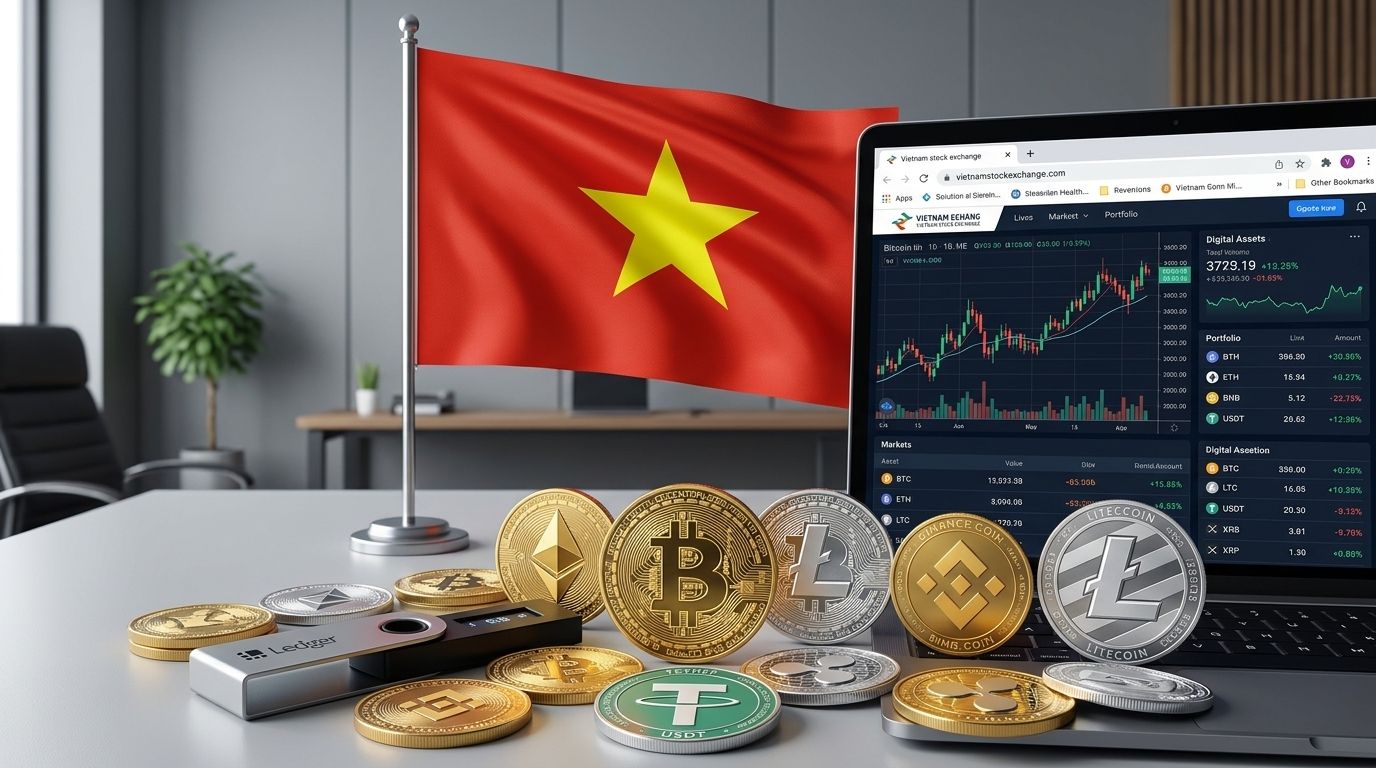
Illustration: Generated by AI
Read Also: Nvidia's $500 Billion AI Funding, Will AI Crypto Tokens Benefit?
Five Prospective Crypto Exchanges in Vietnam Pass Initial Review
As of the end of August 2026, Vietnam has not yet issued full operational licenses for crypto exchanges. However, five companies have been declared to have met the document completeness requirement at the initial review stage.
The five prospective providers are:
- VIX Crypto Assets Exchange JSC (VIXEX), affiliated with the VIX ecosystem.
- Loc Phat Vietnam Crypto Assets Exchange (LPEX/SCEX), affiliated with LPBank.
- Vietnam Prosperity Crypto Assets Exchange (CAEX), backed by the VPBank and VPBankS ecosystems.
- Techcom Crypto Assets Exchange (TCEX), affiliated with Techcombank and TCBS.
- Vietnam Digital Assets JSC, backed by Sun Group.
The status of these five companies must be distinguished from a final license. Passing the initial review means that documents and initial requirements have met the examination stage; it does not mean that the companies can already operate as licensed exchanges.
Full operations can only commence after the final approval process is completed and the license is issued.
Read Also: Tokenized Stocks vs. Traditional Stocks: Definition, Differences, and How to Buy
Vietnam Crypto Exchange License Requirements
Vietnam’s regulation sets fairly high requirements for companies wishing to become crypto asset service providers. These provisions cover capital, ownership structure, information system security, and foreign ownership.
Minimum Capital of VND 10 Trillion
Prospective crypto exchanges must have a minimum paid‑up capital of VND 10 trillion, approximately US$383 million based on the figures in the source.
This capital must be fully paid in Vietnam's currency, the Vietnamese Dong (VND).
This requirement makes the crypto exchange business in Vietnam require substantial capital support from the outset.
Institutional Ownership
At least 65% of the capital must be held by institutional shareholders.
In addition, more than 35% of the capital must come from at least two qualified institutions. This group includes commercial banks, securities companies, fund managers, insurance companies, or technology firms.
This structure shows that Vietnam is steering the exchange industry toward companies with strong institutional backing.
Level 4 System Security Certification
Security is also a key part of the licensing requirements. Prospective exchanges are required to have Level 4 certification from Vietnam's Ministry of Public Security.
This requirement shows that technology infrastructure security is one of the main filters before a company can officially operate crypto asset services.
Foreign Ownership Cap of 49%
Vietnam also limits foreign ownership in licensed crypto exchange companies to 49%.
Thus, foreign investors can still participate in the industry, but control of the company remains limited by the ownership structure set by the government.
Read Also: 10 Free Bitcoin Mining Sites and Faucets in 2026 – Which Are Legit?
Tokenized Assets and RWA Become Main Focus
One of the key characteristics of the Vietnam crypto market is the focus on tokenizing real‑world assets (RWA).
In the pilot program, the permissible assets are tokens backed by real‑world assets and issued by a Vietnamese entity.
Meanwhile, securities and fiat currencies, including stablecoins such as USDT, are not included in the tokenized asset categories permitted under the program.
Another provision is that all transactions must be settled using Vietnamese Dong (VND).
At the initial stage, program access is also directed toward foreign investors. Domestic investors will only be required to use licensed service providers six months after the first license is issued.
This focus opens up space for the development of tokenization of various assets, including commodities, real estate, infrastructure, bonds, and other asset‑based instruments.
Read Also: Top 10+ AI Coins in 2026: List of Best Artificial Intelligence Crypto!
Penalties for Unlicensed Crypto Activities
The implementation of the new regulation is also accompanied by law enforcement mechanisms.
From September 1, 2026, certain crypto asset activities carried out without a license may be subject to administrative sanctions.
Individual investors may face fines of approximately VND 30 million to VND 50 million, or about US$1,140 to US$1,900 based on the figures in the source.
Meanwhile, unlicensed service providers can be fined up to VND 200 million for organizations and VND 100 million for individuals. Sanctions may also include suspension of activities, asset confiscation, and website takedown.
However, there is a transition period for domestic investors. The obligation to use licensed exchanges will only apply six months after the first license is issued.
This means that the enforcement of rules against domestic users will not take effect immediately on the first day the regulation comes into force.
Read Also: Top 10 Largest RWA Crypto Tokenization Assets in the World
What Is the Impact on Investors and the Crypto Industry?
The new regulations have the potential to significantly change the structure of Vietnam's digital asset industry.
The presence of prospective exchanges linked to banks, securities firms, and conglomerates indicates the growing role of traditional financial institutions in the digital asset market.
The five prospective providers are affiliated with ecosystems such as VPBank, Techcombank, VIX, LPBank, and Sun Group. This condition can accelerate the integration of tokenized assets with existing financial infrastructure.
On the other hand, the high capital and security requirements can become barriers for startups.
The minimum capital of VND 10 trillion, the institutional ownership requirement, Level 4 security certification, and the 49% foreign ownership cap make this market relatively difficult for small players to enter.
This structure may ultimately drive the formation of a market more concentrated on companies with large capital and institutional support.
Read Also: Futures Trading for Beginners: How It Works, Tips, and Risks
Vietnam Crypto Regulation: Open but Controlled Market
The direction of Vietnam's regulation shows a fairly clear approach. The government opens the door for the digital asset industry but sets strict limits on who can provide services and which assets can be traded in the pilot program.
The use of VND for settlement, the 49% foreign ownership cap, and the high capital requirements show that Vietnam's crypto regulation is designed with strong domestic control.
At the same time, the focus on RWA and tokenized assets offers opportunities for the blockchain industry to go further into the financial and real economy sectors.
For investors and industry players, the development of licenses for the five prospective exchanges is one of the important points to monitor after the regulation takes effect.
Read Also: 9 Advantages of Profitable Digital Gold Investment in 2026 (XAUT & PAXG)
Conclusion
Vietnam crypto market enters a new phase with the implementation of crypto asset regulations on September 1, 2026. The government is running a five‑year pilot program with a strong focus on tokenized assets and RWA.
Five prospective crypto exchanges have passed the initial review but have not yet obtained full operational licenses. They still need to complete the approval process before they can officially operate services.
The regulation also sets a minimum capital requirement of VND 10 trillion, institutional ownership structure, Level 4 security certification, and a maximum foreign ownership cap of 49%.
For the industry, these rules can increase legal certainty while creating high entry barriers. For the blockchain sector, Vietnam's focus on RWA can become a new opportunity to develop tokenization of real‑world assets within the domestic financial ecosystem.
Check prices for Bitcoin (BTC), Ethereum (ETH), XRP, Solana (SOL), GRAM, and BNB as well as the leading memecoin DOGE. You can trade directly on Bittime!

Bittime is a Digital Financial Asset Trader (PAKD) platform licensed and supervised by the Financial Services Authority — where you can buy Bitcoin in Indonesia and hundreds of other crypto assets starting from Rp10,000. Registration is fast, secure, and you can start today.
Monitor the USDT to IDR conversion rate and the real‑time price movements of your favorite crypto assets. All available in one crypto investment app that can be downloaded for free from the Play Store.
Ready to start? Register now on Bittime and execute your investment strategy on a platform trusted by millions of users in Indonesia.
Vietnam Crypto Market FAQ
When does Vietnam's crypto regulation take effect?
The new regulations take effect on September 1, 2026, including the implementation of Decree No. 284/2026/ND‑CP which imposes administrative sanctions on unlicensed crypto asset activities.
What is the minimum capital requirement for a crypto exchange license in Vietnam?
Prospective crypto exchanges are required to have a minimum paid‑up capital of VND 10 trillion, approximately US$383 million based on the figures in the source.
Have the five prospective exchanges in Vietnam already obtained licenses?
Not yet. The five companies have only passed the initial review. Full operational licenses are still awaiting final approval.
Which assets are the focus of Vietnam's crypto program?
The pilot program focuses on tokenized assets backed by real‑world assets (RWA) and issued by Vietnamese entities. Securities and fiat, including USDT, are not included in the tokenized asset categories under the program.
What is the foreign ownership cap for a crypto exchange in Vietnam?
Foreign ownership in licensed crypto exchanges is capped at a maximum of 49%.
Disclaimer: The views expressed belong exclusively to the author and do not reflect the views of this platform. This platform and its affiliates disclaim any responsibility for the accuracy or suitability of the information provided. It is for informational purposes only and not intended as financial or investment advice.

.png)