Is USOV Crypto Legit or a Scam? Check Reserves and Liquidity
2026-08-04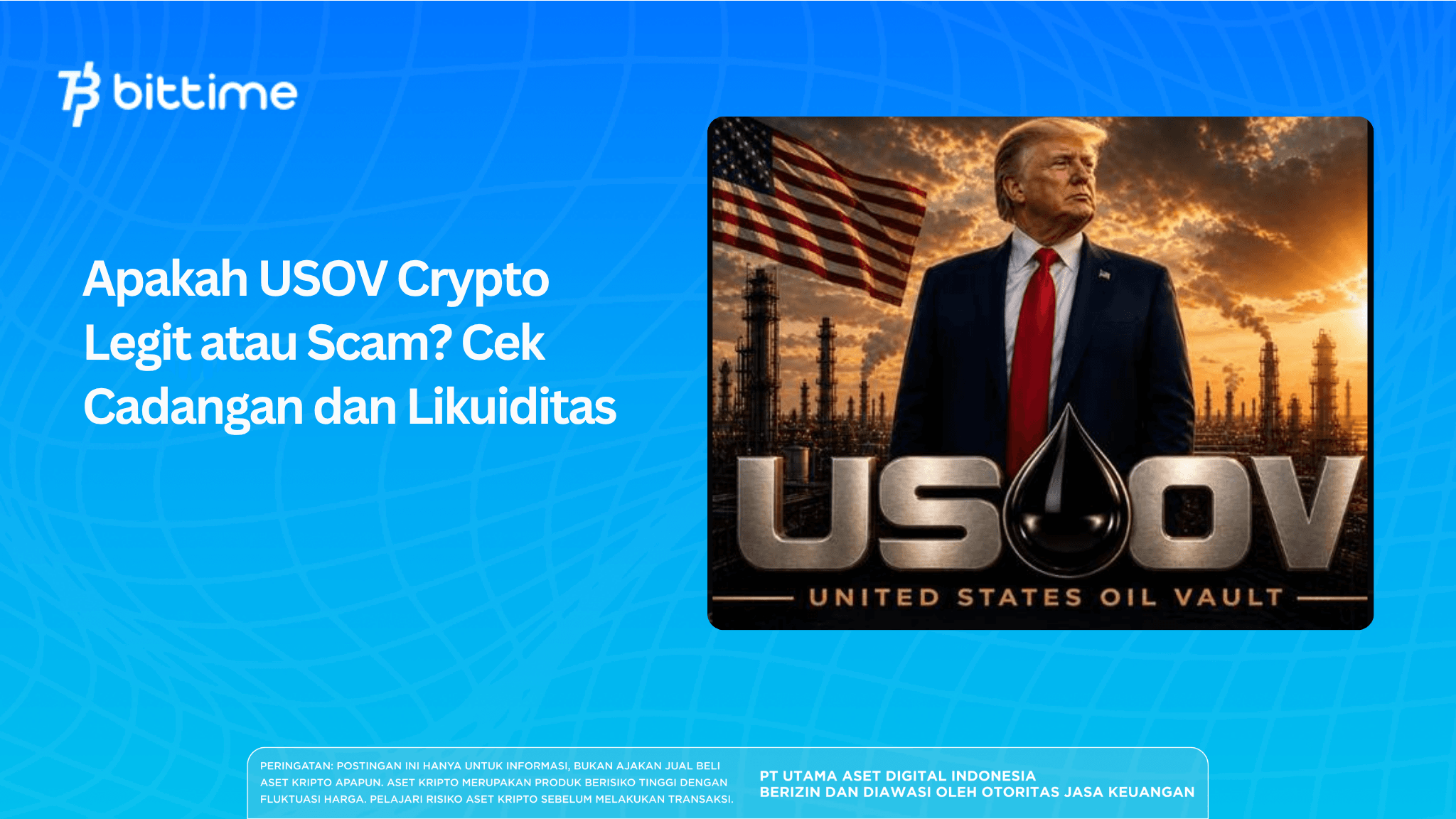
Is USOV Crypto legitimate or a scam? This question requires a careful answer because United States Oil Vault, or $USOV, claims to be a Solana token that provides exposure to the United States Strategic Petroleum Reserve.
Its contract and token markets can indeed be found on-chain, but claims concerning oil reserves, institutional custody, and a one-token-to-one-barrel ratio have not yet been supported by complete independent documentation.
Key Takeaways
- $USOV is a Solana token that claims to be backed by oil reserves at a ratio of one token to one barrel.
- The $USOV contract and liquidity pools can be verified, but adequate evidence of the oil reserves is not yet available.
- The number of holders remains limited, and liquidity varies significantly between pools, making the token high-risk.
What Is USOV Crypto?
USOV Crypto is a token called United States Oil Vault that was issued using the SPL standard on the Solana network. The project markets $USOV as a real-world asset or real-world asset that provides fractional exposure to strategic oil reserves.
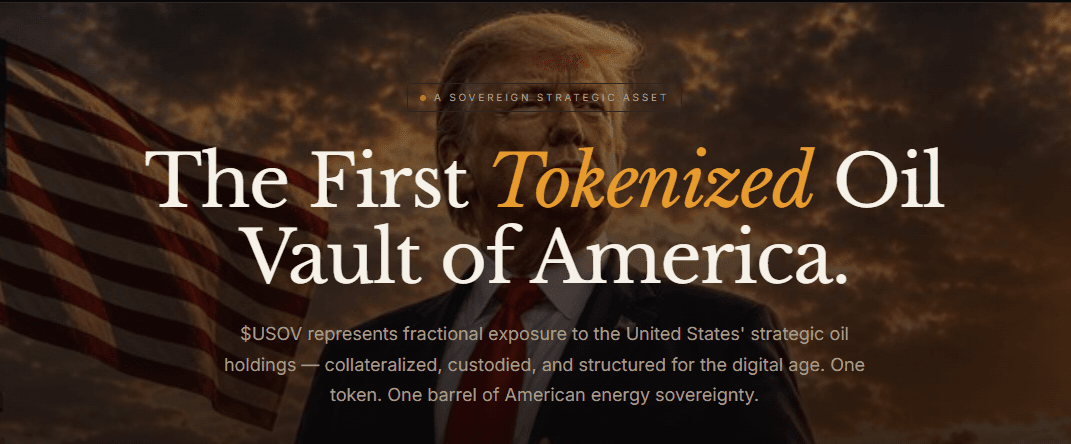
Its official website uses the “one barrel, one token” concept. The project also states that the token is backed by physical oil, uses institutional custody, can be traded 24 hours a day, and has real-time proof of reserves.
Although these claims sound appealing, the marketing statements do not automatically grant token holders legal rights to oil. Ownership of physical assets typically requires a legal entity, custody agreements, audit reports, insurance policies, and a clear redemption mechanism.
Who Are the Team and Developers Behind USOV?
Team transparency is an important factor when assessing whether USOV Crypto is legitimate or a scam. The official website reviewed did not disclose the names of the founders, developers, advisers, issuing legal entity, or oil reserve manager.
The website only explains the token concept, contract, roadmap, and development plans. It does not provide professional profiles that could be used to verify the team’s experience in blockchain, commodities, law, or asset custody.
An anonymous team does not necessarily mean that a project is a scam. However, the absence of verifiable identities reduces accountability if problems arise involving reserves, liquidity, contract security, or fund management.
Also read: Is Oil Strategic Reserve (OSR) Legitimate? Check the Facts Before FOMO!
How Does USOV’s Oil Reserve Claim Work?
According to its official website, each $USOV token is claimed to provide exposure to one barrel of oil. The project states that the oil is held under an institutional custody framework and can be verified through a proof-of-reserves system.
For this mechanism to work in practice, there must at least be a legal and economic link between the token and its underlying oil. Ideally, the mechanism should include:
- The identity of the legal entity purchasing the oil.
- The name and jurisdiction of the custodian.
- The type and quality of the oil being stored.
- The location of the storage facility.
- The amount of reserves available.
- Token issuance and burning procedures.
- Token holders’ rights to the assets.
- A token redemption mechanism.
- Regular reserve audits.
Without these components, the price of $USOV is primarily determined by supply and demand on DEXs. Its price does not automatically track the global price of one barrel of oil.
Also read: What Is IF Coin? A Robinhood Chain Memecoin—Legitimate or Not?
Can USOV’s Proof of Reserves Be Verified?
As of August 4, 2026, when this article was written, the USOV website had not published a reserve audit report, custodian name, storage account, oil ownership certificate, or legal document explaining token holders’ rights.
The project scheduled a “Vault Attestation & Phase II Launch” for September 15, 2026. That date was still in the future, so the planned attestation could not yet be considered published proof of reserves.
The claim regarding “United States strategic oil holdings” also requires particular scrutiny. The Strategic Petroleum Reserve, or SPR, is a federal government-owned oil stockpile managed by the U.S. Department of Energy through four official storage sites in Texas and Louisiana.
The official Department of Energy sources reviewed did not mention $USOV or an SPR tokenization program. Therefore, there is no independent evidence that owning $USOV provides a claim to oil owned by the United States government.
The project may be referring to private reserves positioned alongside a U.S. strategic reserve narrative. However, this possibility would still require a verifiable custodian identity and proof of ownership.
Take advantage of today’s opportunity to get started with investing. Sign up to Bittime and start building your portfolio.
What Is the Official USOV Contract Address?
The official $USOV contract or mint address is:
USoVyFCK2MTnnU4R1K7CLvTC8qoAt2N4EfyDYV13BVB
The address appears on the official website and matches the token traded through Meteora. Solscan also identifies it as United States Oil Vault.
The USOV/USDC pool with the highest liquidity found has the following address:
DKMZJ4zzKMp8RTYHdUmGHMdHrN5euDJMMngmoz8mkC3Q
Meanwhile, the USOV/SOL pool referenced by the primary source has the following address:
ES4YmjLcN4en61xjQZauxCuC8mwCGJesPnyS8kyzEfwx
Users must verify the mint address rather than relying only on the name or ticker. Other parties can create fraudulent tokens using the same USOV symbol.
Also read: Is Pons Launchpad Legitimate or a Scam? Understand How It Works and Its Risks
What Are the Current Price, Volume, and Liquidity Conditions for USOV?
Based on a DEXScreener snapshot from August 4, 2026, the USOV/USDC pair was trading at approximately US$0.003399. Liquidity was around US$114,000, while its market capitalization and fully diluted valuation were approximately US$3.3 million.
Over a 24-hour period, the pool recorded approximately US$46,000 in volume from 5,702 transactions. DEX Screener displayed 2,862 buy transactions and 2,840 sell transactions conducted by approximately 105 traders.
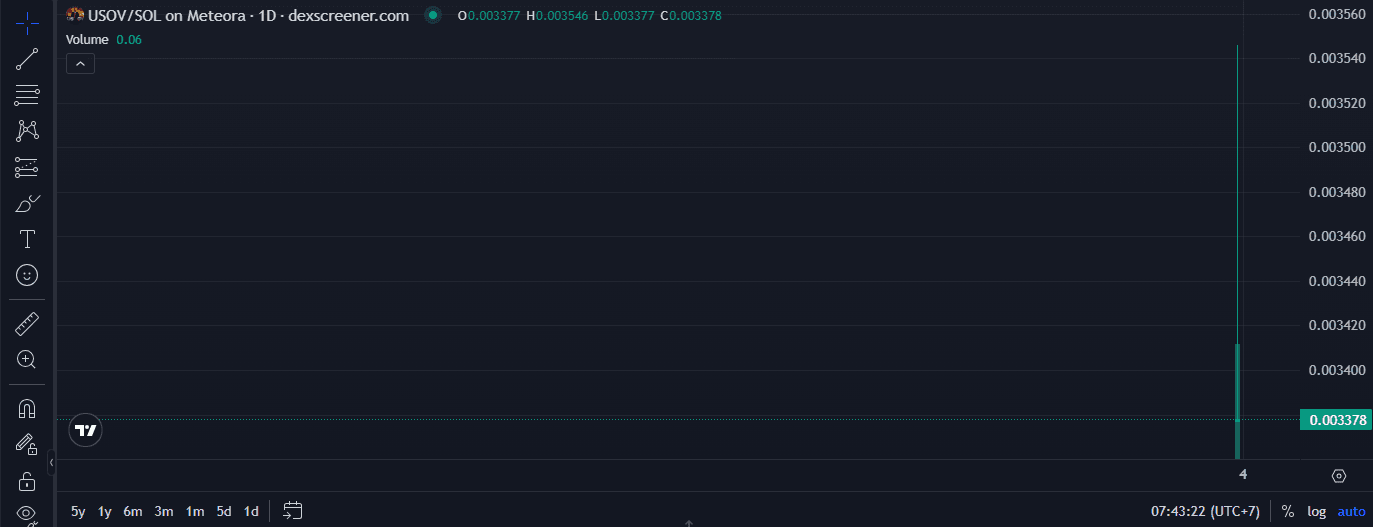
The number of transactions appears high relative to the number of unique traders. This pattern may result from repeated trading, algorithmic activity, or small-value transactions. It is not proof of manipulation, but it warrants further analysis.
The USOV/SOL pool showed substantially higher risk. DEX Screener displayed liquidity of only around US$1, volume below US$1, and a warning that the pair had very little liquidity.
This difference shows that the price in one pool may not represent the entire market. Users entering through a thin pool may experience extreme slippage or difficulty selling the token.
Also read: Is Show Token (SHOW) Safe or a Scam? Check the Facts
Is USOV Holder Distribution Too Concentrated?
DEX Screener displayed approximately 115 holders in the USOV/USDC pool. Meanwhile, GeckoTerminal’s security checker recorded 78 holders at a different indexing time. The difference may result from each platform’s update schedule and counting method.
The limited number of holders indicates that USOV does not yet have a broad ownership base. However, the holder count alone is insufficient to prove that distribution is overly concentrated.
A more accurate analysis should examine:
- The percentage of supply held by the 10 largest holders.
- Wallets associated with the deployer.
- Wallets belonging to liquidity pools.
- The token’s initial distribution.
- Transaction links between wallets.
- Holdings controlled by insiders or insiders.
- Changes in the balances of large wallets.
GeckoTerminal assigned an automated security score of 56 and stated that liquidity was locked. However, an automated score does not replace a manual audit of holders and the contract.
Also read: Is FireFaucet Win Legitimate? How It Works, Its Security, and Its Earning Potential
What Are USOV’s Red Flags and Risks?
Several USOV red flags that should be considered include:
- The identities of the team and legal entity have not been disclosed.
- The oil custodian has not been identified.
- No independent reserve report is currently available.
- The one-token-to-one-barrel claim cannot yet be tested.
- There is no clear redemption mechanism.
- No evidence of a relationship with the United States government has been found.
- The numbers of holders and traders remain limited.
- At least one pool has almost no liquidity.
- The token’s market history is still very short.
- The roadmap does not include measurable technical targets.
Solflare also displays the token’s status as “unverified.” The platform warns that unverified tokens with a limited number of holders carry higher risk.
DEX Screener displays an automated audit result of “No issues,” but it also warns that automated checks are not always 100% accurate. This indicator does not prove the existence of oil reserves or the legitimacy of the business entity.
Also read: Is USFR (United States Food Reserve) Legitimate? Here Are the Facts
Is USOV Legitimate or Potentially a Scam?
There is currently insufficient evidence to definitively classify $USOV as a scam. Its token, contract, and liquidity pools do exist on the Solana blockchain.
However, the existence of an on-chain token does not prove its oil-related claims. To date, the team’s identity, legal entity, custodian, reserve reports, and token holders’ rights have not been adequately verified.
The most proportionate conclusion is that USOV is a highly speculative, very high-risk token with unverified oil reserve claims.
The token should not yet be treated as ownership of one barrel of oil or as an audited real-world asset instrument. This assessment may change if the project publishes an independent attestation and valid legal documentation.
Also read: America Oil Reserve Agility (AMORA): Legitimate or Merely a Narrative Token?
How to Research USOV Before Buying
Before buying USOV, conduct the following checks:
- Compare the mint address across multiple sources.
- Check the mint authority and freeze authority.
- Analyze the 10 to 20 largest holders.
- Separate liquidity pool wallets from ordinary holder wallets.
- Trace transactions involving the deployer wallet.
- Check evidence that liquidity has been locked.
- Identify the issuing legal entity.
- Request the identity of the oil custodian.
- Independently verify any attestation report.
- Check whether the token can be sold back.
- Start with a very small amount.
- Use only funds you can afford to lose entirely.
Conclusion
USOV Crypto cannot immediately be classified as a scam, but the available evidence is also insufficient to consider it a fully legitimate oil-backed token. Its contract and on-chain markets can be verified, while the one-token-to-one-barrel claim is not yet supported by an independent reserve report.
USOV’s main risks include an anonymous team, an unidentified custodian, a limited number of holders, a short market history, and substantial differences in liquidity between pools.
The USOV/USDC pool had more than US$100,000 in liquidity, while the USOV/SOL pool had only around US$1 at the time of review.
Do not buy solely because the project’s narrative appears professional or the price is rising.
Bittime is a licensed Digital Financial Asset Trader (PAKD) platform supervised by the Financial Services Authority— where you can buy Bitcoin in Indonesia and hundreds of other crypto assets starting from Rp10,000. Registration is fast and secure, and you can get started today.
Monitor the USDT-to-IDR conversion and real-time price movements of your favorite crypto assets. Everything is available in one crypto investment application that can be downloaded for free from the Play Store.
Ready to get started? Register with Bittime now and execute your investment strategy on a platform trusted by millions of users in Indonesia.
FAQ
Has USOV Crypto Been Proven to Be a Scam?
There is not enough evidence to classify USOV as a scam. However, its oil reserve claims and the identities of its managers have not received adequate independent verification.
Is One USOV Really Backed by One Barrel of Oil?
The project website claims a ratio of one token to one barrel. However, its audit report, custodian identity, storage location, and redemption mechanism have not been made publicly available.
Is USOV Connected to the United States Government?
No evidence of an official relationship between USOV and the United States government has been found. The Strategic Petroleum Reserve is owned and managed by the U.S. Department of Energy.
What Is the Official USOV Contract Address?
Its official mint address is USoVyFCK2MTnnU4R1K7CLvTC8qoAt2N4EfyDYV13BVB. Verify every character before buying or making a swap.
What Are the Biggest Risks of Buying USOV?
The main risks include unverified reserve claims, limited team transparency, a very young market, and potential slippage in pools with thin liquidity.
Disclaimer: The views expressed belong exclusively to the author and do not reflect the views of this platform. This platform and its affiliates disclaim any responsibility for the accuracy or suitability of the information provided. It is for informational purposes only and not intended as financial or investment advice.
.png)