USDT/IDR vs BTC/IDR: Which One Suits Your Trading Strategy?
2026-07-31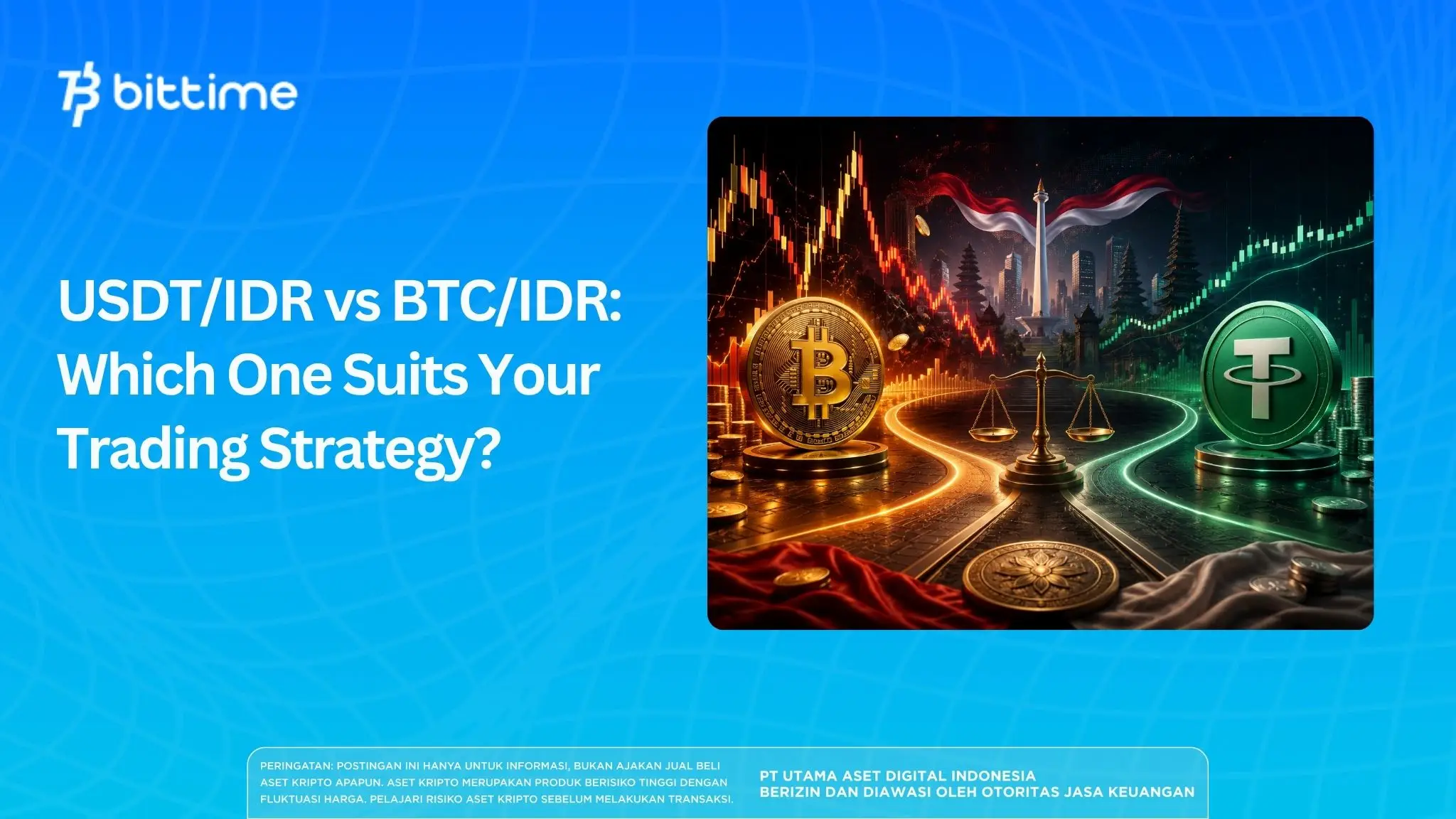
Choosing a crypto market pair is not just about deciding which asset to buy.
PartnerTrading also determines the source of risk, how to read profits, transaction costs, and the next steps after the position is closed.
At Bittime, users can find pairs BTC/IDR And USDT/IDR.
Both use the rupiah as a benchmark asset, but have very different functions.
BTC/IDR provides direct exposure to Bitcoin movements, while USDT/IDR is used to exchange rupiah for stablecoins that track the value of the US dollar.
Therefore, the questionThe question of which USDT/IDR vs BTC/IDR is better cannot be answered.based solely on price or popularity.
The right choice depends on the goal: storing Bitcoin, maintaining value in dollar terms, moving to multiple altcoins, or doing short-term trading.
Key Takeaways
BTC/IDR is suitable for direct exposure to Bitcoin, but has volatility and higher risk of price decline.
USDT/IDR is more suitable as a conversion path, temporary storage, or capital to access USDT based pairs.
At Bittime, both markets are IDR-based, so the transaction fee structure is the same. Differences in results are largely determined by volatility, spreads, and trading objectives.
Choose a pair according to your strategy and start trading BTC/IDR or USDT/IDR and Register at Bittime.
What is a Market Pair?

Source : AI
Market pair is a combination of two assets traded against each other. The first asset is called base asset, while the second asset is calledquote assetor comparable assets.
The pair value indicates how much of the counter asset is required to purchase one unit of the underlying asset.
In the BTC/IDR pair, BTC is the underlying asset and IDR is the benchmark. If BTC/IDR is at IDR 1.2 billion, that means one BTC is worth IDR 1.2 billion.
In USDT/IDR, USDT is the underlying asset. If the pair price is Rp18,000, one USDT can be purchased for approximately Rp18,000.
So, they are not two different ways to buy Bitcoin, but rather two different assets that are both traded against the rupiah.
BTC/IDR Characteristics and When to Use It
BTC/IDR allows users to buy Bitcoin directly using their Rupiah balance. The process is simple because traders don't need to convert IDR into stablecoins first.
The main character of this pair is volatility.
The BTC/IDR price is influenced by Bitcoin's movement in the global market, the rupiah exchange rate against the dollar, and supply and demand in the local order book.
When Bitcoin rises, the value of holdings in rupiah has the potential to increase.
However, a Bitcoin correction could also directly depress the portfolio value.
BTC/IDR is more suitable for use when:
The main goal is to accumulate Bitcoin.
Investment returns are calculated in rupiah.
Users implement periodic purchases.
Funds do not need to be frequently transferred to other altcoins.
Investors are prepared for BTC price volatility.
For long-term investments, this pair can reduce transaction stages.
Users simply deposit Rupiah, buy Bitcoin, and then sell it back to IDR when they want to withdraw funds.
Read Also: How to Buy Bitcoin (BTC) | BTC to IDR | BTC to USDT
Characteristics of USDT/IDR and When to Use It
USDT/IDR is used to buy or sell Tether using rupiah. USDT is a stablecoin designed to maintain its value close to one US dollar.
Although relatively stable against the dollar, the price of USDT in rupiah can still rise or fall depending on the USD/IDR exchange rate, local liquidity, and market demand.
This pair is often used as an entry point to USDT-based markets.
After purchasing USDT with Rupiah, traders can use it to buy BTC, ETH, or any altcoin available in USDT pairs.
USDT/IDR is more suitable when:
Traders want to hold a temporary balance without maintaining BTC exposure.
Users need capital to buy some altcoins.
The strategy involves rapid movement between pairs.
Traders compare prices with global markets.
Users want to perform inter-market or exchange arbitrage.
However, USDT is not a risk-free asset. Its value can deviate from the dollar and still carries issuer, regulatory, platform, and liquidity risks.
Read Also: Complete Guide to Converting IDR to USDT on Bittime 2026
USDT/IDR vs BTC/IDR comparison
Liquidity cannot be judged solely by the pair name.
Traders need to compare transaction volume, order book thickness, the spread between the buy and sell prices, and the potential for slippage when an order is placed.
Liquid pairs typically have tighter spreads and can execute orders without moving the price too far.
Read Also: How to Deposit Rupiah and Crypto Assets on Bittime: It's So Easy!
BTC/IDR and USDT/IDR Fee Comparison at Bittime
Because BTC/IDR and USDT/IDR both use IDR as their currency.quote asset, both of which follow the IDR market fee structure on Bittime.
Based on information updated on July 25, 2026, buy transactions through the IDR market are subject to a total taker fee of 0.22% or a maker fee of 0.12%. Sell transactions to IDR are subject to a total taker fee of 0.43% or a maker fee of 0.33%. These fees include trading fees, taxes, and CFX fees.
The "Buy USDT/Crypto" category in the Bittime fee table does not refer to USDT purchases via USDT/IDR. This category applies when users purchase assets using USDT or other crypto as a counterparty.
This means that, in terms of fee percentage, there is no direct advantage between BTC/IDR and USDT/IDR.
Real cost differences can arise if users choose a layered path, for example IDR → USDT → BTC, because each stage is a separate transaction.
Read Also: What's the Difference Between BTC, IDR, and USDT? A Complete Guide for Beginners
Which is More Profitable?
BTC/IDR offers greater profit potential when Bitcoin's price rises, but also carries a higher risk of loss. USDT/IDR is typically not chosen to pursue aggressive gains, but rather as a conversion and capital management tool.
For long-term investors who truly want to own Bitcoin, BTC/IDR is usually more efficient because it doesn't require intermediary transactions.
Meanwhile, active traders can choose USDT/IDR if they want to access more USDT-based pairs or move capital quickly.
Profit isn't determined solely by choosing IDR or USDT. Entry and exit prices, spreads, slippage, transaction costs, liquidity, and risk management have a greater impact.
Read Also: What is Trading? Definition, How It Works, and How It's Different from Investing
How to Trade BTC/IDR and USDT/IDR on Bittime
First, create a Bittime account and complete identity verification. After that, deposit rupiah using the available payment methods.
Open the market menu, then search for BTC/IDR if you want to buy Bitcoin directly or USDT/IDR if you want to convert rupiah to USDT.
Choose a market order for an immediate transaction at the best available price or a limit order to set your own price.
Enter the purchase amount, check the estimated assets received and the total cost, then confirm the order. Once the transaction is complete, the BTC or USDT will be credited to your account balance.
Conclusion
In comparisonUSDT/IDR vs BTC/IDR, BTC/IDR is more relevant for users who want toget direct exposure to Bitcoin.
USDT/IDR is more suitable for maintaining dollar-denominated balances, moving into the USDT market, or conducting active trading.
Both have the same IDR market fee structure on Bittime.
Therefore, decisions should be based on volatility, trading channels, liquidity, and the intended use of the asset—not just the assumption that one pair is always more profitable.
Bittime is a licensed and regulated Digital Financial Asset Trader (PAKD) supervised by Indonesia’s Financial Services Authority (OJK) — where you can buy Bitcoin in Indonesia and hundreds of other crypto assets starting from just Rp10,000. The registration process is fast, secure, and you can get started today.
Track USDT to IDR conversions and monitor your favorite crypto assets in real time. Everything is available in one crypto investment app that you can download for free on the Play Store
Ready to start? Register now on Bittime and execute your investment strategy with a platform trusted by millions of users in Indonesia.
FAQ
What is the difference between USDT/IDR and BTC/IDR?
USDT/IDR is used to trade USDT against rupiah, while BTC/IDR is used to buy or sell Bitcoin using rupiah.
Which one is suitable for long term investors?
BTC/IDR is more suitable if the investor's goal is to accumulate and store Bitcoin in the long term.
Which one is suitable for active traders?
USDT/IDR can be more practical for traders who frequently switch assets, access USDT pairs, or conduct arbitrage.
Are USDT/IDR fees cheaper than BTC/IDR?
No. At Bittime, both are IDR markets, so they use the same fee structure. Fees may increase if the transaction involves multiple steps.
Is USDT safer than Bitcoin?
USDT is more stable against the dollar, but still carries issuer, depeg, regulatory, and platform risks. Bitcoin is more volatile, but it isn't tied to a single issuing company.
Do I have to buy USDT before buying Bitcoin?
No. Users can buy Bitcoin directly via BTC/IDR without purchasing USDT first.
Disclaimer: The views expressed belong exclusively to the author and do not reflect the views of this platform. This platform and its affiliates disclaim any responsibility for the accuracy or suitability of the information provided. It is for informational purposes only and not intended as financial or investment advice.

.png)