USDT-M Futures vs COIN-M Futures: Differences in Margin, PnL, and Liquidation Risk
2026-08-19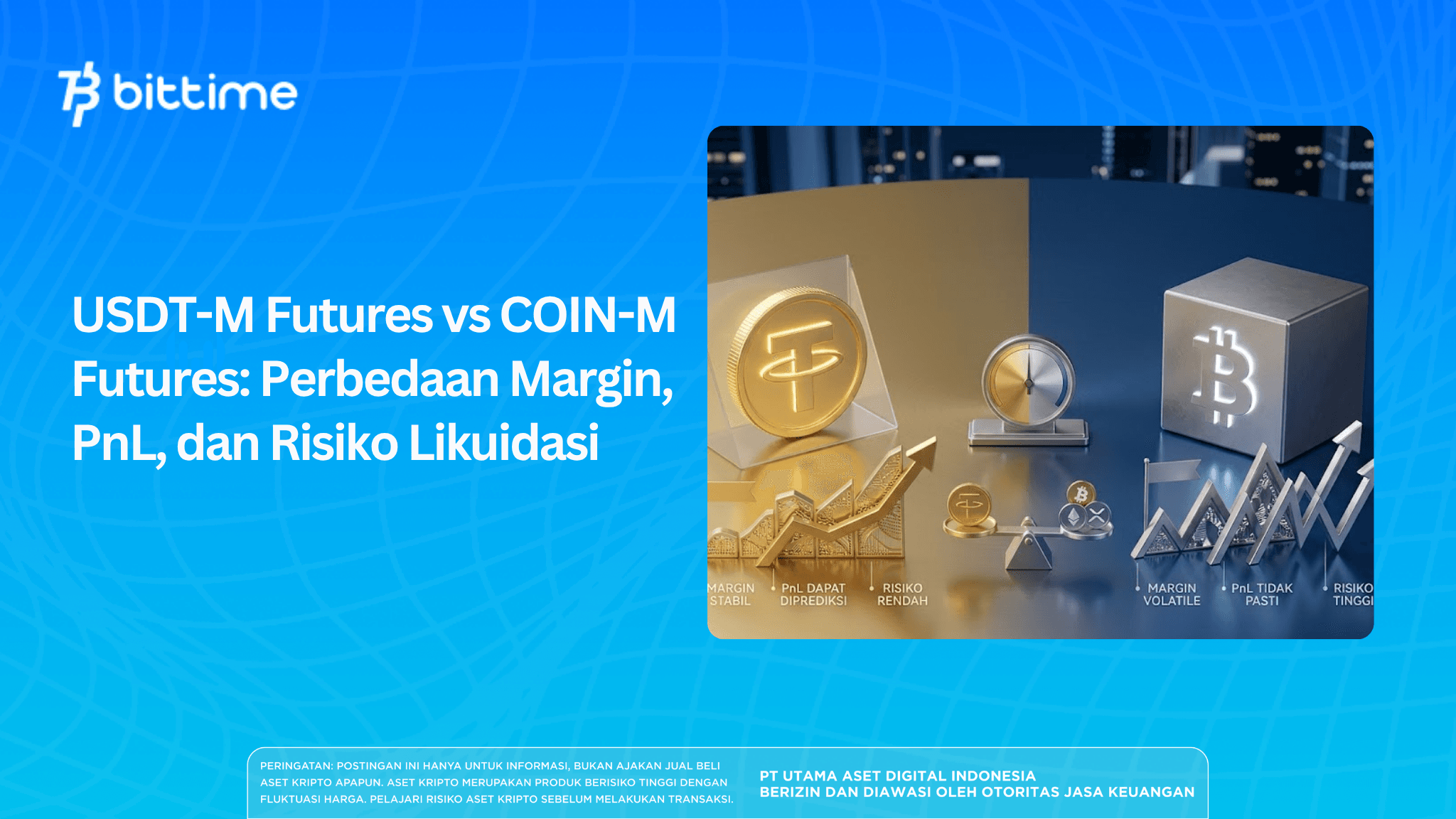
The choice of margin can change how a trader calculates profit, bears losses, and faces liquidation. In USDT margined futures and coin margined futures, the price movement of the underlying asset is indeed the focus, but the asset used as collateral creates a different risk profile.
The differences between USDT-M and COIN-M also don't stop at linear and inverse terms. The contract settlement method, collateral type, PnL calculation, and intended use all help determine which type of futures better suits a trader's strategy.
Key Takeaways
- USDT-M Futures use USDT as margin and settlement, making PnL easier to read in dollar denomination.
- COIN-M Futures use crypto assets like BTC or ETH as margin and settlement, so the collateral value is also affected by the asset's price.
- Liquidation risk depends on leverage, margin, maintenance margin, and price movement, not just the contract type.
What Are USDT-M and COIN-M Futures?
USDT-M Futures, or linear futures, are contracts that use a stablecoin like USDT as both margin and settlement currency. This structure makes profits and losses easier to calculate because PnL is denominated in USDT.
Meanwhile, COIN-M Futures, or inverse futures, use crypto assets as margin and settlement. Examples include BTC or ETH. This means traders can use crypto assets they already hold as collateral without having to convert them to USDT first.
The fundamental differences can be seen below:
MEXC also notes that both contract types can use isolated or cross margin modes, depending on the features available on the platform.
If you want to explore digital asset trading through a local platform, Bittime provides access for users who want to explore crypto trading features.
Margin and Collateral Differences: USDT-M vs COIN-M
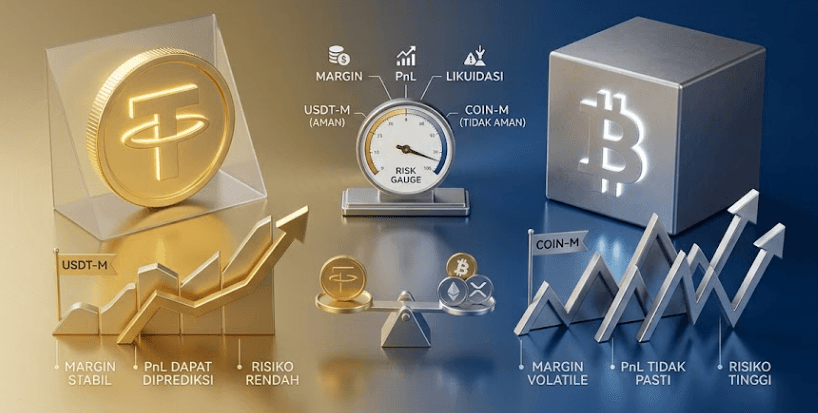
Illustration: Generated-AI image
Margin is the funds used to support a futures position. In USDT-M, the trader deposits USDT as collateral. The value of that USDT is relatively stable against the dollar, so BTC price changes do not directly change the number of collateral units held.
For example, a trader has 1,000 USDT as margin to open a BTCUSDT position. If BTC then drops, the value of that 1,000 USDT remains 1,000 USDT before accounting for PnL, fees, or other changes to the account.
The situation is different in COIN-M. If a trader uses BTC as collateral, the dollar value of that asset also changes when the BTC price moves. MEXC notes that this characteristic makes COIN-M attractive for crypto holders who want to maintain their assets while trading or hedging.
The consequence is that COIN-M has an additional layer of risk. Traders face changes in the futures position as well as changes in the value of the crypto collateral used.
This is why the term crypto futures collateral becomes important. Two positions with the same contract size do not necessarily have the same risk profile if their collateral is different.
Read Also: Nvidia’s $500 Billion AI Funding – AI Crypto Tokens Also Benefit?
PnL in USDT Futures vs COIN-M Futures
The next difference lies in how profits and losses are calculated and received.
In USDT-M, PnL can be understood more directly in USDT. For example, a trader opens a long position of 1 BTC when the BTC price is at $60,000. If the price rises to $61,000, the profit on that position is simply around $1,000, before accounting for fees and other contract components.
If the price drops to $59,000, the loss is approximately $1,000.
This type of model makes USDT futures PnL relatively easy to understand for traders who are used to calculating results in dollars.
In COIN-M, settlement uses crypto assets. As a result, the dollar-denominated value of profit or loss changes according to the price of that asset. This mechanism makes inverse futures calculation more complex than linear contracts.
The advantage of COIN-M, however, is for traders who want to maintain exposure to crypto assets. A BTC holder, for example, can use COIN-M contracts to hedge without having to sell their BTC first. This characteristic allows users to hedge with crypto assets they already hold.
Read Also: Popular Tokenized Stocks in 2026: Technology Stocks Become Investor Favorites
Liquidation Risk in USDT-M and COIN-M
Leverage multiplies the position size compared to the capital used as margin. Because of this, relatively small price changes can have a large impact on account equity.
In USDT-M, a drop in the price of the asset underlying a long position will reduce margin equity through negative PnL. If the account value falls to the maintenance margin threshold set by the platform, the position can be liquidated.
COIN-M introduces an additional consideration because the collateral, being a crypto asset, also changes in value. When BTC is used as margin and the BTC price drops, the dollar-denominated value of the collateral also decreases.
Simply put:
USDT-M:
Asset price drops → PnL worsens → margin equity drops → liquidation risk increases.
COIN-M:
Asset price drops → PnL from position worsens + crypto collateral value also drops → pressure on margin can increase.
Therefore, calling one type of contract "safe" would be an oversimplification. The risk is still determined by leverage, position size, available margin, maintenance margin, volatility, and the platform's liquidation mechanism.
Read Also: Tokenized Stocks vs Traditional Stocks: Definitions, Differences, and How to Buy
USDT-M or COIN-M: Which Is More Suitable?
The choice of contract should follow the assets held and the trading objective.
USDT-M is more practical for traders who:
- want to calculate PnL in USDT;
- use stablecoins as futures capital;
- prefer a simpler calculation structure;
- actively engage in short-term trading.
COIN-M can be considered by traders who:
- already hold BTC, ETH, or other supported crypto assets;
- want to use crypto as collateral;
- want to hedge against spot holdings;
- want to maintain exposure to crypto assets.
However, this choice does not automatically determine trading outcomes. High leverage can still accelerate liquidation on both contract types. Even a contract with a simpler mechanism can still result in large losses when the position size is disproportionate to the capital.
Read Also: 10 Free Bitcoin Mining and Faucet Sites in 2026 – Which Are Legit?
Don't Confuse with CME Futures
USDT-M and COIN-M on crypto platforms also need to be distinguished from crypto futures products traded on traditional derivative markets.
CME Group, for example, states that their crypto futures contracts are settled based on the CME CF Reference Rates. CME Bitcoin Futures use the CME CF Bitcoin Reference Rate as the basis for settlement, while contracts such as Micro Bitcoin Futures have their own contract specifications and expiration dates.
Thus, the term "futures" does not always mean the same mechanism. Perpetual futures on crypto exchanges can have a different structure from dated futures with expiration dates, such as those traded on CME.
Read Also: 10+ Best AI Coins in 2026: List of Artificial Intelligence-Themed Crypto!
Conclusion
USDT-M and COIN-M Futures have different purposes and characteristics. USDT-M offers simpler PnL and collateral calculation because it uses USDT, while COIN-M allows crypto assets to be used as both margin and settlement, with the consequence that the collateral value moves with the market.
For traders, understanding the source of that risk is far more important than simply choosing the contract with the highest leverage, because a large leverage number is always attractive until the market moves in the opposite direction.
Check the prices of Bitcoin (BTC), Ethereum (ETH), XRP, Solana (SOL), GRAM, and BNB, as well as the leading memecoin DOGE. You can trade directly on Bittime!

Bittime is a licensed Digital Financial Asset Trader (PAKD) platform, regulated by the Financial Services Authority — where you can buy Bitcoin in Indonesia and hundreds of other crypto assets starting from Rp10,000. The registration process is fast, secure, and can be started today.
Monitor USDT to IDR conversion and real-time price movements of your favorite crypto assets. All available in one crypto investment app that you can download for free on the Play Store.
Ready to start? Register now on Bittime and execute your investment strategy with a platform already trusted by millions of users in Indonesia.
FAQ
What is the main difference between USDT-M and COIN-M Futures?
USDT-M uses USDT as margin and settlement, while COIN-M uses crypto assets like BTC or ETH. This difference affects PnL and collateral risk.
What are USDT margined futures?
USDT margined futures are futures contracts that use USDT as margin and settlement currency. This type of contract is also known as linear futures.
What are coin margined futures?
Coin margined futures are contracts that use crypto assets as margin and settlement. This type is also known as inverse futures.
Which is easier for beginners, USDT-M or COIN-M?
USDT-M is generally easier to understand because PnL and margin are denominated in USDT. However, leverage still carries liquidation risk in both contract types.
Is COIN-M riskier than USDT-M?
COIN-M has an additional risk because the value of the crypto collateral can also change when the asset price moves. The overall risk level still depends on leverage, position size, margin, volatility, and liquidation mechanisms.
Can COIN-M be used for hedging?
Yes, especially for crypto asset holders who want to protect their spot positions from price drops without having to sell their assets outright. This mechanism is one of the main uses of coin-margined contracts.
Disclaimer: The views expressed belong exclusively to the author and do not reflect the views of this platform. This platform and its affiliates disclaim any responsibility for the accuracy or suitability of the information provided. It is for informational purposes only and not intended as financial or investment advice.

.png)