TOKEN2049 Singapore 2026: These Are the Crypto Trends in the Spotlight
2026-10-07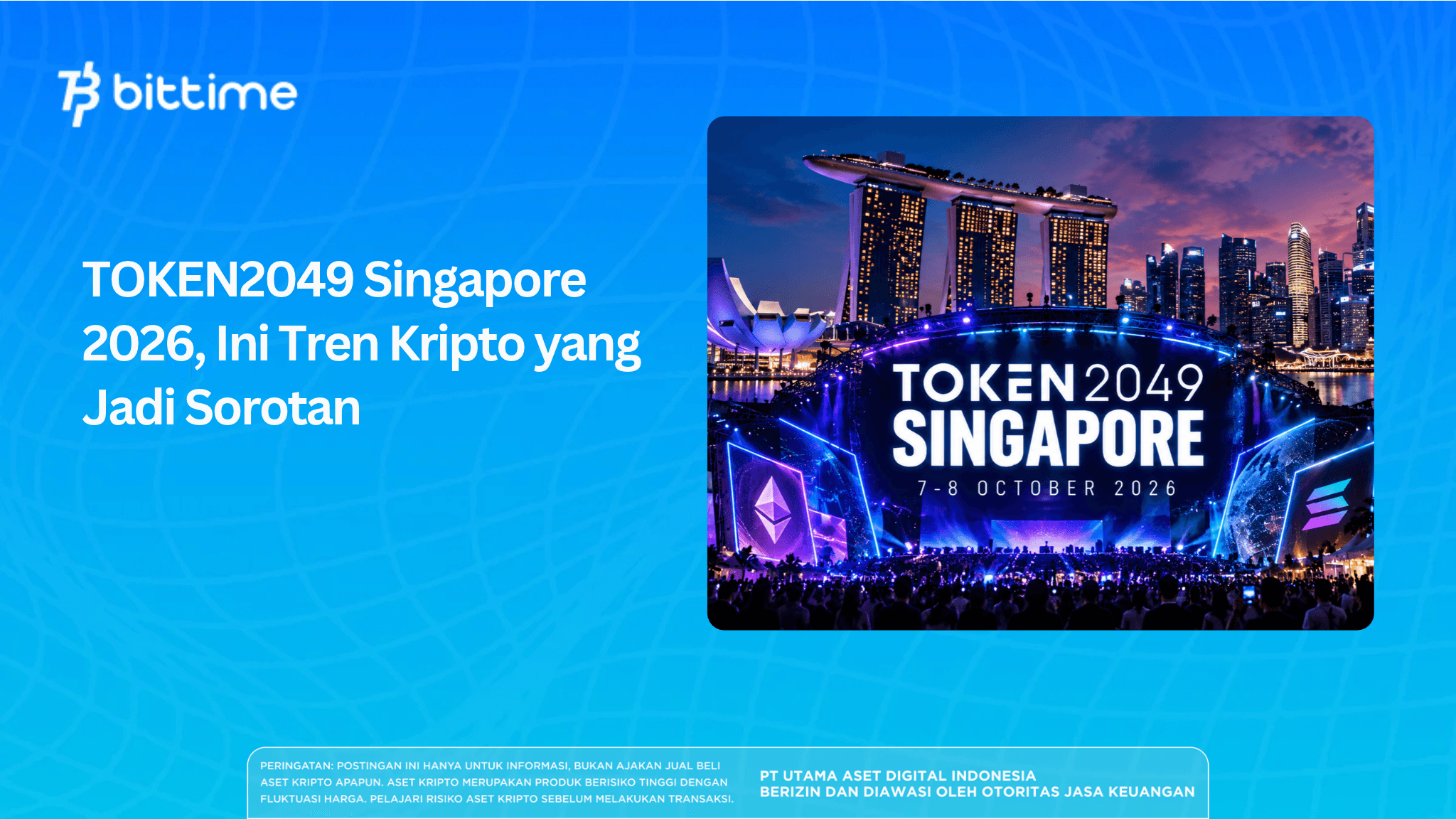
TOKEN2049 Singapore 2026 becomes one of the centers of attention for the global digital asset industry on October 7–8, 2026. Held at Marina Bay Sands, Singapore, this event brings together more than 25,000 attendees from 7,000+ companies, with 300+ speakers and 500+ exhibitors.
However, the important question is not just what TOKEN2049 Singapore 2026 is discussing, but rather where the crypto industry is heading afterward. This year's agenda shows a massive focus on institutional adoption, onchain finance, asset tokenization, stablecoins, AI, DeFi, and digital market infrastructure.
Key Takeaways
- TOKEN2049 Singapore 2026 highlights the shift in crypto towards a financial infrastructure that is increasingly connected with institutions.
- RWAs, stablecoins, AI, DeFi, and onchain finance are some of the key themes on the agenda.
- These global trends are relevant to Indonesia as the national digital financial asset and crypto ecosystem continues to grow.
What Does TOKEN2049 Singapore 2026 Discuss?
TOKEN2049 is a crypto industry conference that brings together founders, investors, technology companies, financial institutions, developers, traders, and Web3 ecosystem players.
For the Singapore 2026 edition, the event spans two days at Marina Bay Sands. The organizers also provide a special TOKEN2049 Institutional agenda that brings together 200 senior leaders from the global financial and digital asset sectors.
This scale shows that crypto discussions are broadening. The focus is no longer just on Bitcoin prices or new token launches, but also on how blockchain can be utilized as part of the financial infrastructure.
The official agenda features a number of sessions on DeFi, AI agents, stablecoins, tokenized markets, institutional capital, onchain settlement, and digital market developments.
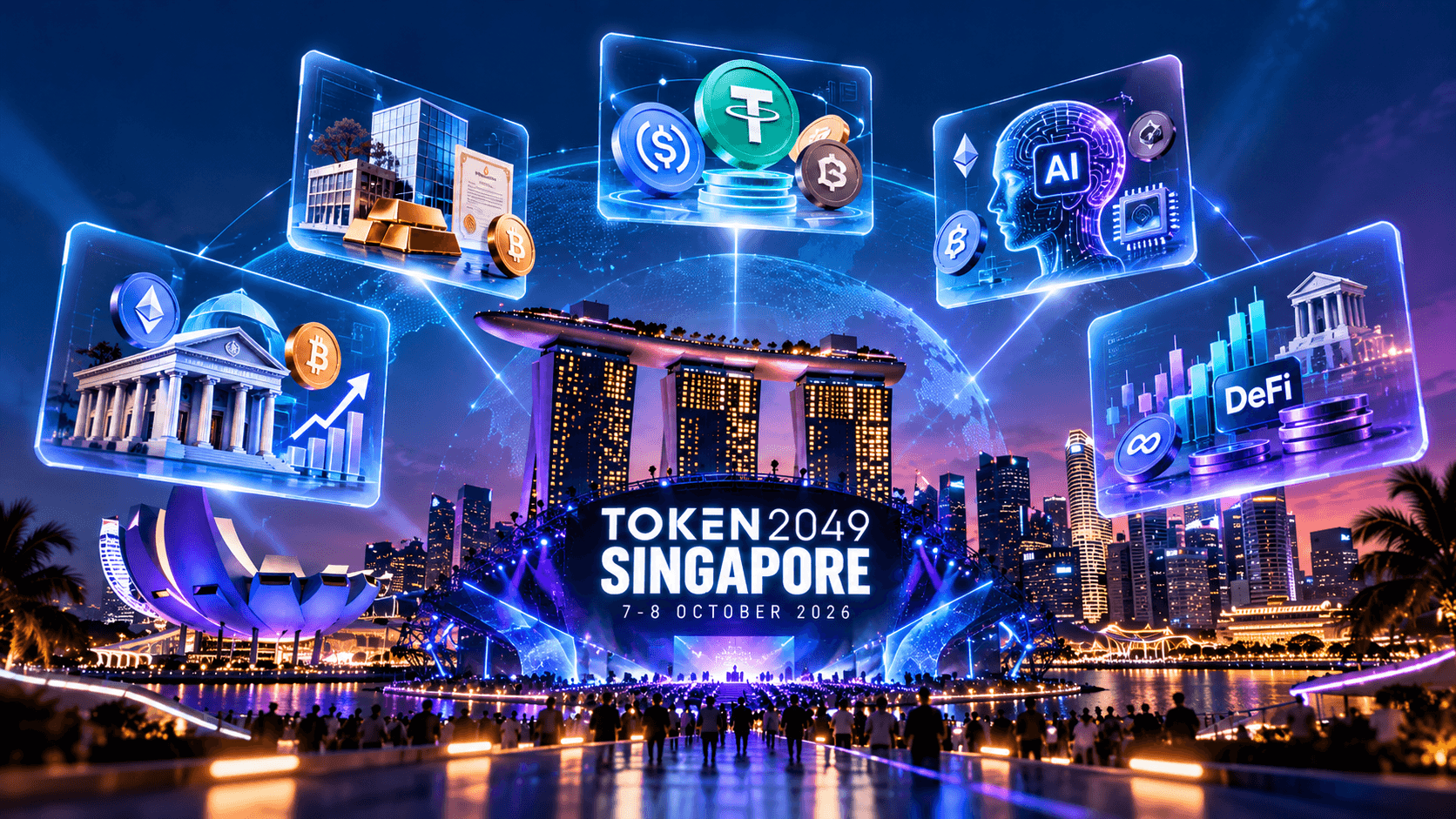
5 Crypto Trends in the Spotlight at TOKEN2049 2026
1. Institutional Adoption and Onchain Finance
One of the significant changes in the crypto industry is the growing attention towards the use of blockchain by institutions.
This is evident from the agenda that specifically discusses institutional finance, institutional capital, and how financial markets can transition to onchain infrastructure. One of the sessions is titled “Tokenized Markets: How Institutional Finance Moves Onchain” featuring speakers from Chainlink, Ripple Prime, FalconX, and Nasdaq.
The concept of onchain finance refers to the use of blockchain networks to execute, record, or settle financial activities. Its development can include asset trading, settlements, instrument issuance, and liquidity management.
This shift is important because it shows that blockchain is starting to be discussed as infrastructure, not merely as the technology behind cryptocurrencies.
On the other hand, institutional adoption does not automatically mean all blockchain products will be used by institutions. Factors such as regulation, security, liquidity, interoperability, and efficiency remain key considerations.
Read also : CFTC Crypto Rules: 5 Key Points of the New US Proposal
2. Asset Tokenization and RWAs
Asset tokenization has become one of the most prominent themes on the TOKEN2049 2026 agenda.
On the second day, there is a session on “The New Institutional Market: Tokenized Assets. Global Liquidity. Onchain Settlement”, as well as discussions on making tokenized assets more productive. Other agendas cover the future of real-world assets, including blockchain-based equities and derivative instruments.
RWAs or Real-World Assets refer to the representation of real-world assets or claims on them via blockchain infrastructure.
Examples can include:
- Financial market instruments.
- Debt securities.
- Equities.
- Credit.
- Commodity-based assets.
- Specific investment products.
The appeal of RWAs lies in the possibility of bridging traditional assets with blockchain systems.
However, the challenges are also significant. Tokenization requires legal certainty regarding ownership, investor rights, custody, settlement, and dispute resolution mechanisms.
Therefore, the development of RWAs should not only be judged by the number of tokens issued. The quality of the underlying assets, legal structures, liquidity, and the responsible parties are equally important.
3. Stablecoins and Payments
Stablecoins also receive substantial space in the TOKEN2049 Singapore 2026 agenda.
On the first day, there is a session titled “The Next Era of Stablecoin Payments”. The second day brings back discussions regarding stablecoins as part of the payment industry's transformation.
This indicates that stablecoin discussions are moving far beyond just being a crypto trading tool.
Stablecoins can be used for:
- Value transfer.
- Settlement.
- Digital payments.
- Cross-border transaction settlements.
- Financial application infrastructure.
If their use continues to grow, the industry's question will no longer be simply about a stablecoin's market capitalization.
The next questions are whether a stablecoin can be used efficiently, possesses adequate reserve mechanisms, meets regulatory requirements, and can integrate with existing payment systems.
Thus, stablecoins are becoming an interesting area to watch within the crypto trend developments of 2026.
Read also : SEC Proposes New Crypto Custody Rules, Here Are the Key Points
4. AI and Crypto
AI is another theme that is drawing closer to blockchain.
The TOKEN2049 agenda lists sessions such as “AI Agents Trading on the Blockchain”, “Agentic Trading”, and discussions on the future relationship between crypto and AI.
The concept of AI agents is intriguing because it allows software to perform tasks more automatically based on specific instructions or goals.
In a blockchain context, their application can relate to:
- Transaction execution.
- Onchain data analysis.
- Asset management.
- Strategy automation.
- Interactions with decentralized applications.
However, integrating AI and crypto also introduces new risks.
AI can make decisions based on flawed data. Smart contracts still pose technical risks. Additionally, transaction automation can amplify the impact of errors when systems have access to assets or capital.
Therefore, crypto AI should be understood as an area of technological development, not a guarantee that all projects utilizing AI share the same prospects.
5. DeFi and Institutional Capital
DeFi remains a crucial part of the TOKEN2049 discussions.
The official agenda features sessions like “DeFi’s Institutional Breakthrough” and “DeFi: The Race to Power Global Finance”. On the second day, there are also discussions regarding DeFi as institutional infrastructure.
DeFi essentially attempts to provide financial services through blockchain-based protocols without relying entirely on the structures of traditional financial institutions.
Its development encompasses lending, borrowing, trading, liquidity provision, and various forms of financial primitives.
DeFi's challenges also grow more complex as institutions begin to enter.
Issues such as compliance, custody, risk management, governance, smart contract security, and liquidity must be addressed if DeFi is to be adopted on a larger scale.
The TOKEN2049 agenda indicates that DeFi discussions no longer stand alone. DeFi is now being discussed alongside institutional capital and financial infrastructure.
Read also : Article 21 Income Tax Borne by the Government 2027: Is a Salary of Rp10 Million Tax-Free?
Why is Institutional Adoption Important?
Institutional adoption is crucial because institutions have different needs compared to retail users.
Institutions typically require:
- Regulatory clarity
- Clear custody
- Adequate liquidity
- Risk management
- Market infrastructure
- Efficient settlements
- Transparency and auditability
Therefore, the increasing amount of discussion around institutions can be an indication that the industry is working towards building a more mature infrastructure.
However, readers must distinguish between institutional presence and actual adoption.
The presence of an executive at a conference does not prove that their company has adopted a specific technology.
This is one of the essential points to keep in mind when reading news about crypto conferences. 24/7 Wall St. emphasizes that announcements can have varying levels of certainty, ranging from agreements with clear terms, live products, partnerships without details, proofs of concept, and statements of intent, to mere stage appearances.
Therefore, readers should look for follow-up evidence after the conference.
What Should Be Checked in TOKEN2049 Announcements?
Pay attention to:
- Who are the parties involved?
- Is there a formal agreement?
- Are the partnership terms disclosed?
- Is the product ready for use?
- Are there any user or transaction data available?
- Was the announcement confirmed by both parties?
- Can the implementation be verified after the event?
This approach helps separate actual progress from mere conference hype.
Read also : Tips for Starting Crypto Futures Trading for Beginners: How to Avoid Losses
What Does TOKEN2049 2026 Mean for the Indonesian Crypto Industry?
These global trends are relevant to Indonesia because the national digital asset ecosystem is also evolving.
The OJK (Financial Services Authority), in its September 2026 financial services sector development report, stated that 34 entities have obtained approval within the crypto asset trading ecosystem. This number consists of two crypto exchanges, two clearinghouses, two custodians, and 28 Digital Financial Asset Traders (PAKD).
This data indicates that the development of digital assets in Indonesia is not only related to the number of users or traded assets.
Its market infrastructure is also continuously being built.
This makes several trends discussed at TOKEN2049 highly relevant to observe in Indonesia, especially:
- Onchain infrastructure.
- Asset tokenization.
- Stablecoins and payments.
- Institutional adoption.
- DeFi.
- AI and blockchain.
- Digital asset regulations.
However, relevance does not mean that Indonesia will follow all these trends with the exact same patterns.
Developments in Indonesia remain influenced by regulations, domestic market needs, infrastructure readiness, consumer protection, and the characteristics of the national financial industry.
How Are Digital Asset Products Evolving for Users?
The industry's growth is also making digital asset products increasingly diverse.
Besides spot trading, users can now find products like staking and futures within digital asset platform ecosystems. Bittime provides Spot, Staking, and Futures all in a single ecosystem.
For Futures, Bittime offers Long and Short positions, up to 25x leverage, as well as Cross Margin and Isolated Margin options. Users also need to understand margin mechanisms and liquidation risks before utilizing these products.
It must be emphasized that having more product choices does not equate to smaller risks.
Leverage can amplify exposure to price movements. When the market moves against a position, losses can multiply and the position may face liquidation.
Therefore, the industry's evolution should be accompanied by increased user understanding of the characteristics of each product.
If you want to keep up with digital asset developments and understand the various available products, you can study market information and features on Bittime before choosing a product that matches your needs and risk tolerance.
Read also : How to Hedge a Crypto Spot Portfolio with Futures
What to Watch For After TOKEN2049 2026?
Events like TOKEN2049 can generate numerous headlines in a short period.
However, the real impact often only becomes apparent after the conference has concluded.
There are several indicators to monitor:
1. Product implementation
Are the announced products genuinely available to users?
2. Real partnerships
Does the partnership involve clear terms, timelines, and specific parties?
3. Institutional adoption
Are institutions actually utilizing the infrastructure, or just participating in discussions?
4. Usage growth
Is there an increase in users, transaction volume, settlements, or onchain activity?
5. Regulatory changes
Are industry discussions translating into policies that influence product development?
This approach is far more useful than merely chasing viral headlines.
Can TOKEN2049 Determine the Direction of Crypto Prices?
Not directly.
TOKEN2049 can be a hub for new information, product announcements, partnerships, and new narratives. However, the presence of a theme on the agenda does not automatically cause related asset prices to rise.
Crypto prices remain influenced by a multitude of factors, such as liquidity, macroeconomic conditions, market sentiment, capital flows, regulations, product utility, and supply-demand.
As such, TOKEN2049 is more appropriately used as an information source regarding industry developments, rather than an automatic trading signal.
Conclusion
TOKEN2049 Singapore 2026 illustrates that discussions in the crypto industry are continually broadening. The focus is not solely on cryptocurrencies as trading assets, but also on institutional adoption, onchain finance, asset tokenization, RWAs, stablecoins, AI, and DeFi.
What is fascinating is how blockchain is inching closer to traditional financial infrastructure. Tokenized assets, stablecoin payments, institutional capital, and DeFi infrastructure are part of an agenda that indicates the direction of the industry's evolution.
For Indonesia, these trends are highly relevant to observe because the national digital asset ecosystem is also advancing, supported by increasingly structured regulations and infrastructure. Nonetheless, every development still needs to be viewed based on actual implementation, regulation, risks, and proof of utility.
If you want to keep up with digital asset developments, regularly monitor market info and industry progress, and understand the risks of each product before conducting any transactions.

Bittime is a licensed Digital Financial Asset Trader (PAKD) platform supervised by the Financial Services Authority (OJK) — where you can buy Bitcoin in Indonesia and hundreds of other crypto assets starting from IDR 10,000. The registration process is fast, safe, and can be started right away today.
Monitor USDT to IDR conversions and real-time price movements of your favorite crypto assets. Everything is available in one crypto investment app that can be downloaded for free on the Play Store.
Ready to start? Register now on Bittime and execute your investment strategy with a platform trusted by millions of users in Indonesia.
FAQ
When is TOKEN2049 Singapore 2026?
TOKEN2049 Singapore 2026 takes place on October 7–8, 2026 at Marina Bay Sands, Singapore. The event features over 25,000 attendees, 7,000+ companies, 300+ speakers, and 500+ exhibitors according to organizer information.
What does TOKEN2049 Singapore 2026 discuss?
The TOKEN2049 2026 agenda covers DeFi, stablecoins, AI agents, tokenized markets, institutional capital, onchain finance, trading infrastructure, and digital asset developments. These themes appear in various sessions throughout the two-day conference.
What are the highlighted crypto trends at TOKEN2049 2026?
Some of the prominent themes are institutional adoption, asset tokenization and RWAs, stablecoins, AI and crypto, and DeFi. The official agenda also points to discussions on onchain settlements and institutional capital.
Why are asset tokenization and RWAs trending at TOKEN2049 2026?
Asset tokenization attempts to link real-world assets or instruments with blockchain infrastructure. TOKEN2049 includes several sessions regarding tokenized assets, institutional markets, global liquidity, onchain settlements, and the future of RWAs.
What is the relevance of TOKEN2049 2026 to the Indonesian crypto industry?
TOKEN2049 provides a snapshot of emerging global themes, while Indonesia possesses a digital asset ecosystem that continues to be developed through regulations and market infrastructure. The OJK noted that 34 entities have gained approval in the crypto asset trading ecosystem as of its September 2026 report.
Disclaimer: The views expressed belong exclusively to the author and do not reflect the views of this platform. This platform and its affiliates disclaim any responsibility for the accuracy or suitability of the information provided. It is for informational purposes only and not intended as financial or investment advice.

.png)