ANSEM Token: Is It Right to Be 65% Owned by One Wallet?
2026-07-10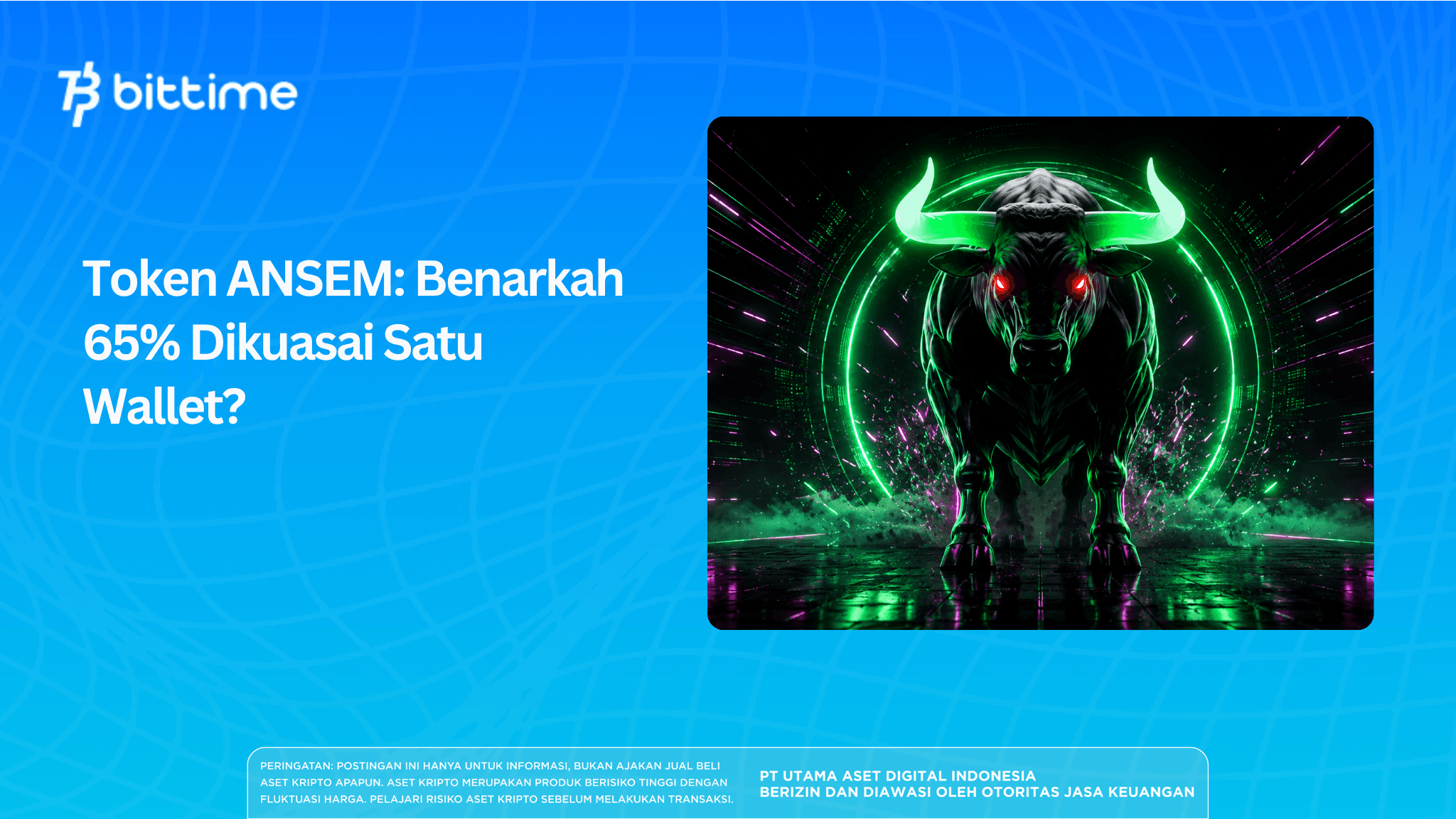
ANSEM token suddenly came into the spotlight after an on-chain investigation found that 650 million of the total one billion tokens were allocated to a single wallet before public trading began.
This figure equates to 65% of the total supply. This finding raises significant questions about token distribution, the fairness of the launch, and the extent of control held by majority holders.
Key Takeaways
- Transfer data shows 65% of ANSEM Tokens went into a single wallet on June 16, 2026, six days before public trading opened.
- After several distributions and airdrops, the wallet still holds approximately 586.6 million ANSEM, or 58.7% of the supply, according to Bitquery's snapshot.
- Blockchain proves the flow of tokens, but it cannot prove the identity of the human holding the private key of a wallet.
What Is ANSEM Token?
The ANSEM discussed in this investigation is The Black Bull, a memecoin on the Solana network with a total supply of one billion tokens.
This token uses a name associated with Ansem, a crypto figure known for his significant influence in the Solana community.

Sumber AI Generated Image
Readers should be wary of the ANSEM ticker, as it's not unique to a single asset. Several different tokens use similar names or symbols. Because blockchains are permissionless, anyone can create a token with the same name. Therefore, verification should be based on the contract address, not just the ticker.
The Black Bull token tracked by CoinGecko uses a Solana contract address that begins with9cRCnand endedTGpump. Ensuring the contract address is crucial to prevent investors from mistakenly analyzing other tokens that happen to use the ANSEM name.
Read also:Ansem Coin in the Spotlight After Viral Tattoo, Can Its Price Rise?
Is it true that 65% of ANSEM Tokens Go into One Wallet?
Based on Bitquery's research, the answer is correct for the initial token allocation.
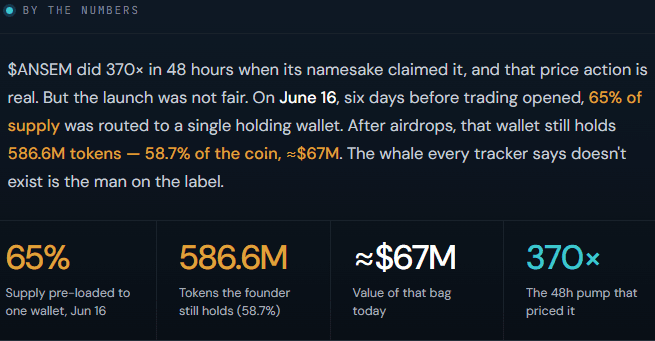
ANSEM tokens were minted on June 16, 2026, in a single transaction, with a total supply of one billion tokens. After the minting process, the supply was divided into two main parts:
- Around 650 million ANSEM or 65% was sent to the walletGV6UU….
- Around 349 million ANSEM or almost 35% is used to provide liquidity in the PumpSwap pool.
- The creator's wallet then no longer holds the token balance after sending the allocation.
Source bitquery.io
Public trading only began on June 22, 2026. This means that the largest wallets had already received 65% of the supply about six days before the public could trade the tokens.
This data can be read from Solana's transfer history. So, the fact that 65% of the initial supply went to a single address isn't just a social media rumor.
However, the use of the term "controlled" needs to be discussed carefully. A blockchain can show that a wallet receives and holds tokens. It doesn't automatically reveal which person, company, or group controls the wallet's private keys.
Does the Biggest Wallet Really Belong to Ansem?
Bitquery linked walletGV6UU…with Ansem based on Arkham's entity label, public reports, and analyzed distribution patterns. The wallet is labeled "ansemconzimp." However, Bitquery also emphasized that the identity of the private key holder cannot be independently confirmed from blockchain data alone.
Thus, there are two conclusions to be separated:
- On-chain facts: One wallet received 65% of the ANSEM Token supply before public trading.
- Identity attribution: The wallet has been linked to Ansem by analytics platforms and public reports, but the link cannot be proven from the blockchain address alone.
This separation is crucial to prevent the analysis from becoming an accusation beyond the evidence. On-chain transactions are transparent, while the identity of the wallet controller remains anonymous until verifiable confirmation.
Read also: What Is The Black Queen (ANSEMWIFE)? A New Meme Coin on Solana
Why is the 65% Allocation of ANSEM Tokens a Problem?
Supply concentration doesn't necessarily mean holders will sell all their tokens. A wallet can function as a treasury, distribution address, ecosystem reserve, or custodial wallet.
Problems arise when wallet functions, distribution schedules, sales limits, and oversight mechanisms aren't adequately explained.
In the case of ANSEM, the 65% concentration poses some risks.
1. Risk of Selling Pressure
Majority holders theoretically have the ability to send large amounts of tokens to liquidity pools or exchanges. If sales exceed the market's ability to absorb the supply, the price could drop sharply.
This risk is exacerbated when the number of tokens in public circulation is much smaller than the majority of wallet balances. Movements in even a small portion of these wallets can alter the balance between supply and demand.
2. Market Control Risk
Wallets with majority ownership can influence the perception of scarcity. As long as tokens remain stationary, the actively traded supply appears limited. This can cause prices to rise more rapidly when demand increases.
However, this scarcity isn't always permanent. Tokens from the largest wallets can re-enter the market through direct transfers, airdrops, gifts to others, or sales from the recipient's wallet.
3. Difference between Market Cap and Fully Diluted Valuation
Pricing platforms can calculate market capitalization based on circulating supply, while the total supply of ANSEM Tokens is one billion tokens. Consequently, the visible market cap doesn't necessarily reflect the value of all tokens if the non-circulating supply is taken into account.
As of July 10, 2026, CoinGecko recorded a traded supply of approximately 420 million ANSEM. This figure is significantly lower than the total supply of one billion tokens. This difference explains why the fully diluted valuation can be significantly higher than the market cap.
4. Dependence on One Figure
Mark memecoin often depends on the community's attention, narrative, and the figures associated with it. If the majority of supply is also associated with that figure, reputational risk and ownership risk become concentrated in the same party.
Changes in support, public statements, or wallet activity can trigger market movements. Investors ultimately risk not only their funds on the token, but also on the actions and reputations of the majority holders.
Read also:Hyperliquids Increasingly Dominant, Perpetual Futures Open Interest Reaches US$4.3 Billion
Does the Wallet Still Hold 65% of the ANSEM Tokens?
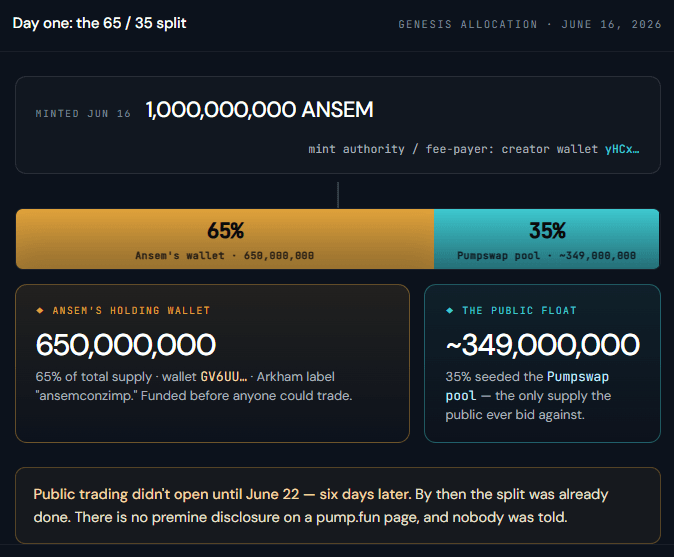
No. The 65% figure reflects the initial allocation as of June 16, 2026, not the final balance.
According to a Bitquery snapshot dated June 30, 2026, the wallet still holds approximately 586.6 million ANSEM, or 58.7% of the total supply. In other words, approximately 63 million tokens have left the wallet since the initial allocation.
Source bitquery.io
Bitquery analysis notes that:
- Around 50 million tokens were sent to seven larger wallets.
- Around 17 million tokens were distributed to approximately 700 small addresses.
- The main wallet is not recorded selling directly to the pool in that snapshot.
- A number of large recipient wallets were then recorded selling tokens to the market.
This pattern doesn't automatically prove a sales disguise. Transfers to other wallets can have various purposes.
However, investors need to monitor more than just the sales activity of the primary wallet. They also need to track the token transfer to the recipient address and observe the wallet's actions after receiving the ANSEM.
Community airdrops also took place. A Bubblemaps report, cited by The Defiant, stated that approximately US$6.7 million in ANSEM was sent to over 700 wallets. One recipient received over US$1 million worth of tokens, while others received varying amounts.
Read also:GORP Rises Sharply, Where Can You Buy Global Oil Recovery Program (GORP)?
How Can the Price of ANSEM Token Rise So Fast?
Before gaining widespread attention, ANSEM trading activity had slowed. Bitquery recorded a daily drop in the number of traders to 336 on June 26, 2026.
The situation changed on June 27th. Within an hour, the number of transactions in the main pool increased from 95 to 25,230. The price tracked by Bitquery moved from around US$0.00018 to US$0.0083 during the same period. The token's valuation then peaked at around US$126.4 million on June 29th.
The surge is related to Ansem's growing attention to the token and his plan to distribute creator fees to the community. The attention of a figure with a large audience can create reflexivity: rising prices attract attention, attention attracts buyers, and repurchases drive up the price.
However, price increases also increase the value of majority wallet holdings. When a wallet holds nearly 60% of the supply, any increase in valuation automatically increases the nominal value of that balance, even if the tokens haven't been sold.
Read also:BonkDAO US$20 Million Stolen via Malicious Proposal: What Happened?
Is ANSEM Trading Volume Fake?
Bitquery's investigation doesn't conclude that all ANSEM volumes are fake. Seven-day data shows approximately US$120.8 million in DEX volume across 698,796 transactions and over 55,000 wallets. This distribution indicates genuine market demand.
However, some activity comes from bots and market makers. Bitquery found that one bot executed 32,291 transactions with a volume of approximately US$10.4 million, or 8.6% of the total volume. The top 100 wallets accounted for approximately 42% of trading activity.
Bitquery estimates that approximately 25%–40% of volume can be attributed to bot turnover. After subtracting this component, organic activity is estimated to remain in the range of US$80 million–US$90 million for the analyzed period. This estimate should be interpreted as a result of Bitquery's methodology, not a final figure.
So, the main issue with ANSEM Token isn't simply whether it's trading legitimately. The bigger issue lies in the concentration of ownership and transparency of distribution.
Why Can Dashboard Holders Be Misleading?
Some dashboards only count buy and sell transactions via DEX. These systems don't always include regular transfers between wallets in their profit or balance calculations.
For example, Bitquery discovered a wallet displayed on the leaderboard as still holding 42.3 million ANSEM and making a profit of approximately US$3.7 million. A transfer check showed the wallet had sent all the tokens the same day they were received. Its actual balance was zero.
This type of error occurs because the dashboard detects swap activity but ignores regular token transfers. Therefore, investors should check:
- Transfer history since the token was minted.
- Net balance of each wallet.
- The relationship between the primary wallet and the recipient wallet.
- Swap activity after tokens are moved.
- Liquidity pool addresses and custodial wallets.
- The difference between circulating supply and total supply.
Holder data without context can lead to erroneous conclusions. Exchange wallets, liquidity pools, treasuries, routers, and individual wallets all have different functions, even though they all appear on the holder list.
Read also:The US Strategic Bitcoin Reserve is Hampered, What's Going On?
How to Check ANSEM Token Distribution
Investors don't have to be professional blockchain analysts to do basic research.
1. Verify Contract Address
Don't just search by the name "ANSEM." Compare the contract address across multiple sources, as there are several tokens with similar tickers.
2. Open First Transfer History
Check when the tokens were minted, the total initial supply, and where the tokens were first sent. Pre-trade allocations often provide information not visible on price charts.
3. Identify the Largest Wallet
Pay attention to the percentages held by the top ten or one hundred wallets. Separate pool wallets, exchange wallets, burn addresses, treasuries, and regular holders.
4. Follow the Derivative Wallet
Don't stop at the largest wallets. Check the token recipient addresses and see if the funds were subsequently transferred to an exchange or sold through a DEX.
5. Check Liquidity
Large holdings become riskier when liquidity is thin. Compare the number of tokens potentially sold with the depth of available liquidity.
6. Use More Than One Platform
Combine blockchain explorer data, analytics platforms, pricing sites, and official announcements. Each dashboard can use a different methodology.
To monitor progress ANSEM Token, crypto asset prices, and other on-chain news, you can register at Bittime and keep up with the latest market updates. Always verify the contract address and blockchain data before making any transaction decisions.
Read also:Trump Gains $1.2 Billion vs. Retail Losses $3.81 Billion: The TRUMP Token Drama
What is the Impact on ANSEM Token Investors?
Holding 58%–65% of a single wallet doesn't guarantee a price drop. The holder can continue holding or gradually distribute tokens. However, this structure makes investor risk highly dependent on a single wallet's decisions.
Some risks to consider include:
- Bulk sales.
- Distribution via secondary wallet.
- Changes in support of key figures.
- Liquidity that is unable to absorb supply.
- Misreading circulating market cap.
- Volatility due to free float is limited.
- The emergence of clone tokens with the same ticker.
Investors must also distinguish between unrealized value and realized profits. The value of tokens in a wallet is calculated based on the latest market price. Holders may not be able to sell their entire balance at that price, as large sales can drain liquidity and lower the price.
Conclusion
The finding that 65% of ANSEM Tokens went into a single wallet is supported by blockchain transfer history.
A total of 650 million of the one billion tokens were sent to a single address on June 16, 2026, before public trading began. After the distribution and airdrop, the wallet still held approximately 586.6 million tokens, or 58.7% of the supply, according to a Bitquery snapshot dated June 30, 2026.
However, ownership claims must be conveyed precisely. The blockchain shows the allocation and movement of tokens, but it doesn't prove the identity of the person controlling the wallet. The wallet's connection to Ansem stems from the Arkham label and public reports used by Bitquery.
For investors, the primary issue isn't just who owns the wallet. Supply concentration creates risks of selling pressure, market control, limited free float, and dependence on a single party.
Therefore, don't judge ANSEM solely on its price chart or trading volume. Check the contract address, transfer history since its inception, receiving wallets, and liquidity depth before making a decision.
Check out other popular Solana meme coins such as BONK, TRUMP, WIF, and PENGU, available on the Bittime market
Bittime is a licensed and regulated Digital Financial Asset Trader (PAKD) supervised by Indonesia’s Financial Services Authority (OJK) — where you can buy Bitcoin in Indonesia and hundreds of other crypto assets starting from just Rp10,000. The registration process is fast, secure, and you can get started today.
Track USDT to IDR conversions and monitor your favorite crypto assets in real time. Everything is available in one crypto investment app that you can download for free on the Play Store
Ready to start? Register now on Bittime and execute your investment strategy with a platform trusted by millions of users in Indonesia.
FAQ
Is it true that one wallet received 65% of ANSEM Tokens?
Yes. Data analyzed by Bitquery shows that 650 million of the one billion ANSEM were sent to a single wallet on June 16, 2026. The allocation occurred six days before public trading began.
Is the wallet proven to belong to Ansem?
This can't be proven solely through blockchain. The wallet is linked to Ansem through Arkham tags and public reports, but on-chain data can't definitively reveal the identity of the private key holder.
Does the wallet still hold 65% of the supply?
No. Bitquery's snapshot of June 30, 2026, shows the balance has dropped to approximately 586.6 million ANSEM, or 58.7% of the total supply, after several distributions.
Does the concentration of supply mean a rug pull will occur?
Not always. Supply concentration is a risk factor, not definitive proof of a rug pull. Investors should still monitor transfers, liquidity, receiving wallet activity, and distribution transparency.
How to ensure the correct ANSEM Token?
Use the contract address, not just the name or ticker. Compare the address on blockchain explorers, trusted pricing sites, and relevant official channels before making a transaction.
Disclaimer: The views expressed belong exclusively to the author and do not reflect the views of this platform. This platform and its affiliates disclaim any responsibility for the accuracy or suitability of the information provided. It is for informational purposes only and not intended as financial or investment advice.
.png)