Stop Market vs Stop Limit for Futures Risk Management, Don't Choose Wrong
2026-08-06
Many traders already understand the importance of placing a stop order when opening a position in crypto futures, but many still make mistakes in choosing between Stop Market and Stop Limit.
This mistake may seem simple, but it can cause the stop loss to fail to execute or exit the position at a price far different from the original plan. Therefore, understanding how these two order types work is an essential part of risk management before starting trading using leverage.
Key Takeaways
- Stop Market prioritizes execution certainty even if the final price may experience slippage.
- Stop Limit offers better price control but risks not executing when the market moves very quickly.
- The choice of stop order type should be adapted to market volatility and the trading strategy used.
What Are Stop Market and Stop Limit in Futures Trading?
Stop Market and Stop Limit are two types of stop orders that automate transactions when the price reaches a certain level. Traders generally use this feature to limit losses (stop loss), lock in profits, or enter the market during a breakout.
Before discussing both, it is important to understand that a stop order is different from a Market Order or Limit Order. A Market Order will immediately buy or sell an asset at the best available price, while a Limit Order will only execute at a price determined by the trader.
A stop order works slightly differently. This order becomes active only after the price touches the stop price or trigger price.
In a Stop Market order, it automatically becomes a Market Order after the trigger price is reached. Meanwhile, in a Stop Limit order, it becomes a Limit Order, so the transaction only takes place if the price is still within the limit set.
For futures traders, both orders are important tools to reduce risk when they cannot monitor price movements at all times.
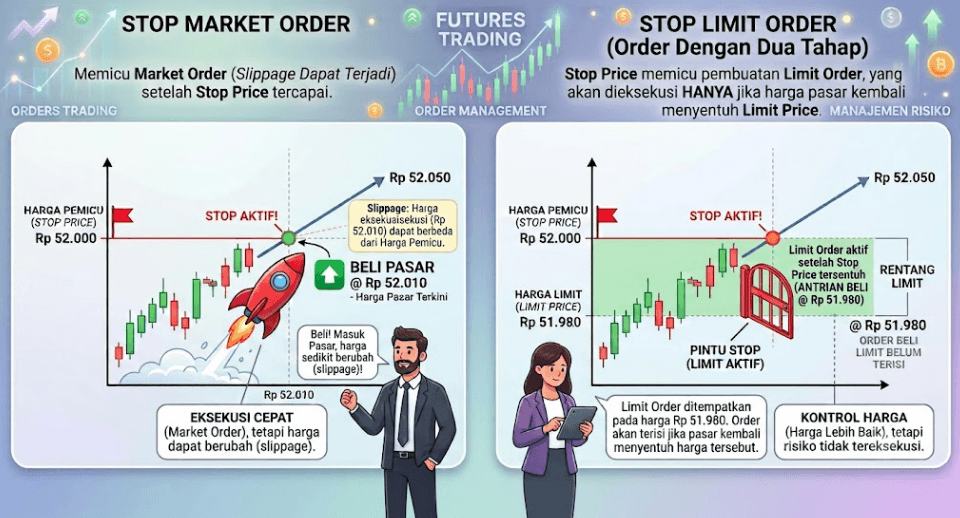
Illustration: Generated by AI
Read Also : How to Trade Futures on Bittime for Beginners
Key Differences Between Stop Market and Stop Limit You Need to Understand
The main difference between these two orders lies in the priority between execution certainty and price certainty.
Stop Market
In a Stop Market, once the price hits the stop level, the system immediately sends a Market Order to the market.
The advantage is that the chance of the order being executed is very high even if the market is moving fast. However, traders must be prepared for slippage, which is the execution price that can differ from the stop price due to very rapid price changes.
For example, a trader places a Bitcoin stop loss at US$110,000. When the price falls and touches that level, the system immediately sells at the best available price. If the market is very volatile, the selling price could be slightly lower than the stop price.
Read Also:A Margin Call on Crypto Futures? Here’s What to Do to Avoid Liquidation
Stop Limit
Unlike Stop Market, Stop Limit will turn the order into a Limit Order after the trigger price is reached.
The trader retains control over the selling or buying price because they can set a limit price. However, if the price moves too quickly past that limit, the order may fail to execute, leaving the position still open.
This situation often occurs when the market experiences price gaps or volatility spikes due to economic data releases or important news.
In simple terms:
- Stop Market prioritizes transaction certainty.
- Stop Limit prioritizes price certainty.
For those who want to learn how to use Stop Market and Stop Limit directly, Bittime now offers Futures Trading features that support various order types. More information can be accessed by registering through Bittime.
When Should You Use Stop Market and Stop Limit?
There is no order type that is always better. The best choice depends on market conditions and trading objectives.
Use Stop Market when:
- the market is very volatile;
- you want to ensure the position is closed immediately;
- you prioritize capital protection over the execution price difference.
This type of order is widely used by futures traders because it can reduce the risk of losses growing larger when prices move extremely.
Conversely, Stop Limit is more suitable when the trader wants to keep the transaction price in line with the plan.
This order is typically used when volatility is relatively stable and the trader expects that the price still has enough liquidity to fill the order at the desired level.
However, traders must still understand that Stop Limit carries the risk of the order not being filled if the price moves too quickly past the limit.
As part of a broader strategy, traders also need to adjust the stop loss position according to capital size, leverage, and risk tolerance. This combination is far more effective than just relying on one type of order.
Also Read: Futures Trading: History and How It Works
Conclusion
Stop Market and Stop Limit both serve as risk management tools in crypto futures trading, but they have different characteristics.
Stop Market is suitable for traders who prioritize execution certainty so that the position can be closed immediately when the price hits the stop level. On the other hand, Stop Limit provides better price control but carries the risk of the order not executing if the market moves too quickly.
By understanding these differences, traders can choose the stop order type that best suits their strategy, market conditions, and risk profile.

Check the prices of Bitcoin (BTC), Ethereum (ETH), XRP, Solana (SOL), GRAM, and BNB as well as top memecoins DOGE. You can trade directly on Bittime!
Bittime is a Digital Financial Asset Trader (PAKD) platform licensed and supervised by the Financial Services Authority — where you can buy Bitcoin in Indonesia and hundreds of other crypto assets starting from Rp10,000. The registration process is fast, secure, and can be started today.
Monitor USDT to IDR conversions and the price movements of your favorite crypto assets in real time. All available in one crypto investment app that can be downloaded for free on the Play Store.
Ready to start? Register now on Bittime and execute your investment strategy on a platform trusted by millions of users in Indonesia.
FAQ
What is the main difference between Stop Market and Stop Limit?
Stop Market becomes a Market Order after the trigger price is reached, whereas Stop Limit becomes a Limit Order with a predetermined price limit.
Is Stop Market always executed?
Under normal market conditions, the chance of execution is very high. However, the final price may differ from the stop price due to slippage.
Why can a Stop Limit fail to execute?
Because the order will only execute at the limit price or better. If the price jumps past that level, the order may remain open.
When should I use Stop Market?
Stop Market is more suitable when the market is highly volatile and you want to ensure the position is closed immediately to limit losses.
Do beginner traders need to use stop orders?
Yes. Stop orders help limit risk and reduce emotional decision-making when the market moves quickly, especially in crypto futures trading.
Disclaimer: The views expressed belong exclusively to the author and do not reflect the views of this platform. This platform and its affiliates disclaim any responsibility for the accuracy or suitability of the information provided. It is for informational purposes only and not intended as financial or investment advice.

.png)