How Spread and Slippage Affect the USDT/IDR Rate When Trading on Indonesian Exchanges
2026-04-09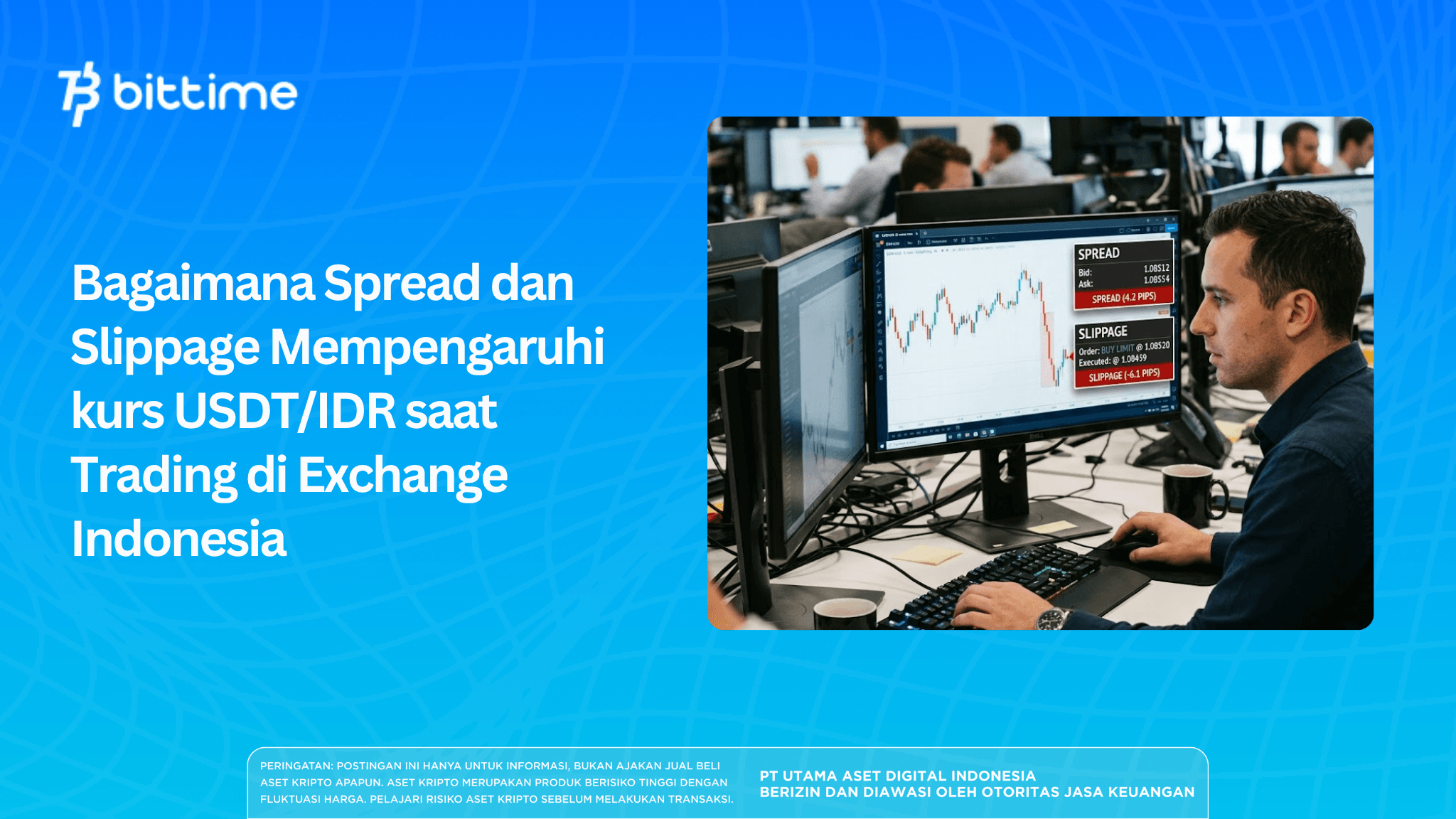
Traders focus on price without realizing the hidden costs that can impact their trading results. Two key factors that are often overlooked are spread and slippage.
Both of them have a big role in determiningUSDT/IDR rateon Indonesian exchanges, mainly due to the different liquidity conditions on each platform.
Understanding how spreads and slippage work is crucial for optimizing your trading strategy and avoiding unnecessary losses.
Key Points
- Spread and slippage are indirect costs that affect the buy and sell prices of USDT/IDR.
- Liquidity and trading volume greatly determine the size of the spread and slippage.
- The right trading strategy can help minimize the negative impact of both.

What Are Spreads and Slippage in Crypto Trading?
The spread is the difference between the buy (bid) and sell (ask) prices in the order book. For example, if the USDT/IDR bid price is 16,900 and the ask price is 16,950, the spread is 50 rupiah. This difference is the minimum cost you will incur when making a transaction.
The narrower the spread, the more efficient the market. A narrow spread usually indicates high liquidity and active trading activity.
Meanwhile, slippage is the difference between the price you expected when placing an order and the actual price when the order was executed.
This often happens when the market has low liquidity or when you place large orders.
Read Also:Buy and Sell & Trade USDT/IDR
The Relationship Between Liquidity and Spread and Slippage
Liquidity is a major factor influencing spreads and slippage. In highly liquid markets, order books are typically thicker, meaning there are many buy and sell orders at various price levels.
This condition results in:
- Narrower spread
- Smaller slippage
- More stable order execution
On the other hand, in markets with low liquidity:
- Spread tends to widen
- Slippage increases, especially for large orders
- Prices are more likely to move drastically
This is the reason why the USDT/IDR exchange rate can differ quite significantly between exchanges in Indonesia.
Read Also:Why USDT IDR Value Could Soar
How the USDT/IDR Exchange Rate Works on the Indonesian Exchange
The USDT/IDR exchange rate not only follows the US dollar exchange rate against the rupiah, but is also influenced by internal factors at each exchange.
Some of the main factors that shape this rate include:
- USD/IDR exchange rate in global markets
- USDT supply and demand within the platform
- Local user trading activity
For example, if many traders sell USDT to get rupiah, the price of USDT on that exchange could fall. Conversely, if demand increases, the price could rise.
Because each platform has different liquidity conditions, the USDT/IDR exchange rate can vary between exchanges.
Read Also:A Complete Guide to OTC USDT IDR Transactions on Bittime
The Influence of Trading Volume on the USDT/IDR Exchange Rate

Trading volume plays a crucial role in maintaining price stability. Exchanges with high volume typically have deeper and more liquid order books.
The impact:
- Tighter spreads
- Lower slippage
- Prices are more stable and closer to global market prices
Conversely, on low volume exchanges:
- Price movements are more sensitive
- Spread widens
- Slippage increases
This makes the USDT/IDR price on some platforms appear more expensive or cheaper than others.
Read Also:What is Slippage?
Difference between USD and IDR Market
In crypto trading, there are two main types of markets that are often used:
Market USDT:
- Using USDT as a trading pair
- High global liquidity
- Smaller spread
- Prices follow international markets
Market IDR:
- Using rupiah as a pair
- Influenced by domestic factors
- Lower liquidity compared to global markets
- Spreads and slippage tend to be larger
This distinction is important to understand, especially if you frequently move between local and global markets.
Read Also:Tether USDT Price Today | USDT/IDR Price
Hidden Costs When Trading Crypto in Indonesia
Many traders only pay attention to trading fees, even though there are other costs that are often invisible.
1. Spread as a direct cost
Spreads can range from 0.1% to 0.5% or more, depending on liquidity. The wider the spread, the more expensive your purchase price will be.
2. Slippage as an additional cost
Slippage often occurs when:
- The market is volatile
- Order in large quantities
- Using market orders
Under extreme conditions, slippage can reach 0.5% to 2% or more.
3. Fee trading (maker/taker)
These fees typically range from 0.05%–0.1% and will add to your total transaction costs.
Read Also:Guide on How to Buy USDT with IDR Balance in the App
Practical Tips to Minimize Spread and Slippage
To reduce the negative impact of spread and slippage, you can apply the following strategies:
- Use limit orders instead of market orders
- Choose an exchange with high trading volume
- Avoid trading during extreme volatility
- Break large orders into several smaller transactions
- Use the OTC feature if available for large transactions.
With the right strategy, you can save costs and get more optimal prices.
Register at Bittime
Before you start trading and applying the strategies above, make sure you are using a trusted platform with good liquidity.
One important step you can take is to register on the Bittime platform to get a more optimal and efficient trading experience.
Conclusion
Spread and slippage are two important factors that are often overlooked in crypto trading, even though they significantly affect the USDT/IDR exchange rate on Indonesian exchanges.
By understanding the relationship between liquidity, trading volume, and market structure, you can make smarter decisions.
Using strategies such as limit orders, choosing a platform with high liquidity, and understanding market conditions will help you minimize hidden costs and improve your overall trading results.
FAQ (Frequently Asked Questions)
- What is a spread in crypto trading? Spread is the difference between the buy price and the sell price in the order book which is the basic cost of the transaction.
- What causes slippage? Slippage occurs due to the difference between the desired price and the execution price due to low liquidity or large orders.
- Why is the USDT/IDR exchange rate different on each exchange? Due to differences in liquidity, trading volume, and supply and demand on each platform.
- How to reduce slippage? Use limit orders, avoid large market orders, and choose trading times with high liquidity.
- Is the spread included in the trading costs? Yes, the spread is an indirect cost that affects the buy and sell prices even though it is not visible as a fee.
How to Buy Crypto on Bittime?

Want to trade sell buy BitcoinLooking for easy crypto investing? Bittime is here to help! As an Indonesian crypto exchange regulated by the Financial Services Authority (OJK), Bittime ensures every transaction is secure and fast.
Start by registering and verifying your identity, then make a minimum deposit of IDR 10,000. After that, you can immediately purchase your favorite digital assets!
Check the course BTC to IDR, ETH to IDR, SOL to IDRand other crypto assets to find out today's crypto market trends in real-time on Bittime.
Additionally, visitBittime Blogto get various interesting updates and educational information about the world of crypto. Find trusted articles on Web3, blockchain technology, and digital asset investment tips designed to enrich your crypto knowledge.
Disclaimer: The views expressed belong exclusively to the author and do not reflect the views of this platform. This platform and its affiliates disclaim any responsibility for the accuracy or suitability of the information provided. It is for informational purposes only and not intended as financial or investment advice.

.png)


