SEC and CFTC Clarify Crypto Staking, Mining, and Airdrop Rules
2026-03-18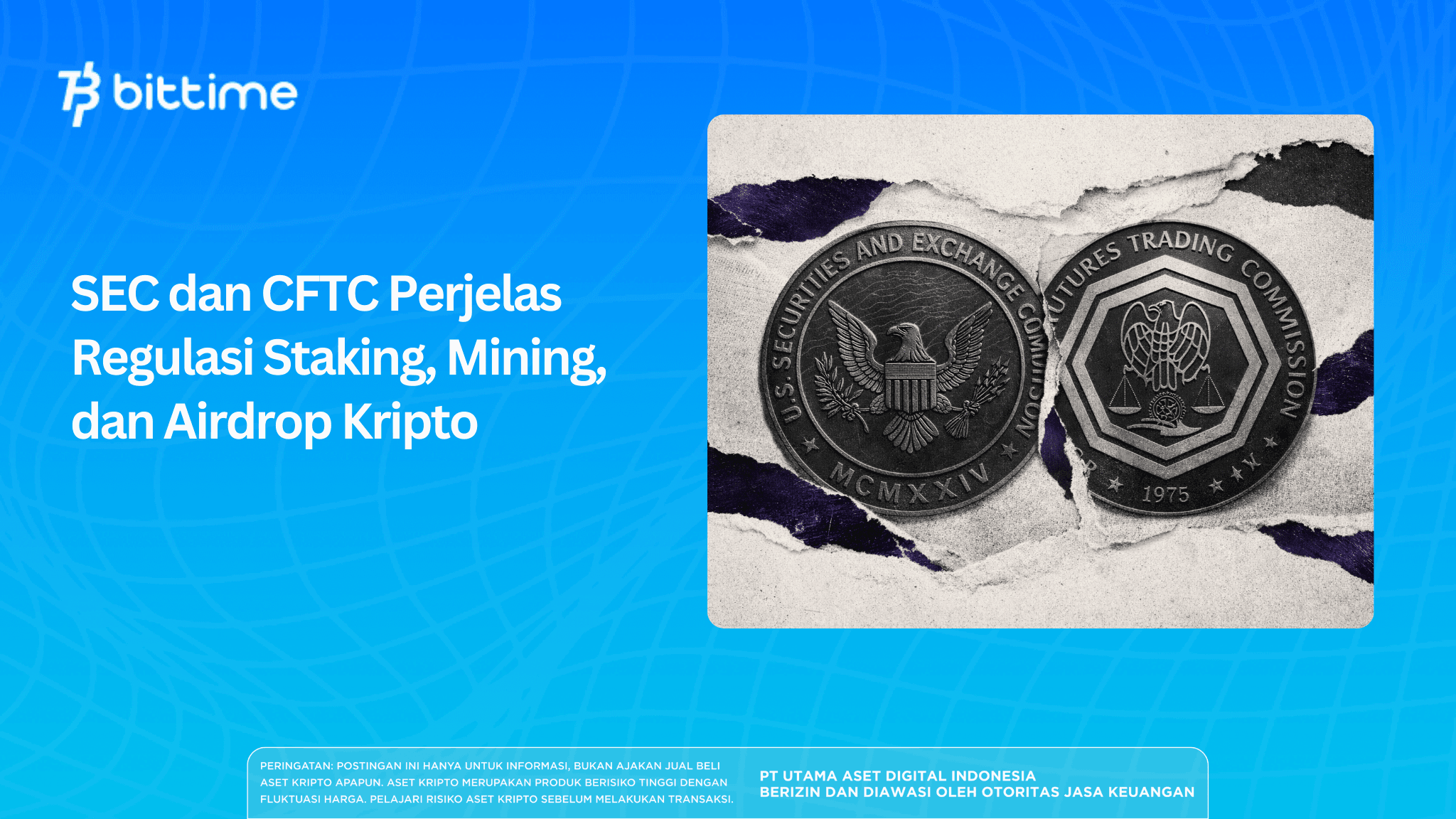
The US Securities and Exchange Commission, or SEC, together with the Commodity Futures Trading Commission, or CFTC, has begun providing more structured clarity on several crypto activities that have long existed in a broad area of interpretation.
The main focus includes staking, mining, airdrops, the wrapping of certain crypto assets, and the basic classification of various digital tokens. This development is important because the industry has faced substantial uncertainty for several years over the boundary between digital assets treated as securities and those that fall within the area of commodities.
For market participants, this shift carries strategic importance. Clearer regulation is not only about legal certainty, but also affects product design, platform governance, listing strategy, and compliance planning in the United States market.
With this new direction, discussions around crypto asset securities law become more concrete and no longer depend mainly on market assumptions.
Key Takeaways
- The SEC and CFTC are beginning to align their approach to crypto asset classification and its legal treatment in the United States.
- Certain forms of staking, mining, and airdrops are not automatically categorized as securities offerings, but still depend on structure and context.
- This clarification matters for exchanges, projects, and investors because it helps them assess legal risk more accurately.

Register at Bittime now and start trading crypto with a fast, safe, and easy process in the app.
Key Changes in the Direction of US Crypto Regulation
The most notable shift is the introduction of a more systematic explanation of digital asset types and their relationship to federal securities law. Until now, one of the biggest issues in US crypto regulation was the absence of boundaries that the market could easily understand.
Many industry participants were aware of legal risk, but did not always have a practical reference point to judge whether a token, a service, or an asset distribution fell under securities law or was more closely linked to commodity regulation.
Under the new framework, the SEC introduces a more organized classification approach for digital assets. This helps distinguish tokens that function as digital commodities, digital tools, digital collectibles, certain stablecoins, or digital securities.

An approach like this matters because it creates a more objective basis for analysis. Projects are no longer judged only by narrative, but also by function, distribution structure, and the economic relationship between the asset and its issuer or operator.
At the same time, the SEC also makes clear that non security crypto assets do not automatically remain outside the reach of capital markets law forever. If a token is offered in a way that creates an expectation of profit based on the managerial efforts of others, then the transaction may still be treated as an investment contract.
However, the latest guidance also leaves room for that condition to change. In other words, the legal status of an arrangement may evolve depending on the facts and its economic relationship over time.
The involvement of the CFTC strengthens this direction. For the market, the most valuable point is not only the interpretation itself, but also the signal of interagency coordination.
When the SEC and CFTC move with increasingly aligned frameworks, industry participants gain a better foundation for building internal policy, product structures, and compliance strategies. This is especially important in the context of US crypto regulation, which has often been viewed as fragmented.
Read also : Secret Service Teams Up With the UK and Canada to Crack Down on Crypto Fraud
What the New Rules Mean for Staking, Mining, and Airdrops
The part receiving the most public attention naturally concerns crypto staking, crypto mining, and airdrops. Over the past several years, these three activities have been at the center of debate because regulators, market participants, and legal observers often viewed them differently.
In the latest development, the SEC explains that certain protocol based staking and mining activities are not automatically considered securities offers and sales. Still, that conclusion depends on how the activity is carried out and the structure in which it is presented to the public.
In the context of staking, this clarification is especially important. As long as staking truly reflects a protocol function and the rewards come from the network mechanism itself, the activity is not automatically categorized as a securities offering.
However, if a staking service is packaged with promises of returns that rely heavily on centralized management, aggressive promotion, or specific business representations, the risk profile may change. This means regulation does not only look at the label being used, but also at the substance of the economic relationship.
A similar principle applies to crypto mining. Certain forms of protocol based mining are viewed differently from investment schemes that pool public funds with promised returns. In this framework, regulators appear to be distinguishing between network activity that is inherent to blockchain operations and fundraising activity that resembles an investment product.
For the industry, this kind of distinction is highly important because it can affect operational structures, the preparation of promotional materials, and expansion strategy.
For airdrops, the central focus is the investment element within the legal framework for securities analysis. If token recipients do not provide money, goods, services, or another form of consideration to the issuer, then certain airdrops may not automatically satisfy the core element of an investment of money.
Even so, this clarification does not mean all airdrops are entirely free from legal risk. Distribution structure, marketing purpose, and the connection to profit expectations still remain important factors for both projects and investors.
What Is Now Clearer
Here are several points that the market can now understand more easily:
- certain protocol activities are not automatically the same as securities offerings
- token classification is beginning to be explained with a more systematic approach
- staking and mining are assessed based on structure and function, not labels alone
- certain airdrops do not automatically satisfy the investment element in securities law analysis
- stronger SEC and CFTC coordination sends a signal of greater certainty for the industry
Read also : Tether Invests More Than $1.6 Billion, Juventus FC Included
The Impact on Industry, Exchanges, and Investors
The presence of clearer guidance has a direct impact on the digital asset business ecosystem in the United States. For crypto exchanges, a firmer regulatory direction helps with token review, listing risk assessment, and the development of internal compliance frameworks.
Exchanges no longer need to rely solely on defensive approaches, but can begin to build more precise policies based on asset type and transaction characteristics.
For project developers, the change is also significant. Many blockchain projects at an early stage face a dilemma between the need to build a community and the legal risk of offering tokens to the public.
With a clearer token taxonomy, development teams have a stronger basis for designing token launches, reward programs, staking mechanisms, and initial asset distributions. This can help reduce the risk of product structures that are problematic from the beginning.
Investors and retail users also benefit through better risk readability. In a vague regulatory climate, users tend to be in a weaker position because they must assess products without enough guidance.
With clearer rules, investors can more easily distinguish between technical network activity and schemes that are closer to fundraising based on profit promises. While this does not eliminate market risk, legal clarity helps improve the quality of decision making.
From a broader business perspective, this move also signals that US regulators are beginning to move toward harmonization, not simply separate enforcement. This matters because interagency uncertainty has been one of the largest barriers to crypto industry growth in the United States.
For companies operating across segments, from blockchain infrastructure to custody and trading services, this kind of interpretive stability is highly valuable.
Read also : Dogecoin and X Money: Is This the Start of a New Bull Run for DOGE?
What Still Needs Attention After This New Clarity
Although this development should be noted as progress, the market still needs to read it carefully. Regulatory clarity does not mean every issue has been resolved. In fact, the next phase will likely involve adjustments to business models, updates to legal documents, product reviews, and possibly new interpretations for specific cases that are not yet fully covered by the current guidance.
The first point to watch is that regulators still use a context based approach. This means terms such as staking, mining, or airdrop cannot be judged in general terms without looking at their actual structure.
Two services that both use the term staking could still be treated differently if their reward models, management roles, and methods of public promotion are different. This means industry participants cannot rely only on product labels to assess legal safety.
The second point is the possibility of further legislative change. Regulatory guidance helps provide direction in the short and medium term, but a truly comprehensive framework will still depend heavily on updated laws or broader market policy.
For that reason, crypto companies, institutional investors, and market participants still need to monitor legislative developments and the positions of other relevant agencies.
The third point is the need for stronger compliance readiness. The clearer the rules become, the less room there is for the industry to operate on assumptions.
This means crypto businesses in the United States will need to strengthen documentation, governance, disclosure structures, and risk mitigation systems. In that sense, regulatory clarity does not only create opportunity, but also raises the standard of discipline for the industry.
How to Buy Crypto on Bittime?

Want to trade sell buy Bitcoins and crypto investment easily? Bittime is here to help! As an Indonesian crypto exchange officially registered with Bappebti, Bittime ensures every transaction is safe and fast.
Start with registration and identity verification, then make a minimum deposit of IDR 10,000. After that, you can immediately buy your favorite digital assets!
Check the exchange rate BTC to IDR, ETH to IDR, SOL to IDR and other crypto assets to find out today's crypto market trends in real-time on Bittime.
Also, visit the Bittime Blog for interesting updates and educational information about the crypto world. Find reliable articles about Web3, blockchain technology, and digital asset investment tips designed to enrich your crypto knowledge.
Conclusion
The clarification provided by the SEC and CFTC marks an important phase in the development of crypto regulation in the United States. For the first time, the market is receiving a more structured explanation of how securities law and commodities law may apply to staking, mining, airdrops, and certain categories of digital assets.
This is not the final resolution to every debate, but it is clearly a step forward toward more measurable certainty.
For the industry, the central meaning lies in improved risk readability. Exchanges can develop more orderly listing policies, projects can design products on a clearer legal foundation, and investors can assess opportunities with better understanding. In business terms, clearer regulation does not always mean looser regulation, but it almost always means more manageable regulation. And for the digital asset market, that is a highly significant development.
FAQ
Does this mean all crypto staking is now legally safe?
No. This new clarity helps distinguish protocol based staking from arrangements that look more like investment products, but the service structure still matters.
Is crypto mining automatically outside securities law?
Not automatically. Certain forms of mining are viewed differently from investment offerings, but the assessment still depends on the operating model and how the activity is presented.
Are all airdrops now free from regulatory risk?
Not necessarily. Certain airdrops may fall outside the core investment element of securities law analysis, but the distribution context and economic purpose still matter.
Why is SEC and CFTC coordination important?
Because differences in approach between agencies have long created uncertainty. Stronger coordination helps the market understand regulatory boundaries more clearly.
What does this development mean for the crypto industry?
It means better certainty for product design, listing strategy, governance, and compliance planning, although market participants still need to stay alert to further changes.
Disclaimer: The views expressed belong exclusively to the author and do not reflect the views of this platform. This platform and its affiliates disclaim any responsibility for the accuracy or suitability of the information provided. It is for informational purposes only and not intended as financial or investment advice.

.png)