Scalping vs. Swing Trading in Futures: Which Is Best for Beginners?
2026-08-04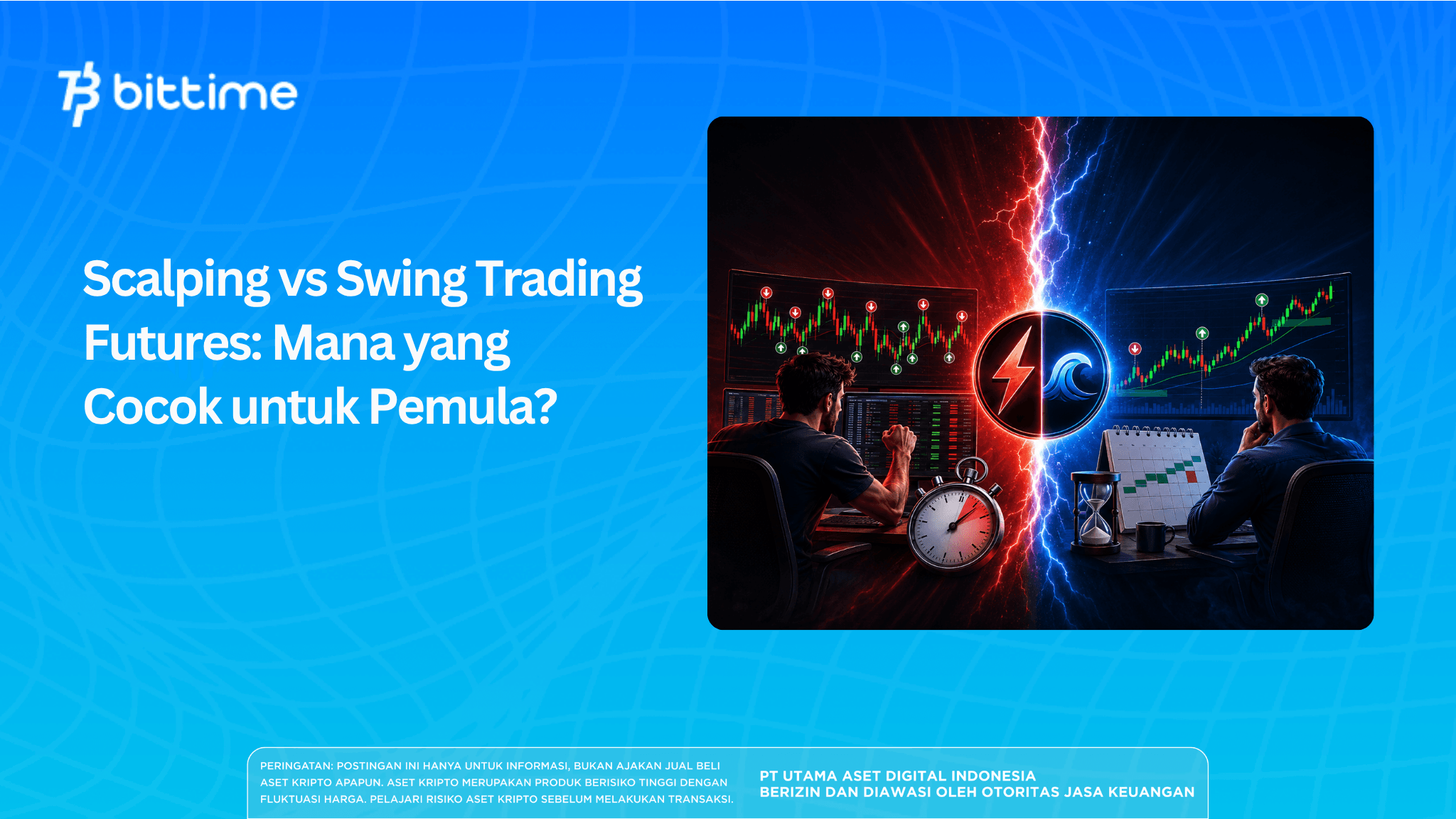
Scalping and swing futures trading are often compared by beginner traders seeking to profit from cryptocurrency price movements. Scalping offers fast trades with small targets, while swing trading attempts to capture longer price movements.
Both can use long positions, short positions, and leverage, so their profit potential is always accompanied by the risk of losses and liquidation.
Key Takeaways
- Scalping requires intense focus, rapid decision-making, and a higher trading frequency.
- Swing trading provides more time for analysis, but it carries overnight-position risk and funding costs.
- For most beginners, swing trading with low leverage is easier to learn than futures scalping.
What Are Scalping and Swing Trading in Futures?
Scalping and swing trading are not different types of contracts. They are trading styles that can be applied to futures contracts or perpetual futures.
Scalping focuses on price movements over very short periods. A scalper may open and close positions within seconds or several minutes. The profit target per trade is usually small, but traders attempt to accumulate gains through numerous trades.
Swing trading uses a longer time horizon. Positions may be held for several hours, days, or even weeks as long as the market structure remains consistent with the plan. Traders attempt to capture part of a broader trend or a larger price swing.
 Source: AI-generated image
In cryptocurrency futures, traders can open long positions when they expect prices to rise or short positions when they expect prices to fall. The use of margin allows traders to control positions worth more than the capital they deposit.
Leverage can amplify profits, but it can also accelerate losses. When the margin balance no longer meets the maintenance requirement, the platform may automatically close the position.
Also read: Perpetual Futures vs. Quarterly Futures: What Is the Difference?
How Does Futures Scalping Work?
Futures scalping attempts to take advantage of small price changes that occur repeatedly. Traders usually monitor low-time-frame charts, such as one-minute, three-minute, or five-minute charts.
Scalpers may look for momentum after a breakout, a bounce from support, rejection at resistance, or a shift in buying and selling pressure. Once a signal appears, a position is opened with a nearby target and a relatively tight stop-loss.
In a simple example, a trader opens a long position after the price breaks above short-term resistance. The position is closed a few minutes later when the price reaches a small target or falls back to the loss limit.
Scalping success is not determined solely by price direction. Traders must also account for:
- The spread between bid and ask prices.
- Transaction fees each time a position is opened and closed.
- Slippage when the market moves rapidly.
- The platform’s execution speed.
- The liquidity of the futures pair.
- Discipline in following stop-loss orders.
- The risk of making too many trades.
High trading frequency means that fees can significantly reduce returns. Scalping also demands full concentration because a delay of just a few seconds can change the outcome of a position.
This strategy may look simple because positions are held briefly. In practice, scalping requires the ability to read the market and make rapid decisions without being driven by emotion.
You can also register with Bittime to learn about futures features and monitor the latest cryptocurrency news before opening a position.
Make sure you understand how leverage, margin, funding rates, and liquidation work. Do not open futures contracts simply because you are following signals or trends on social media.
How Does Futures Swing Trading Work?
Futures swing trading seeks larger price movements with a lower trading frequency. Traders usually use four-hour or daily time frames, or a combination of several time frames.
The process begins by determining the direction of the trend. Traders then wait for the price to enter a support, resistance, breakout, or retracement area that fits the strategy.
A position does not have to be closed on the same day. As long as the market structure has not changed and the risk limit has not been reached, traders may hold it for longer.
This approach provides more time to:
- Examine the trend structure.
- Identify an entry area.
- Calculate the risk-to-reward ratio.
- Place a stop-loss rationally.
- Wait for confirmation.
- Evaluate news that could affect the market.
However, swing trading carries overnight-position risk. Prices may change sharply while the trader is not monitoring the market, especially when major news emerges or volatility spikes.
With perpetual contracts, positions held for longer periods may also receive or pay a funding rate. This mechanism helps keep the perpetual contract price close to the spot price.
Swing-trading stop-losses are generally wider than those used in scalping because positions need room to withstand normal fluctuations. Position size must therefore be adjusted so that potential losses remain controlled.
Also read: Margin Call in Crypto Futures? Take These Steps to Avoid Liquidation
What Is the Difference Between Scalping and Swing Trading in Futures?
The main differences between futures scalping and swing trading lie in position duration, trading frequency, price-movement targets, and the intensity of market monitoring.
Position duration
Scalping holds positions for a few seconds or minutes. Swing trading may hold positions for several hours or several days.
Trading frequency
Scalpers may execute many trades in a single session. Swing traders are generally more selective and only take a few positions when the market structure meets their criteria.
Profit target
Scalping targets small price movements. Swing trading targets larger moves, but it takes longer for those targets to be reached.
Monitoring intensity
Scalping requires nearly continuous attention throughout the session. Swing trading does not require second-by-second monitoring, although positions still need to be checked periodically.
Trading costs
Scalping generates more fees because entries and exits occur more frequently. Swing trading involves fewer transactions, but it may incur funding costs when perpetual positions are held across several funding periods.
Type of psychological pressure
Scalping creates pressure because decisions must be made quickly. Swing trading tests patience because traders must endure price fluctuations while positions remain open.
Stop-loss placement
Scalping tends to use a nearby stop-loss, so minor price noise may close the position. Swing trading allows more room for price movement, but the position size must be smaller to maintain the loss limit.
Also read: Long vs. Short Crypto Futures Strategies: When Should You Buy and Sell?
Which Is Riskier for Beginners?
Scalping usually presents greater operational risk for beginners. Traders must read charts, place orders, control leverage, and make decisions within a short period.
Small mistakes may occur repeatedly. After a loss, beginners are also vulnerable to revenge trading or opening new positions without a signal in an attempt to recover their capital.
Scalping is not automatically safer simply because its stop-loss is small. High trading frequency can cause accumulated losses, fees, and slippage to become substantial.
Swing trading provides more time to analyze the market. This makes it relatively easier to learn, but it does not mean the strategy is risk-free.
Swing positions face the risk of overnight price changes, sudden news, funding rates, and wider stop-losses. Excessive leverage can still cause liquidation even when the medium-term directional analysis is correct.
Short-term speculative trading becomes increasingly dangerous when combined with products that are not fully understood and high leverage. Beginners should only use risk capital, not money needed for essential expenses or emergency funds.
Also read: Strategies for Taking Profit in a Bearish Market with Crypto Futures
What Capital, Time, and Skills Are Required?
No amount of capital guarantees success in scalping or swing trading. Capital should be sufficient to withstand price fluctuations without encouraging traders to use excessive leverage.
Scalping requirements
Scalping is suitable for traders who can dedicate uninterrupted time to monitoring the market. Internet connectivity, order execution, and market liquidity are also extremely important.
Required skills include:
- Reading short-term price movements.
- Making decisions quickly.
- Executing stop-losses without hesitation.
- Avoiding overtrading.
- Calculating fees and slippage.
- Maintaining concentration throughout the session.
Scalping capital should provide enough room to absorb a series of small losses and transaction fees. Using the entire balance as margin can place the account under pressure very quickly.
Swing-trading requirements
Swing trading is more suitable for people who cannot watch charts throughout the day. Traders can conduct analysis at designated times, place orders, and then monitor positions periodically.
Required skills include:
- Reading trends and market structure.
- Identifying support and resistance.
- Waiting for high-quality setups.
- Calculating position size.
- Understanding the news calendar.
- Maintaining discipline while a position is open.
Because stop-losses tend to be wider, swing-trading position sizes need to be smaller. Traders should calculate risk based on the distance from entry to stop-loss, not on the maximum leverage offered by the platform.
Futures margin is only collateral for opening a position, not a safe measure of risk. The number of contracts should be determined from the loss scenario, not from the maximum position permitted by the platform.
Also read: The Difference Between Crypto Spot and Futures for Beginner Traders
Scalping or Swing Trading: Which Is Suitable for Beginners?
For most beginners, swing trading is easier to use as a starting point. This strategy provides time to analyze setups, calculate risk, and review decisions before entering the market.
Swing trading also reduces the urge to keep opening positions. Its lower frequency helps beginners focus on setup quality rather than chasing every price movement.
However, swing trading is only more beginner-friendly when it is implemented with:
- Low leverage.
- Small position sizes.
- A predetermined stop-loss.
- Consistent risk per trade.
- A limited number of open positions.
- A plan for major news events.
- An understanding of funding rates.
Scalping may be considered after traders have a tested system, can execute orders consistently, and understand the impact of transaction fees. Beginners should not choose scalping simply because they want faster results.
The best choice also depends on personal schedules and temperament. People who can maintain full focus, remain calm under pressure, and make decisions quickly may be more comfortable with scalping.
By contrast, people with a primary job who can only analyze the market a few times a day are generally better suited to swing trading.
Before using real money, practice through a simulated account. A simulator allows traders to test strategies with market data without risking capital.
Also read: Futures Open Interest: How to Read Market Trends and Sentiment
Conclusion
A comparison of scalping and swing trading in futures does not produce a single strategy that suits everyone. Scalping offers more frequent trading opportunities, but it requires intense focus, rapid decision-making, and strong emotional control.
Swing trading provides more time for analysis and a lower trading frequency. These characteristics make it relatively easier for beginners to learn, particularly those who cannot monitor charts throughout the day.
Nevertheless, swing trading still carries overnight-position risk, funding rates, sudden price changes, and liquidation. The strategy only becomes more manageable when traders use low leverage, reasonable position sizes, and a clear stop-loss.
Beginners should start with simulation, maintain a journal, and test one strategy consistently. Do not switch from swing trading to scalping simply because the first few trades do not generate a profit.
The initial objective is not to earn the largest possible profit, but to build a repeatable process. Once traders can manage risk and follow a plan, they can assess whether a faster style truly suits their skills and psychological condition.

Maximize your opportunities in both bull and bear markets with Bittime Futures. Sign up and start trading now!
Bittime is a licensed Digital Financial Asset Trader (PAKD) platform supervised by Indonesia’s Financial Services Authority— where you can buy Bitcoin in Indonesia and hundreds of other crypto assets starting from Rp10,000. Registration is fast and secure, and you can get started today.
Track the USDT-to-IDR conversion and real-time price movements of your favorite crypto assets. Everything is available in one crypto investment app that can be downloaded for free from the Play Store.
Ready to get started? Register with Bittime now and execute your investment strategy on a platform trusted by millions of users in Indonesia.
FAQ
Is Futures Scalping Suitable for Beginners?
Scalping is generally more difficult for beginners because it requires rapid decisions and a high trading frequency. This strategy should be practiced through a simulated account before real capital is used.
Is Futures Swing Trading Safer?
Swing trading is not automatically safe, but it provides more time for analysis. Overnight-position risk, funding rates, and liquidation still need to be managed.
How Long Is a Scalping Position Usually Open?
A scalping position may remain open for a few seconds to several minutes. The duration depends on volatility, the target, and the trader’s exit rules.
How Long Is a Swing-Trading Position Held?
A swing position may be held for several hours or several days. Traders generally close the position when the target is reached, the stop-loss is triggered, or the market structure changes.
What Leverage Is Suitable for Beginners?
No level of leverage is completely safe. Beginners should avoid high leverage, start at a low level, and determine position size according to the maximum loss they can afford.
Disclaimer: The views expressed belong exclusively to the author and do not reflect the views of this platform. This platform and its affiliates disclaim any responsibility for the accuracy or suitability of the information provided. It is for informational purposes only and not intended as financial or investment advice.

.png)