Crypto Enters Russian Banking: Sberbank Prepares ETH and USDT Loans
2026-09-01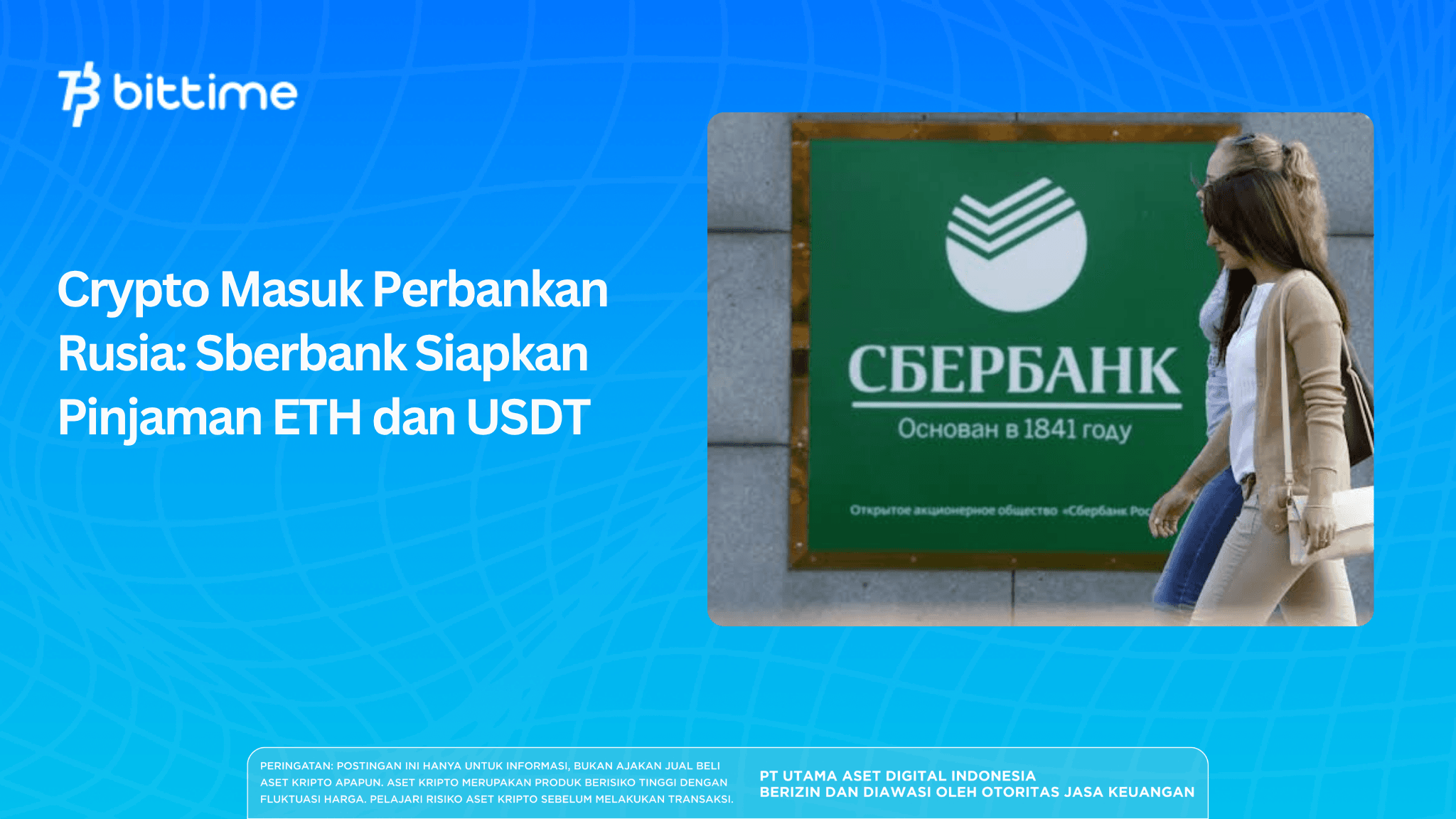
Russia's largest state-owned bank, Sberbank, is officially preparing a loan scheme backed by Ethereum (ETH) and USDT, following the enactment of Russian crypto regulation on September 1, 2026.
Sberbank Deputy Chairman of the Board Anatoly Popov revealed the plan to expand Sberbank ETH and USDT offerings to the state news agency TASS, while projecting that domestic crypto transaction volume could reach 4 trillion rubles, or about US$46.4 billion, in the first year of the new rules.
Previously, Sberbank's crypto-backed loan scheme only accepted Bitcoin. The expansion to ETH and USDT collateral follows the list of assets recently approved by the Central Bank of Russia for public trading, although the plan still hangs on one important condition: official approval from the regulator.
Key Takeaways
- Sberbank expands its crypto-backed loan scheme from Bitcoin to ETH and USDT, pending approval from the Central Bank of Russia.
- Russian crypto transaction volume is projected to reach 4 trillion rubles (~US$46.4 billion) in the first year, rising to 7.5 trillion rubles (~US$87 billion) by 2029.
- Only Bitcoin, Ethereum, and USDT made the Central Bank of Russia's official list of approved assets — XRP and other tokens were not cleared.
Sberbank Expands Loan Collateral to ETH and USDT
Popov explained to TASS that Sberbank plans to accept not only Bitcoin, but also Ethereum and the stablecoin Tether as loan collateral. He emphasized that this step can only materialise after the Central Bank of Russia (CBR) officially allows both assets to circulate publicly.
As of this writing, Sberbank has not disclosed the loan‑to‑value (LTV) ratio, interest rates, or the official launch date of this service. Everything still awaits the green light from the regulator.
This is not Sberbank's debut in crypto‑backed lending. In December 2025, the bank extended Russia's first Bitcoin‑backed loan to the mining company Intelion Data, with custody handled by the bank's own in‑house product — the loan amount was not disclosed publicly.
Read Also: Nvidia's $500 Billion AI Funding, AI Crypto Tokens Also Benefiting?
Two months later, in February 2026, Sberbank expressed its intention to expand this product to other crypto‑holding businesses, not just mining companies.
The business model makes sense amid Russia's key interest rate standing at 14%. For miners or crypto holders, selling their assets means losing out on potential future price gains. Using them as collateral for loans allows them to maintain exposure while gaining fresh liquidity.
If you are interested in exploring ETH and USDT trading yourself, the first step is to register an account at Bittime, a crypto exchange platform officially licensed by the Indonesian Financial Services Authority (OJK).
Sberbank Russia. Source: Russia Business Today
New Rules of the Game: Russian Crypto Regulation Effective September 1, 2026
Sberbank's plan coincides with a crucial milestone: the entry into force of Russia's crypto regulatory framework under Federal Law No. 282‑FZ "On Digital Currencies and Digital Rights". President Vladimir Putin signed the law on August 4, 2026, after it was passed by the State Duma on July 21 and the Federation Council on July 24.
Some key points of the rules that take effect on September 1, 2026, according to reports from Cointelegraph and KuCoin News:
- All legal crypto trading must go through exchanges licensed by the Central Bank of Russia; custody and record‑keeping are handled by digital depositories with capital of 50–250 million rubles.
- Non‑qualified retail investors must first pass a suitability test, with an annual purchase limit of 300,000 rubles (~US$3,700) per intermediary. Qualified investors are not subject to this limit.
- A ban on domestic payments using crypto remains in effect, except for cross‑border export‑import transactions, which must be reported and are subject to taxation.
- The full licensing deadline for exchanges, brokers, and non‑resident depositories falls on July 1, 2027, coinciding with the start of a 48‑hour transfer waiting period.
It is this framework that provides the legal basis for Sberbank to formally design crypto‑backed loan products, rather than just internal pilots like last year's Bitcoin trial.
Read Also: Tokenized Stocks vs Ordinary Shares: Understanding, Differences, and How to Buy
Why Only Bitcoin, Ethereum, and USDT Approved?
Approval for ETH and USDT is actually not final yet — everything depends on a single document: the draft list of assets released by the Central Bank of Russia on August 11, 2026. From the many tokens circulating on global markets, the regulator only cleared three names for retail investor trading: Bitcoin, Ethereum, and USDT.
The selection criteria are quite strict: market capitalisation, daily trading volume, and a track record of at least five years of price history on foreign exchanges. XRP, despite arguably meeting the liquidity requirements, was left out of the list.
Decrypt noted that XRP's history of legal disputes with the US regulator (SEC) — which led to the token being delisted and relisted on various global exchanges — is believed to be one of the contributing factors.
Read Also: 10 Free Bitcoin Mining and Faucet Sites for 2026, Which Ones Are Legit?
Additional Risks Behind USDT Collateral
There is one detail rarely discussed: including USDT as loan collateral carries additional risks not present with Bitcoin or Ethereum.
CoinDesk noted that Sberbank itself has been subject to full blocking sanctions from the United States since April 2022 and asset freezes by the European Union since July 2022 — a status that makes any involvement of this bank with dollar‑based stablecoins like USDT geopolitically more sensitive.
Popov himself openly stated that his transaction volume projections are conservative. Most Russian crypto transactions, he said, will continue to flow through informal exchangers outside official exchanges.
An analysis by TS2.tech, citing data from the Russian Ministry of Finance and SberCIB, estimates that only 3.5–4 trillion rubles will enter the official channel in the first year — about 19–22% of the estimated total Russian crypto activity of 18 trillion rubles per year.
In other words, legalisation on paper does not necessarily immediately shift the majority of transactions to the regulated track.
Read Also: 10+ Best AI Coins for 2026: This is the List of Artificial Intelligence‑Themed Crypto!
Conclusion
Sberbank's plan to accept ETH and USDT as loan collateral marks a further step in integrating crypto into Russia's banking system, in line with Russian crypto regulation that officially took effect on September 1, 2026.
However, its realisation still depends on approval from the Central Bank of Russia, and the bank's own projections indicate that the majority of domestic crypto transactions are likely to remain off the official radar in the near term.
Check the prices of Bitcoin (BTC), Ethereum (ETH), XRP, Solana (SOL), GRAM, and BNB as well as leading memecoins DOGE. You can trade directly on Bittime!
Bittime is a licensed Digital Financial Asset Trader (PAKD) platform supervised by the Financial Services Authority — where you can buy Bitcoin in Indonesia and hundreds of other crypto assets starting from Rp10,000. The registration process is fast, secure, and can be started today.
Monitor USDT to IDR conversion and the price movements of your favorite crypto assets in real‑time. All are available in one crypto investment app that can be downloaded for free on the Play Store.
Ready to start? Register now at Bittime and execute your investment strategy with a platform trusted by millions of users in Indonesia.
FAQ
When will Sberbank start accepting ETH and USDT as loan collateral?
There is no official date yet. The plan still awaits approval from the Central Bank of Russia to allow ETH and USDT to circulate publicly.
What is the Russian crypto regulation that takes effect on September 1, 2026?
Federal Law No. 282‑FZ, which regulates crypto trading, custody, and cross‑border payments in Russia. The rules still prohibit the use of crypto for domestic payments.
Why was XRP not included in Russia's official list of crypto assets?
The Central Bank of Russia only cleared Bitcoin, Ethereum, and USDT based on criteria of capitalisation, volume, and price track record. XRP's history of legal disputes with US regulators is believed to be one of the factors for its exclusion.
Are Russians free to pay with crypto?
No. The ban on domestic payments using crypto remains in effect, except for cross‑border export‑import transactions, which must be reported and taxed.
What is the projected volume of Russian crypto transactions in the first year?
Sberbank projects official Russian crypto transaction volume to reach 4 trillion rubles, or about US$46.4 billion, in the first year of the new rules.
Disclaimer: The views expressed belong exclusively to the author and do not reflect the views of this platform. This platform and its affiliates disclaim any responsibility for the accuracy or suitability of the information provided. It is for informational purposes only and not intended as financial or investment advice.

.png)