Why Did Circle (CRCL) Stock Drop Sharply After OpenUSD Launch?
2026-07-01
Circle Internet Group (CRCL) shares plunged nearly 15% on June 30, 2026, following the launch of OpenUSD (OUSD), a new stablecoin backed by over 140 major companies including Visa, Mastercard, BlackRock, Stripe, Google, and Coinbase.
OUSD threatens dominance USDC, Circle's flagship stablecoin, by offering a more attractive economic model for partners: revenue from stablecoin reserves is shared with partners, not just the issuer.
This is a major blow to Circle, which will generate 99% of its revenue in 2024 from USDC reserve yields.
This article explores why the launch of OUSD poses a serious threat to Circle and what the implications are for investors.
Key Takeaways
- Circle (CRCL) shares fell nearly 15% after OpenUSD (OUSD) launched.
- OUSD threatens Circle's USDC-based revenue model.
- Coinbase joined OUSD ahead of its contract renewal with Circle.
Register at Bittime now and start trading crypto with a fast, safe, and easy process in the app.
Why Did Circle (CRCL) Stock Drop Sharply After OpenUSD Launch?
Circle (CRCL) shares plunged nearly 15% following the launch of OpenUSD (OUSD), a new stablecoin backed by more than 140 corporate giants such as Visa, Mastercard, BlackRock, and Coinbase.
OUSD threatens Circle's business model because it allows partners to keep the revenue from stablecoin reserves, unlike USDC, where 99% of Circle's revenue comes from reserve returns.
Coinbase, which received $908 million from Circle in 2024 for USDC distribution, has now joined the OUSD consortium as the partnership contract expires in August 2026.
Read also: USDC Faucet: A Guide to Getting Free Circle Stablecoins
What is OpenUSD (OUSD)?
OpenUSD is a stablecoin pegged 1:1 to the US dollar, managed by Open Standard through an independent board of partners.
This token is designed to be an “open standard” that businesses and financial institutions can use for free, with no minting or redemption fees.
The main advantage of OUSD: partners who join the consortium are entitled to income from the yield of the reserves that support the token, after deducting a small fee.
Zach Abrams, former CEO of Bridge (a stablecoin company acquired by Stripe for $1.1 billion in 2025), is leading Open Standard as interim CEO.
Stripe itself immediately integrated OUSD as the default stablecoin for businesses running on its platform.
Read also: Bitcoin Monetization Program Strategy: Michael Saylor's New Strategy
Why is OUSD Threatening Circle?
Circle generates nearly all of its revenue (99%) from the yield on USDC reserves held in safe-haven instruments such as US Treasuries.
In 2024, Circle paid Coinbase $908 million in exchange for USDC distribution, making it Circle's largest partner.
With OUSD, partners like Coinbase, Visa, and Stripe can actually “cut out the middleman” and keep the revenue from their stablecoin reserves.
This is an existential threat to Circle's business model, as USDC loses its appeal to enterprise partners who now have more profitable alternatives.
Circle Stock (CRCL): Market Reaction
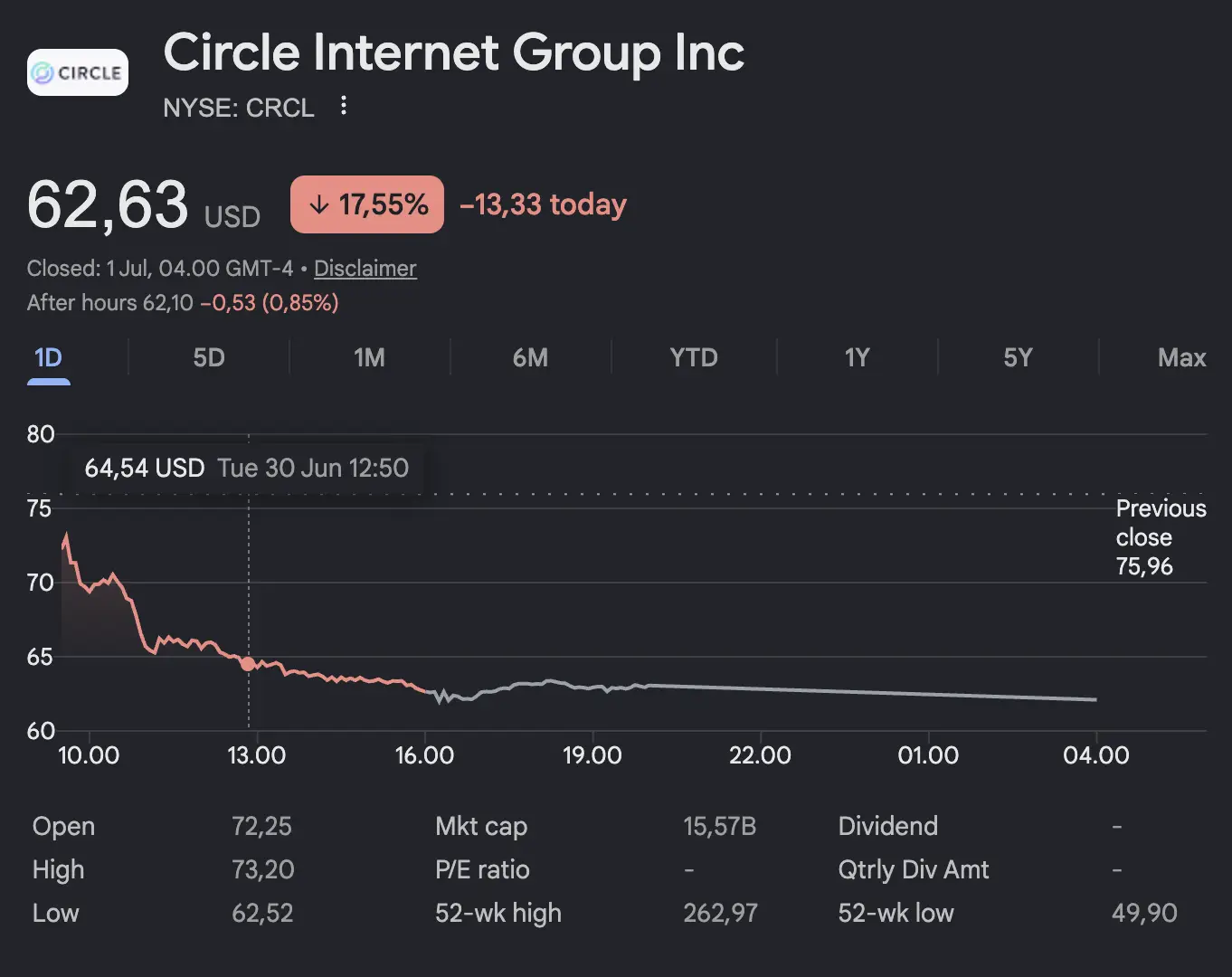
Source: Google Finance
CRCL shares fell nearly 15% on the day of OUSD's launch, hitting a session low.
This decline extends the bearish trend after Circle shares had rallied from $50 to $129 in the previous six weeks.
Analysts see this decline as a rational response to competitive threats.
Dragonfly Capital's Rob Hadick called OUSD's partner list a "real threat" to Circle's business.
Investors are concerned that OUSD could erode USDC's market share, which currently stands at $74 billion, and squeeze Circle's profit margins in the future.
OUSD Supporting Ecosystem
OpenUSD is backed by a cross-sector consortium that includes:
- Payment network: Visa, Mastercard, Stripe
- Financial institutions: BlackRock, BNY Mellon
- Technology companies: Google, Shopify
- Crypto platform: Coinbase
Many of these companies previously supported Facebook's Libra in 2019, but backed out under regulatory pressure.
This time, the main differences are a more decentralized approach and more mature regulatory compliance in the US and Europe.
OUSD will launch in late 2026 on Plasma and other blockchains specifically designed for stablecoin payments.
The presence of this infrastructure adds to the belief that OUSD is not just a speculative project.
Read also: Visa Ambil 90% On-Chain Card Payments
What is the future of Circle?
Circle still has a competitive advantage: USDC has robust regulation in the US and Europe, as well as deep liquidity across multiple global exchanges.
However, the pressure from OUSD comes at a critical moment: USDC's distribution agreement with Coinbase is up for renewal in August 2026, giving Coinbase an opportunity to shift its focus to OUSD.
Circle CEO Jeremy Allaire has not yet issued an official statement regarding the company's strategic response.
Meanwhile, Tether (USDT) with a market cap of $185 billion, and PayPal are not involved in the OUSD consortium, choosing to focus on their respective stablecoin ecosystems.
Read also: Bitcoin vs. AI: BlackRock and JPMorgan Have Different Outlooks for 2026
Conclusion
The launch of OpenUSD fundamentally changes the stablecoin landscape, threatening USDC's dominance and Circle's business model, which relies on reserve yields.
With the support of 140+ major companies, OUSD has the potential to become the new standard in enterprise digital payments.
For Circle, the biggest challenge is responding quickly to retain partners and market share.
CRCL investors should pay close attention to these developments, especially ahead of the contract extension with Coinbase in August 2026.
Want to own assets whose value tracks the U.S. dollar? Check the price movements of USDT, USDC, USD1, and USDS, then start trading your favorite stablecoins on Bittime.
Bittime is a licensed and regulated Digital Financial Asset Trader (PAKD) supervised by Indonesia’s Financial Services Authority (OJK) — where you can buy Bitcoin in Indonesia and hundreds of other crypto assets starting from just Rp10,000. The registration process is fast, secure, and you can get started today.
Track USDT to IDR conversions and monitor your favorite crypto assets in real time. Everything is available in one crypto investment app that you can download for free on the Play Store
Ready to start? Register now on Bittime and execute your investment strategy with a platform trusted by millions of users in Indonesia.
FAQ
What is OpenUSD (OUSD)?
OpenUSD is a stablecoin pegged 1:1 to the US dollar, managed by Open Standard and backed by over 140 companies including Visa, Mastercard, and Coinbase.
Why are Circle (CRCL) shares down?
Circle shares fell nearly 15% as OUSD offered an economic model that threatened Circle's primary revenue from USDC reserve yields.
Who are the OUSD supporters?
Visa, Mastercard, Stripe, BlackRock, Coinbase, Google, Shopify, BNY Mellon, and over 140 other companies.
What is the difference between OUSD and USDC?
OUSD shares revenue from reserve yields with partners, while USDC provides yields to Circle (99% of Circle's revenue comes from this).
When will OUSD launch?
OUSD is scheduled to launch in late 2026 on Plasma and other blockchains.
What is the current market cap of USDC?
USDC currently has a market cap of around $74 billion, below USDT ($185 billion).
Is Coinbase still partnered with Circle?
Coinbase is a USDC distribution partner and received $908 million from Circle in 2024. Their contract is up for renewal in August 2026.
Who is the leader of Open Standard?
Zach Abrams, former CEO of Bridge (acquired by Stripe for $1.1 billion), is leading Open Standard as interim CEO.
Is OUSD regulatory safe?
OUSD was built with regulatory compliance in the US and Europe in mind, with a board independent of the partners.
What are Circle's future prospects?
Circle faces significant pressure from OUSD, but still has regulatory and liquidity advantages. Circle's strategic response in the coming months will determine the company's future.
Disclaimer: The views expressed belong exclusively to the author and do not reflect the views of this platform. This platform and its affiliates disclaim any responsibility for the accuracy or suitability of the information provided. It is for informational purposes only and not intended as financial or investment advice.

.png)