MSCI Rebalancing May 29, 2026: Will the JCI Decline or Rebound? Here's the Analysis
2026-06-03
Today, Friday, May 29, 2026, the Indonesian stock market is a hot topic. The MSCI rebalancing is underway and will be completed after today's trading close.
The MSCI rebalancing is a routine adjustment of global stock indices conducted by Morgan Stanley Capital International.
Large passive funds follow this index, so changes in weighting or stock listings could significantly move volume on the JCI today. Many investors are asking whether IHSG will fall further today or is there a chance of a rebound?
Key Takeaways
- The MSCI rebalancing, effective after the close on May 29, 2026, triggered high volatility in the JCI today due to passive fund adjustments.
- Eighteen Indonesian stocks were removed from the MSCI index, including AMMN and BREN, which could put short-term price pressure on stocks.
- After the rebalancing is complete, many analysts see the potential for a JCI rebound in May 2026 due to anticipated selling pressure and a rotation into fundamentally sound stocks.
Register at Bittime now and start trading crypto with a fast, safe, and easy process in the app.
What Is MSCI Rebalancing and Why Is It Important for the JCI Today?
MSCI rebalancing is a routine, twice-yearly process in which MSCI reviews and changes the list and weightings of stocks in its indexes.
The goal is to ensure the index remains a good reflection of the market based on company size, liquidity, and free float. For Indonesia, this is particularly significant because many foreign funds participate in the MSCI Emerging Markets index.
Today, May 29, 2026, is the key date. Final adjustments will be made at market close, and the changes will take effect on June 1, 2026. Passive funds must adjust their portfolios accordingly.
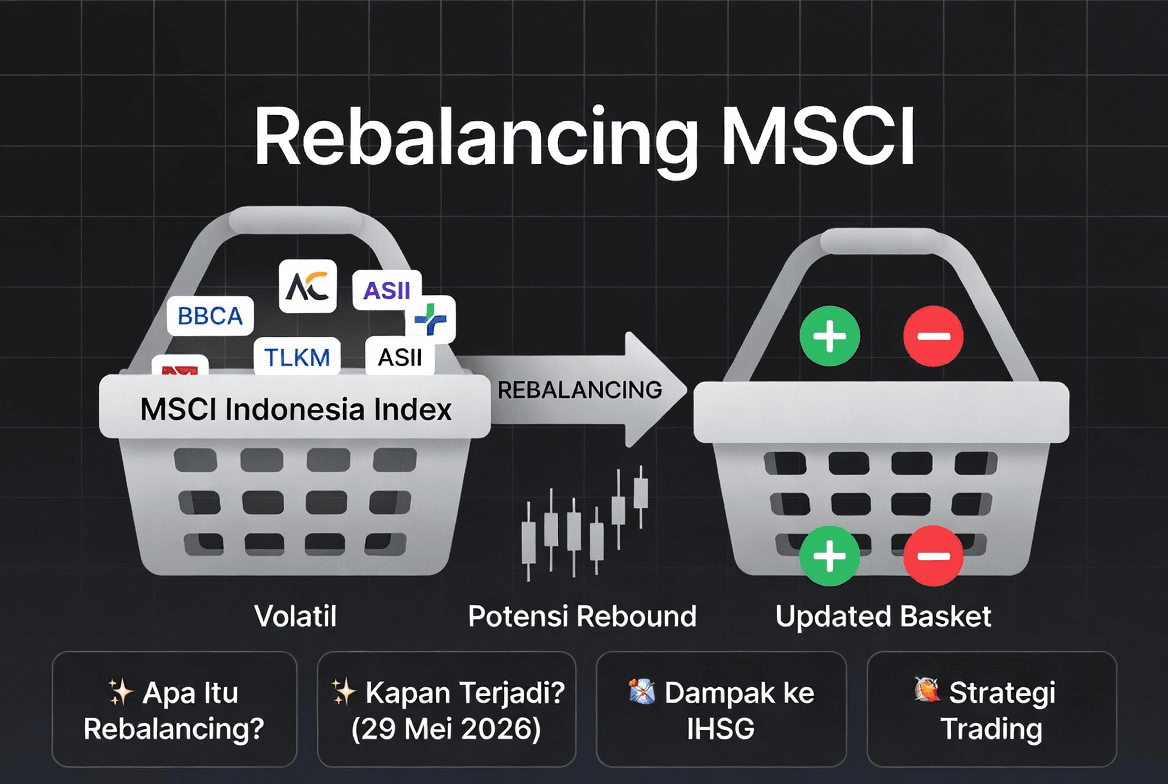
As a result, volatile MSCI rebalancing often occurs on dates like this. Trading volume can increase sharply, and the prices of stocks entering or leaving the index can move more strongly.
New to crypto investing? Bitcoin (BTC) and Ethereum (ETH) are among the most popular starter cryptocurrencies to explore and trade on Bittime.
In 2026, this rebalancing was somewhat different. MSCI did not add any new Indonesian stocks to the Global Standard Index. Instead, it removed eighteen stocks. This triggered an outflow of foreign funds as passive funds sold stocks no longer included in the index.
As of May 26, foreign net selling had reached Rp 45.45 trillion for the year. The JCI itself had fallen by around 29 percent year-to-date to around 6,130 points.
But remember, this rebalancing is more technical than fundamental. The stocks that are leaving aren't necessarily bad. Many of them have good prospects and attractive valuations. That's why some analysts say today's pressure could be an opportunity.
Once the adjustments are complete, capital flows can be rotated to stocks that remain in the index, such as large banks. Therefore, although the JCI may feel tense ahead of the MSCI rebalancing, the short-term aftermath often sees stabilization or a rebound.
Local investors are also becoming more active. Reforms to the Financial Services Authority (OJK) and the Indonesia Stock Exchange have helped increase transparency, reducing reliance on foreign funds. Nevertheless, today remains a day to be wary of.
Read also:SEC Investigation into TLKM: A Full Explanation
Stocks Affected by the MSCI May 2026 Rebalancing
This rebalancing has had a direct impact on several major stocks. Here's a complete list of what you need to know.
The shares issued from the MSCI Global Standard Index are six large issuers:
- AMMN (Amman Mineral)
- BREN (Barito Renewables Energy)
- TPIA (Chandra Asri Pacific)
- DSSA (Dian Swastatika Sentosa)
- CUAN (Petrindo Jaya Kreasi)
- AMRT (Alfaria Trijaya Source)
A total of eighteen stocks were removed, including the Small Cap Index. No new stocks were added. This increased the relative weight of the remaining stocks in the index.
After rebalancing, the ten stocks with the largest market cap on the Indonesia Stock Exchange are:
- BBCA (Rp729 trillion)
- BBRI (Rp. 461 trillion)
- DCII (Rp. 460 trillion)
- BMRI (Rp. 382 trillion)
- BREN (still on the list although partially out)
- AFTER
- SEA
- TLKM
- AMMN
- ASIA
Banking stocks like BBCA, BBRI, and BMRI are likely to see fund rotation. Their weightings have increased due to free float and improved governance. Meanwhile, energy and commodity stocks like AMMN and BREN could be under pressure due to their index exclusion.
Here's a simple list you can take note of:
- Stock out → potential selling pressure today.
- Stocks remain or increase in weight → potential for stability or increase.
This movement is technical. The company's fundamentals remain unchanged. Many analysts say the shares that were released now have attractive valuations.
Interested in getting started with crypto investing? Learn how to buy Bitcoin (BTC) or Ethereum (ETH), some of the most popular coins for beginners!
Read also:GameStop Offers $56 Billion to Acquire eBay
Today's JCI Prediction and Potential Rebound After Rebalancing
The JCI (Jakarta Composite Index) forecast for May 29, 2026, is likely to be volatile. Selling pressure could occur today as passive funds make final adjustments. The JCI today is likely to move in the range of 6,100 to 6,300 points, with fairly wide fluctuations.
But there's a positive side. Many analysts see the potential for a rebound in the JCI in May 2026 after this event concludes.
This is because selling pressure has been anticipated since the announcement last May. The market had already fallen quite significantly. Now could be the moment to bottom out, especially if Indonesia's economic fundamentals remain strong.
Another contributing factor: the rotation of funds into blue-chip stocks like BBCA, BBRI, BMRI, and TLKM.
These stocks carry a higher weighting, allowing funds leaving the dumped stocks to flow into them. Global sentiment and the rupiah exchange rate also played a role.
Let’s start trading crypto with the largest assets, such as BTC/IDR and ETH/IDR, right in the Bittime app.
Analysts from various securities companies say today's volatility is normal. There's no major market panic. After May 29th, pressure will ease, and the JCI could gradually rebound. However, there are no guarantees. The stock market always carries risks.
For today's JCI analysis, monitor trading volume and net foreign flow at the end of the session. If local net buying is strong, the chances of a rebound are greater.
Read also: AI agents are predicted to dominate in 2028.
Conclusion
The May 29, 2026, MSCI rebalancing has indeed caused volatility in the JCI. There is potential for very short-term downward pressure due to outflows from stocks leaving the index. However, many analysts see a potential rebound once the adjustment is complete. Stocks remaining in the index, such as banks, are likely to be the biggest winners.
The important thing is to look at the company's fundamentals, not just the index. Diversify your portfolio and avoid panic selling. This rebalancing is a normal part of the market. After today, the JCI can refocus on more fundamental domestic and global news.
We hope this analysis helps you make more informed decisions. Keep an eye on the JCI today, and happy trading!

For beginners, choosing a cryptocurrency with strong fundamentals and adoption can be a more comfortable first step toward starting to invest.
Bittime is a licensed and regulated Digital Financial Asset Trader (PAKD) supervised by Indonesia’s Financial Services Authority (OJK) — where you can buy Bitcoin in Indonesia and hundreds of other crypto assets starting from just Rp10,000. The registration process is fast, secure, and you can get started today.
Track USDT to IDR conversions and monitor your favorite crypto assets in real time. Everything is available in one crypto investment app that you can download for free on the Play Store
Ready to start? Register now on Bittime and execute your investment strategy with a platform trusted by millions of users in Indonesia.
FAQ
What is meant by MSCI IHSG rebalancing?
MSCI rebalancing is an adjustment of the list and weighting of stocks in the MSCI global index that affects passive funds and the movement of the JCI.
When is MSCI rebalancing effective?
Effective after the close of trading on May 29, 2026 and will take effect on June 1, 2026.
Which stocks are leaving the MSCI May 2026?
Six large stocks left the Global Standard Index: AMMN, BREN, TPIA, DSSA, CUAN, and AMRT. A total of 18 stocks are small caps.
Will the JCI fall today?
It could be volatile due to selling pressure, but there is potential for a rebound after rebalancing is completed as the pressure has been anticipated.
How do investors deal with this rebalancing strategy?
Monitor fundamentally sound stocks like BBCA and BBRI, diversify, and avoid panic selling amidst volatility.
Disclaimer: The views expressed belong exclusively to the author and do not reflect the views of this platform. This platform and its affiliates disclaim any responsibility for the accuracy or suitability of the information provided. It is for informational purposes only and not intended as financial or investment advice.

.png)