Trading Psychology: Recognize the Emotional Phases and How to Manage Them
2026-07-29
Bitcoin price suddenly dumping 10% within hours is not unusual in the crypto market. What separates traders who last long from those who are quickly eliminated is not how accurate their technical analysis is, but how stable their trading psychology is when facing such turbulence.
This article explores the emotional phases almost every trader goes through, complete with ways to control them before emotions control the decisions.
Key Takeaways
- Traders go through five recurring emotional phases — euphoria, fear, despair, hope, and peace — and each phase has its own psychological traps.
- Fear and greed are the two emotional forces that most often destroy a trading plan, especially when prices move quickly as in the crypto market.
- A trading journal, strict risk management, and discipline to the plan are the three most effective tools for keeping psychology stable.
What Is Trading Psychology and Why Is It Important?
Trading psychology is the ability to manage emotions and mindset when making buy and sell decisions in financial markets. Many traders spend time learning chart patterns and indicators, but neglect the factor that actually determines the final result more.
Brights by BRI Danareksa Sekuritas notes that around 70% of trading results are determined by mindset, not solely by the strategy used.
This figure makes sense when seeing how easily traders with good strategies still lose because they panic-sell at low prices, or greedily hold positions too long. In the crypto market, which moves far more volatile than stocks or forex, this psychological factor is even more decisive.
Come register on Bittime with a fast, secure, and easy process so you can trade and invest in crypto assets!
What Emotional Phases Do Traders Experience?
Every trader, from beginner to professional, tends to go through the same emotional cycle repeatedly. Recognizing these phases early helps traders not get stuck in them for too long.
- Euphoria — appears after several consecutive profits. Traders feel they are always right and start taking bigger risks than usual.
- Fear — appears after the first loss. Traders panic and often make hasty decisions to “save” the position.
- Despair — appears after a series of losses. Traders begin to doubt their entire ability and are prone to making emotional decisions.
- Hope — traders start trying again to recover previous losses, sometimes in a more aggressive way than usual.
- Peace — the most mature stage, where traders can already accept profit and loss as a normal part of the process, then make decisions calmly.
According to FOREXimf/QuickPro, this cycle can occur repeatedly throughout a trader’s career, not just once at the beginning of learning.
What distinguishes experienced traders is the ability to accelerate the transition from the hope phase to peace, rather than getting stuck for a long time in the fear or despair phase.
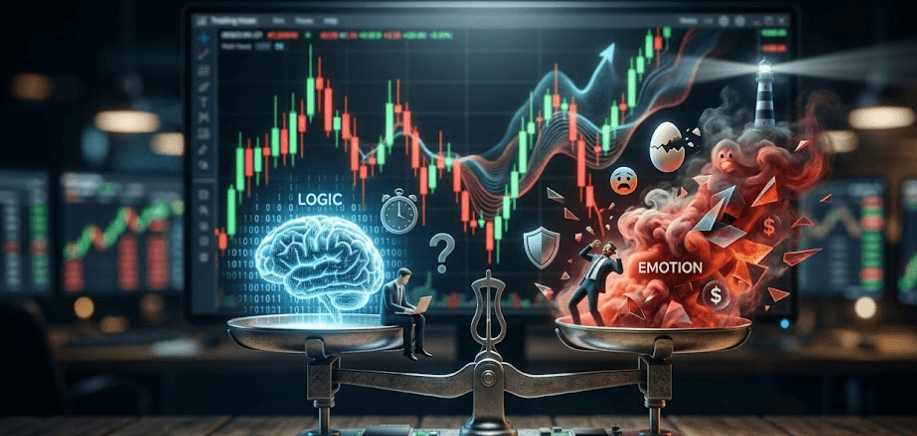
Illustration: Generated by AI
Read Also: 7 Reasons You Should Start Investing in Tokenized Stocks
How Do Fear and Greed Affect Trading Decisions?
Fear and greed are the two forces that drive most bad trading decisions. Fear makes traders sell at low prices out of panic, even though there is no strong analytical reason yet to exit the position.
Greed, on the other hand, makes traders hold positions too long because they hope for bigger profits, until the trend finally reverses.
In the crypto market, the combination of both is more pronounced because of rapid price movements and information that spreads through social media within minutes. One tweet or news item can trigger mass FOMO, followed by panic selling once sentiment reverses.
Traders who understand this pattern are usually calmer in facing volatility, because they know extreme movements are often triggered by collective emotions, not fundamental changes.
Read Also: How to Avoid Margin Calls in Futures Trading: 5 Risk Management Tips
What Psychological Mistakes Do Traders Often Make?
These flawed mindsets appear repeatedly among traders, both beginners and those who have been in the market for a long time:
- FOMO (Fear of Missing Out) — entering a position out of fear of missing a trend, without mature analysis.
- Overtrading — opening too many positions because of feeling overconfident after several profits.
- Revenge trading — retaliating against losses by entering a new position emotionally, usually with a larger size than usual.
- Anchoring bias — fixating on the initial purchase price, making it difficult to cut losses even when the signal is already clear.
- Confirmation bias — only seeking information that supports a decision already made, while ignoring contradictory data.
These five patterns are interconnected with the emotional phases discussed earlier. FOMO, for example, most often appears in the euphoria phase, while revenge trading is a concrete form of the hope phase going in the wrong direction.
Read Also: How to Trade Easily on Bittime!
How to Manage Emotions While Trading?
Managing emotions is not about eliminating fear or greed completely, because that is impossible. The goal is to ensure emotions do not become the main basis for decision-making. Some proven effective ways:
- Use a trading journal to record the reasons for entering a position, the results, and the subsequent evaluation. This habit trains awareness of one’s own emotional patterns.
- Perform mental simulation before opening a position — imagine the worst-case scenario and make sure you are ready to accept it before actually entering the market.
- Set rest times after experiencing consecutive losses, rather than immediately opening a new position to “retaliate.”
- Build personal routines such as exercise or short meditation to maintain focus and reduce daily stress.
Why Are a Trading Plan and Risk Management So Important?
A trading plan serves as a guardrail when emotions start to take over decisions. A clear plan — when to enter, when to exit, and the stop-loss limit — means traders do not need to improvise amid rapidly moving market pressure.
An inseparable part of the trading plan is risk management, particularly the rule of limiting maximum risk to 1–2% of capital on every transaction.
This simple rule prevents one emotional decision from destroying the entire portfolio, while also providing psychological space to stay calm even if one or two positions do not go according to plan.
For instruments with leverage such as crypto futures, discipline to this rule is far more crucial because potential losses can grow much faster than in regular spot trading.
Read Also: 30 Crypto Slang Terms You Must Know Before Playing Crypto
How to Build Discipline and a Healthy Trader Mindset?
Discipline is not an innate talent, but a habit built through repetition. Consistent traders usually have the following characteristics:
- Accepting losses as a normal part of the process, not a personal failure.
- Thinking in terms of probability — realizing no strategy is 100% accurate, so focusing on long-term consistency rather than the result of a single transaction.
- Applying emotional detachment, that is, not “falling in love” with a particular asset and being ready to exit the position as soon as an exit signal appears.
- Managing expectations realistically, understanding that consistent profits are built from small accumulations, not instant gains.
The combination of discipline and this mindset is what distinguishes traders who last for years from those who give up after the first few months of facing losses.
Read Also: Bittime Futures: Complete Guide to Crypto Derivatives Trading in Indonesia
Conclusion: How to Keep Trading Psychology Stable?
Stable trading psychology is built from awareness, not from avoiding emotions altogether. Recognizing the emotional phase currently being experienced — whether euphoria, fear, or already in the peace phase — helps traders take a pause before those emotions dictate decisions.
Combined with a clear trading plan, consistent risk management, and the habit of self-evaluation through a trading journal, a trader has a much greater chance of surviving and growing in a dynamic market like crypto.
Monitor US stock tokens: AMZON, AMDON, TSLAX, NFLXON MSFTON and many more, you can start trading on Bittime.
Bittime is a Digital Financial Asset Trader (PAKD) platform licensed and supervised by the Financial Services Authority — a place where you can buy Bitcoin in Indonesia and hundreds of other crypto assets starting from Rp10,000. Registration is fast, secure, and can be started today.
Monitor USDT to IDR conversion and the price movements of your favorite crypto assets in real time. Everything is available in one crypto investment app that can be downloaded for free on the Play Store.
Ready to start? Register now on Bittime and execute your investment strategy with a platform trusted by millions of users in Indonesia.
FAQ
What is trading psychology?
Trading psychology is the ability to manage emotions and mindset when making buy and sell decisions in financial markets. This factor often determines trading results more than technical strategy alone.
What emotional phases do traders experience?
Traders generally go through five phases: euphoria, fear, despair, hope, and peace. These phases can occur repeatedly throughout a person’s trading career.
How to overcome FOMO while trading?
Set a trading plan before opening a position and stick to that plan even when seeing a trend rising quickly. Remember that one missed opportunity will not destroy a long-term strategy.
Why is revenge trading dangerous?
Revenge trading drives traders to open large positions emotionally to retaliate against previous losses. This habit often enlarges losses instead of recovering them.
What is the ideal risk per trading transaction?
Most risk management practices recommend a maximum of 1–2% of capital per transaction. This rule helps keep the portfolio safe even if several transactions do not go according to plan.
Is trading psychology more important than technical strategy?
Both are equally important, but a good technical strategy can fail completely if the trader’s psychology is unstable. Discipline in executing the plan is often more decisive for results than the accuracy of analysis alone.
Disclaimer: The views expressed belong exclusively to the author and do not reflect the views of this platform. This platform and its affiliates disclaim any responsibility for the accuracy or suitability of the information provided. It is for informational purposes only and not intended as financial or investment advice.
.png)