Bitcoin Price Prediction for 2026: Bullish or Bearish?
2025-12-30
Bitcoin always has a unique way of stirring up the market. As we approach 2026, the most frequent topic of discussion is the direction of the next trend. Will Bitcoin continue to rise and reach new heights, or will it enter a major correction phase?
The safest answer is to look at several scenarios. Therefore, this article discusses Bitcoin price predictions for 2026 in a neutral, easy-to-read manner, while still including technical analysis to give you a clearer picture.

Bitcoin Price Prediction Map for 2026 According to Global Analysts: Bullish and Bearish Targets
After being compiled, Bitcoin predictions for 2026 usually fall into three main groups. The numbers vary, but the thinking is similar: some believe the uptrend is still strong, some predict the market will be flat, and some believe a sharp correction could occur if conditions change.

Here is a summary for easier understanding:
- Moderate bullish
- Price target: US$120,000 to US$170,000
- Main reasons: stable demand, healthy market, gradual increase
- Movement characteristics: slow rise, reasonable correction, then continues again
- Aggressive bullish
- Price target: US$180,000 to US$250,000
- Main reasons: demand is growing faster than supply, investor interest is expanding
- Characteristics of movement: strong breakout, many phases of rapid rally, high volatility
- Defensive bearish
- Target price: US$70,000 to US$56,000
- Main reasons: weakening demand, risk-off sentiment, pressure from the derivatives market
- Movement characteristics: breakdown support, rapid decline, slow recovery
If you ask “which one is the most accurate,” the answer depends on each prerequisite. Predictions are more useful when used as a map, not a single number. With this map, you can assess news, data, and price movements without being easily swayed.
Read also: Why Will Bitcoin Prices Fall in December 2025? These Are the Main Factors Pressuring BTC
Reasons for Bitcoin Bullishness and Bearishness in 2026: Upside and Downside Factors
To avoid getting caught up in numbers, we need to look at the underlying factors. In practice, bulls and bears often use repetitive arguments. Here is a summary.
Factors that typically make the market bullish
- Institutional demand
- Many are optimistic because institutions tend to have more stable allocations
- Institutional purchases typically don't exit quickly just because of daily volatility
- Tighter supply
- Bitcoin has a limited supply, and new supply is decreasing over time
- When supply is tighter, even small increases in demand can be felt in the price
- Improved global liquidity
- When global conditions favor risky assets, Bitcoin often gets a boost
- When the cost of money decreases, investors tend to be more willing to take risks
- Investment access is getting easier
- Easy access usually expands market participation
- The wider the participation, the greater the chance that the trend will continue
Factors that usually cause a bearish market
- Leverage and chain liquidity
- In crypto, high leverage can trigger a rapid decline when prices start to fall
- Automatic liquidations add to selling pressure and accelerate the decline
- Outflows
- When sentiment shifts, money can exit the market quickly
- If new buyers are scarce, selling pressure can more easily depress prices
- Global risk off
- When global markets fear risk, risky assets are usually affected
- Bitcoin is often treated as a risky asset in certain phases
- Regulatory and policy surprises
- Rule changes can hit sentiment even if fundamentals don't change much
- The effects are often felt in the short term through high volatility
Read also: Arthur Hayes' Bitcoin Price Prediction of USD 500K by 2026
Bittime: A Secure Crypto Trading Platform
If you choose to actively trade, focusing on account security is a must. Bittime can be an option for crypto transactions with strong account security features. If you want to start more neatly, create an account on Bittime, activate 2FA, and start transactions with a measured amount. These are simple steps, but they are very helpful in maintaining your assets and disciplined trading habits.
Read also: Bitcoin Price Prediction 2025–2030: Can BTC Reach $900K in 2030?
Bitcoin Technical Analysis 2026: Key Levels, Trend Signals, and How to Read Targets
Now we move on to the technical side. Technical analysis does not guarantee certainty, but it can help you read market direction in a more structured way. To keep it simple, focus on three things: major trends, important levels, and momentum indicators.
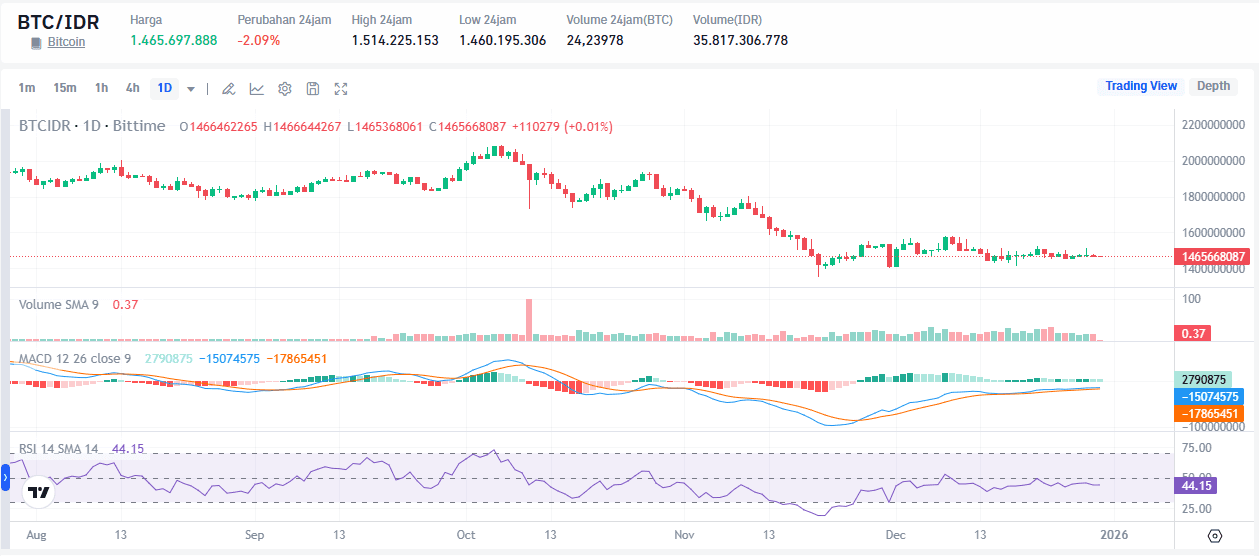
1. Reading major trends
- Long-term moving averages, especially the 200-day MA
- If the price is consistently above the 200 MA, the major trend is usually considered to be upward
- If the price falls and stays below it for a long time, the market often enters a weak phase
2. Monitoring psychological levels and support resistance structures
- Psychological levels
- Round numbers such as 100,000 or 150,000 are often areas of price reaction
- Many orders accumulate in these areas, so consolidation often occurs
- Support and resistance
- Support is an area where buyers usually start to become active
- Resistance is an area where sellers or profit-takers often appear
- The more often a level is tested, the more important it is to monitor
3. Use momentum indicators wisely
- RSI
- RSI helps read momentum, not determine a “definite reversal”
- In a strong trend, RSI can remain in a high or low area for a long time
- What to look for: signs of weakening momentum such as divergence
Read also: Bitcoin Halving: Explanation, Impact, and Prediction to Occur in 2028
4. Three technical scenarios that can be used as a roadmap for 2026
- Realistic scenario
- Target: 120,000 to 170,000
- Conditions: Uptrend remains intact, corrections are still healthy
- Technical signals: Price holds above the major trend, pullbacks do not damage the structure
- Aggressive Scenario
- Target: 180,000 to 250,000
- Conditions: Strong breakout and broad market participation
- Technical signals: Breakthrough of major resistance, successful retest, supportive volume
- Defensive Scenario
- Target: 70,000 to 56,000
- Conditions: risk-off sentiment dominant and high leverage pressure
- Technical signals: breakdown of support, repeated lower highs, increasing selling volume
With this format, the 2026 Bitcoin price target no longer feels like a guess. You can place price movements into the most suitable scenario based on the visible signals.
Conclusion
Bitcoin price predictions for 2026 are divided between bullish and bearish camps, with a wide range of targets. Broadly speaking:
- The bullish scenario places targets at 120,000 to 250,000
- The bearish scenario places targets at 70,000 to 56,000
The safest way to interpret predictions is to use a scenario-based approach, then test it with technical analysis. Monitor major trends, watch for support and resistance levels, and do not overlook liquidity factors and leverage risks. Bitcoin can offer significant opportunities, but it always demands discipline.
How to Buy Crypto on Bittime

Want to trade sell buy Bitcoins and crypto investment easily? Bittime is here to help! As an Indonesian crypto exchange officially registered with Bappebti, Bittime ensures every transaction is safe and fast.
Start with registration and identity verification, then make a minimum deposit of IDR 10,000. After that, you can immediately buy your favorite digital assets!
Check the exchange rate BTC to IDR, ETH to IDR, SOL to IDR and other crypto assets to find out today's crypto market trends in real-time on Bittime.
Also, visit the Bittime Blog for interesting updates and educational information about the crypto world. Find reliable articles about Web3, blockchain technology, and digital asset investment tips designed to enrich your crypto knowledge.
FAQ
What are the commonly cited Bitcoin price targets for 2026?
Generally, it ranges from 120,000 to 250,000 for a bullish scenario, and 70,000 to 56,000 for a bearish scenario.
What are the biggest factors driving Bitcoin bullishness in 2026?
Institutional demand, tight supply, and supportive global liquidity.
Why could Bitcoin be bearish in 2026?
Global risk-off sentiment, leverage pressure, capital outflows, and regulatory surprises.
What are the easiest technical indicators to use?
The 200-day moving average (MA) for major trends, support and resistance levels for key price points, and the Relative Strength Index (RSI) to gauge momentum.
Can price predictions be used as a definitive benchmark?
No. It is safer to use them as scenarios, then test them against technical data and market conditions.
Disclaimer: The views expressed belong exclusively to the author and do not reflect the views of this platform. This platform and its affiliates disclaim any responsibility for the accuracy or suitability of the information provided. It is for informational purposes only and not intended as financial or investment advice.

.png)