Otter AI: When a Productivity Tool Turns Into a Privacy Problem
2026-08-18
On August 13, 2026, the California District Court handed down a ruling that could change the way millions of people use Otter AI in their daily work meetings. The judge declared Otter.ai as a third party that wiretaps its own users' conversations, not just a meeting note‑taking assistant as it has long been promoted.
This ruling answers the question that more and more people have been searching for lately: is Otter AI safe to use, or does it actually carry a greater risk of Otter AI privacy violations than many suspect?
Key Takeaways:
- The California court ruled that Otter.ai is a third‑party wiretapper, not merely a recording tool of the meeting host, because it uses recordings to train its own AI models.
- Most of the claims survived the motion to dismiss: CIPA, ECPA, BIPA, unjust enrichment, and UCL claims proceed, while CFAA, CDAFA, and Washington Privacy Act claims were dismissed.
- This case is the first federal legal test on whether an AI notetaker can be classified as a wiretapper, and it could change how all AI meeting assistant vendors operate going forward.
What Is Otter AI and How Does It Work?

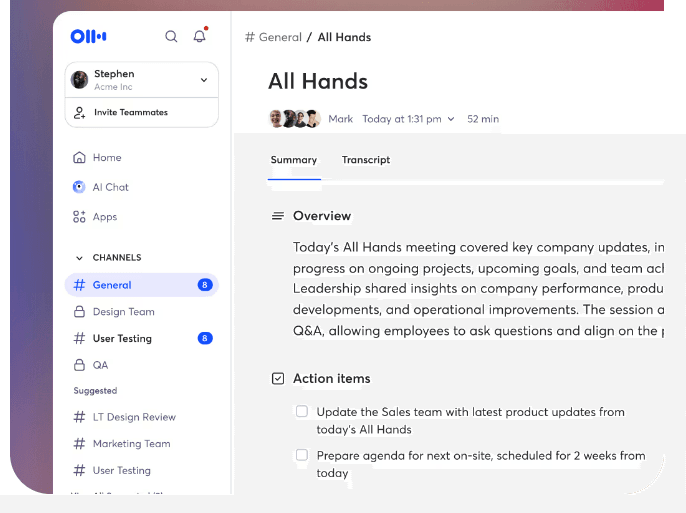
Otter AI is an artificial intelligence‑based meeting assistant that positions itself as a "Conversational Knowledge Engine." Through its flagship feature, OtterPilot, Otter automatically joins Zoom, Google Meet, or Microsoft Teams meetings based on calendar synchronization, then records and transcribes conversations in real time.
The meeting results are turned into automatic summaries, action items, and insights accessible through integrations with Slack, Notion, Salesforce, and even MCP Server connecting it to Claude and ChatGPT. Large companies like Amazon, IBM, and Mastercard are recorded as using this service for team efficiency.
The problem is that this convenience has a price that has only now been revealed through legal channels. If you care about where your personal data ends up and who controls it, the same principle is important when choosing a platform to store and manage your digital assets — make sure the platform is transparent and officially supervised, such as Bittime, which is registered and supervised by OJK.
Chronology of the Otter AI Privacy Lawsuit
The case originated from a lawsuit filed by Justin Brewer, a California resident, who brought a class action against Otter.ai on August 15, 2025.
Several similar lawsuits followed, and on October 22, 2025, they were all consolidated into a single case called In re Otter.AI Priv. Litig. in the U.S. District Court for the Northern District of California, presided over by Judge Eumi K. Lee.
A total of seven plaintiffs from California, Illinois, and Washington accused Otter of recording their conversations — including medical consultations, discussions with financial professionals, and confidential business meetings — without the consent of all parties involved.
The lawsuit alleges that Otter stored those recordings, including voiceprints, to train its own speech recognition models.
Otter filed a motion to dismiss to have the case thrown out. The argument hearing took place on May 20, 2026, and the judge's decision was handed down on August 13, 2026 — just a few days before this article was written.
Also Read: Nvidia's $500 Billion AI Funding, AI Crypto Tokens Also Benefiting?
Court Ruling: Otter AI Declared a Third‑Party Wiretapper
The judge granted in part and denied in part Otter's request to dismiss the lawsuit. There are three crucial points in this ruling.
First, regarding Otter's status in the meeting. Otter argued that it merely functions as an extension of the meeting host, similar to the protection previously granted in the Graham v. Noom case.
Source: Otter
The judge rejected this argument because Otter does not merely transcribe and hand over the results — the company stores and uses the recordings for its own commercial benefit. That status is what led the court to declare Otter a third‑party wiretapper under CIPA Section 631.
Second, regarding evidence of the confidentiality of the communication. The plaintiff named Theus, who mentioned specific details — a conversation with a doctor about personal medical information — successfully substantiated their claim. In contrast, other plaintiffs who merely described their conversations as "private" or "sensitive" without further detail had their claims dismissed for being too general.
Also Read: 10 Free Bitcoin Mining and Faucet Sites in 2026: Which Ones Are Legit?
Third, regarding Otter's defense under the ECPA. Otter argued that its purpose was purely commercial, so it falls under a legal exception.
The court flatly rejected this argument with the firm statement that "committing a tort and seeking a profit are not mutually exclusive" — committing a legal violation and seeking profit are not mutually exclusive, according to the National Law Review.
The BIPA claim regarding voiceprints as biometric data also proceeds, while claims under the CFAA and CDAFA were dismissed because the plaintiffs could not prove concrete damages as defined by those statutes.
Also Read: 10+ Best AI Coins 2026: List of Artificial Intelligence Themed Crypto!
Conclusion
This ruling is the first federal legal test questioning the status of AI notetakers: is it merely a tool, or is it actually an independent party that can be considered to be wiretapping its users' conversations? For Otter AI, the court's answer is now clear — and this could set a precedent for other AI meeting assistant vendors with similar business models.
If you regularly use AI notetakers for work meetings, the safest step is to ensure all participants are aware of and agree to the recording, and to read the vendor's data policy regarding the use of recordings for AI model training.
After learning about the developments in AI, now is the time to find out about AI‑based crypto at Bittime such as digital assets AI, AGI, RENDER, TAO, VVV, and many more AI coins.

Bittime is a licensed Digital Financial Asset Trader (PAKD) platform supervised by the Financial Services Authority — where you can buy Bitcoin in Indonesia and hundreds of other crypto assets starting from Rp10,000. The registration process is fast, secure, and can be started today.
Track USDT to IDR conversion and the price movements of your favorite crypto assets in real time. All available in one crypto investment app that can be downloaded for free on the Play Store.
Ready to start? Register now at Bittime and execute your investment strategy with a platform trusted by millions of users in Indonesia.
FAQ
What is Otter AI?
Otter AI is an AI‑based meeting assistant that automatically records, transcribes, and summarizes conversations on platforms such as Zoom, Google Meet, and Microsoft Teams.
Why is Otter AI being sued?
Otter is being sued for allegedly recording conversations without the consent of all meeting participants and for using those recordings to train its own AI models.
Is Otter AI safe to use?
Based on the August 2026 court ruling, Otter's recording practices risk violating wiretap laws in states with two‑party consent rules such as California, so users are advised to ensure explicit consent from all participants.
What was the court's ruling on Otter AI?
The court denied most of the motion to dismiss and declared Otter a third‑party wiretapper, allowing CIPA, ECPA, and BIPA claims to proceed to the next stage.
How can I protect my privacy when using AI notetakers?
Make sure to obtain explicit consent from all meeting participants before recording, and review the vendor's policy regarding the use of data for AI model training.
Disclaimer: The views expressed belong exclusively to the author and do not reflect the views of this platform. This platform and its affiliates disclaim any responsibility for the accuracy or suitability of the information provided. It is for informational purposes only and not intended as financial or investment advice.

.png)