MSCI Maintains Indonesia as an Emerging Market
2026-08-13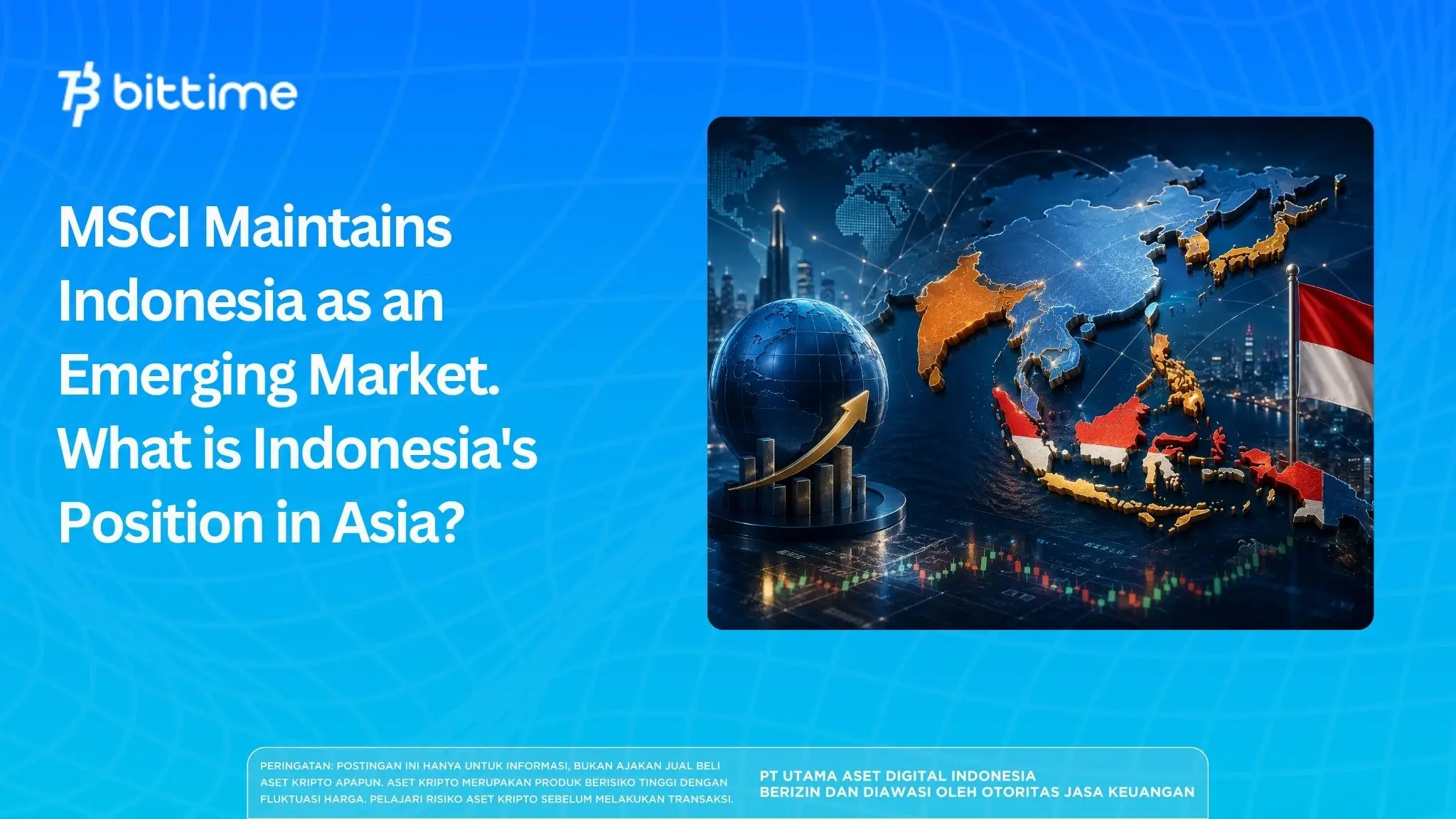
MSCI again maintains Indonesia in its ranking group Emerging Market in 2026.This decision is important because the MSCI market classification is one of the main references for global institutional investors in determining investment exposure to various countries.
In a regional context,Indonesia Emerging Market is in the same group with some of Asia's major stock market powerhouses. The MSCI Emerging Markets Asia index includes China, India, Indonesia, South Korea, Malaysia, the Philippines, Taiwan, and Thailand.
However, maintaining this status does not mean Indonesia is free from its homework. MSCI still maintains a number of restrictions on Indonesian stocks, thus keeping Indonesia's position among the day emerging Asian markets need to look further than just a label Emerging Market.
Key Takeaways
MSCI continues to classify Indonesia as an Emerging Market and has not changed the list of Emerging Market countries following the latest review.
Indonesia is ranked alongside China, India, South Korea, Malaysia, the Philippines, Taiwan, and Thailand in the MSCI Emerging Markets Asia group.
Indonesia's status remains intact, but issues of transparency, market accessibility, free float, and reform implementation remain key concerns for MSCI.
MSCI: Indonesia Remains an Emerging Market
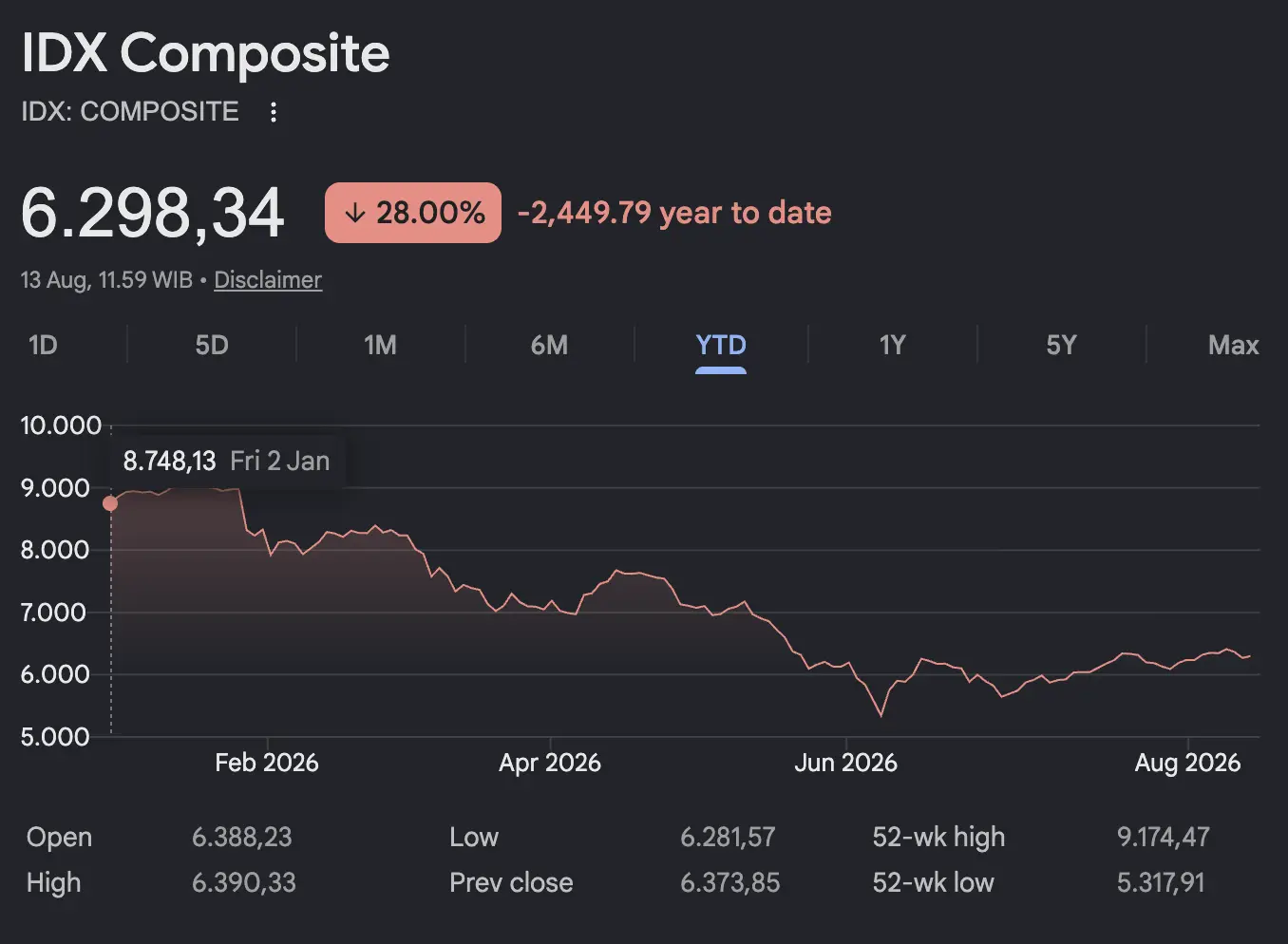
IDX August 13, 13:00 | Source: Google Finance
The results of the latest review confirmMSCI Indonesiaremains in the Emerging classification Market. There are no changes to the list of Emerging Market countries included in the MSCI Frontier Emerging Markets Index based on the review.
In simple terms, an Emerging Market describes a market that already has a certain size, liquidity, and level of accessibility for international investors, but is not yet categorized as a Developed Market.
Therefore, the statusIndonesia is a developing market has strategic significance. Indonesia remains on the radar of investors who use the Emerging Markets index as a portfolio benchmark.
MSCI itself conducts periodic market classification assessments. The process takes into account not only the size of a country's economy, but also the size and liquidity of its market and its accessibility to global investors.
Read Also: GIAA Shares Rise Sharply, Still Attractive?
How Does Indonesia Stand Among Asia's Emerging Markets?
In MSCI Asia, Indonesia is not the only country with Emerging Market status. The MSCI Emerging Markets Asia Index covers eight markets: China, India, Indonesia, South Korea, Malaysia, the Philippines, Taiwan, and Thailand.
This group shows that the competition for global capital is fierce.
Taiwan, China, South Korea, and India have a very large representation in the Emerging Markets Asia index, while Southeast Asian countries such as Indonesia, Malaysia, Thailand, and the Philippines have a more limited portion.
This means that Emerging Market status alone does not automatically make Indonesia a primary destination for capital flows.
Stock attractiveness, investable capitalization, liquidity, free float, transparency, and ease of access for foreign investors remain determining factors.
Want to gain exposure to US shares? Sign up to Bittime and start investing via tokenised stocks.
How Big is the MSCI Indonesia Market?
MSCI Indonesia Index designed to represent the capitalization stock segment large and medium in the Indonesian market.
MSCI data as of June 30, 2026, shows the index is heavily concentrated in a few large companies.
Bank Central Asia has a weighting of 28.89%, followed by Bank Rakyat Indonesia 17.47%, Bank Mandiri 15.18%, and Telkom Indonesia 11.06%.
With this composition, just four companies accounted for the majority of MSCI Indonesia's weighting at the time the data was recorded.
The dominance of the financial sector is also an important characteristic of the Indonesian market.
This condition is different from some big players.Emerging Markets Asia Pacific such as Taiwan and KoreaSouth which has strong exposure to the technology sector.
Read Also:7 Best Investments of 2026 Worth Considering Now
Safe Status, but Indonesia Still Facing a “Freeze”
There is an important difference between maintaining Emerging Market classification and gaining complete freedom in the MSCI indexing process.
In its July 2026 announcement, MSCI stated that it was maintaining a number of measures against Indonesian securities.
MSCI is freezing increases in the Foreign Inclusion Factor (FIF) and Number of Shares (NOS), not implementing the addition of shares to the MSCI Investable Market Indexes, and not implementing upward migrations between size segments until further notice.
The issue relates to concerns about share ownership transparency and market accessibility.
MSCI previously granted additional time to review the implementation of Indonesia's reforms, including steps to improve transparency and the free float structure.
Thus, maintaining MSCI market classification is not the finish line.
Indonesia still needs to improve market quality to be able to compete more strongly with emerging market countries in Asia.
Read Also:MSCI Announcement August 13, 2026: What Impact Will It Have on Indonesian Stocks?
MSCI August 2026 Rebalancing Still Brings Change
The country's unchanged status also does not mean that the composition of Indonesian shares in the index will always be the same.
In the August review, a number of Indonesian stocks experienced changes.
GOTO was removed from the MSCI Global Standard Indexes, while CPIN was moved to the MSCI Global Small Cap Indexes.
Nine other stocks were also removed from the MSCI Global Small Cap Indexes. The changes took effect after the close of trading on August 31, 2026, and became effective on September 1, 2026.
The case demonstrates two layers of MSCI decisions that investors need to distinguish: classification of a country and eligibility of each stock to be included in the index.
Indonesia could retain its Emerging Market status, while certain stocks would still experience a downgrade or be removed from the index due to technical and investability criteria.
Read Also: MSCI Stocks: Definition, How They Work, and Their Impact on the Indonesian Stock Market
Why is Emerging Market Status Important for Indonesia?
The MSCI index is widely used as a benchmark by international fund managers.
Changes in weightings and classifications have the potential to influence the decisions of investors who follow the index passively or actively.
Reuters previously reported that the MSCI Emerging Markets Index is a benchmark for trillions of dollars in assets.
Therefore, changes to Indonesia's position can affect risk perceptions and potential foreign capital flows.
Indonesia's continued status as an emerging market at least protects the market from the direct consequences of a downgrade to a frontier market.
However, for investors, MSCI's decisions should not be read as automatic signals to buy or sell stocks.
Issuer fundamentals, valuation, liquidity, macroeconomic conditions, exchange rates, and global risks still need to be analyzed separately.
Read Also: What is the MSCI Emerging Market Index and why is Indonesia's status a focus for investors?
Indonesia's Position in the MSCI APAC Index: Survival Is Not Enough
In the areaMSCI APAC, Indonesia has large capital in the form of economic scale and a trading base domestic investors.
The challenge is to translate this scale into a capital market that is increasingly liquid, transparent, and accessible, and has a wider range of quality stocks with adequate free float.
Competition in Asia is also constantly evolving. China, India, Taiwan, and South Korea dominate much of Asia's emerging markets exposure, so Indonesia needs to improve its investability if it wants to attract greater attention from international investors.
Therefore, the success of actually it's not just about maintaining the labelIndonesia Emerging Market, but rather to improve the quality of the market so that MSCI restrictions can be revoked and the opportunity to increase Indonesian stock representation reopened.
Read Also:GMFI Stock News: Sharp Rise, Still Worth Watching?
From the Stock Market to Crypto Assets, Keep Research at the Foremost
Global capital movements aren't limited to stocks. Investors are now also tracking developments in digital assets as part of broader financial market dynamics.

Gain exposure to shares in leading technology companies through tokenised stocks like TSLAX, MSFTON or GOOGLX only on Bittime!
Bittime is a licensed and regulated Digital Financial Asset Trader (PAKD) supervised by Indonesia’s Financial Services Authority (OJK) — where you can buy Bitcoin in Indonesia and hundreds of other crypto assets starting from just Rp10,000. The registration process is fast, secure, and you can get started today.
Track USDT to IDR conversions and monitor your favorite crypto assets in real time. Everything is available in one crypto investment app that you can download for free on the Play Store
Ready to start? Register now on Bittime and execute your investment strategy with a platform trusted by millions of users in Indonesia.
FAQ
Is Indonesia still an Emerging Market according to MSCI?
Yes. In the latest 2026 review, Indonesia remains in the Emerging Market group and has not seen its status change to Frontier Market.
Which Asian countries are included in the MSCI Emerging Market Index?
For the MSCI Emerging Markets Asia Index, the markets covered are China, India, Indonesia, South Korea, Malaysia, the Philippines, Taiwan, and Thailand.
Does Emerging Market status mean all Indonesian stocks are included in MSCI?
No. Country status is separate from individual stock selection. Each stock must still meet MSCI's methodology and criteria for size, free float, liquidity, and investability.
Is MSCI still restricting Indonesian stocks?
Yes. MSCI is maintaining a freeze on FIF and NOS increases, stock additions to the MSCI IMI, and upward migration between size segments until further notice.
What impact does MSCI status have on Indonesian investors?
The MSCI classification can influence international investors' perceptions and the allocation of funds that use MSCI indices as benchmarks. However, this status is only one factor and is not a recommendation to buy or sell specific stocks.
Disclaimer: The views expressed belong exclusively to the author and do not reflect the views of this platform. This platform and its affiliates disclaim any responsibility for the accuracy or suitability of the information provided. It is for informational purposes only and not intended as financial or investment advice.

.png)