Mark Price vs Last Price vs Index Price: Differences and Their Impact
2026-07-30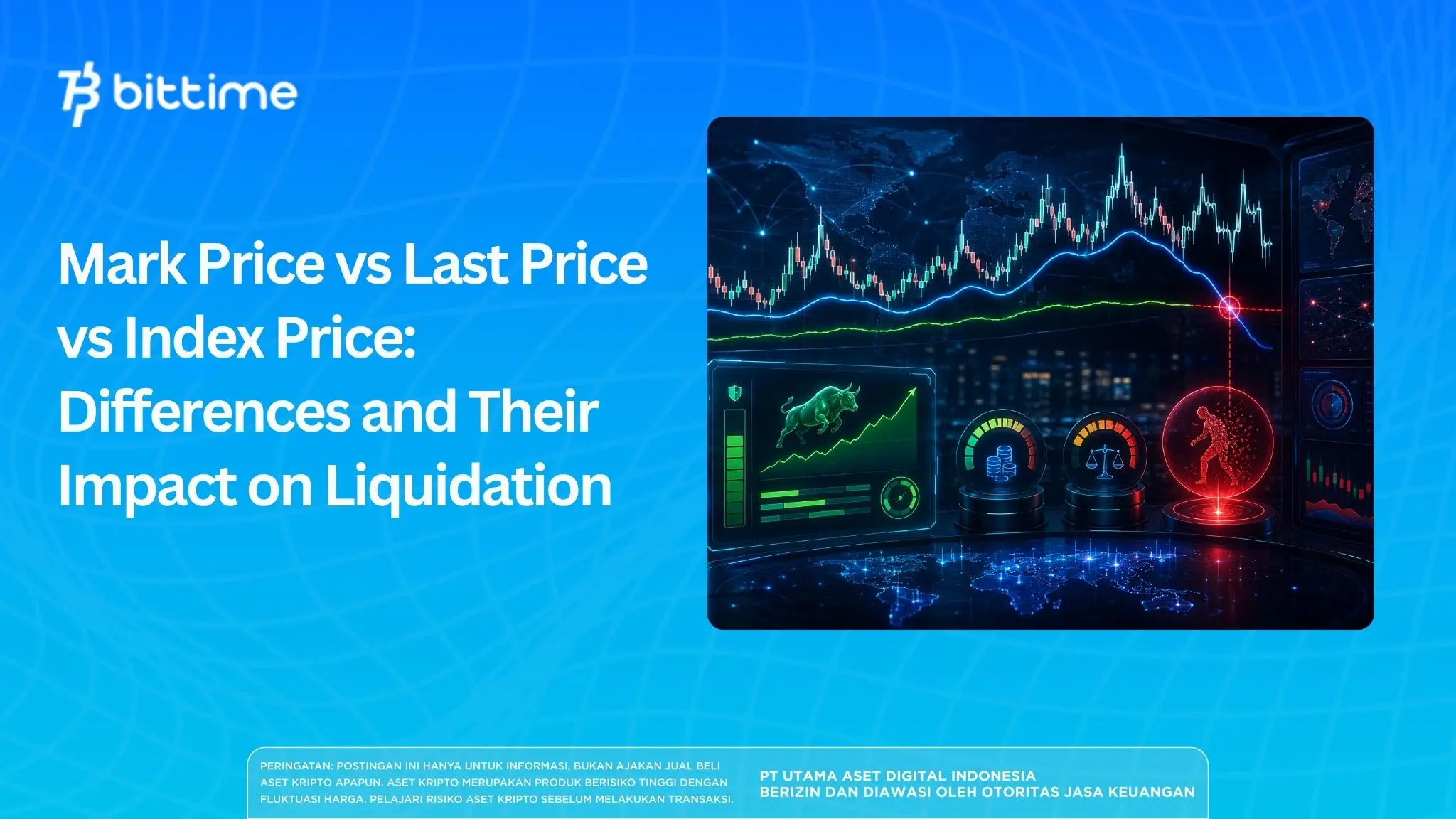
In trading crypto futures, one asset can display multiple price figures simultaneously.
The trader may see the price on the chart is still above the liquidation limit, but his long position has been forcibly closed by the system.
This condition usually occurs because the graph displaysLast Price, while the liquidation machine usesMark Price.
In addition to these two prices, derivative platforms also useIndex Priceas a referencebroader spot market prices.
The three are interrelated, but have different functions in transaction execution, unrealized profit calculation, margin, and crypto liquidation.
Understanding the difference between Mark Price, Last Price, and Index Price is important before using leverage.
Misreading price types can cause traders to be late in adding margin, setting stop losses incorrectly, or not realizing that their position is close to liquidation.
Key Points
Last Price shows the last transaction price, while Index Price reflects the spot price from several markets.
Mark Price is used to calculate margin, unrealized PnL, and trigger liquidation of futures positions.
Positions can be liquidated even if the chart has not yet touched the limit because the chart uses the Last Price, while the system monitors the Mark Price.
Understand the risks of futures before opening a position. Register at Bittime and start trading in a more measured way.
Summary of the Differences Between Mark Price, Last Price, and Index Price
Calculation details may vary on each exchange.
However, in general, the Last Price describes the last transaction, the Index Price reflects the spot price across markets, while the Mark Price is used to assess the risk of a position.
Read Also: What is Trading? Definition, How It Works, and How It's Different from Investing
What is Last Price?

Source : AI
Last Price or Last Traded Price is the last price when a buy order and a sell order are successfully matched in the futures market.
For example, the last BTC to USDT contract traded at 100,000 USDT.
This figure becomes the Last Price until the next transaction occurs.
When the next order is executed at 100,010 USDT, that number will then become the latest Last Price.
This price is generally used to form candlesticks on the chart.
Because it moves according to the most recent transactions in the order book, the Last Price can change very quickly when there is a surge in volume, an order imbalance, or a decrease in liquidity.
Futures contract prices on one platform may also move slightly differently from spot prices because derivatives markets have their own supply and demand.
Last Price Function
Last Price is mainly related to trading activities, such as:
shows the latest transaction price.
forming candlestick movements.
becomes the price reference when the market order is executed.
Triggers a stop order or take-profit if the trader selects Last Price as the trigger.
determine realized PnL based on the actual price when the position is closed.
Although it appears to be a “market price,” the Last Price does not always reflect the asset’s overall fair value.
One large order in a thin market can produce a wick or momentary price change that is quite far from the spot market.
Read Also: The Complete Guide to Cryptocurrency Trading: What Is Trading?
What is Index Price?
Index Price is a reference price calculated from the asset's spot price on multiple exchanges. Each platform may use different exchange components and weightings.
The main goal is to produce prices that represent broader crypto market conditions, not just order book conditions on a single platform.
If prices on one exchange experience disruption, abnormal spikes, or temporary deviations, using multiple sources can reduce the impact of these distortions.
As a simple illustration, a platform can take BTC prices from several spot markets:
Exchange A: 100,000 USDT.
Exchange B:100,020 USDT.
Exchange C: 99,990 USDT.
These prices are then processed according to the platform's methods and weightings. The final result is the Index Price.
Read Also:How to Trade Futures on Bittime for Beginners
The Function of Index Price in Futures Trading
The functions of Index Price in futures trading include:
be the reference price of the underlying asset of the contract.
helps keep futures prices linked to the spot market.
become one of the components of the Mark Price calculation.
reduce dependence on prices from a single exchange.
provide a reference when the contract is completed or its value is calculated.
Index Price does not mean the exact price a trader will obtain when opening or closing a position.
Execution still takes place through the order book and depends on liquidity, spread, and order size.
What is Mark Price?
Mark PriceA reference price is a price designed to reflect the estimated fair value of a futures or perpetual contract. This price is not always the transaction price that traders can directly obtain.
On many platforms, the Mark Price is built from the Index Price and then adjusted based on the contract, premium, or funding component.
Because the formulas vary, traders need to read the documentation of the exchange they use and not assume that all platforms use the same formula.
One of the exchanges applies Mark Price derived from Index Price using a funding basis.
Meanwhile, other exchanges use a dual pricing mechanism with a formula that can include the spot index, basis, moving average, and Last Traded Price, depending on the contract type.
Mark Price Function
Mark Price is generally used for:
calculate unrealized profit and loss.
assess position margin requirements.
measure whether equity still meets the maintenance margin.
monitor account risk levels.
triggers liquidation when it hits the liquidation price.
The influence of Mark Price on liquidation is very large because this is the number that is usually monitored by risk engines.
The Last Price may appear to have not yet reached the liquidation price, but the position will still be closed if the Mark Price has touched that limit.
Read Also:How to Trade Crypto for Beginners from Zero to Understanding
Why Does Liquidation Use Mark Price?
The use of Mark Price aims to reduce the possibility of positions being liquidated simply because of a momentary transaction or extreme wick on a single order book.
If the Last Price is used as the sole trigger, a large market order in a low-liquidity pair can drive the contract price sharply up or down. Such a short-lived movement could potentially trigger a chain of liquidations, even if the spot price in the broader market remains unchanged.
The Mark Price is less likely to be affected by a single transaction because it uses index pricing and an adjustment mechanism.
This approach helps protect margin calculations from short-term manipulation, local price deviations, and volatility unique to a single platform.
However, the Mark Price doesn't eliminate the risk of liquidation.
When the spot market actually moves against a position and the Index Price changes accordingly, the Mark Price will also approach the liquidation price.
How Mark Price, Last Price, and Index Price Work
The relationship between the three can be explained through the following flow:
Spot market on multiple exchanges → Index Price → Mark Price calculation → margin assessment and liquidation
Meanwhile:
Order activity on the futures platform → Last Price → charts and trade execution
The Last Price moves based on actual transactions in the futures market. The Index Price moves according to spot prices from various sources.
Mark Price links the two through the fair value formula used by the risk system.
Under normal market conditions, the difference between the three prices is usually relatively small.
Spreads can widen when volatility increases, liquidity decreases, large orders occur, funding is very high or low, or when demand in the futures market is unbalanced.
Read Also:Beginners Must Know! Here's What to Prepare for Before Trading Crypto Futures
Example of the Influence of Mark Price on Liquidation
Suppose a trader opens a long BTCU/SDT position with the following data:
entry price: 100,000 USDT.
leverage: 20x.
liquidation price: 96,000 USDT.
Last Price: 96.100 USDT.
Index Price: 95.970 USDT.
Mark Price: 95.990 USDT.
Traders might see the last candlestick still at 96,100 USDT and assume their position hasn't reached the liquidation price yet.
However, the Mark Price is already below 96,000 USDT. Because the system uses the Mark Price as a trigger, positions can enter the liquidation process even if the Last Price hasn't reached that level.
The opposite situation can also occur.
The Last Price may drop briefly to below the liquidation price, but the position won't necessarily be liquidated immediately if the Mark Price remains above that level.
Why Can Stop Loss Loss Loss Faster Than Liquidation?
One common mistake futures traders make is setting a stop loss based on the Last Price too close to the liquidation price.
For example:
liquidation price:12,000 USDT.
stop loss: 12,030 USDT.
trigger stop loss: Last Price.
If the Mark Price drops to 12,000 USDT first, the liquidation engine can take over the position before the Last Price reaches 12,030 USDT.
As a result, the stop loss is cancelled and the position is closed through the liquidation process.
Liquidation triggered by Mark Price can occur before stop loss that uses Last Price or Index Price as trigger.
Therefore, traders need to check two things: the type of price used as a stop loss trigger and the distance of the stop loss from the liquidation price.
Read Also: Trading Psychology: Understanding Emotional Phases and How to Manage Them
Mark Price dan Unrealized PnL
On many platforms, unrealized PnL is calculated using Mark Price.
As a result, the profit or loss value displayed on open positions may differ from the calculation based on the last candlestick.
For example, a trader opens a long position of 100,000 USDT.
Last Price is at 100,500 USDT, but Mark Price is still 100,350 USDT.
Unrealized PnL can be calculated based on 100,350 USDT instead of 100,500 USDT.
This value does not yet reflect actual profit. Realized PnL is only determined when a position is actually closed at the execution price, after accounting for trading costs, funding, and possible slippage.
Read Also: Understanding the Long Short Ratio: Calculation and Examples
Does Mark Price Determine Liquidation Execution Price?
Mark Price usually determinesWhenthe liquidation process begins, but it is not always the actual price when all positions are successfully closed.
Once liquidation is triggered, the exchange engine must close the position through the applicable mechanisms.
The closing result can be affected by order book conditions, position size, spread, volatility, and market liquidity.
In a deep market, positions are relatively easy to close near the expected price. In a thin market, large closing orders can experience slippage.
Therefore, traders should not consider the liquidation price as a guarantee of the final selling or buying price.
Read also: How to Stake USDT on Bittime in 4 Easy Steps
How to Reduce the Risk of Crypto Liquidation
Understanding price types needs to be accompanied by proper risk management.
1. Use leverage in a measured manner.
The higher the leverage, the smaller the distance between the entry price and the liquidation price.
2. Monitor the Mark Price, not just the Last Price candlestick.
Some platforms provide the option to display the Mark Price line on the chart.
3. Place a stop loss at an adequate distance from the liquidation price.
Avoid waiting for positions too close to the maintenance margin limit.
4. Check the trigger type on the stop loss.
Traders can choose Last Price, Mark Price, or Index Price on certain platforms. Each can result in a different activation time.
5. Pay attention to funding rates, spreads, order book depth, and volatility.
These factors can affect the cost of a position, the difference between futures and spot prices, and the quality of execution.
Finally, understand the difference between isolated margin and cross margin.
In isolated margin, risk is generally limited to the margin allocated to a particular position.
In cross margin, the available balance can be used to support positions, so changes in other positions can also affect the account margin conditions.
Read also:How to Invest and Save USD Dollars Up to 10 Percent per Year
Conclusion
The difference between Mark Price and Last Price lies in their intended use. Last Price indicates the most recent transaction and is commonly seen on charts.
Index Price describes spot prices based on several market sources.
Mark Price is an estimate of fair value used to calculate risk, unrealized PnL, margin, and liquidation.
Futures positions can be subject to liquidation even if the candlestick has not yet reached the liquidation price because the chart usually follows the Last Price, while the risk engine monitors the Mark Price.
This difference also explains why Last Price-based stop losses can be late to activate.
Before using leverage, traders need to know which prices are displayed on the chart, which prices trigger orders, and which prices are used as liquidation triggers.
This understanding does not guarantee profits, but it can prevent technical errors that could otherwise be avoided.

Bittime is a licensed and regulated Digital Financial Asset Trader (PAKD) supervised by Indonesia’s Financial Services Authority (OJK) — where you can buy Bitcoin in Indonesia and hundreds of other crypto assets starting from just Rp10,000. The registration process is fast, secure, and you can get started today.
Track USDT to IDR conversions and monitor your favorite crypto assets in real time. Everything is available in one crypto investment app that you can download for free on the Play Store
Ready to start? Register now on Bittime and execute your investment strategy with a platform trusted by millions of users in Indonesia.
FAQ
What is the main difference between Mark Price and Last Price?
The Last Price is the last transaction price on the futures platform. The Mark Price is the reference price the system uses to assess margin, unrealized PnL, and liquidation risk.
What is the function of Index Price in futures trading?
The Index Price provides a broader reference for spot prices because it is calculated from multiple market sources. This price is typically the primary component in calculating the Mark Price.
What price triggers liquidation?
On many crypto derivatives platforms, liquidation is triggered when the Mark Price reaches the liquidation price. The exact terms and formula should still be checked on each exchange.
Why is the position liquidated even though the chart has not touched the liquidation price?
The chart may display the Last Price, while the Mark Price may indicate the liquidation limit has been reached. The two prices may differ, especially during market volatility.
Is Mark Price used to execute orders?
Not always. The Mark Price is more often used as a risk reference and trigger. The actual execution price depends on the order book, order type, spread, and market liquidity.
Can Mark Price and Index Price have the same value?
Yes, especially when the contract base is very small. However, the two can also differ because the Mark Price may include a premium, basis, funding, or other adjustment mechanisms.
Disclaimer: The views expressed belong exclusively to the author and do not reflect the views of this platform. This platform and its affiliates disclaim any responsibility for the accuracy or suitability of the information provided. It is for informational purposes only and not intended as financial or investment advice.

.png)