Margin Usage, IM Ratio, and MM Ratio: How to Read
2026-08-19
Trading futures is not enough to just look at profit and loss or liquidation price.
There are several indicators that can actually provide earlier signals regarding account health,that is margin usage futures, Initial Margin Ratio (IM Ratio), Maintenance Margin Ratio (MM Ratio), and available margin.
These four indicators are interrelated, but their functions are different.
IM Ratio is closer to the account's capacity to open new positions, whereas maintenance margin ratio directly related to the account's ability to maintain positions that are already open.
In the Bittime Unified Futures system, for example, an IM Ratio of 100% means that the available margin has been fully utilized, while an MM Ratio reaching 100% indicates that the account is at risk of liquidation.
Understanding the difference allows traders to not only react when the liquidation price is too close.
Key Takeaways
IM Ratio futuresshows how much margin capacity has been used forsupport position opening.
MM Ratio futuresmore important to read the liquidation risk; at Bittime, the level is 100%indicates the account is at risk of liquidation.
Terms and thresholdsmargin usagecan differ between platforms. A platformgives a warning when Margin Usage passes 75%.
What is Futures Margin Usage?
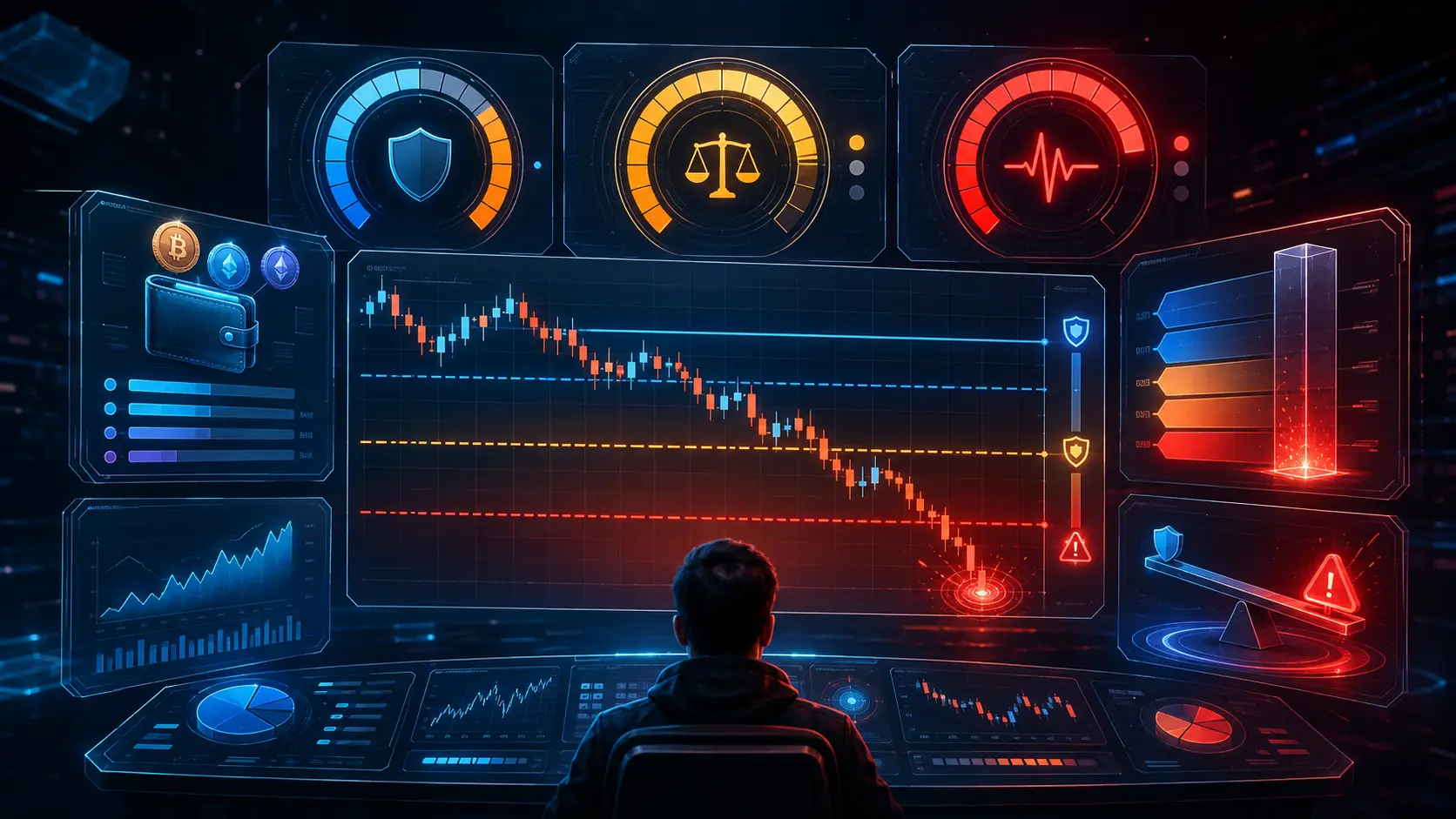
Image Source: AI
Margin usage futures shows how much margin resources are being used used to support leveraged positions.
The higher the utilization, the smaller the capital cushion remaining if the market moves against the position.
Reku defines Margin Usage as the percentage of funds in a futures wallet used to maintain leveraged positions.
The calculation involves the total maintenance margin and available margin, while Reku provides a risk warning when Margin Usage has exceeded 75%.
However, don't assume the 75% figure applies to every platform.
How to read margin usage must follow the methods and risk limits of each exchange because of the terms,formulas, and warning levels may vary.
Read Also:Crypto Funding Rate Arbitrage: How It Works and Examples of Strategies
What is the Initial Margin Ratio or IM Ratio?
Initial Margin (IM) is the initial funds required to open a futures position. The amount depends on the position value and the leverage used.
As a simple example from Bittime's documentation, a 1,000 USDT BTC position with 10x leverage requires an initial margin of around 100 USDT.
This means that leverage allows traders to control positions that are worth more than their directly allocated capital.
Initial margin ratio then helps to show the level of margin capacity utilization the.
On Bittime's Unified Futures Account, when IMRatio reached100%, the entire margin that available has been used.
The important thing:IM Ratio 100% is not the same as liquidation.
This condition further indicates that the space to open or enlarge positions is very limited.
Read Also: What is ATR in Crypto Trading?
What is the Maintenance Margin Ratio or MM Ratio?
Maintenance Margin (MM) is the minimum margin required to maintain a position. If the capital supporting a position continues to decrease due to unrealized losses to the point where it is unable to meet the MM requirement, the system may initiate liquidation.
Because of that, MM Ratio futures is a more direct indicator for reading liquidation risk compared to IM Ratio.
In Unified Futures Bittime:
MM Ratio approaching 100% = risk is getting higher
MM Ratio reaches 100% = account is at risk of liquidation
Bittime also explains that liquidation occurs when remaining funds no longer cover maintenance margin requirements.
So, when looking for indicators margin usage approaching liquidation, MM Ratio is one of the main numbers that need to be paid attention to
Read Also: How to Farm Kaito Aura Points: Kaito Pulse Guide and Web3 Activities.
IM Ratio and MM Ratio Should Not Be Interchanged
A common mistake novice traders make is to assume that IM and MM represent the same risk.
Simply:
IM determines whether you still have the capacity to open a position.
MM determines whether an open position can still be maintained..
Bittime summarizes the concept by referring to IM as the requirement to open a position, while MM is the minimum threshold related to liquidation.
Therefore, an account may have a high IM Ratio but not be close to liquidation.
On the other hand, when large losses erode equity and maintenance margin ratio continues to increase, the trader's attention should shift to position safety.
What is Available Margin Futures?
Available margin futures is the margin fund that is still available after taking into account positions, unrealized PnL, and other relevant components of the account.
In Unified Futures Bittime, Available Margin is calculated based on Margin Value minus Frozen Margin.
Margin Value itself takes into account USDT balance, unrealized PnL, and borrowed USDT.
The smaller the available margin, the less room a trader has to open new positions or absorb additional losses in a Cross Margin scheme.
Unrealized loss can also reduce margin value.
This means that even unclosed positions can significantly change the account's condition.
Read Also:Cross Margin vs Isolated Margin di Bittime Futures
How Do Cross and Isolated Affect Margin Risk?
Margin mode determines how much a position's losses can use up capital.
In Cross Margin, futures balances are used together to support positions.
A loss on one position can reduce the account buffer and impact other positions, but using a shared balance can also give positions more room to withstand volatility.
With Isolated Margin, funds are separated for each position. If one position experiences a significant loss, the remaining balance isn't automatically used to cover it.
The risk of loss is more isolated, but individual positions can also reach MM limits more quickly if margins are small.
Therefore, reading as margin ratio futures also need to consider the margin mode in use.
If you want to learn the features directly, you can register on Bittime, complete the KYC and Knowledge Test, then learn about margins and liquidation risks.
How to Read Liquidation Risk Practically
Don't wait until the liquidation price is almost reached before checking your account status. Monitor your IM Ratio, MM Ratio, available margin, unrealized PnL, and estimated liquidation price simultaneously.
If the IM Ratio continues to rise, the account capacity becomes increasingly limited.
If MM Ratio futures move towards the liquidation threshold, the condition is much more serious because the capital supporting the position is starting to approach the required minimum.
Bittime explains that liquidation prices are also dynamic.
Funding fees, losses on other positions on Cross Margin, margin changes, changes in position size, and trading fees can change the estimated liquidation price even if the trader does not open a new position.
In other words, futures risk needs to be monitored as a constantly changing account condition, not a static figure when the order is first opened.
Read Also: What Is a Stop Loss? How to Use It in Trading
How to Reduce Risk Before the MM Ratio Gets Too High?
The best steps are taken before the account approaches the maintenance margin limit.
Traders can reduce position size, use more conservative leverage, set stop losses, or increase margin when strategy and risk management support such actions.
Ajaib also emphasizes that traders should pay attention to liquidation prices, not use their entire balance, and consider funding and trading fees when managing futures positions.
In Isolated Margin, additional margin can enlarge the position buffer and generally move the estimated liquidation price further away.
Conversely, reducing margin makes positions more sensitive to price movements.
So, Which Indicator is the Most Important?
No single indicator should be read alone, Margin usage futures provides an overview of margin usage, IM Ratio shows the margin capacity for a position, while MM Ratio is the indicator closest to liquidation risk.
Available margin complements the three by indicating how much funds are still available for use. Meanwhile, the estimated liquidation price provides an overview of the market price level that could trigger a forced closure.
At Bittime Futures, users can viewIM Ratio, MM Ratio, Available Margin, dan Total Assets dari dashboard Unified Futures Account.

Bittime is a licensed and regulated Digital Financial Asset Trader (PAKD) supervised by Indonesia’s Financial Services Authority (OJK) — where you can buy Bitcoin in Indonesia and hundreds of other crypto assets starting from just Rp10,000. The registration process is fast, secure, and you can get started today.
Track USDT to IDR conversions and monitor your favorite crypto assets in real time. Everything is available in one crypto investment app that you can download for free on the Play Store
Ready to start? Register now on Bittime and execute your investment strategy with a platform trusted by millions of users in Indonesia.
FAQ
What are margin usage futures?
Margin usage is an indicator that describes the use of margin funds to maintain leveraged positions. The formula and warning levels may vary between platforms.
What is the difference between IM Ratio and MM Ratio?
The IM Ratio relates to the use of initial margin and the ability to open positions, while the MM Ratio relates to the maintenance margin required to prevent positions from entering a liquidation condition.
Does an IM Ratio of 100% mean immediate liquidation?
No. At Bittime, an IM Ratio of 100% means all available margin has been utilized. Liquidation risk is directly related to the MM Ratio and maintenance margin requirements.
What MM Ratio causes liquidation?
The limits depend on the platform's system. On Bittime Unified Futures, when the MM Ratio reaches 100%, the account is at risk of liquidation.
Why can available margin decrease?
Available margin can decrease due to open positions, unrealized losses, frozen funds for orders, fees, or changes in other margin components. In the Bittime system, Available Margin is calculated by subtracting the Frozen Margin from the Margin Value.
Does high leverage increase the risk of liquidation?
Yes. Higher leverage allows smaller amounts of capital to control larger positions, allowing relatively small price movements to have a greater impact on margin and narrowing the gap to liquidation.
Disclaimer: The views expressed belong exclusively to the author and do not reflect the views of this platform. This platform and its affiliates disclaim any responsibility for the accuracy or suitability of the information provided. It is for informational purposes only and not intended as financial or investment advice.

.png)