Liquidation Price vs. Bankruptcy Price: What's the Difference in Crypto Futures?
2026-07-27
The term “bankruptcy price” in crypto futures is often considered synonymous with “liquidation price,” even though the two indicate different levels of risk. The liquidation price is the level at which the system begins to take over and close the position because the margin no longer meets the maintenance requirements.
The bankruptcy price is set further out and represents the point at which the position’s margin has essentially been depleted or is only sufficient to cover settlement costs.
Key Takeaways
- The liquidation price is reached first because the system must close the position before the margin is completely exhausted.
- Bankruptcy price is the risk limit when available equity or margin is no longer able to cover position losses.
- High leverage narrows the entry distance to both levels, thus increasing the risk of liquidation.
Apa Itu Liquidation Price Crypto Futures?
Liquidation price crypto futures is the estimated price when the position no longer meets the maintenance margin requirement.
Maintenance margin is the minimum amount that must be maintained to maintain a position. When the mark price reaches this limit, the system can initiate an automatic liquidation process to prevent position losses from exceeding the available collateral.
Source: AI Generated Image
On some platforms, liquidation occurs when the maintenance margin ratio reaches or exceeds a certain threshold. The liquidation price displayed on the interface is usually an estimate and can change depending on the account balance, profits or losses on other positions, additional margin, transaction costs, and funding fees.
The important thing to understand is that liquidation is usually triggered by market price, not just the last traded price.
The mark price is designed to reflect the fair value of a contract based on price indices and other mechanisms established by the platform. Users may see the final price move differently from the mark price, but the liquidation system still adheres to the price specified in the contract rules.
For long positions, the liquidation price is below the entry price. A price drop near this limit will reduce the position's margin.
For short positions, the liquidation price is above the entry price. A price increase against the position will reduce margin until the maintenance requirement is no longer met.
Read also:How to Calculate Futures Funding Fees: Long and Short Formulas
What Are Bankruptcy Price Futures?
Bankruptcy price futures is the level at which the margin or equity allocated to a position is exhausted due to losses. In certain implementations, this level can also be calculated as the price at which the remaining margin is only sufficient to cover the taker's costs during the settlement process.
Conceptually, the bankruptcy price indicates the maximum loss a margin position can sustain. When the price reaches this level, there is no longer sufficient equity to absorb adverse price movements.
The bankruptcy price is not typically used as the initial trigger for liquidation. The system should begin liquidating positions first, when the price reaches the liquidation price.
In a number of futures mechanisms, the bankruptcy price is used as:
- Liquidation order price reference.
- Maximum limit of position margin loss.
- Settlement reference between position and insurance fund.
- Protection against executions exceeding user equity.
- Internal parameters of the risk management system.
The bankruptcy price is an internal calculation and may not necessarily be the actual execution price. Therefore, this level is not typically displayed as a transaction on candlestick charts.
Read also:Beginners Must Know! Here's What to Prepare for Before Trading Crypto Futures
The Difference Between Bankruptcy Price and Liquidation Price
The main difference between the two lies in the timing, objectives, and margin conditions when the level is reached.
Liquidation Price Becomes a Trigger for Closing Positions
The liquidation price is the level at which the system takes action because the margin has fallen to the minimum limit. At this stage, the position still has some equity in the form of maintenance margin.
The goal of liquidation is to close a position before the loss wipes out the entire collateral.
Bankruptcy Price Shows Margin Has Been Depleted
Bankruptcy price is the point at which the margin allocated to a position has been consumed by losses or is only sufficient to cover closing costs as per platform rules.
This level becomes the risk limit that the liquidation system tries to avoid.
The Price Order is Different for Long and Short
In a long position, the sequence is usually:
- Entry price.
- Liquidation price.
- Bankruptcy price.
As prices move down, the liquidation price of a long position is usually higher than the bankruptcy price.
In a short position, the sequence is usually:
- Entry price.
- Liquidation price.
- Bankruptcy price.
Because short positions lose when prices rise, the liquidation price is usually lower than the bankruptcy price.
In other words:
- Long position: liquidation price > bankruptcy price.
- Short position: liquidation price < bankruptcy price.
Liquidation Price Subject to Change
Liquidation price may change when user:
- Add or withdraw margins.
- Open another position in cross margin.
- Realizing profits or losses.
- Pay or receive funding fees.
- Resize position.
- Add positions at different prices.
- Using other assets as collateral.
With cross margin, the entire account equity can be used to support multiple positions. Therefore, the estimated liquidation price may change based on unrealized P&L and other position conditions.
Bankruptcy prices can also change if the effective margin, position size, average price, or collateral balance changes.
Read also:Understanding Leverage Strategies in Crypto Futures for Safer Trading
Why Are Positions Liquidated Before Bankruptcy Price?
Futures platforms don't wait until a user's margin is completely depleted. If the system only closes positions when the bankruptcy price is reached, rapid price movements or slippage could result in execution results that are worse than that limit.
This condition can result in a negative balance that must be covered by the platform's protection mechanism.
Therefore, positions begin to be liquidated while they still have maintenance margin. The difference between the liquidation price and the bankruptcy price provides room for the liquidation engine to close positions.
If the position is successfully closed at a price better than the bankruptcy price, a portion of the settlement difference can be transferred to the insurance fund. If the execution is worse, the insurance fund can be used to cover the shortfall, according to the platform's mechanisms.
Insurance funds serve as a layer of system protection. However, the mechanisms, fund size, and procedures for insufficient funds can vary between futures providers.
How to Calculate Bankruptcy Price Simply
Actual formula how to calculate bankruptcy price differ based on:
- Linear or inverse contracts.
- USDT-margined or coin-margined.
- Cross margin or isolated margin.
- One-way or hedge position.
- Leverage level.
- Taker fee.
- Maintenance margin tier.
- Additional margin.
- Funding fee.
- Contract multiplier specifications.
To understand the basic concept, we can use a simple formula for a linear contract with isolated margin. This calculation ignores transaction fees, funding costs, and platform-specific adjustments.
Long Position Formula
Bankruptcy price long:
Entry price − (initial margin ÷ quantity)
If the initial margin is obtained from the position value divided by the leverage:
Bankruptcy price long ≈ entry price × (1 − 1 ÷ leverage)
Short Position Formula
Bankruptcy price short:
Entry price + (initial margin ÷ quantity)
In the form of leverage:
Bankruptcy price short ≈ entry price × (1 + 1 ÷ leverage)
This formula is only suitable for conceptual purposes. Platforms may include closing costs, margin ratios, contract multipliers, and other factors, causing actual results to vary. The official formula also differs between USDT-M and coin-margined contracts.
Read also:Understanding Leverage Strategies in Crypto Futures for Safer Trading
Example of Bankruptcy Price on Long Position
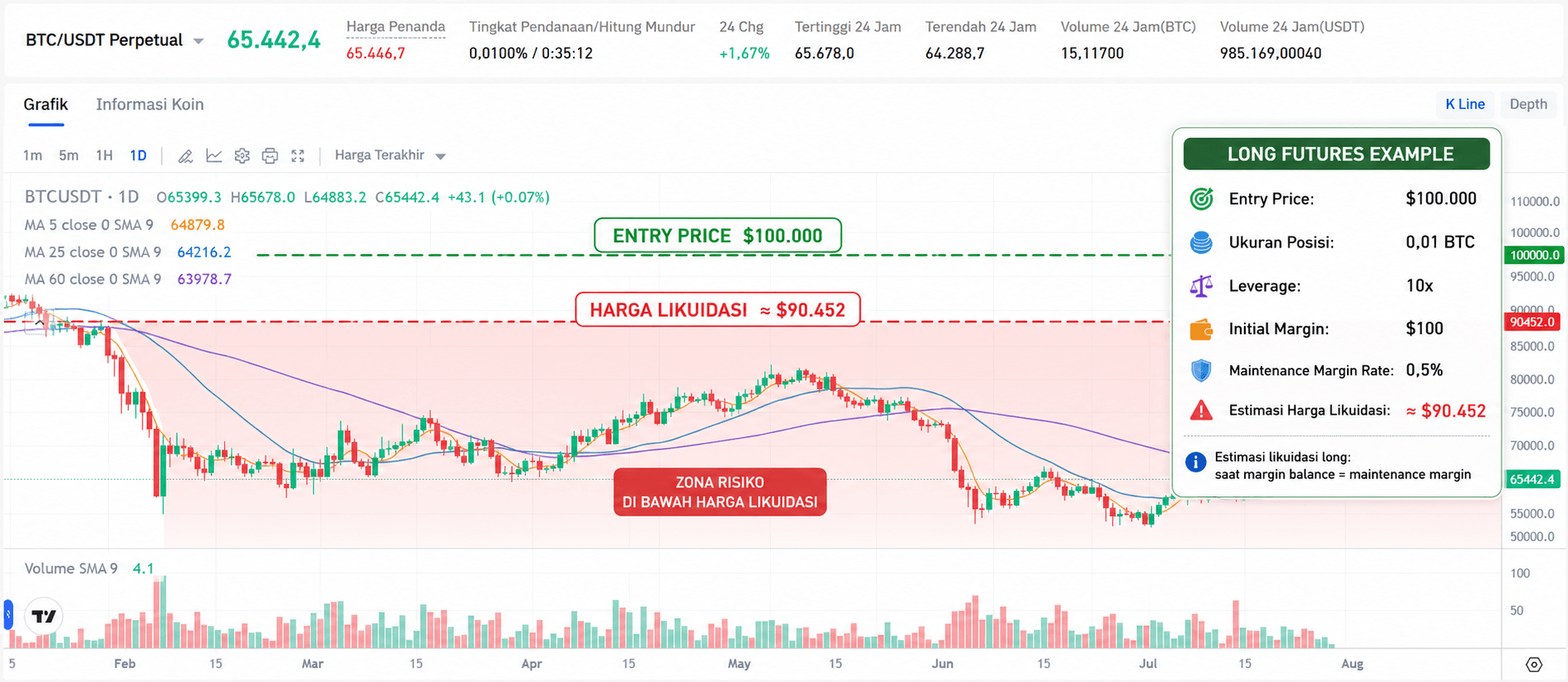
A trader opens a long BTC position at $100,000 with the following details:
- Position size: 0.01 BTC.
- Position value: $1,000.
- Leverage: 10x.
- Initial margin: $100.
- Maintenance margin rate: 0,5%.
- Costs and funding are ignored.
Calculation of bankruptcy price:
$100.000 − ($100 ÷ 0,01)
$100.000 − $10.000 = $90.000
In this simple example, the bankruptcy price is around$90.000.
At that level, a $10,000 price drop results in a loss:
0,01 × $10.000 = $100
A loss of $100 is equal to the entire initial margin.
However, the position won't wait until the price actually reaches $90,000. The system needs to maintain a maintenance margin of 0.5%.
A simple liquidation price estimate can be calculated by:
$100.000 × (1 − 1 ÷ 10) ÷ (1 − 0,005)
The result is approximately$90.452.
Thus an:
- Entry price: $100.000.
- Liquidation price: approximately $90,452.
- Bankruptcy price: around $90,000.
The difference of around $452 gives the system room to close the position before the entire margin is exhausted.
Actual calculations on the platform may be higher or lower due to taker fees, funding, margin tiers, rounding, slippage, and contract rules.
Read also:Long vs Short Crypto Futures Strategy: When to Buy and Sell?
Example of Bankruptcy Price on a Short Position
Using the same assumptions:
- Entry price: $100.000.
- Position size: 0.01 BTC.
- Leverage: 10x.
- Initial margin: $100.
- Maintenance margin rate: 0,5%.
Source www.bittime.com/futures/BTC
Calculation of bankruptcy price for short position:
$100.000 + ($100 ÷ 0,01)
$100.000 + $10.000 = $110.000
The bankruptcy price is simply around $110.000.
By simply calculating the maintenance margin, the liquidation price will be below the bankruptcy price, which is around:
$100.000 × (1 + 1 ÷ 10) ÷ (1 + 0,005)
The results are more or less$109.453.
The order is:
- Entry price: $100.000.
- Liquidation price: approximately $109,453.
- Bankruptcy price: around $110,000.
The system starts liquidating positions before the price increase consumes the entire margin.
Read also:Profit-Taking Strategy During a Bearish Market with Crypto Futures
The Influence of Crypto Futures Leverage on Bankruptcy Prices
Crypto futures leverage determines how large a position can be opened with a given margin.
For example, $100 capital can be used to open:
- $200 position with 2x leverage.
- $500 position with 5x leverage.
- $1,000 position with 10x leverage.
- $5,000 position with 50x leverage.
The higher the leverage, the smaller the price movement required to wipe out the margin.
In a long position with a simple formula:
- 2x leverage results in a bankruptcy price about 50% below entry.
- 5x leverage results in a bankruptcy price about 20% below entry.
- 10x leverage results in a bankruptcy price about 10% below entry.
- 20x leverage results in a bankruptcy price about 5% below entry.
- 50x leverage results in a bankruptcy price about 2% below entry.
The liquidation price will be closer to the entry point because the system still has to maintain the maintenance margin and closing costs.
Leverage doesn't change the percentage price movement of an asset. Leverage increases position exposure relative to the margin provided, magnifying the impact of gains and losses on capital. Futures products can magnify both gains and losses, and leverage limits are typically adjusted based on the asset and position size.
Read also:Differences Between Crypto Spot and Futures for Beginner Traders
Cross Margin vs Isolated Margin
Margin mode has a big influence on liquidation and bankruptcy price.
Isolated Margin
In isolated margin, risk is limited to the margin allocated to a single position.
If a position is liquidated, losses generally don't immediately consume the entire funds in the futures account. Users can also manually add margin to avoid the liquidation price.
Advantages of isolated margin:
- The risk of a single position is easier to limit.
- Liquidation price calculations are easier to understand.
- Other positions do not directly support losses.
- Suitable for testing strategies with specific allocations.
The downside is that positions are liquidated more quickly if the allocated margin is too small.
Cross Margin
With cross margin, the entire qualifying balance can be used to support a position. Unrealized profits from other positions can also affect account equity, depending on the system used.
Advantages of cross margin:
- More flexible use of capital.
- Positions have greater margin support.
- The gains and losses of some positions can offset each other.
The risk is that a single losing position can wipe out a significant portion of your account balance. Liquidation prices can also fluctuate because all positions share the same equity.
For beginners, isolated margin is often easier to use to determine the maximum loss on a single position. However, this mode does not eliminate the risk of liquidation.
Read also:Bittime Futures: A Complete Guide to Crypto Derivatives Trading in Indonesia
Factors That Change Liquidation Price
The liquidation price displayed when opening a position is not a fixed figure. Its value can change due to several factors.
Additional Margin
Increasing margin will move the liquidation price further away from the entry point. For long positions, the liquidation price will be lower. For short positions, the liquidation price will be higher.
Funding Fee
Funding fees paid can reduce the balance or effective margin. If there is insufficient available balance, funding payments can bring the liquidation price closer.
Maintenance Margin Tier
Large positions can enter a higher maintenance margin tier, making the distance to liquidation narrower than simple estimates.
Position Closing Fee
The system can calculate the estimated taker cost to close a position. This is one reason why simple calculator results differ from the prices displayed on the platform.
Position Size Change
Increasing a position without proportionally increasing margin will increase effective leverage. The liquidation price may move closer.
Unrealized PnL Other Positions
With cross margin, the profits or losses of other positions affect the overall equity. Therefore, one position can be close to liquidation even though the asset price hasn't changed much.
Read also:How to Trade Futures on Bittime for Beginners
Common Mistakes in Understanding Bankruptcy Price
Consider Bankruptcy Price as Stop Loss
The bankruptcy price is not a stop-loss level. That level is already too close to losing all margin.
Stop loss is ideally placed well before the liquidation price based on the strategy invalidation point.
Considering Liquidation Price as a Certain Maximum Loss
Actual results may be affected by slippage, fees, insurance fund mechanisms, and liquidation methods. Prices displayed are estimates and not guarantees of exact execution.
Using Last Price as a Reference
Traders often see the price on the chart not yet reaching the liquidation price, but the position has already been closed. This can occur if the mark price has already reached the liquidation limit.
Adding Leverage to Avoid Liquidation
Changing the leverage on a position doesn't always automatically increase margin. To truly reduce the liquidation price, traders need to understand whether the change also affects the allocated margin.
Ignoring Costs
Funding and transaction fees can reduce margins. Even small fees can have a significant impact when you're very close to the liquidation price.
How to Reduce Futures Trading Risks
Understanding the difference between liquidation and bankruptcy prices will be of no use without consistent risk management in futures trading.
Use Low Leverage
Low leverage allows more room for price fluctuations. Traders don't always have to use the maximum available leverage.
Set Stop Loss
Stop-loss orders should be determined based on market structure and risk limits. Do not use the liquidation price as a substitute for a stop-loss.
Limit Risk per Transaction
Determine your maximum loss before opening a position. Many traders use a small percentage of their capital as a risk limit, but this should be tailored to their individual strategy and financial situation.
Use Isolated Margin to Limit Exposure
Isolated margin can help separate the risk of one position from the rest of your account balance. Always monitor the allocated margin amount and the distance to liquidation.
Monitor Mark Price
Check the mark price, not just the last price. The mark price is an important indicator because many systems use it to calculate unrealized PnL and trigger liquidations.
Keep a Safe Distance
Don't open a position with a liquidation price too close to the entry price. A short-term movement or wick can close the position even if the long-term analysis is ultimately correct.
Avoid Opening Positions During Extreme Volatility
Economic data releases, Bitcoin movements, and shifts in sentiment can increase volatility in the short term. Slippage also tends to increase when liquidity decreases.

Implementing Risk Management through Bittime Futures
Once you understand the liquidation price and bankruptcy price, you can explore how they’re applied through the Bittime Futures service. This platform offers perpetual futures trading, long and short positions, leverage settings, and both cross and isolated margin modes.
Additionally, Bittime is the first digital asset platform in Indonesia to obtain a full futures trading license from PT Central Financial X (CFX) under the regulatory oversight of the Financial Services Authority (OJK).
Register at Bittime, complete the verification process and Knowledge Test, then use funds you are fully prepared to risk. Before opening a position, check the estimated liquidation price, margin size, leverage, and stop-loss limits.
Check the prices of Bitcoin (BTC), Ethereum (ETH), XRP, Solana (SOL), and BNB, as well as the popular meme coin DOGE. You can trade directly on Bittime!
Conclusion
The main difference between the liquidation price and the bankruptcy price lies in margin conditions and their respective functions.
The liquidation price is the level at which the system begins to close a position because the margin has reached the minimum requirement. The bankruptcy price is the level at which the position’s margin is conceptually depleted or only enough remains to cover settlement costs.
For long positions, the liquidation price is typically above the bankruptcy price. For short positions, the liquidation price is below the bankruptcy price. The difference between the two provides room for the liquidation mechanism to close the position before a margin shortfall occurs.
A simple formula can help you understand the concept, but don’t use it as your sole basis for trading. Actual prices are influenced by leverage, margin mode, maintenance margin, funding fees, taker fees, position size, and platform rules.
Use leverage cautiously, set stop-loss orders, and always check the figures displayed on the platform before confirming a position. You can also learn about the latest futures features and guides through Bittime before you start trading.

Bittime is a licensed and regulated Digital Financial Asset Trader (PAKD) supervised by Indonesia’s Financial Services Authority (OJK) — where you can buy Bitcoin in Indonesia and hundreds of other crypto assets starting from just Rp10,000. The registration process is fast, secure, and you can get started today.
Track USDT to IDR conversions and monitor your favorite crypto assets in real time. Everything is available in one crypto investment app that you can download for free on the Play Store
Ready to start? Register now on Bittime and execute your investment strategy with a platform trusted by millions of users in Indonesia.
FAQ
What is bankruptcy price crypto futures?
Bankruptcy price is the price at which the margin allocated to a position is essentially exhausted due to losses. In certain systems, the remaining margin at this level is only enough to cover settlement costs.
What is the difference between liquidation price and bankruptcy price?
The liquidation price triggers the system to begin closing positions when the maintenance margin is not met. The bankruptcy price is further away and indicates the limit when the margin is exhausted.
Is the position immediately closed at the bankruptcy price?
The liquidation process usually begins before the bankruptcy price is reached. The bankruptcy price can be used as a reference for orders or settlements, but the actual execution price depends on market conditions and platform mechanisms.
How does leverage affect bankruptcy prices?
The higher the leverage, the closer the bankruptcy price and liquidation price are to the entry point. Small price movements against a position can wipe out margin more quickly.
Is stop loss the same as liquidation price?
No. A stop-loss order is a risk management order set by the trader, while the liquidation price is determined by the system based on margin. A stop-loss order should be placed before the price approaches liquidation.
Disclaimer: The views expressed belong exclusively to the author and do not reflect the views of this platform. This platform and its affiliates disclaim any responsibility for the accuracy or suitability of the information provided. It is for informational purposes only and not intended as financial or investment advice.

.png)