Liquid vs Lightning Network: Pros and Cons of Bitcoin Layer 2
2026-09-07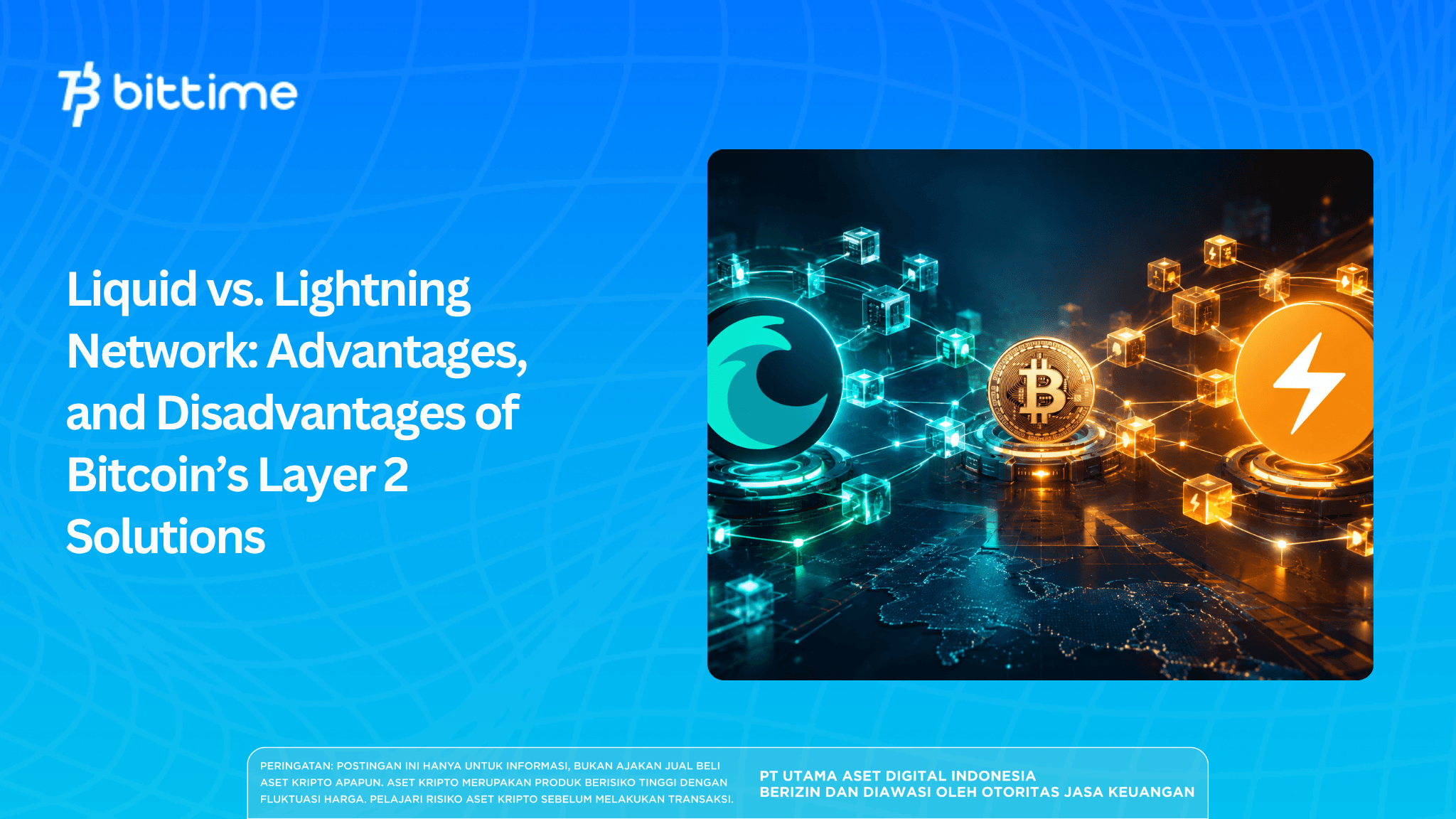
Bitcoin is not only evolving through improvements to its main blockchain. As the need for fast, low-cost, and more flexible transactions increases, various Bitcoin Layer 2 solutions and networks connected to Bitcoin are being used to expand the functionality of the crypto asset.
Two names that are often compared are Liquid Network and Lightning Network. Although both are designed to expand Bitcoin's capabilities, they have different designs and purposes.
Lightning is primarily designed for fast payments and small transactions, while Liquid is better suited for larger-value transfers, trading, and financial needs that require privacy.
Understanding the difference is important because Liquid and Lightning are not direct competitors. Both offer different approaches to making Bitcoin more practical to use.
Key Takeaways
- Lightning Network excels at fast Bitcoin payments, microtransactions, and low fees.
- Liquid Network is better suited for large Bitcoin transfers, settlement, asset tokenization, and transactions that require privacy.
- Both have trade-offs. Lightning requires channel liquidity management, while Liquid uses a federation model, resulting in a different level of trust from the Bitcoin mainnet.
What Are Liquid Network and Lightning Network?
Liquid Network is a sidechain connected to Bitcoin through a two-way peg mechanism.
Bitcoin can be transferred to the Liquid network as Liquid Bitcoin (L-BTC) at a 1:1 ratio with BTC. The network also supports other digital assets and features such as Confidential Transactions and asset issuance.
These characteristics make Liquid widely used for trading, settlement, and financial applications.
Meanwhile, Lightning Network is a Layer 2 payment protocol that uses payment channels. Transactions can take place off-chain, so users do not need to record every payment directly on the Bitcoin blockchain.
This mechanism enables payments to be processed extremely quickly at relatively low costs.
Simply put, Liquid is more like an additional financial network surrounding Bitcoin, while Lightning focuses on making Bitcoin payments faster and more efficient.
Read Also: Top 15 Layer-2 Blockchains That Offer the Best Solutions
How Do Liquid and Lightning Work Differently?
On Lightning, users open a payment channel by locking a certain amount of BTC in a multisignature transaction. Once the channel is active, multiple transactions can be conducted without sending each transaction to the Bitcoin blockchain.
Funds are only settled on the main network when the channel is closed or when on-chain settlement is required. Therefore, Lightning is highly suitable for recurring payments involving small amounts.
Liquid takes a different approach. BTC transferred to Liquid is represented as L-BTC. Transactions then take place on the Liquid blockchain, which has its own blocks and federation-based validation mechanism.
This difference also creates a different trust model. Lightning is designed to minimize reliance on third parties, while Liquid depends on the Liquid Federation for important network functions and the peg mechanism.
Monitor BTC and other crypto assets by signing up on Bittime and stay updated with the latest market developments.
Advantages of Lightning Network for Bitcoin Payments
One of the biggest advantages of Lightning Network is its speed. Payments can be processed almost instantly as long as there is a sufficient route and channel liquidity.
This characteristic makes Lightning attractive for merchants, digital payments, gaming, tipping, and microtransactions. Payment fees can also be significantly lower than on-chain Bitcoin transactions because most activity takes place outside the main blockchain.
Lightning also provides a relatively high level of trust minimization. Users do not need to hand over ownership of their BTC to a third party simply to make payments through a channel.
However, Lightning is not without drawbacks. Users and network operators must pay attention to channel liquidity.
For larger transactions, finding a route with sufficient capacity can become more difficult. Managing nodes and channels can also add complexity.
Read Also: 5 Websites Offering Free Bitcoin in 2026
Advantages of Liquid Network for Large Transactions
If Lightning is strong in small payments, the advantages of Liquid Network are more apparent for medium- to large-sized transactions.
Liquid allows users to transfer L-BTC without having to set up a payment channel with the recipient. The network also offers Confidential Transactions, which are designed to hide the amount and type of assets being transacted from public observation.
This feature can be useful for traders and institutions that do not want their transaction activity to be easily analyzed on the blockchain.
In addition to Bitcoin, Liquid supports the issuance of various digital assets. This opens opportunities for stablecoins, tokenized assets, and other financial applications.
Liquid can also use cold storage and multisignature, making it more flexible for custodial and institutional needs.
Its drawback lies in the federation model. Liquid does not have a security model identical to the Bitcoin mainnet because important network functions depend on the Federation.
This means users must understand the trade-off between additional features, privacy, and the trust model.
Convert 1 BTC to IDR - Bitcoin to Rupiah Exchange Rate
Which Is Cheaper and Faster?
For low-value Bitcoin transactions, Lightning is generally more attractive. Transactions do not need to be recorded individually on the Bitcoin blockchain, helping reduce costs while enabling fast payments.
Liquid also offers relatively low transaction fees and faster settlement compared with the Bitcoin mainnet.
However, its transaction structure is different because it still uses the Liquid blockchain, with its own blocks and network fees.
Therefore, it is not accurate to say that one network is always cheaper. Efficiency depends heavily on transaction size, frequency of use, liquidity management needs, and the costs of entering and exiting each network.
Liquid or Lightning: Which Is More Suitable?
The comparison shows that the two are better viewed as complementary technologies.
In fact, developments in the Bitcoin ecosystem show that integration between Liquid and Lightning is also possible.
Recent Liquid developments include increasingly close support for Lightning and swap infrastructure between Liquid, Lightning, and the Bitcoin mainnet.
Read Also:Find Lost Bitcoin After 12 Years, This Englishman Becomes a Billionaire
What Is the Future of Bitcoin Layer 2?
The future of Bitcoin Layer 2 is unlikely to be determined by a single network. Bitcoin has diverse needs, ranging from retail payments to large-value settlement and financial applications.
Lightning has a strong position in making Bitcoin a more practical payment method. Meanwhile, Liquid could play a larger role in market infrastructure, asset tokenization, settlement, and Bitcoin-based financial applications.
The development of both networks also shows that Bitcoin scalability is not only about processing more transactions. Factors such as privacy, custody, liquidity, programmable finance, and interoperability are becoming increasingly important.
Therefore, the more appropriate question is not Liquid or Lightning, but which network best suits a particular transaction requirement.
Start trading BTC/IDR with Bittime here!
Conclusion
Liquid Network and Lightning Network both expand Bitcoin's capabilities, but they take different approaches.
Lightning excels at fast payments, microtransactions, and low fees. In contrast, Liquid stands out for large-value transfers, settlement, privacy, and digital asset issuance.
As Bitcoin evolves, both networks have the potential to operate alongside each other. Lightning can handle everyday payment needs, while Liquid supports financial activities that require greater capacity, privacy, and flexibility.

Bitcoin is available and ready to trade on Bittime with the BTC/USDT pair. There are also other assets on the Bitcoin BRC20 network, such as SATS and ORDI.
Bittime is a licensed Digital Financial Asset Trader (PAKD) platform authorized and supervised by the Financial Services Authority (OJK) — where you can buy Bitcoin in Indonesia and hundreds of other crypto assets starting from IDR 10,000. The registration process is fast, secure, and can be started today.
Monitor USDT to IDR conversions and the price movements of your favorite crypto assets in real time. Everything is available in one crypto investment app that can be downloaded for free from the Play Store.
Ready to get started? Sign up on Bittime now and execute your investment strategy with a platform trusted by millions of users in Indonesia.
FAQ
What Is Liquid Network?
Liquid Network is a Bitcoin sidechain that allows BTC to be used in the form of L-BTC while supporting private transactions and the issuance of various digital assets.
What Is Lightning Network?
Lightning Network is a Bitcoin Layer 2 protocol that uses payment channels to enable fast and low-cost transactions without recording every payment directly on the main blockchain.
Which Is Cheaper, Liquid or Lightning?
For microtransactions and everyday payments, Lightning is generally more efficient. Liquid is better suited for larger transactions and settlement needs.
Are Liquid and Lightning Competitors?
Not entirely. They serve different functions and can complement each other within the Bitcoin ecosystem.
Is Lightning Network Safe?
Lightning is designed with cryptographic mechanisms and payment channels that allow transactions to be conducted without giving custody of BTC to a third party. However, users still need to understand the risks related to channels, liquidity, nodes, and private key management.
Does Liquid Network Use Bitcoin?
Yes. BTC can be transferred to Liquid and represented as L-BTC at a 1:1 ratio through the peg mechanism.
Disclaimer: The views expressed belong exclusively to the author and do not reflect the views of this platform. This platform and its affiliates disclaim any responsibility for the accuracy or suitability of the information provided. It is for informational purposes only and not intended as financial or investment advice.

.png)