What Is the Liquid Network? Understanding Bitcoin's Layer 2 Platform for Faster Crypto Transactions
2026-09-07
Liquid Network offers a way to use Bitcoin value through the network with shorter confirmations and additional privacy features.
Users can send BTC representations, trade digital assets, and take advantage of services that support the network.
However, understanding the speed alone is not enough.
Liquid has different security mechanisms and asset transfer processes than the main Bitcoin network.
These differences determine when users can benefit and what risks need to be taken into account.
Key Takeaways
Liquid Network is a Bitcoin sidechain that uses a federated security model.
L-BTC represents BTC with one-to-one backing through an asset locking mechanism.
Fast confirmations apply to transactions within Liquid, while moving from Bitcoin requires a separate process.
What is Liquid Network and its relationship to Bitcoin?
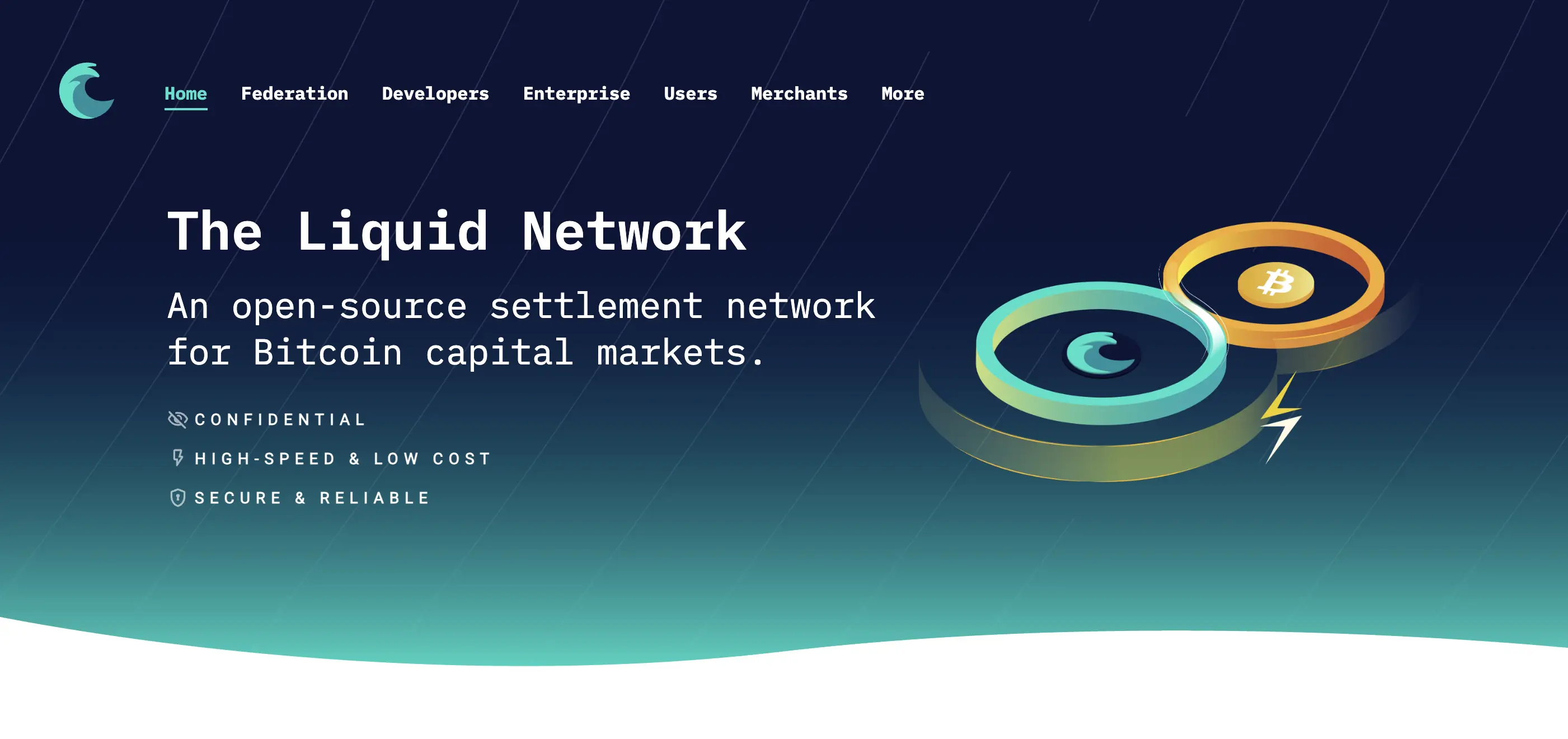
Source: liquid.net
Liquid Network is a separate blockchain that is connected to Bitcoin through a mechanism of two-way peg.
The network is built using Elements, an open-source platform based on Bitcoin code.
Blockstream provides the technology, while federation members run the network operations.
Liquid is often called Bitcoin's Layer 2 because it extends BTC's utility beyond the main network.
Architecturally, a more specific term is a Bitcoin sidechain with federated consensus.
This means that users need to understand that Liquid security is not identical to Bitcoin mining security.
Although frequently discussed in discussions about the latest Bitcoin technology, Liquid has been operating since September 2018.
Its development focuses on the needs of Bitcoin-based asset transfers and financial services.
How Liquid Network Works: From BTC to L-BTC
How Liquid Network works starts through peg-in.
Users send BTC to a federated address and then claim an equivalent amount of L-BTC once the confirmation requirements are met.
The BTC remains locked on the mainnet as long as its representation circulates on Liquid.
The live peg-in process requires 102 Bitcoin confirmations.
Therefore, entering Liquid through this mechanism doesn't take two minutes. Users can also acquire L-BTC through exchanges that provide liquidity, with their own terms and conditions.
To return to the main network, the mechanismpeg-outdestroy L-BTC and release an equivalent amount of BTC.
Immediate peg-out is available to authorized federation members.
General users need the services of a member or exchange provider to convert L-BTC to BTC.
As an illustration, a 0.01 BTC lockup supports a 0.01 L-BTC claim before accounting for associated fees.
This mechanism doesn't duplicate users' Bitcoin. L-BTC is also required to pay asset transfer fees on Liquid.
To learn more about the Bitcoin market, register Bittime account and use the asset information as research material before making a transaction.
How Fast Are Transactions on Liquid?
Liquid targets the formation of a block every one minute.
Transactions are considered final after two confirmations in its consensus model, with completion taking around two to three minutes when the network is functioning normally.
Operator or network disruptions can extend this time.
Thus, the term fast Bitcoin transaction refers to sending L-BTC within the sidechain.
Peg-in, peg-out, exchange check and balance recording times still need to be calculated separately.
For example, sending L-BTC between two services that support Liquid can take advantage of these short confirmations.
However, the time it takes for the balance to be available to the recipient still depends on the destination service's procedures. Network support on both sides is a practical requirement before a transfer.
Read Also: Bitcoin Price History from 2009–2026
Privacy of Digital Asset Transactions and Issuance
Liquid uses Confidential Transactions to hide the amount and type of assets sent.
The network can still check the validity of transactions without making either information public.
Users can also share certain details with parties of their choice.
This feature does not mean that the entire transaction trail becomes anonymous.
Addresses and transaction relationships still need to be considered when assessing privacy.
Therefore, nominal confidentiality should not be equated with hiding all user activity.
In addition to L-BTC, Liquid supports token issuance for stablecoins, securities, and other assets.
The issuer is responsible for these assets. The network does not automatically guarantee the availability of external asset reserves.
Read Also:Liquid vs Lightning Network: Pros and Cons of Layer 2 Bitcoin
Liquid and Lightning Address Different Needs
Lightning uses payment channels to enable fast transfers without recording each payment on the main blockchain.
This approach supports small value payments and recurring transactions.
Liquid uses its own blockchain with support for multiple assets.
As a Bitcoin scaling solution, its uses include L-BTC transfers and digital asset exchanges.
Network selection should follow transaction needs, recipient support, and security models that users understand.
Read Also: Learn Crypto from Scratch: A Complete and Easy Guide for Beginners
Things to Check Before Using Liquid
Users can run nodes and send transactions, but federation operators perform specific functions to secure and operate the network.
Open user access does not mean that all participants have the same authority.
Before sending funds, check wallet support, destination network, fees, and conversion path back to BTC.
Read Also: Buy and Sell BTC/USDT
Bittime is a licensed and regulated Digital Financial Asset Trader (PAKD) supervised by Indonesia’s Financial Services Authority (OJK) — where you can buy Bitcoin in Indonesia and hundreds of other crypto assets starting from just Rp10,000. The registration process is fast, secure, and you can get started today.
Track USDT to IDR conversions and monitor your favorite crypto assets in real time. Everything is available in one crypto investment app that you can download for free on the Play Store
Ready to start? Register now on Bittime and execute your investment strategy with a platform trusted by millions of users in Indonesia.
FAQ
Is L-BTC the same as BTC?
L-BTC is a one-to-one backing of BTC on Liquid. Both operate on different networks and security models.
Are all Liquid processes completed in two minutes?
No. Short confirmations apply within Liquid, while direct peg-ins require 102 Bitcoin confirmations.
Can Liquid be used by general users?
Yes. Regular users can send and receive assets through Liquid-enabled wallets, while direct peg-outs have restrictions.
Disclaimer: The views expressed belong exclusively to the author and do not reflect the views of this platform. This platform and its affiliates disclaim any responsibility for the accuracy or suitability of the information provided. It is for informational purposes only and not intended as financial or investment advice.

.png)