Bitcoin Price Drops to US$62,000: AI Stock Impact?
2026-11-16
Bitcoin price fell to US$62,000 over the November 14–15, 2026 weekend as a wave of selling swept through the crypto market. The decline triggered approximately US$2.02 billion in liquidations within 24 hours, most of them involving traders who had bet on rising prices. Bitcoin briefly recovered to around US$65,000, but it was still down roughly 14% for the week.
Notably, the pressure was not confined to cryptocurrencies. Shares of artificial intelligence (AI) technology companies, particularly Nvidia, also weakened as investors awaited the company's latest earnings report. Combined with Bitcoin ETF outflows and shifting expectations for US interest rates, this raised questions about whether turmoil in AI stocks had made Bitcoin's decline worse.
Key Takeaways
- Bitcoin fell to around US$62,000 on November 15, 2026, before rebounding toward US$65,000.
- Crypto market liquidations totaled approximately US$2.02 billion, including US$1.68 billion in long positions.
- Weakness in Nvidia shares, Bitcoin ETF outflows, and interest rate concerns weighed on market sentiment.
Bitcoin Price Falls to US$62,000: What Happened?
Bitcoin faced sustained selling pressure in mid-November 2026. After failing to hold the US$70,000 level, its price continued to slide, reaching approximately US$62,080 on Sunday, November 15.
That marked Bitcoin's lowest level in roughly four months and showed how quickly market sentiment can shift.
Other cryptocurrencies also experienced a correction. Ethereum and Solana posted even steeper weekly declines, suggesting that investors were reducing their exposure to the broader cryptocurrency market.
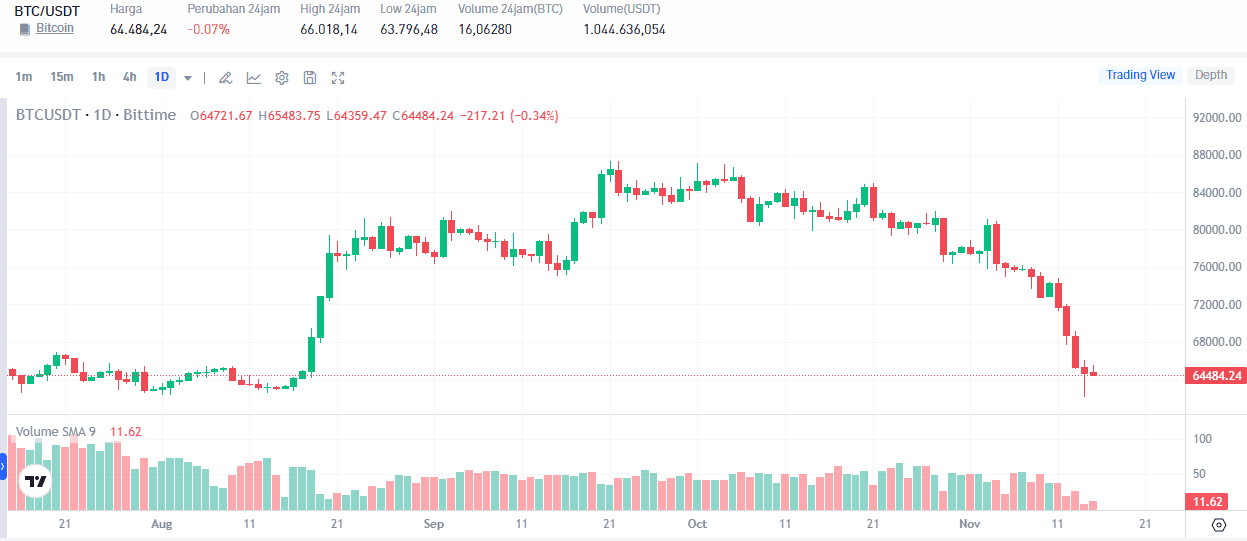
As the new week approached, Bitcoin began recovering toward US$65,000. However, the rebound was not enough to confirm that selling pressure had ended.
The following table summarizes reported market movements over that period.
These liquidation figures cover a specific 24-hour observation period over the weekend; they do not represent amounts that continued to apply to every subsequent 24-hour period.
Read also: Why Did Bitcoin Dump After the US Election? History and Causes
Why Did Bitcoin's Price Plunge?
Bitcoin's latest plunge cannot be explained by a single event. Several pressures emerged almost simultaneously, both within the crypto market and across the global financial system.
Five factors stood out:
- Large-scale leveraged liquidations, which accelerated the decline as long positions were forcibly closed.
- Spot Bitcoin ETF outflows, reflecting weaker demand among investors in ETF products.
- Pressure on AI stocks, particularly Nvidia, which added to concerns about technology company valuations.
- Federal Reserve interest rate expectations, which made investors more cautious about risk assets.
- Deteriorating market sentiment, which caused selling to spread across a wider range of cryptocurrencies.
Each factor plays a different role. Liquidations can amplify price movements within hours, while ETF fund flows and monetary policy have a greater influence on demand and the overall direction of market sentiment.
US$2 Billion in Crypto Liquidations: Why Were Long Positions Hit Hardest?
One of the biggest consequences of Bitcoin's decline was a wave of liquidations in leveraged trading.
During the 24-hour period reported over the weekend, total liquidated positions across the crypto market reached approximately US$2.02 billion. Of that amount, US$1.68 billion came from long positions, while roughly US$342.4 million came from short positions.
In other words, more than 80% of the liquidation value came from traders betting on higher prices.
The US$2.02 billion figure refers to liquidations across the entire cryptocurrency market, not Bitcoin alone. BTC-related position liquidations were estimated at approximately US$800 million in the report covering that period.
Why Does Leverage Make Price Declines More Severe?
Traders using leverage can open positions larger than their available capital. This strategy magnifies potential profits, but losses also grow more quickly when prices move against them.
For example, a trader with US$1,000 in capital might use 10x leverage to open a position worth US$10,000.
If the price falls 5%, the position would incur a simplified loss of US$500, equal to half the initial capital. This calculation excludes trading fees and the platform's margin requirements.
When losses approach the available collateral threshold, traders may receive a margin call or have their positions liquidated immediately, depending on the platform's rules.
Forced closures of long positions can add to selling pressure. If further price declines trigger additional liquidations, a chain reaction known as a liquidation cascade.
This is why Bitcoin's price movements can become especially violent when many traders use leverage in the same direction.
Read also: Do US Midterm Elections Affect Bitcoin (BTC) Prices?
Did Nvidia's AI Stock Help Trigger Bitcoin's Decline?
Amid the crypto market sell-off, Nvidia was among the technology companies attracting investors' attention.
On November 12, 2026, Nvidia announced the resignation of Jensen Huang from his positions as CEO and a member of the board of directors. Chief Financial Officer Colette Kress was subsequently appointed interim CEO.
The leadership change came ahead of Nvidia's earnings report, scheduled for November 17, 2026, US time.
Nvidia shares reportedly fell about 4.3% to US$166.19 on the day of the announcement. The move added uncertainty amid investor concerns about valuations and the AI industry's growth outlook.
As one of the most influential companies in the technology stock market, Nvidia can affect broader trading sentiment. When its shares come under pressure, investors may reassess positions in other assets sensitive to shifts in market confidence.
But does that mean Nvidia caused Bitcoin to fall?
Not necessarily. The fact that AI stocks and Bitcoin weakened around the same time does not, by itself, establish a direct cause-and-effect relationship.
Why Can Bitcoin and AI Stocks Fall at the Same Time?
Bitcoin and technology stocks belong to different markets, but both can be influenced by investors' appetite for risk.
When economic conditions appear favorable for growth, investors are generally more willing to allocate capital to assets with high potential returns, even if those assets are volatile.
Conversely, when uncertainty rises, some investors reduce their exposure to such assets.
This shift in behavior is known as risk-off sentiment.
Under these conditions, Bitcoin and technology stocks can both face selling pressure. The triggers may include interest rate expectations, liquidity needs, or investors' decisions to rebalance their portfolios.
However, Bitcoin's correlation with Nvidia and the Nasdaq is not constant over time.
For that reason, weakness in AI stocks is better viewed as one possible factor worsening sentiment, rather than the sole cause of Bitcoin's plunge.
Read also: AI Discovers Bitcoin Security Vulnerability: Is BTC at Risk?
Bitcoin ETF Outflows Add to Market Pressure
Beyond turbulence in technology stocks, waning interest in US spot Bitcoin ETFs was another development worth watching.
Over seven consecutive trading sessions from November 5 through 13, 2026, spot Bitcoin ETF products recorded approximately US$1.91 billion in net outflows.
On November 13 alone, net withdrawals totaled US$185.4 million.
These figures show that selling pressure was not limited to futures markets. Investors using ETF products to gain Bitcoin exposure were also reducing their holdings.
When capital leaves spot ETFs, fund managers may need to adjust the assets backing their ETF shares. This process can affect Bitcoin supply and demand in the market.
However, ETF outflows do not necessarily mean that fund managers are actively deciding to sell Bitcoin because they expect its price to keep falling.
Withdrawals may come from end investors who need liquidity, are rebalancing their portfolios, or prefer other investment vehicles.
That is why ETF flow data is more useful when considered alongside spot-market conditions, trading volume, and broader sentiment.
Read also: Cryptocurrencies Worth Watching in November 2026
How Do Federal Reserve Interest Rates Affect Bitcoin?
Macroeconomic conditions also weighed on markets in November 2026.
US inflation data for October showed consumer prices rising 0.4% month over month, while core inflation increased 0.3%.
These figures prompted investors to pay closer attention to the Federal Reserve's interest rate outlook, including the possibility of further tightening in December.
Why does this matter for Bitcoin?
When interest rates are expected to remain high or rise, financing costs tend to increase. Fixed-income investments may also appear more attractive than riskier assets.
These conditions can encourage investors to reduce their exposure to technology stocks and cryptocurrencies.
A stronger US dollar and rising government bond yields often accompany the same shift in market conditions.
It is worth remembering that asset prices can react to expectations before the Fed officially announces its decision.
As a result, investors watch not only the central bank's meeting outcomes but also changes in the market's expectations for future policy.
Bitcoin Support and Resistance Levels to Watch
After Bitcoin touched US$62,000, investors began watching whether the price could hold near that recent low.
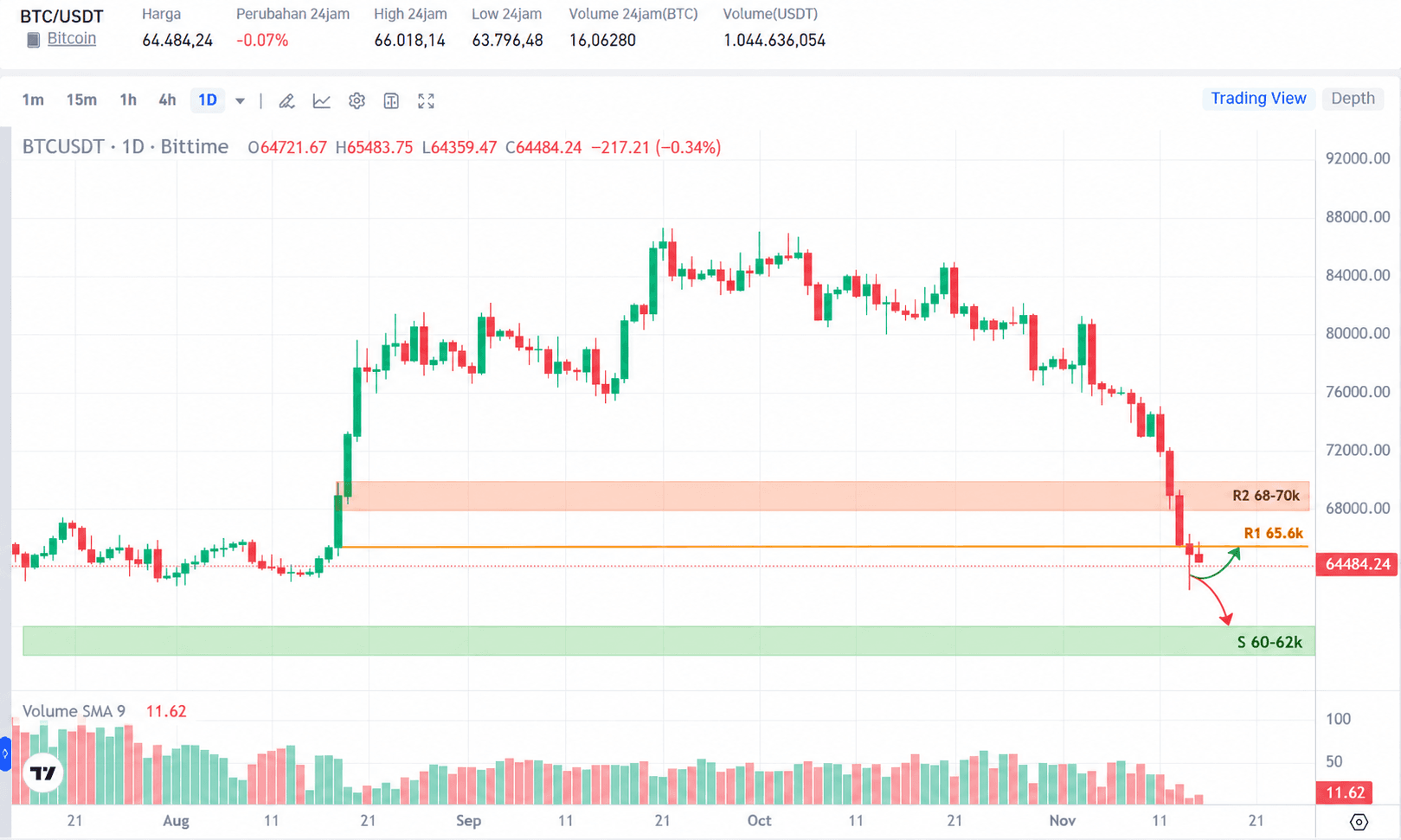
Several technical price zones can serve as reference points for potential future movements.
Support levels are areas where buying interest may emerge, while resistance levels are areas where selling pressure may appear.
However, neither acts as a guaranteed price boundary.
Bitcoin can break below support when selling intensifies or move above resistance if demand is strong enough.
That is why observing how prices react around these zones is more useful than assuming a single number will determine the market's direction.
Read also: Bitcoin Falls Below $73,000, Wiping Out Three Months of Gains
Could Bitcoin Fall Below US$60,000?
Bitcoin could still fall below US$60,000, particularly if selling pressure intensifies again.
Nevertheless, the weekend's price action alone is not enough to conclude that a deeper decline will occur.
There are three possible scenarios to watch.
1. Bitcoin Weakens Again
Pressure could continue if ETF outflows persist, technology stock sentiment deteriorates, and investors become more concerned about interest rate policy.
If Bitcoin loses the US$62,000 area again, US$60,000 could be one of the next levels tested by the market.
2. Prices Enter a Consolidation Phase
After a major liquidation wave, trading activity may enter a calmer phase.
In this scenario, Bitcoin could move within a relatively narrow range as buyers and sellers seek a new price equilibrium.
Consolidation does not necessarily mean the market will immediately rise or fall. The next directional move still needs support from trading activity.
3. Bitcoin Begins to Recover
A stronger recovery could develop if ETF-related pressure eases, macroeconomic conditions become more supportive, and spot demand starts to rise.
In this scenario, Bitcoin's ability to reclaim the US$65,600 to US$68,000 area could indicate improving momentum.
However, a price increase lasting only a few trading sessions is not enough to conclude that the downtrend has ended.
Read also: How Does an AI Bubble Affect Crypto? Can Bitcoin Hold Up?
5 Indicators Bitcoin Investors Should Monitor
When prices move sharply, focusing too heavily on a single level can cause investors to miss important market developments.
Five indicators can help provide a more complete picture.
- Bitcoin ETF flows: Are outflows continuing, or are they beginning to improve?
- Liquidations and open interest: Are leveraged positions still building up, or is liquidation pressure easing?
- Federal Reserve interest rate expectations: Is the market increasingly pricing in tighter policy, or is it beginning to anticipate easing?
- Nvidia and Nasdaq performance: Is sentiment toward technology stocks improving after the earnings report?
- BTC price action at key levels: Can Bitcoin hold the US$62,000 area and break through nearby resistance?
These five indicators complement one another, but none can provide certainty about the direction of prices.
For example, fewer liquidations can reduce automatic selling pressure. However, without fresh demand, Bitcoin's price may not recover immediately.
Likewise, even when ETFs begin recording inflows, the effect on prices still depends on broader market conditions.
How to Manage Risk During a Bitcoin Price Crash
Bitcoin's November 2026 decline showed that price movements can unfold far faster than expected, particularly in markets crowded with leveraged positions.
For traders, understanding risk is just as important as identifying opportunities.
Choosing a position size appropriate for available capital can help limit the impact of losses. Understanding margin requirements before opening futures trades is equally important.
High leverage increases position size, but it also brings the liquidation threshold closer.
Stop-loss orders can form part of a risk management strategy, although execution prices may differ from the specified level when volatility rises sharply.
For spot investors, decisions should account for investment goals, cash needs, and tolerance for price declines.
Opening a position simply because Bitcoin has already fallen substantially is not necessarily a sound decision.
If you want to follow Bitcoin prices, market flows, and the latest cryptocurrency news, you can sign up for Bittime to access market information and digital asset updates. Make sure every trading decision is based on your own research and appropriate risk management.
Conclusion
Bitcoin fell to US$62,000 in mid-November 2026 as selling pressure triggered approximately US$2 billion in liquidations across the crypto market.
The decline coincided with Bitcoin ETF outflows, growing uncertainty over Federal Reserve policy, and weakness in AI stocks such as Nvidia.
Although turbulence in technology stocks may have affected investor sentiment, there is insufficient evidence to identify Nvidia as the primary cause of Bitcoin's decline.
Bitcoin's next move will depend on how quickly demand returns, whether selling pressure eases, and how global market conditions evolve.
For investors, understanding these factors is more useful than simply guessing when prices will rise again.

Bittime is a licensed Digital Financial Asset Trader (PAKD) regulated and supervised by Indonesia's Financial Services Authority (OJK) — where you can buy Bitcoin in Indonesia and hundreds of other cryptocurrencies starting from IDR 10,000. Registration is quick and secure, and you can get started today.
Track the conversion rate for USDT to IDR and real-time price movements of your favorite cryptocurrencies. Everything is available in one crypto investment app that you can download for free from the Play Store.
Ready to get started? Sign up for Bittime now and put your investment strategy into action on a platform trusted by millions of users in Indonesia.
FAQ
Why did Bitcoin fall to US$62,000 in November 2026?
Bitcoin came under pressure from a combination of leveraged liquidations, spot ETF outflows, and concerns about US interest rate policy. Weakness in technology stocks also contributed to negative sentiment. However, no single factor has been proven to be the sole cause of the decline.
How much was liquidated during Bitcoin's plunge?
Approximately US$2.02 billion in leveraged positions was liquidated across the cryptocurrency market during the reported 24-hour period over the November 14–15, 2026 weekend. Of that total, US$1.68 billion came from long positions and US$342.4 million from short positions. These figures do not represent Bitcoin-only liquidations.
Did Nvidia's AI stock cause Bitcoin's price to fall?
Nvidia's weakness may have further dampened investor sentiment toward risk assets, including Bitcoin. Both can move in the same direction when markets face economic uncertainty. Even so, that relationship does not prove that Nvidia's share-price decline directly caused Bitcoin's drop.
Why do Bitcoin ETF outflows affect the crypto market?
Spot ETF outflows indicate net withdrawals from Bitcoin investment products. This can reduce demand and add market pressure, especially when investor sentiment is negative. The extent of the impact still depends on overall Bitcoin trading activity and liquidity.
Could Bitcoin fall below US$60,000?
That remains possible if selling pressure continues and Bitcoin fails to hold its nearest support zone. Conversely, improving ETF flows and stronger demand could help stabilize the price. There is not yet a sufficient basis to predict Bitcoin's next move with certainty.
Disclaimer: The views expressed belong exclusively to the author and do not reflect the views of this platform. This platform and its affiliates disclaim any responsibility for the accuracy or suitability of the information provided. It is for informational purposes only and not intended as financial or investment advice.

.png)