Float Airdrop: How Rewards from FLOAT Trading Fees Work
2026-10-29
One transaction, five distributions. That is how the Float trading fee works on the Float launchpad, a coin launch platform on Solana that pairs each coin with a tokenized stock. One portion of that fee is collected in a vault, then distributed through the FLOAT airdrop to traders with the largest transaction volume.
Key Takeaways
- Float is a Solana launchpad that pairs each coin with a tokenized stock, so holder rewards are paid in tokenized shares.
- Trading fees are split five ways: 15% holders, 5% creators, 35% FLOAT buyback and burn, 35% trader airdrop, and 10% treasury.
- The Float program has not been audited by a third party, and tokenized stock issuers can pause or move tokens.
What Is the Float Launchpad on Solana?
According to Float Docs, each coin on Float is paired with a tokenized stock, such as NVIDIA, Tesla, or McDonald's. Users transact using SOL. The site swaps SOL into tokenized shares while buying the coin in one step, so users do not need to hold the stock themselves.
Coins are launched on Raydium LaunchLab with a fixed supply of 1,000,000,000 and no mint or freeze authority. Initial market capitalization is around USD 20,000, with price moving along a bonding curve.
At an increase of about 7.5 times, or roughly USD 150,000, the coin graduates to a Raydium pool and its liquidity is permanently locked through Burn & Earn.
Creators may buy first in the same launch transaction, so no party can buy before them.
Because transactions use SOL, this asset needs to be prepared first. Register on Bittime to buy Solana and explore the tokenized stock market.
Read Also: Popular Tokenized Stocks 2026: Technology Stocks Become Investor Favorites
Float Trading Fee Distribution
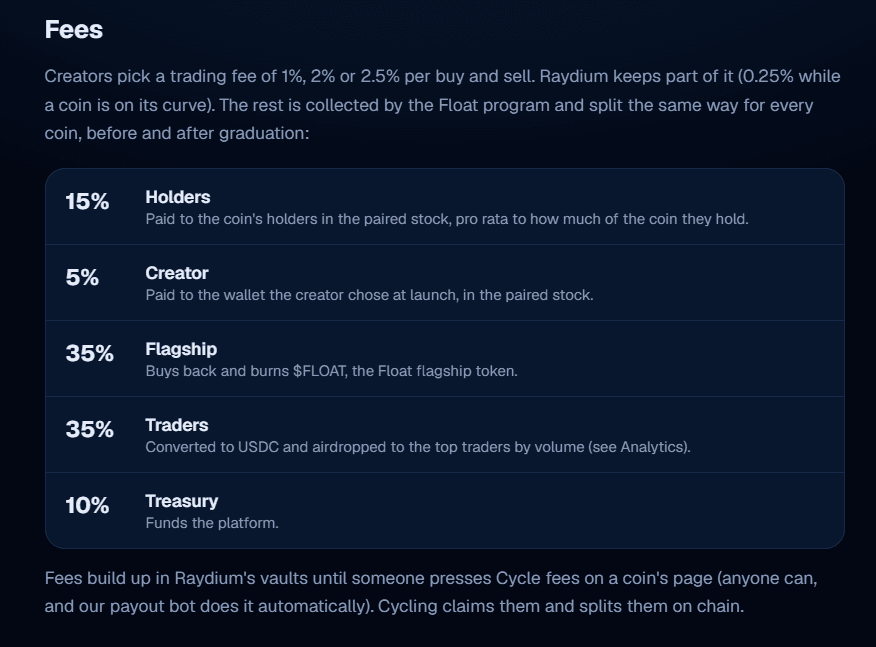
Creators choose a fee of 1%, 2%, or 2.5% for each buy and sell. Raydium takes a portion, namely 0.25% while the coin is still on the bonding curve. The remainder is collected by the Float program and split with the same proportions for all coins, both before and after graduation.
- 15% for holders, paid in the paired tokenized stock, proportional to the number of coins held
- 5% for creators, paid in the paired tokenized stock to the creator's chosen wallet
- 35% for flagship, used to buy back and then burn FLOAT tokens
- 35% for traders, converted to USDC and airdropped to top traders
- 10% for treasury, funding the platform
Fees accumulate in the Raydium vault until someone presses the Cycle fees button on the coin page. Anyone may do it, and Float's payment bot runs it automatically. The process claims fees and then splits them directly on the blockchain.
Read Also: Injective SICI: NVIDIA GPU Rental Futures with Leverage up to 10x
Float Airdrop Vault and Holder Rewards
The trader allocation is the core of the Float airdrop vault. Based on Float Docs, this portion is collected in a single vault containing USDC, then distributed to wallets with the largest trading volume. The leaderboard is available on the Float Analytics page.
Holder rewards work differently. The payment bot sends each coin's holder allocation every few minutes, in the form of the paired tokenized stock and proportional to ownership. Payments below USD 0.01 roll over to the next round.
Rewards go to the tokenized stock account already in the wallet, and that account is created automatically when users buy through Float. Each coin's page displays the amount of rewards already paid and still pending.
All of these mechanisms come from the project's documentation. The actual size of Float rewards depends on each coin's transaction volume, and this figure cannot yet be verified from independent sources.
FLOAT Token and Burn Mechanism
The FLOAT token is Float's flagship token. The 35% fee allocation is swapped to SOL, used to buy FLOAT, then burned automatically on the blockchain. Purchases are made little by little so that no single transaction moves the price too far.
FLOAT was launched separately on Raydium LaunchLab, and its own trading fees go to the Float developer wallet, not to the distribution above. Its contract address is listed in the documentation: Bv1a7cEj5aRnJQhMw4kRQqAFesMSd5LwcDnUzq52BMmr.
Match that address before transacting, because several other projects use the name Float or FLOAT.
Risks to Watch
Float itself calls the coins on its platform highly speculative. Most lose value, and all funds can be lost.
Several other risks come directly from its documentation:
- The Float program has not been audited by a third party, and upgrade authority is still held by the team's deployer key until moved to a multisig.
- Tokenized stocks are issued by third parties such as xStocks, Sunrise, and PreStocks. Issuers can pause transfers or move and burn tokens from any wallet. If the issuer pauses, trading and rewards for the paired coin also stop.
- Float is not affiliated with the companies that own the shares, and the coins grant no rights over those companies.
- When fees are cycled, traders who moved the price beforehand can take up to around 2% of that swap.
The platform is also relatively new, and there is no independent media coverage that can serve as a comparison.
Read Also: CoinDCX Hack: 15.99 Million USDT Gone, Initially Called a False Alarm
Conclusion
Float launchpad distributes trading fees to holders, creators, traders, FLOAT burn, and treasury, with the airdrop vault as a reward for the highest-volume traders. All mechanism data comes from the project documentation, while audit and issuer control risks for tokenized shares are real. Learn the risks before transacting. This article is not investment advice.
Check the prices of Bitcoin (BTC), Ethereum (ETH), XRP, Solana (SOL), GRAM, and BNB as well as leading memecoin DOGE. You can trade directly on Bittime!
Bittime is a Digital Financial Asset Trader (PAKD) platform licensed and supervised by the Financial Services Authority — where you can buy Bitcoin in Indonesia and hundreds of other crypto assets starting from Rp10,000. The registration process is fast, secure, and can be started today.
Monitor USDT to IDR conversion and your favorite crypto asset price movements in real time. All available in one crypto investment app that can be downloaded for free on the Play Store.
Ready to start? Register now on Bittime and execute your investment strategy with a platform trusted by millions of users in Indonesia.
FAQ
What is Float?
Float is a launchpad on Solana that pairs each new coin with a tokenized stock. Liquidity for graduated coins is permanently locked on Raydium.
How does the FLOAT airdrop work?
35% of fees are converted to USDC and collected in one vault. Its contents are distributed to wallets with the largest trading volume.
Who receives rewards from trading fees?
Holders, coin creators, top traders, and the platform treasury, plus FLOAT token burning. Holders and creators are paid in the paired tokenized stock.
Does holding a Float coin mean owning company shares?
No. The documentation states that the coins grant no rights over the company that owns the shares.
Has Float been audited?
Not yet. The Float program has not been audited by a third party, according to its official documentation.
Disclaimer: The views expressed belong exclusively to the author and do not reflect the views of this platform. This platform and its affiliates disclaim any responsibility for the accuracy or suitability of the information provided. It is for informational purposes only and not intended as financial or investment advice.

.png)