MUI Fatwa on Cryptocurrency: Haram, Halal, or Depends?
2026-03-10
The Indonesian Ulema Council (MUI) has issued an official fatwa on cryptocurrency through the 7th Indonesian Fatwa Commission Ulama Meeting held at the Sultan Hotel in Jakarta on November 11, 2021.
This decision is not merely an opinion, but rather a product of Islamic law produced by the highest forum of Islamic scholars in Indonesia after considering the evidence of the Quran, hadith, the opinions of classical scholars, and the current state of Indonesian regulations.
The answer is not black and white: the law on cryptocurrency according to the MUI depends on how it is used.
Key Takeaways
Cryptocurrency as a currency or means of payment is haram according to the MUI.
As a digital commodity or asset, it is not legally permissible to buy or sell unless certain conditions are met.
There is room for halal: if crypto meets the requirements of sil'ah according to sharia, has an underlying, and is free from gharar, then it is permissible to trade.
Register at Bittime now and start trading crypto with a fast, safe, and easy process in the app.
Context: Why Does MUI Need to Issue a Fatwa on Cryptocurrency?
Before understanding the contents of the fatwa, it is important to understand why a forum of scholars of the caliber of the Ijtima' Ulama felt the need to issue this decision.
Cryptocurrency has become an economic instrument used by millions of Indonesians, but its status under Islamic law has never been officially clarified at the national level.
In Indonesia, crypto is not recognized as a currency by the government, Law Number 7 of 2011 concerning Currency states that the only legal currency is the Rupiah.
However, BAPPEBTI, through Regulation Number 5 of 2019, recognizes crypto as a digital asset or commodity that can be legally traded on futures exchanges.
These two different legal statuses create confusion in society, and that is the space filled by the MUI fatwa.
The Ijtima' Forum also noted several real risks: crypto threatens the sovereignty of the country's official currency, is vulnerable to being used for money laundering, and at that time there was no official regulator or government-sponsored institution to guarantee crypto asset transactions.
Read also:MUI Fatwa on Crypto: Halal or Haram? Here's an Explanation from an Islamic Perspective
Three MUI Legal Provisions on Cryptocurrency
The MUI issued three interrelated legal provisions, and understanding all three together is key to not misinterpreting this fatwa.
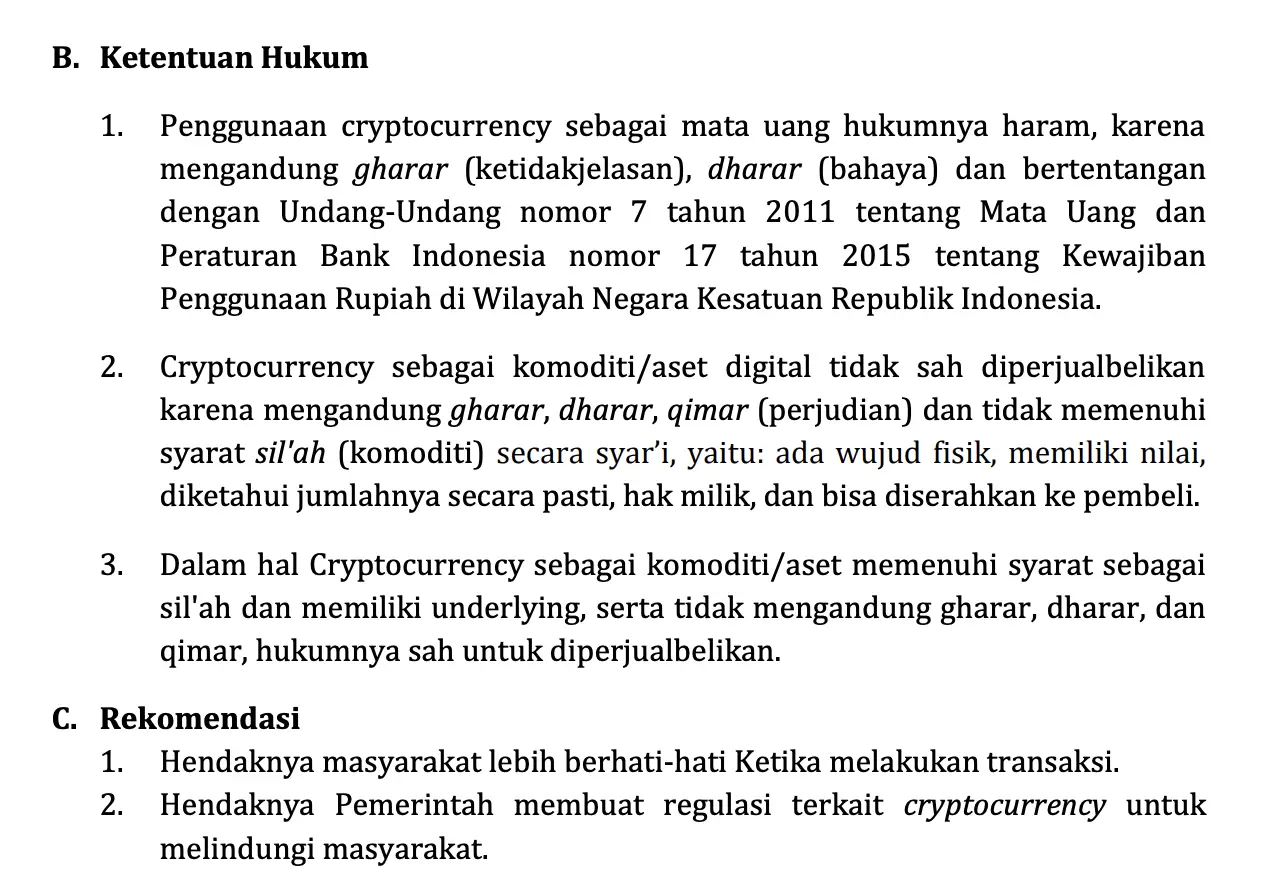
First Provision, As Currency: Haram
Using cryptocurrency as a currency or means of payment is haram (forbidden). The Indonesian Ulema Council (MUI) cited two main reasons.
First, it contains gharar (uncertainty) and dharar (danger) due to extreme price volatility, MUI said that there are crypto whose value can fall to zero.
Second, it is contrary to the laws and regulations in force in Indonesia, particularly the Currency Law and Bank Indonesia Regulations which require the use of Rupiah within the territory of the Republic of Indonesia.
Second Provision, As an Unconditional Commodity: Invalid
Cryptocurrency, as a commodity or digital asset, is not legally traded if it does not meet the requirements. The Indonesian Ulema Council (MUI) identified four main issues: it contains gharar (unlawful), dharar (unlawful), qimar (gambling), and it does not meet the requirements of sil'ah (Islamic law).
The conditions for sil'ah in Islamic jurisprudence include five things: it must have a physical form, have value, the amount must be known with certainty, be a property right, and can be transferred to the buyer.
Under standard conditions, most cryptocurrencies are considered to not fully meet these five requirements.
Third Provision, Subject to Certain Conditions: Valid
This is the provision that most often escapes public attention. The Indonesian Ulema Council (MUI) explicitly states that if a cryptocurrency meets the requirements for sil'ah (Islamic law), has an underlying asset, and is free from gharar, dharar, and qimar (unlawful), then it is legally permissible to trade.
This third provision opens up space for the future development of Sharia-compliant digital assets, such as tokens backed by real-world assets, with clear and measurable value, and operating within a regulated and transparent ecosystem.
This is also the basis for why discussions about Islamic crypto and the tokenization of Islamic assets continue to grow after this fatwa.
Legal Basis Used
MUI did not issue this fatwa without basis. Some of the main arguments used include QS. Al-Baqarah verses 278–280 on the prohibition of usury, QS. Al-Baqarah verse 188 on the prohibition of consuming wealth in a vain way, QS. An-Nisa verse 29 on the principle of mutual consent in trade, and QS. Al-Maidah verse 90 on the prohibition of gambling.
On the hadith side, Muslim's narration is used regarding the prohibition of gharar buying and selling, hadith regarding the conditions of mutual consent in transactions, as well as hadith regarding the exchange of usurious commodities which require equality and direct handover.
The opinions of classical scholars referred to include Imam Ghazali in Ihya Ulum al-Din, Ibn Hajar al-Haitami in Al-Zawajir, and Sheikh Ali Banjari in I'anat al-Thalibin, all emphasize that new transactions are considered valid if they meet the principles of justice, transparency, and are free from elements of fraud.
Read also:Are Islamic Coins (ISLM) Halal and Is It Legal in Indonesia?
What Does This Mean for Muslim Crypto Traders in Indonesia?
In practical terms, this MUI fatwa provides a relatively clear framework. UsingBitcoinor other crypto as a direct means of payment, paying for goods or services with Bitcoin for example, falls into the forbidden category.
Trading crypto on exchanges without meeting the sil'ah requirements is also in an illegal area.
However, the MUI does not rule out digital assets with a real underlying asset, clear valuation, a defined delivery mechanism, and freedom from extreme speculation.
How to Buy Crypto on Bittime?

Want to trade sell buy Bitcoins and crypto investment easily? Bittime is here to help! As an Indonesian crypto exchange officially registered with Bappebti, Bittime ensures every transaction is safe and fast.
Start with registration and identity verification, then make a minimum deposit of IDR 10,000. After that, you can immediately buy your favorite digital assets!
Check the exchange rate BTC to IDR, ETH to IDR, SOL to IDR and other crypto assets to find out today's crypto market trends in real-time on Bittime.
Also, visit the Bittime Blog for interesting updates and educational information about the crypto world. Find reliable articles about Web3, blockchain technology, and digital asset investment tips designed to enrich your crypto knowledge.
FAQ
Is cryptocurrency haram according to MUI?
As currency or a means of payment, it is haram. As a commodity that doesn't meet sharia requirements, it's also illegitimate, but a third provision provides a halal loophole.
When can crypto be halal according to MUI?
If it meets the requirements of Islamic law, has real underlying assets, and is free from elements of gharar, dharar, and qimar, then it is permissible to buy and sell.
What is gharar in the context of crypto?
Gharar is uncertainty or excessive speculation, in crypto, MUI refers to extreme volatility that can cause the value of an asset to fall to zero.
When will the MUI fatwa on crypto be issued?
This fatwa was issued on November 11, 2021, through the 7th Indonesian Fatwa Commission Ulama Meeting at the Sultan Hotel, Jakarta.
Does this fatwa prohibit all crypto activities?
No. The Indonesian Ulema Council (MUI) only prohibits the use of crypto as a means of payment and trade unconditionally; crypto that meets Sharia standards remains valid.
Disclaimer: The views expressed belong exclusively to the author and do not reflect the views of this platform. This platform and its affiliates disclaim any responsibility for the accuracy or suitability of the information provided. It is for informational purposes only and not intended as financial or investment advice.

.png)