US CPI October 14, 2026: Impact on Bitcoin Price
2026-10-13
Bitcoin CPI in October 2026 is attracting investors' attention ahead of the release of US inflation data on Wednesday, October 14, 2026, at 7:30 PM WIB. The data measures changes in consumer prices during September 2026, meaning it is not an inflation report for October. The results could influence interest rate expectations for The Fed and sentiment in the crypto market, particularly if the actual figures differ from economists' forecasts.
Ahead of the announcement, investors should compare the latest actual inflation figures, market consensus, and Bitcoin's condition before the release. August data showed annual US inflation at 3.4%, while annual core inflation reached 2.4%.
The market is now awaiting September's figures to assess whether price pressures have intensified again and how developments could affect monetary policy at the Federal Open Market Committee (FOMC) meeting in late October.
Key Takeaways
- The US CPI report for September 2026 is scheduled for release on October 14 at 7:30 PM WIB, while the latest actual figures available before the announcement are from August.
- Pre-release consensus forecasts annual headline inflation rising to 3.7%, making the difference between the actual result and expectations a key focus for the market.
- Bitcoin could move in either direction after the announcement because market reactions are also influenced by interest rate expectations, the US dollar, Treasury yields, liquidity, and investor positioning.
October 2026 US CPI Schedule and Data Period
The US Bureau of Labor Statistics (BLS) has scheduled the September Consumer Price Index (CPI) release for Wednesday, October 14, 2026, at 8:30 AM Eastern Time. Since the United States will still be observing Eastern Daylight Time on that date, the release time corresponds to 7:30 PM WIB on the same day.
Read also: Crypto Futures Regulations in Indonesia, the US, Europe, and Asia: A Complete Guide
Latest US Inflation Data: Headline and Core CPI
The CPI measures changes in the prices of goods and services purchased by consumers. This data helps illustrate cost-of-living pressures and serves as one of the indicators market participants monitor when assessing the direction of monetary policy.
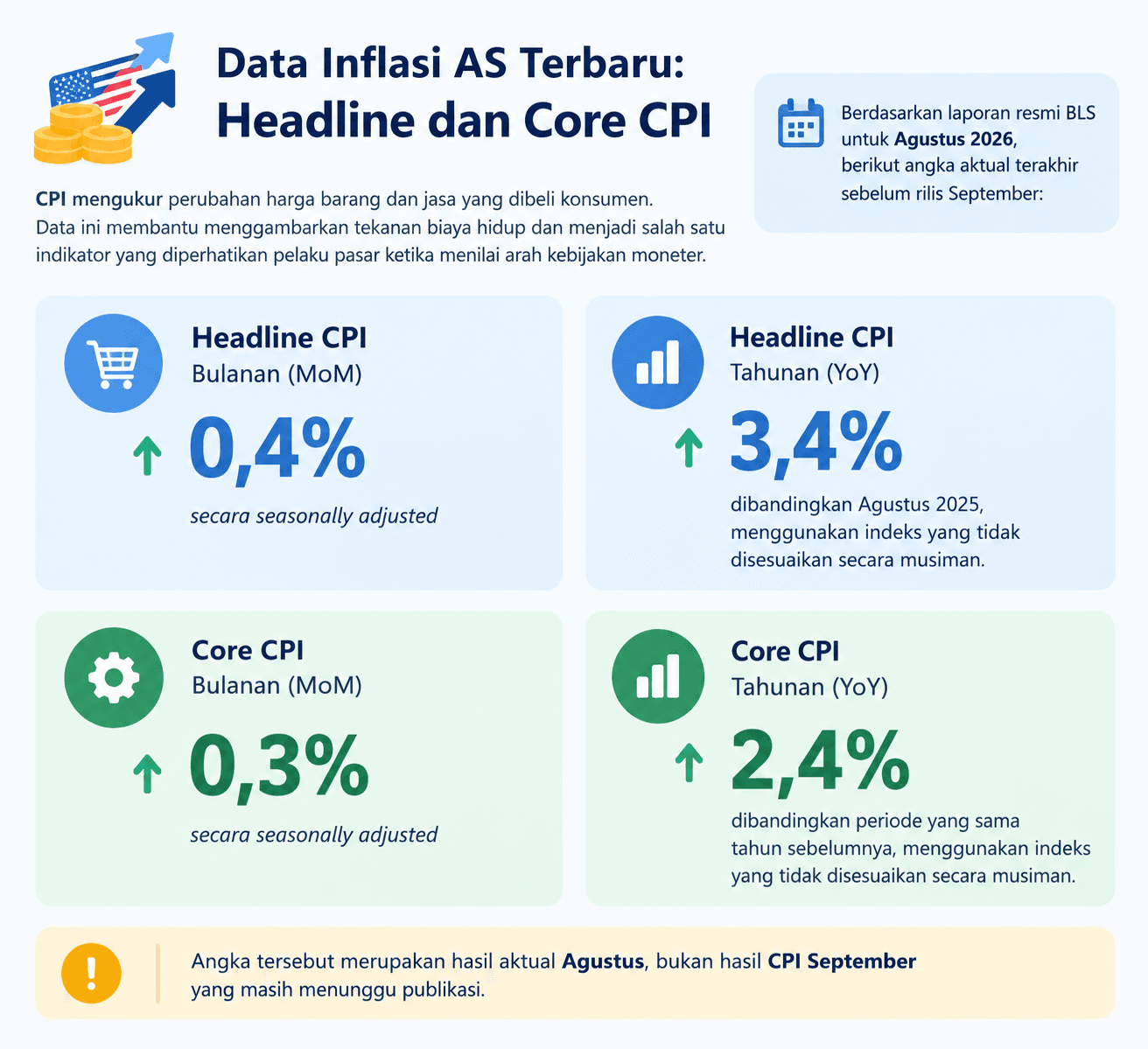
According to the official BLS report for August 2026, the following were the latest actual figures before the September release:
- Monthly headline CPI (MoM): rose 0.4% on a seasonally adjusted basis.
- Annual headline CPI (YoY): rose 3.4% compared with August 2025, using a non-seasonally adjusted index.
- Monthly core CPI (MoM): rose 0.3% on a seasonally adjusted basis.
- Annual core CPI (YoY): rose 2.4% compared with the same period a year earlier, using a non-seasonally adjusted index.
These figures are the actual August results, not the September CPI results, which are still awaiting publication.
What Is the Difference Between Headline CPI and Core CPI?
Headline CPI includes all components of the index, including food and energy. Its movement can be affected by changes in gasoline, electricity, food, housing, and other consumer spending categories.
Core CPI excludes food and energy, whose prices tend to be more volatile. This measure helps analysts assess broader price pressures, although it does not capture the entire picture of consumer living costs.
Investors should also distinguish between two measurement methods:
- Month-over-month (MoM): the change in prices compared with the previous month.
- Year-over-year (YoY): the change in prices compared with the same month in the previous year.
An increase in monthly inflation does not necessarily mean annual inflation will rise by the same amount. The year-over-year comparison is influenced by price changes during the corresponding period in the previous year.
Read also: Digital Financial Assets and Crypto Assets Handbook 2.0
Market Consensus Ahead of the CPI Release
According to a Reuters report dated October 9, 2026, economists' consensus forecast annual headline CPI for September at 3.7%, up from 3.4% in August. Annual core inflation was expected to reach 2.5%, compared with 2.4% in the previous month.
A MarketWatch report on October 12 also cited forecasts for a 0.6% monthly increase in headline CPI and a 0.2% monthly increase in core CPI. These monthly figures come from different reports and consensus contexts, so their sources and publication times should be rechecked before they are used to evaluate the post-release results.
Consensus forecasts are not official results and may change before the announcement. For a disciplined analysis, record the forecast figures and their source dates, then compare them with the actual figures published by the BLS.
Relevant comparisons include:
- The actual results versus the latest consensus before the release.
- Changes in headline and core CPI, both MoM and YoY.
- The US dollar's reaction and Treasury yields after the data is announced.
- Bitcoin's movement over a consistent time window before and after the release.
Read also: Latest Indonesian Crypto Taxes in 2026: A Complete CARF Guide
Historical Comparison of Bitcoin's Reaction to US CPI Releases
Historical data shows that Bitcoin's reaction following US CPI releases does not consistently follow a single pattern. Based on an analysis of 68 CPI releases between 2021 and 2026, BTC recorded a median average gain of around 1.1% on the following day, with 65% of observations ending in positive territory.
However, the same research states that this pattern does not demonstrate a clear advantage over ordinary trading days. Therefore, it cannot be used as evidence that CPI releases consistently drive Bitcoin prices higher.
Different responses were also observed following several releases in 2026. After the US CPI was released on August 12, Bitcoin fell by around 0.17% the following day, whereas after the July 14 release, BTC rose by approximately 3.9% the following day.
These figures use the same source's daily price-change methodology rather than measuring price movements in the minutes immediately following the announcement.
This comparison shows that the direction of inflation alone is insufficient to explain BTC price movements. Investors need to assess actual results against consensus, changes in interest rate expectations, movements in the US dollar, Treasury yields, and market conditions at the time of release.
Price movements following the announcement are not automatically caused by CPI, as other economic and geopolitical factors may influence prices at the same time.
Read also: Bitcoin Gains Over a Week as Bittime Highlights US Crypto Regulations as an Investor Focus
Why Does CPI Affect Bitcoin Prices?
CPI generally affects Bitcoin through changes in monetary policy expectations and market liquidity conditions. When inflation comes in higher than expected, investors may conclude that interest rates need to remain elevated for longer or that monetary policy may need to be tightened.
These expectations may push the US dollar or US government bond yields higher. If financial conditions tighten, some investors may reduce their exposure to risk assets, including Bitcoin.
Conversely, inflation below expectations may ease pressure to maintain tight monetary policy. This shift in expectations could support risk appetite, but it does not guarantee a Bitcoin price increase.
The relationship does not always move in one direction. Markets often price in some information before its release, while economic conditions, capital flows, liquidity, and geopolitical news can change investor reactions.
CPI is also not the only inflation indicator monitored by the Fed. The US central bank expresses its long-term inflation target in terms of PCE (Personal Consumption Expenditures), while CPI remains an important source of information for assessing economic conditions.
Read also: Will the Clarity Act Have a Major Impact on the Crypto Market in 2026?
Bitcoin CPI in October 2026: Three Market Scenarios
1. CPI Comes in Higher Than Expected
If headline or core CPI exceeds consensus, the market may view inflationary pressures as more persistent than previously expected. This could strengthen expectations of tighter monetary policy, particularly if increases occur across a broad range of components rather than being driven solely by temporary factors.
In this scenario, the US dollar and Treasury yields could strengthen. If both rise alongside declining risk appetite, Bitcoin may face selling pressure or increased volatility.
However, a higher CPI reading does not automatically mean BTC will fall. If the market has already anticipated a higher figure, or the composition of the data is considered less concerning, the price reaction may differ from initial expectations.
2. CPI Matches Expectations
If the actual figures are close to consensus, Bitcoin's reaction will depend on how much of that information the market has already priced in. Data that matches expectations may trigger limited movement, but it can also cause volatility as investors adjust positions established before the announcement.
The composition of inflation remains important. An increase in headline CPI driven by temporary energy price movements alongside a slowdown in core CPI may be interpreted differently from a broad-based increase across core categories.
Investors should not assume that a result matching consensus guarantees a calm market. Leveraged position liquidations, changes in bond yields, or other simultaneous news may still trigger sharp movements.
3. CPI Comes in Lower Than Expected
If inflation comes in below consensus, expectations of looser monetary policy could support risk assets. If the US dollar and Treasury yields also weaken, these conditions could provide a supportive factor for Bitcoin.
Nevertheless, investors need to assess the source of the decline in inflation. A slowdown caused by easing price pressures may send a different signal from a decline that coincides with deteriorating economic activity.
A lower CPI reading also does not automatically trigger a BTC rally. Prices may remain under pressure if investors face geopolitical uncertainty, capital outflows, declining liquidity, or other more dominant factors.
CPI's Relevance to the October 2026 FOMC Meeting
The Federal Reserve has scheduled its FOMC meeting for October 27–28, 2026. Therefore, the September CPI release on October 14 will be available before the meeting and could serve as one of the inputs used to assess economic conditions.
Inflation is not the sole basis for interest rate decisions. The Fed also evaluates labor market conditions, economic growth, inflation expectations, and risks to achieving its mandate.
It is important to distinguish CPI from PCE. The Fed's long-term inflation target is expressed using a 2% PCE inflation rate, not a 2% CPI target. Therefore, a single CPI report is insufficient to conclude that the Fed will definitely raise, lower, or maintain interest rates.
The schedule and policy documents can be checked on the Federal Reserve's monetary policy page. Investors should also monitor statements from central bank officials and other economic data available before the meeting.
Read also: AI Bitcoin vs. Ethereum Price Prediction: Scenarios for a Move Toward ATH
Bitcoin Price Conditions Ahead of the Release
Ahead of the CPI announcement, BTC prices should be monitored alongside changes in other markets, rather than assessed solely by the direction of price movements. Historical daily data from Investing.com recorded Bitcoin closing at approximately US$83,501.90 on October 13, 2026, with a daily change of +2.03% in the displayed data.
For comparison, an intraday Reuters report at 01:44 UTC on October 13 recorded Bitcoin falling around 0.4% to US$82,705.08. These figures come from different observation times and contexts, so they should not be treated as prices recorded at the same timestamp.
These differences highlight the importance of recording timestamps when discussing Bitcoin's price today. Before the release, recheck the latest price, 24-hour change, trading volume, and time zone used by the source.
What Investors Should Watch
Before and after the CPI release, use the following checklist to assess the information in a more structured way.
- Actual results versus consensus: determine whether the data is above, below, or in line with expectations.
- Headline versus core: check whether inflation changes originate from energy, food, or broader components.
- US dollar and Treasury yields: observe whether the dollar and bond yields move in line with the market's interpretation of the data.
- Volume and liquidity: check whether price movements are accompanied by increased trading activity.
- Derivatives positioning: where available, monitor funding rates, open interest, and liquidations using sources with clear timestamps.
- Institutional flows: use ETF or investment product flow data only when its date and methodology can be verified.
- Other news: account for geopolitical developments, trade policies, stock market conditions, and other macroeconomic news.
These indicators help establish context rather than provide certainty about price direction. For example, derivatives data showing numerous leveraged positions is not sufficient to determine when or in which direction liquidations will occur.
If you want to use Bittime, you can register and explore the available crypto assets market. Understand the fees and risks before trading.
Conclusion
The October 2026 Bitcoin CPI release is an important event to monitor because September's inflation results could change market expectations for Fed policy ahead of the October 27–28 meeting. However, the impact on BTC will depend not only on the inflation figures but also on the difference between actual results and consensus, the composition of the data, movements in the US dollar, Treasury yields, and broader market conditions.
Investors should check the official BLS release after the announcement on October 14 at 7:30 PM WIB, then compare the actual figures with forecasts documented before the release. Use the results to evaluate risk rather than as the sole basis for trading decisions.\ \

Bittime is a licensed and regulated Digital Financial Asset Trader (PAKD) supervised by Indonesia’s Financial Services Authority (OJK) — where you can buy Bitcoin in Indonesia and hundreds of other crypto assets starting from just Rp10,000. The registration process is fast, secure, and you can get started today.
Track USDT to IDR conversions and monitor your favorite crypto assets in real time. Everything is available in one crypto investment app that you can download for free on the Play Store
Ready to start? Register now on Bittime and execute your investment strategy with a platform trusted by millions of users in Indonesia.
FAQ
When Will the October 2026 US CPI Be Released in WIB?
The US CPI for September 2026 is scheduled for release on Wednesday, October 14, 2026, at 7:30 PM WIB. The official BLS schedule lists the release time as 8:30 AM Eastern Time.
Does the October Release Contain Inflation Data for September 2026?
Yes. The October release measures changes in consumer prices during September 2026. The publication month and the data period are two different things.
Why Can US CPI Affect Bitcoin Prices?
CPI can change interest rate expectations, which in turn affect the US dollar, Treasury yields, and investors' risk appetite. Bitcoin may react to these changes, but its price does not always move in the same direction after every release.
Does Lower CPI Guarantee That Bitcoin Will Rise?
No. Lower inflation may support risk assets, but Bitcoin remains influenced by liquidity, derivatives positioning, capital flows, economic conditions, and geopolitical developments.
How Does CPI Affect the Fed's Interest Rate Expectations?
Inflation above expectations may strengthen the case for maintaining tight monetary policy, while slowing inflation may ease that pressure. The Fed continues to consider PCE, employment, economic growth, and other risks before making a decision.
Disclaimer: The views expressed belong exclusively to the author and do not reflect the views of this platform. This platform and its affiliates disclaim any responsibility for the accuracy or suitability of the information provided. It is for informational purposes only and not intended as financial or investment advice.

.png)