CATGENT Uses AI to Trade and Collect CASHCAT
2026-08-13
Experiments combining Crypto AI, autonomous agents, and meme coins continue to grow.
One of the projects that emerged in Robinhood Chain is CATGENT, a system that designed so that token trading activities do not depend solely on human manual decisions.
The main concept CATGENT is quite different: the fees generated by CATGENT are used as working capital for agents to look for opportunities in new tokens, then part of the results obtained are directed to accumulateCASHCAT.
The project documentation mentions CASHCAT as the ultimate goal of the system, while ETH used as operational capital.
However, CATGENT remains a high-risk meme coin project.
The documentation itself confirms that the CASHCAT accumulation target is not a prediction of success and the strategy used operates on a new pool with high volatility.
Key Takeaways
CATGENT AIusing autonomous trading agent that evaluates new tokens using volume, momentum, pool depth, fees, and entry time.
The profits generated are directed tocumulativeCASHCAT, with project targetsreaching 10 million CASHCAT or 1% of the total supply which is said to be 1 billion tokens.
CATGENT has a stop loss mechanism, initial capital withdrawal, scaling out, position cap, daily loss limit, and kill switch to limit agent risk.
What is CATGENT AI?
Source: catgent.xyz
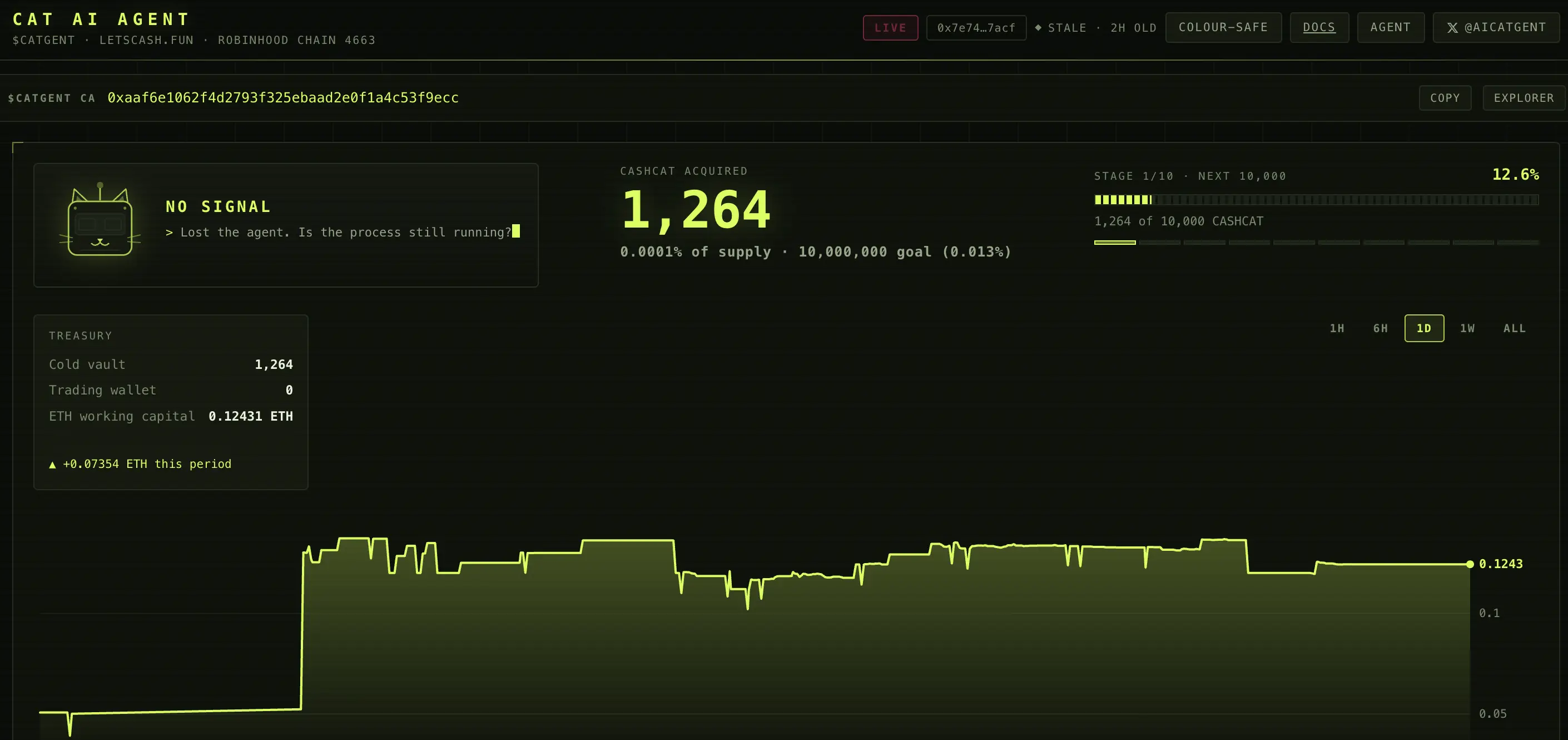
CATGENT orCat AI Agentis a meme coin projectand an autonomous execution system built for the letscash.fun ecosystem on Robinhood Chain.
The official website describes the agent as a continuous process with its own ledger and can be connected to a dashboard to view positions, targets, transactions, treasury, and even the reasons behind trading decisions.
Term CATGENT AIneed to be understood properly.
There is more public documentation explaining scoring systems, rule-based execution, risk filters, and decision automation rather than explaining the use of specific machine learning models or large language models.
Therefore, CATGENT can be viewed as an autonomous trading agent with transparent automated decision mechanism based on predefined on-chain parameters.
Read Also: AI Agents & Arbitrage Bots in Polymarket: How Intelligent Machines Make Profits
How CATGENT Works: From Fees to Cash
Source: catgent.xyz
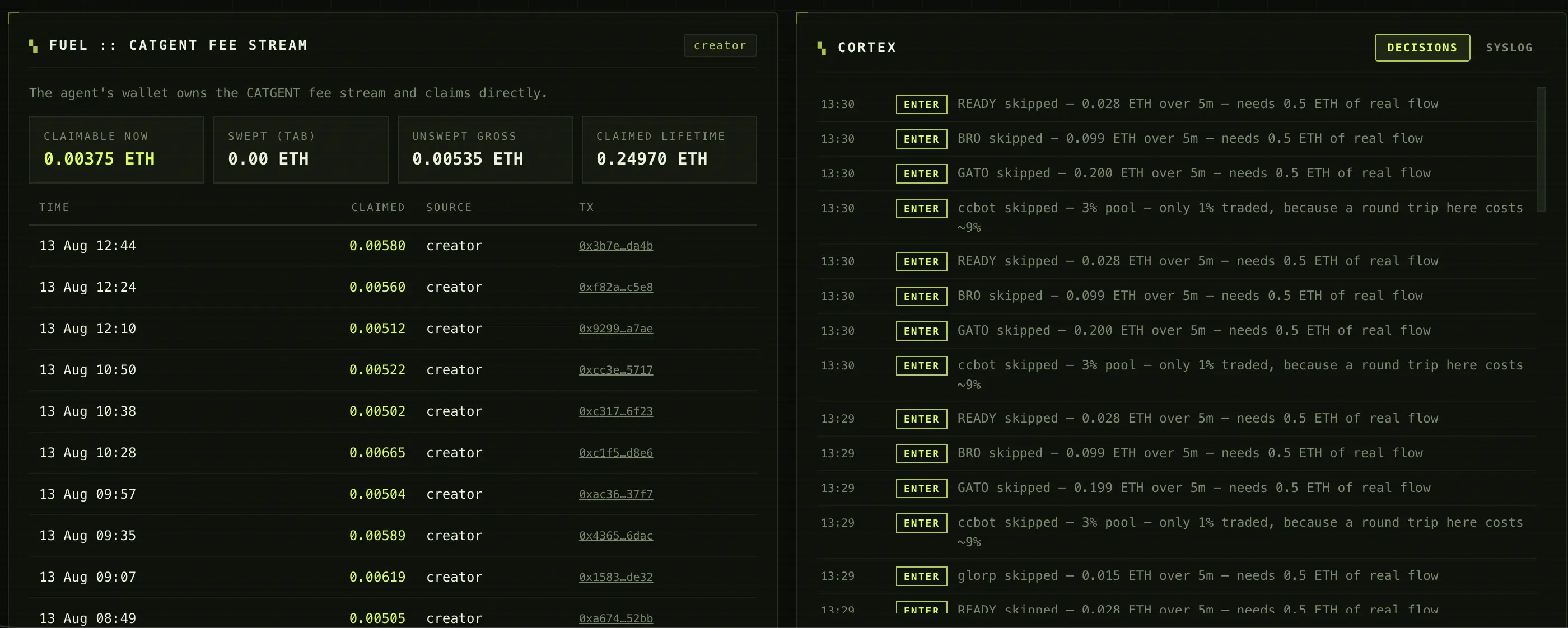
MechanismHow CATGENT worksstarted whenCATGENT trading activities generate creator fees in the form of ETH.
Instead of the entire fee going into the developer's wallet, the project states the fee is used to fund trading agents.
The agent then scans the new tokens on letscash.fun and looks for candidates that meet its criteria.
If the trade generates a profit, the surplus can be converted become CASHCAT, then the CASHCAT obtained transferred to a cold wallet that cannot be accessed again by the trading agent.
The flow is simply:
Trading CATGENT → creator fee in ETH → agent capital → trading new tokens → profit → purchase CASHCAT → cold wallet.
The project target is to collect 10 million CASHCAT.
Blockscout notes the total supply of CASHCAT is 1 billion tokens, so the target is equivalent to approximately 1% of the supply.
For those of you who want to know the crypto market more broadly, you can Register at Bittime and study the available crypto assets before making an investment decision.
How Does CATGENT Choose Tokens for Trading?

Source: catgent.xyz
The interesting part ofAI trading crypto CATGENT terlThe impact on the candidate screening process. Agents don't simply buy all newly launched meme coins.
CATGENT documentation states that each candidate receives a score of 0–100 based on six factors.
The biggest factors are volume acceleration with a weighting of 24%, then five-minute momentum 20%, absolute volume 16%, pool depth 14%, fee drag 14%, and entry timing 12%.
Momentum is also not treated simply.
Extreme price increases can actually lower scores because agents try to avoid buying when prices are near short-term peaks.
Read Also: 10+ Best AI Coins 2026: Here's a List of Artificial Intelligence-Themed Cryptocurrencies!
CATGENT Doesn't Just Rely on Scores
Before a transaction is executed, there are a number of conditions that can immediately cancel the entry.
Agents can reject tokens if the pool is too shallow, the transaction impact on the price is too large, price data is insufficient, or the potential profit is estimated to be insufficient to cover transaction costs and fees.
This approach is important in the market because the liquidity of new tokens can be very thin.
Even relatively small capital movements can create a high price impact and make it difficult to resell a position at the desired price.
How Does the CATGENT Exit Strategy Work?
After purchasing tokens,CATGENT CASHCATusing a tiered exit mechanism.
OnIn the initial stage, capital is still considered at risk so that stop losses remain active and positions that fail to cover transaction costs within a certain time can be closed.
When the position value reaches around 2x, the system is designed to take back the initial capital taking into account the fee.
Once the initial capital is returned, normal stops are disabled and some positions can be left running longer.
The agent then scales out at several levels such as 3x, 5x, and 10x.
Approximately 20% of positions are designated as “moonbags” that are not sold solely on price increases, unless market flow conditions deteriorate or the exit mechanism no longer works.
Read Also: 5 Best AI Tokens for Crypto Futures Trading
CASHCAT Becomes a Goal, Not Just a Trading Asset
In the CATGENT architecture, ETH is the working capital while CASHCAT becomes an asset that you want to continue collecting.
The CASHCAT that has been obtained is sent to a cold wallet, while the agent only knows the destination address and does not hold the private key to withdraw the funds.
CASHCAT itself is a meme coin on Robinhood Chain with a supply of 1 billion tokens.
The letscash.fun ecosystem also has its own mechanism where a portion of the platform fees are used to buy and burn CASHCAT, separate from the CATGENT trading strategy.
Looking for opportunities with trending meme coins? Keep an eye on and buy DOGE, PEPE, WIF, and FLOKI—only on Bittime
What is the function of CATGENT Token?
CATGENT token acts as a token that moves the fee stream towards the agent while also being related to the holder reward mechanism.
The project documentation states that when a CASHCAT accumulation milestone is reached, 5% of the milestone value is allocated to CATGENT holders through a specific wallet selection mechanism.
To qualify for the reward mechanism, the documentation lists a minimum holding of 50,000 CATGENT.
The winner is designed to be selected through a deterministic function using a block hash so that the results can be verified.
CATGENT Already Traded?
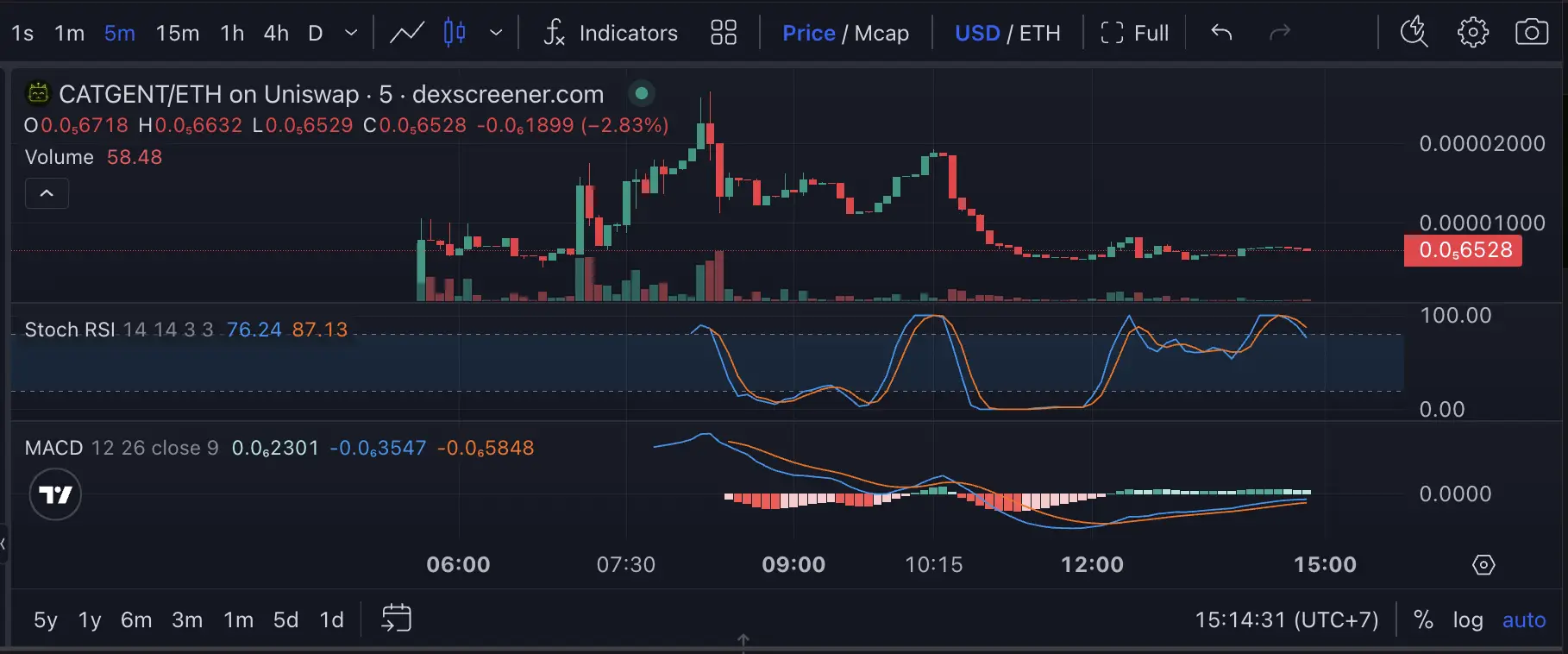
At the time of checkingAugust 13, 2026, Dexscreener displays the pairCATGENT/ETH in Uniswap v4 on Robinhood Chain, complete with transaction activities and liquidity.
However, the CATGENT dashboard still displays the message “not launched yet” in the contract address section, so there is a lack of synchronization between the project page and market data that needs to be considered.
Since this pair is still very new and liquidity is relatively thin at the time of checking, price swings can be extreme.
Price, volume, and liquidity data may also change rapidly after this article is published.
Read Also:What Are AI Cryptocurrencies? 9 Popular AI Coins to Watch in 2026
Is CATGENT Worth Paying Attention To?
CATGENT offers a unique experiment on howCrypto AIand automatedexecution can be linked to the meme coin economy.
Instead of treating the token as a mere speculative asset, the project attempts to make the token fee a source of capital for autonomous trading agents aiming to accumulate CASHCAT.
However, the existence of trading algorithms, stop losses, or scoring systems does not eliminate risk.
CATGENT's own documentation states that most new tokens can fall to zero and acknowledges that agents cannot know the developer's intentions, including the possibility of the developer suddenly selling tokens.

Don’t miss out on the meme coin craze! Trade DOGE, SHIB, PEPE, WIF, and BONK easily through Bittime
Bittime is a licensed and regulated Digital Financial Asset Trader (PAKD) supervised by Indonesia’s Financial Services Authority (OJK) — where you can buy Bitcoin in Indonesia and hundreds of other crypto assets starting from just Rp10,000. The registration process is fast, secure, and you can get started today.
Track USDT to IDR conversions and monitor your favorite crypto assets in real time. Everything is available in one crypto investment app that you can download for free on the Play Store
Ready to start? Register now on Bittime and execute your investment strategy with a platform trusted by millions of users in Indonesia.
FAQ
What is CATGENT AI?
CATGENT is an autonomous trading agent and meme coin on Robinhood Chain designed to use creator fees as capital for trading new tokens, then direct the proceeds to accumulate CASHCAT.
What is CASHCAT in CATGENT?
CASHCAT is the primary asset targeted for accumulation by CATGENT agents. The project aims to own 10 million CASHCAT, or approximately 1% of the 1 billion token supply.
How does CATGENT work?
Agents earn capital from CATGENT creator fees, search for new tokens based on a number of on-chain indicators, execute transactions that pass the filter, take profits gradually, and then convert a certain surplus into CASHCAT.
Does CATGENT really use AI?
The project calls its product the Cat AI Agent and autonomous execution unit. However, currently available public documentation primarily describes the scoring algorithm, trading rules, and risk controls, not the specific machine learning architecture.
Is CATGENT safe for investment?
There are no guarantees. CATGENT is a meme coin with a strategy that operates on new, high-risk tokens and pools, and its official documentation warns that most new launches can lose value.
Disclaimer: The views expressed belong exclusively to the author and do not reflect the views of this platform. This platform and its affiliates disclaim any responsibility for the accuracy or suitability of the information provided. It is for informational purposes only and not intended as financial or investment advice.

.png)