How to Determine Entry and Exit Prices in Futures Trading
2026-07-27
Determining entry and exit prices for futures isn’t simply a matter of choosing a price that seems cheap or closing a position once a profit has been made. In futures trading, both of these levels must be planned based on market structure, your risk tolerance, and reasonable profit targets.
Without a clear plan, trading decisions can easily be swayed by fear, greed, or short-term price movements.
Key Takeaways
- Futures entries should be based on specific technical triggers, not hunches or simply following price movements.
- Stop loss and take profit need to be determined before a position is opened to ensure that the risk of each transaction remains under control.
- A good exit is not only about chasing profits, but also establishing when the analysis is no longer considered valid.
What are Futures Entry Price and Futures Exit Price?
Entry price futures is the price at which a trader opens a position in a futures contract. Traders can open a long position when they expect the price to rise or a short position when they expect the price to fall.
Meanwhile, exit price futures is the price at which the position is closed. Positions can be closed due to the profit target being reached, the loss limit being reached, market conditions changing, or the original reason for opening the position no longer being valid. Therefore, an exit does not always mean a profit. An exit can also bet is an action to limit losses.
The main difference between entry and exit lies in their function:
- Entry determines the starting point of exposure to market movements.
- Exit determines the final outcome of the position.
- Entry is related to opportunity validation.
- Exit is related to realizing profits or controlling losses.
In futures trading, this decision becomes even more crucial because the use of leverage can magnify both profits and losses. Derivative products are also complex and not always suitable for traders who don't yet understand how margin, liquidation, and position sizing work.
Read also: How to Calculate Futures Funding Fees: Long and Short Formulas
How to Determine a More Measured Futures Entry
No single entry point is always successful. The goal of a trader isn't to find the perfect point, but rather to develop a method that can be applied consistently.
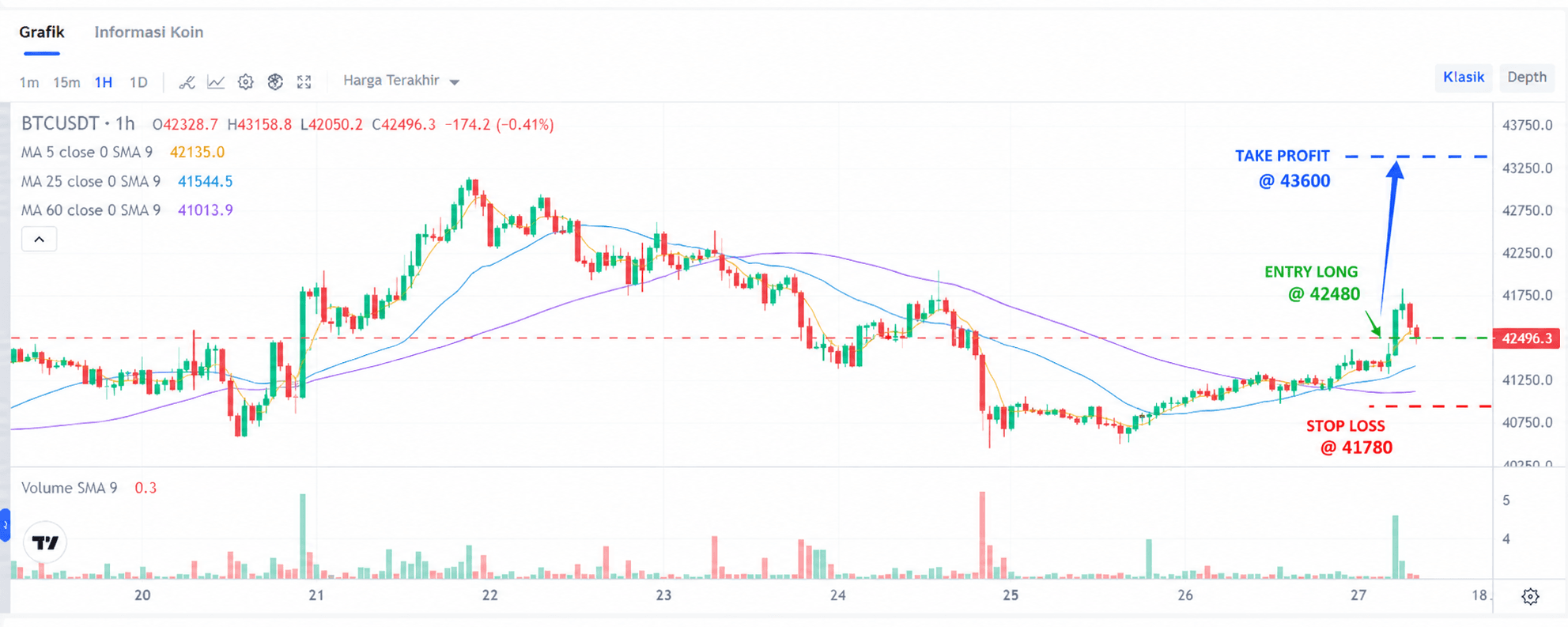
Source bittime.com/futures/BTC
1. Identify Trend Direction
The first step in determining an entry point for crypto futures is to understand market conditions. Generally speaking, the market can be in one of three states:
- Uptrend, marked by a series of higher highs and higher lows.
- Downtrend, characterized by lower highs and lower lows.
- Sideways, when the price moves in between support and resistance without a dominant direction.
Trend-following traders typically look for long positions when prices are forming an uptrend and short positions when the market structure indicates a downtrend.
Forcing a long position during a strong downtrend or opening a short position when bullish momentum is still dominant can increase risk. Therefore, first determine whether your strategy follows the trend, counters the trend, or capitalizes on price range movements.
2. Mark Support and Resistance
Support is a price area that previously attracted buying interest, while resistance is an area that previously generated selling pressure. Both should be understood as zones, not a single, completely precise number.
Some commonly used entry approaches include:
- Opening a long after a bullish reaction appears in the support area.
- Opening a short after there is a rejection in the resistance area.
- Waiting for a breakout from an important level.
- Wait for a retest after the breakout before opening a position.
- Using previous high and low levels as a reference.
Avoid opening a position simply because the price has touched support or resistance. Wait for confirmation that the market is actually reacting to that area.
Read also: Beginners Must Know! Here's What to Prepare for Before Trading Crypto Futures
3. Use Specific Technical Triggers
A technical trigger is a condition that must be met before a position can be opened. The signal must be clearly observable and written down.
Examples of overly common triggers:
Prices seem to be going up.
Examples of more measurable triggers:
The price closed above the four-hour resistance, then retested and formed a bullish candle.
Triggers can also come from moving averages, RSI, MACD, Bollinger Bands, volume, candlestick patterns, or a combination of several indicators. Indicators should be used as confirmation tools, not as guarantees of price direction. Chart and indicator analysis can help traders identify trends, momentum, and relatively overbought or oversold market conditions.
A structured entry framework includes at least technical triggers, risk-based position sizing, and a contextual examination of the funding rate. The first two components are essential, while the funding rate provides additional information for assessing the cost of maintaining a position.
4. Check Funding Rate and Market Conditions
In perpetual futures, the funding rate can be an additional cost or a periodic income for the position holder. A positive funding rate generally indicates a payment from a long position to a short position, while a negative funding rate indicates the opposite.
The funding rate isn't an entry signal that can be used alone. However, its value can help traders understand:
- Density of long or short positions.
- Cost of maintaining a position.
- Potential market sentiment that is too heavy in one direction.
- Is the profit target still commensurate with the cost of the position.
In addition to funding rates, pay attention to volatility, volume, open interest, economic announcement schedules, regulatory news, and developments that may impact the asset.
5. Determine Stop Loss Before Calculating Position Size
A common mistake is to determine the position size first, then place a stop-loss based on a comfortable loss. The order should be reversed.
First, determine the analysis invalidation point. Then, calculate the position size based on the distance from the entry point to the stop-loss.
For example:
- Rencana entry long: 100
- Invalidation point or stop loss: 97
- Price risk: 3 points
- Profit target: 106
- Profit potential: 6 points
- Reward-to-risk ratio: 6 ÷ 3 = 2 or 1:2
This means traders target two units of profit for every one unit of risk. This figure doesn't guarantee a successful trade, but it does provide an objective basis for assessing whether the opportunity is worth pursuing.
Read also:Understanding Leverage Strategies in Crypto Futures for Safer Trading
How to Determine the Futures Exit Price
Exits should be planned at the same time as entries. Waiting for a position to run before deciding when to exit can lead to decisions influenced by emotions and momentary price fluctuations.
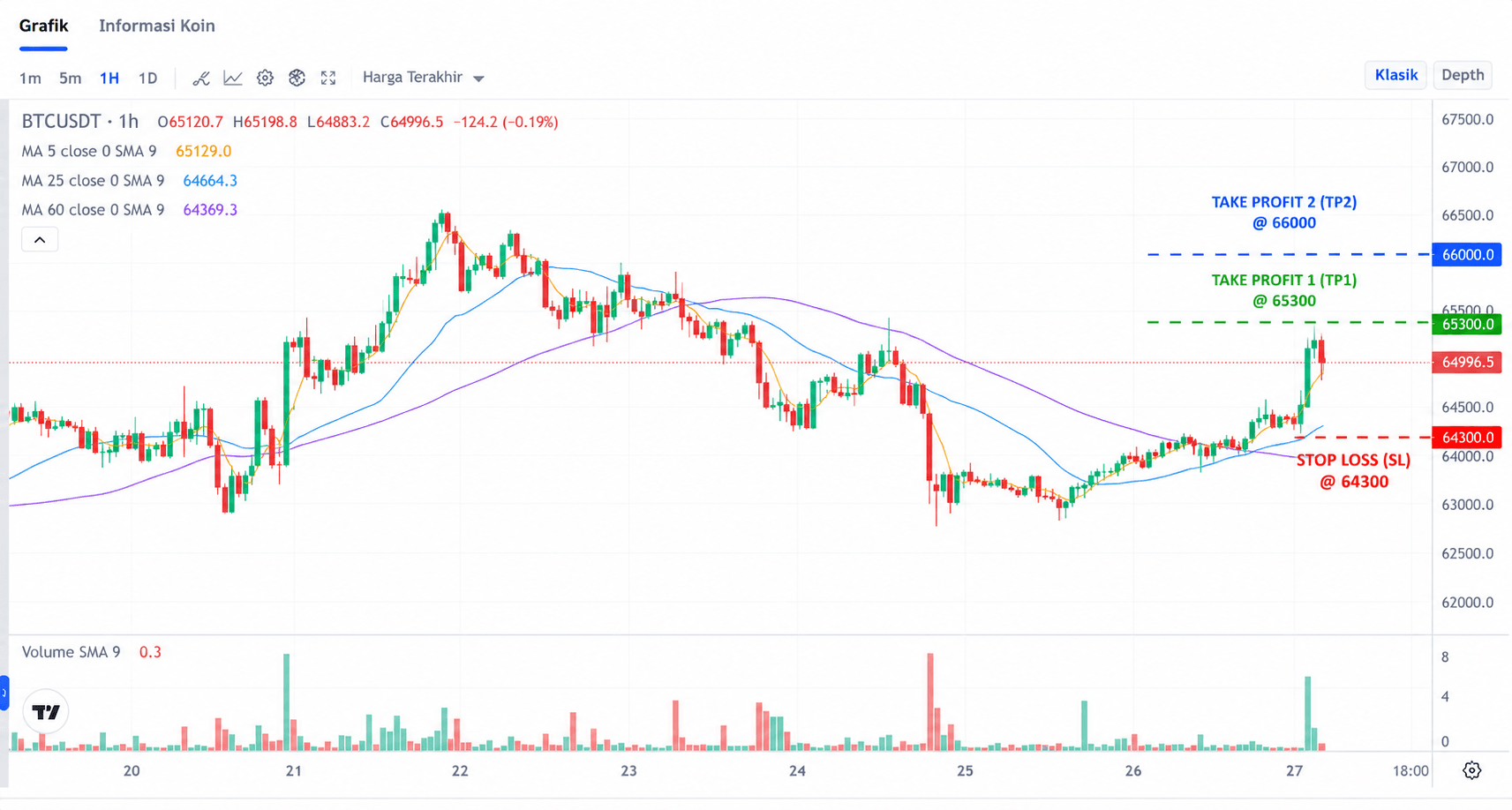
Source bittime.com/futures/BTC
1. Make Invalidation the Basis for Futures Stop Loss
Stop loss futures is a level used to close a position when market movements deviate from the analysis. Its placement should be based on market structure, not random numbers.
For long positions, stop loss can be placed:
- Below the support which is the basis for entry.
- Below the last swing low.
- Below the confirmed retest area.
- At the level that shows the bullish structure has failed.
For short positions, stop loss can be placed:
- Above resistance.
- Above the last swing high.
- Above the failed breakdown area.
- At the level that invalidates the bearish structure.
Ideally, a stop-loss should be activated before the position reaches the liquidation level. Once a position is opened, don't move the stop-loss just to avoid losses. This action actually increases the risk beyond the previously planned limits.
2. Determine Take Profit Based on Market Structure
Taking profit futures is the level for realizing profits. Its placement can refer to:
- Next support or resistance.
- Previous swing high or swing low.
- Breakout projection.
- The upper or lower limit of a price range.
- The reward-to-risk ratio has been determined.
Targets shouldn't be determined solely based on desired returns. Target prices should also be realistic based on market structure and volatility.
As a starting point, traders can consider a minimum reward-to-risk ratio of 1:1.5. However, the ratio used should still be adjusted based on the strategy's success rate, transaction costs, funding, volatility, and market conditions.
3. Use Partial Take Profit
Partial take profit is a strategy of closing part of a position when the price reaches the first target, then keeping the rest for the next target.
For example:
- Close 50% of the position at the first target.
- Move the remaining stop loss of the position to the entry price.
- Close the remaining position at the second target.
- Let the trailing stop follow the move if the trend continues.
This approach can help secure some profits while still allowing the position to follow the longer-term trend. However, this strategy is more complex than closing the entire position at a single target.
Read also:Long vs Short Crypto Futures Strategy: When to Buy and Sell?
4. Consider Trailing Stop
A trailing stop moves with the price as the position develops in a profitable direction. In long positions, the stop can be gradually raised. In short positions, the stop can be lowered as the price declines.
Trailing stop can refer to:
- A certain percentage.
- Average True Range or ATR.
- Moving average.
- Latest swing low or swing high.
- Newly formed support and resistance structures.
Trailing stops differ from moving stop losses. Trailing stops are only moved in a direction that reduces risk or locks in profits.
5. Use Time-Based Exit
Not all positions need to be closed because they hit a stop-loss or take-profit order. Traders can also use time limits.
For example, if a breakout doesn't continue within the next three candles, the position can be closed even if the price hasn't reached the stop-loss. This strategy is useful when the entry rationale relies on momentum that should emerge within a specific period.
Read also:Profit-Taking Strategy During a Bearish Market with Crypto Futures
How to Calculate Risk-to-Reward for Entry and Exit Prices
For long positions:
- Risiko = entry price − stop loss
- Potential profit = take profit − entry price
- Reward-to-risk ratio = potential profit ÷ risk
For short positions:
- Risiko = stop loss − entry price
- Potential profit = entry price − take profit
- Reward-to-risk ratio = potential profit ÷ risk
For example, a short position is opened at 200 with a stop loss of 204 and a target of 192:
- Risk: 204 − 200 = 4 points
- Potential profit: 200 − 192 = 8 points
- Reward-to-risk ratio: 8 ÷ 4 = 2 or 1:2
These calculations should be performed before opening a position. Traders should also consider trading and funding costs, as both can reduce net returns.
Read also:Differences Between Crypto Spot and Futures for Beginner Traders
Checklist Entry Point Crypto Futures
Before pressing the buy or sell button, check the following things:
- Has the trend direction been identified?
- Is the entry in the relevant area?
- Are there specific technical triggers?
- Where is the analysis declared invalid?
- What is the transaction loss limit?
- Is the position size in line with the risk limits?
- Where will the stop loss be placed?
- Where is the profit target located?
- Is the reward worth the risk?
- Is there any important news or agenda?
- What are the funding rate and volatility conditions?
- Have stop loss and take profit been set?
If some important questions cannot be answered, delaying entry may be a more rational decision than forcing a position.
Read also:Bittime Futures: A Complete Guide to Crypto Derivatives Trading in Indonesia
Common Mistakes in Futures Trading Strategies
Entry without confirmation
Traders see the price moving quickly and enter, fearing missing an opportunity. However, there's no structure, levels, or signals supporting the position.
Enlarging positions after experiencing losses
Increasing position size to quickly recover losses can escalate risk. Position size should always be based on risk limits, not emotions.
Keep your stop loss away
Changing the stop loss so that the position is not immediately closed means the trader is accepting a greater risk than originally planned.
Closing profits too soon
Closing a position just because a small profit is visible can damage the risk-reward ratio. Repeatedly, a single large loss can wipe out several small gains.
Using too much leverage
High leverage narrows the gap to liquidation. Even sound directional analysis can result in losses if a position can't withstand temporary fluctuations.
Equalizing all market conditions
Breakout strategies may work well during periods of increased volatility, but they generate numerous false signals during sideways markets. Entry and exit strategies need to be tailored to the prevailing market conditions.
Read also:How to Trade Futures on Bittime for Beginners
Building a Repeatable Trading Plan
An effective trading plan doesn't have to be complicated. The most important thing is that each rule can be written down, tested, and consistently implemented.
A simple trading plan format might include:
- Assets and timeframes monitored.
- Allowable trend conditions.
- Setup entry used.
- Technical triggers to open positions.
- Invalidation points and stop loss.
- Risk limit per transaction.
- Profit target.
- Partial exit or trailing stop rules.
- Conditions that prohibit entry.
- Evaluation notes after the position is closed.
The quality of the process is more important than the ability to predict every market movement. A consistent framework helps limit the impact of erroneous trades and maintain correct positions according to plan.
If you want to start implementing the checklist, you can register at Bittime, learn the function of each order type, and adjust your futures usage to your risk profile. Before opening a position, monitor the available futures assets.
Bittime Futures is the first digital asset platform in Indonesia to obtain a full futures trading license from PT Central Financial X (CFX) under the regulatory supervision of the Financial Services Authority (OJK).
This article is for educational purposes only and does not constitute a recommendation to open any specific positions. Futures trading and the use of leverage carry a high risk of loss. Use funds you can afford to lose and ensure the products you use comply with applicable regulations in your region.
Check the prices of Bitcoin (BTC), Ethereum (ETH), XRP, Solana (SOL), and BNB, as well as the popular meme coin DOGE. You can trade directly on Bittime!

Conclusion
How to determine entry and exit price futures It starts with a clear market structure, objective entry triggers, and established risk limits before a position is opened. Entries shouldn't be based solely on guesswork, and exits shouldn't be decided spontaneously after a price movement.
Determine the invalidation point, calculate the position size, evaluate the reward-to-risk ratio, and then set a stop-loss and take-profit order early. After closing the position, record the results and assess whether the decision followed the trading plan. For additional context before making a decision, monitor market developments and the latest futures educational materials through Bittime.

Bittime is a licensed and regulated Digital Financial Asset Trader (PAKD) supervised by Indonesia’s Financial Services Authority (OJK) — where you can buy Bitcoin in Indonesia and hundreds of other crypto assets starting from just Rp10,000. The registration process is fast, secure, and you can get started today.
Track USDT to IDR conversions and monitor your favorite crypto assets in real time. Everything is available in one crypto investment app that you can download for free on the Play Store
Ready to start? Register now on Bittime and execute your investment strategy with a platform trusted by millions of users in Indonesia.
FAQ
What is a futures entry price?
The futures entry price is the price at which a trader opens a long or short position on a futures contract. This price serves as the basis for calculating profit, loss, stop-loss, and take-profit levels.
How to determine a good futures entry?
Determine the trend direction, mark support and resistance levels, and then wait for a specific technical trigger. Entry points should also include an invalidation point and a position size appropriate to your risk limits.
What is the difference between stop loss and take profit?
A stop-loss closes a position to limit losses when the analysis doesn't go according to plan. A take-profit closes a position when the price reaches a predetermined profit target.
What is the ideal reward-to-risk ratio?
There's no one-size-fits-all ratio for all strategies. A 1:1.5 or 1:2 ratio can be used as a starting point, but it should still be adjusted based on win rate, costs, volatility, and strategy testing results.
Should entry and exit be determined before opening a position?
Ideally, yes. Determining entry, stop-loss, and profit targets early on helps reduce impulsive decisions when the market moves quickly.
Disclaimer: The views expressed belong exclusively to the author and do not reflect the views of this platform. This platform and its affiliates disclaim any responsibility for the accuracy or suitability of the information provided. It is for informational purposes only and not intended as financial or investment advice.

.png)


