BRPT, TPIA, BREN to CUAN: Which Ones Are Worth Monitoring?
2026-08-04
These four stock codes — BRPT, TPIA, BREN, and CUAN — all slumped by more than half their value throughout the first half of 2026, after three of them were removed from the global MSCI index.
The mid-year earnings season then added a new chapter: revenue at most Barito Group issuers actually surged sharply, yet net profit plunged by tens of percent.
So, of these four major names owned by conglomerate Prajogo Pangestu, which ones are still truly worth monitoring?
Key Takeaways
- BRPT net profit fell 64.8% and TPIA plunged 77% in the first half of 2026, even though revenue at both grew by double digits.
- BREN was the exception, with profit rising 29%, supported by a geothermal business that is far more stable than petrochemicals.
- Analysts view the Barito Group’s outlook for the second half of 2026 as still constructive, provided petrochemical oversupply pressure and high interest rates begin to ease.
Profits Under Pressure, Revenue Surging: Here’s the Breakdown of First-Half 2026 Performance
Barito Pacific (BRPT), the parent company, recorded revenue of US$5.68 billion in the first half of 2026, surging 76.1% compared with the same period last year. However, net profit attributable to the parent’s shareholders fell 64.8% to US$190 million, from the previous US$540 million.
The petrochemical segment indeed grew 83.6% to US$5.35 billion, but finance costs also swelled to US$259.25 million from US$189.34 million. Added to this were general and administrative expenses that rose to US$129.65 million.
Even so, on a consolidated basis before minority interests, BRPT still recorded EBITDA of US$1.08 billion and a relatively solid balance sheet — the net debt-to-equity ratio stood at 0.76 times, with total assets rising 9.2% to US$18.95 billion.
Read Also: 7 Reasons You Should Start Investing in Tokenized Stocks
Chandra Asri Pacific (TPIA), the subsidiary that drives the group’s refining and petrochemical business, faced the deepest pressure. According to Investor Trust, TPIA’s net profit was eroded by 77% even though revenue rose to US$5.69 billion from US$3.23 billion.
The cause is clearly visible on the cost side: raw material and production costs jumped to US$4.47 billion from US$2.97 billion, while depreciation and amortization expenses nearly doubled to US$223.16 million — a consequence of the full consolidation of the Aster Refinery (formerly Shell) that was only recently integrated.
Barito Renewables (BREN) stood out as the exception. Its net profit rose 29% to US$106 million, with revenue of US$334 million, or growth of 11.5%. The support came from its geothermal and wind businesses, which are more resilient to cycles, including the completion of the Wayang Windu retrofit project that boosted BREN’s geothermal capacity to 926 megawatts.
Meanwhile, first-half 2026 earnings data for CUAN (Petrindo Jaya Kreasi) and PTRO (Petrosea) had not been widely published as of early August.
However, the first-quarter 2026 trend provides a directional picture: CUAN’s net profit soared 232.7% to US$5.69 million, while PTRO booked a profit of US$1.38 million with revenue rising 84.24% to US$284.13 million — a recovery pattern similar to TPIA, albeit from a much smaller base.
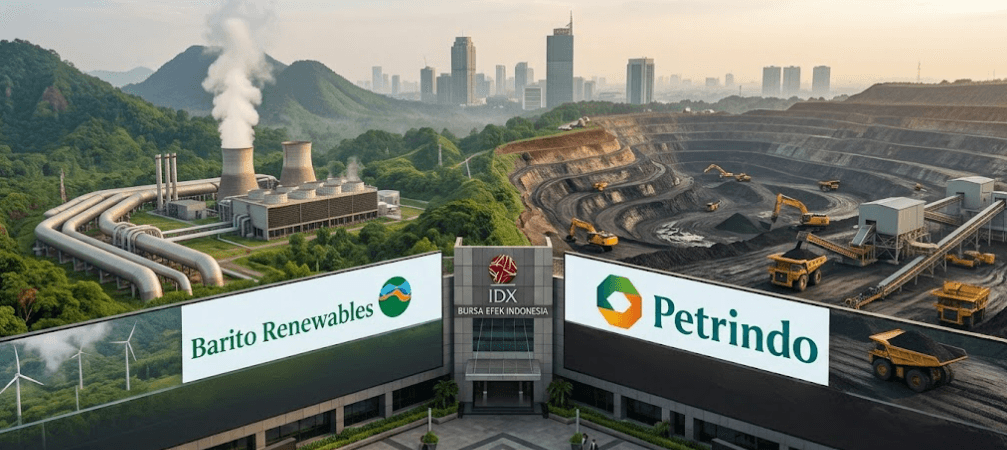
Illustration: Generated by AI
Read Also: List of Highest Dividend Yield Stocks in 2026
Root Cause: Why Did Profits Shrink Even Though Revenue Rose?
The “revenue up, profit down” pattern at the Barito Group is no coincidence. Two factors are at play simultaneously. First, the accounting effects of major acquisitions — the Aster Refinery and the Esso retail fuel network in Singapore were only fully consolidated this year, so depreciation and interest expenses are already fully recorded, while their margin contributions are not yet optimal.
Second, there is a technical factor in the stock market separate from fundamental performance: BREN, TPIA, and CUAN were all removed from the global MSCI index in the first half of 2026, triggering simultaneous outflows of foreign index-tracking funds.
According to Katadata, this combination caused Barito Group stock prices to drop more than 50% in the first six months of the year — far deeper than the decline in their profits themselves.
BRPT is also not an isolated case. This issuer is among six LQ45 index members whose profits shrank in the first half of 2026, alongside other major names such as Astra International, United Tractors, Indofood CBP, Indofood, and Kalbe Farma.
This means margin pressure in the first half of the year was indeed a broader theme, not exclusive to Prajogo Pangestu’s conglomerate.
If you are used to monitoring market movements like this as part of your trading strategy, the same approach also applies to crypto assets and tokenized stocks.
Register an account at Bittime to start exploring the digital asset market through a platform that already holds an official OJK license.
Signs of Improvement in the Second Half of 2026: Corporate Actions to Analyst Projections
As soon as the second half of the year began, the Barito Group hit the ground running with a series of corporate actions.
TPIA, Chandra Daya Investasi (CDIA), and Petrosea (PTRO) all announced expansion steps in the first week of the second half, including CDIA’s acquisition of a fleet company valued at Rp1.6 trillion. Management appears keen to shift the market narrative from “MSCI pressure” to “group expansion and synergy.”
A number of analysts also maintain a positive view. Sukarno Alatas of Kiwoom Sekuritas assesses that BRPT’s outlook through the end of 2026 remains bright, in line with the full contribution of the Aster Refinery and increased refining capacity in the second half that could boost volumes and margins.
Similarly, Head of Research at Korea Investment & Sekuritas Indonesia, Muhammad Wafi, told Kontan that BRPT’s outlook remains constructive thanks to the full integration of the Singapore energy assets.
Read Also: List of Stocks with the Most Investors in Indonesia 2026
The average analyst target price for BRPT is around Rp2,560 per share — quite a distance from the mid-July trading level of around Rp1,690, although the estimate range itself is very wide, from Rp870 to Rp4,100, indicating that market uncertainty remains high.
But this optimism comes with caveats. The three risks most frequently cited by analysts are a flood of petrochemical supply from China that is pressuring Chandra Asri’s margins, the potential normalization of refining margins after they had been high, and interest costs that are increasingly felt due to the BI rate at 5.50%.
As a comparison, the coal sector, which is also part of CUAN’s business line, recorded the opposite trend — BYAN and BUMI both booked profit increases in the first half of 2026, with the sector’s outlook projected to improve further in the second half.
Read Also: What Are HSC Stocks? Definition, Risks, and the Latest List of HSC Stocks
Conclusion
The first half of 2026 was indeed tough for most Barito Group issuers, but not because their core businesses are fragile — more because of the effects of consolidating large newly acquired assets and technical pressure from the removal of these stocks from the MSCI index.
BREN has proven itself a solid counterbalance thanks to its more stable geothermal business model, while BRPT and TPIA need time for the contribution of the Aster Refinery to truly be felt in net profit.
If analyst projections regarding the full integration of Singapore assets and the recovery of refining margins in the second half of 2026 prove correct, these stocks have substantial recovery room.
However, given their high volatility, regularly monitoring quarterly data remains the most sensible step before taking a position.

Monitor US stock tokens: AMZON, AMDON, TSLAX, NFLXON MSFTON and many more — you can start trading on Bittime.
Bittime is a Digital Financial Asset Trader (PAKD) platform licensed and supervised by the Financial Services Authority (OJK) — a place where you can buy Bitcoin in Indonesia and hundreds of other crypto assets starting from Rp10,000. Registration is fast, secure, and can be started today.
Monitor the USDT to IDR conversion and the price movements of your favorite crypto assets in real time. Everything is available in one crypto investment app that can be downloaded for free on the Play Store.
Ready to start? Register now on Bittime and execute your investment strategy with a platform already trusted by millions of users in Indonesia.
FAQ
Why did BRPT’s profit fall even though its revenue rose 76%?
Higher finance costs and administrative expenses, combined with depreciation from the full consolidation of the Aster Refinery, eroded BRPT’s margins even though its revenue surged.
What is the connection between the removal of BREN, TPIA, and CUAN from the MSCI index and the decline in their stock prices?
Exclusion from MSCI triggered automatic outflows of foreign index-tracking funds, putting pressure on the stock prices even though the cause was technical rather than purely related to fundamental performance.
Why did BREN make a profit while BRPT and TPIA were under pressure?
BREN relies on geothermal and wind businesses with long-term contracts that are more stable, unlike petrochemicals and refining, which are more vulnerable to fluctuations in prices and production costs.
Are Barito Group stocks still worth monitoring in the second half of 2026?
A number of analysts view the outlook as constructive thanks to the full integration of Singapore assets, but risks from petrochemical oversupply and high interest rates still need to be watched by investors.
Disclaimer: The views expressed belong exclusively to the author and do not reflect the views of this platform. This platform and its affiliates disclaim any responsibility for the accuracy or suitability of the information provided. It is for informational purposes only and not intended as financial or investment advice.

.png)