BBCA vs BBRI: Which is More Attractive to Buy in 2026?
2026-07-16
BBCA vs. BBRI will once again be an important comparison for banking stock investors in 2026. BBCA offers strong fundamental qualities and stability, while BBRI they appear cheaper and offer higher dividend yields. The best choice depends on each investor's investment goals and risk tolerance.
Key Takeaways
- BBCA excels in asset quality, low-cost funds, efficiency, and consistent profit growth.
- BBRI is offering a lower valuation and a significantly higher dividend yield at the market price in mid-July 2026.
- BBCA is more suitable for investors who prioritize quality, while BBRI is attractive to value investors and dividend hunters who are ready to accept greater risks.
Understanding the Differences Between BBCA and BBRI Businesses
Before discussing BBCA vs BBRI shares, investors need to understand that both have different business characteristics.
PT Bank Central Asia Tbk, or BBCA, is a private bank with strong capabilities in transaction services, low-cost funds, corporate loans, commercial loans, and consumer banking. Its payment ecosystem and transactional customer base are among BCA's key strengths.
In contrast, PT Bank Rakyat Indonesia (Persero) Tbk (BBRI) is known as a bank with a strong focus on the micro, small, and medium enterprise segment. BRI's extensive network gives it a strong position in financial inclusion and MSME financing in Indonesia.
These differences affect the fundamental character of both stocks:
- BBCA tends to have better credit quality and more stable profits.
- BBRI has higher interest margins because it focuses on micro loans.
- BBCA is generally valued more highly by the market.
- BBRI offers the potential for greater dividend yield and valuation rerating.
- BBRI's credit risk is usually higher due to the nature of micro and MSME debtors.
Therefore, comparing BBCA or BBRI solely based on share price is insufficient. Investors also need to consider the quality of the business behind that price.
Read also: CDIA vs BBCA: Which Stock is More Attractive to Buy Right Now?
Comparison of BBCA and BBRI Fundamentals in 2026
BBCA Fundamentals: Asset Quality Remains a Strength
In the first quarter of 2026, BCA posted a consolidated net profit of approximately Rp14.7 trillion, an increase of approximately 3.8% compared to the same period the previous year.
Profit growth may not have been particularly aggressive, but BBCA's balance sheet remains solid. Total loans reached approximately Rp994 trillion, representing 5.6% year-on-year growth. Third-party funds were recorded at approximately Rp1,292 trillion.
One of BBCA's greatest fundamental strengths is its low-cost current account and savings account composition. BCA's CASA reached approximately Rp1,089 trillion and grew 11.2% year-on-year.
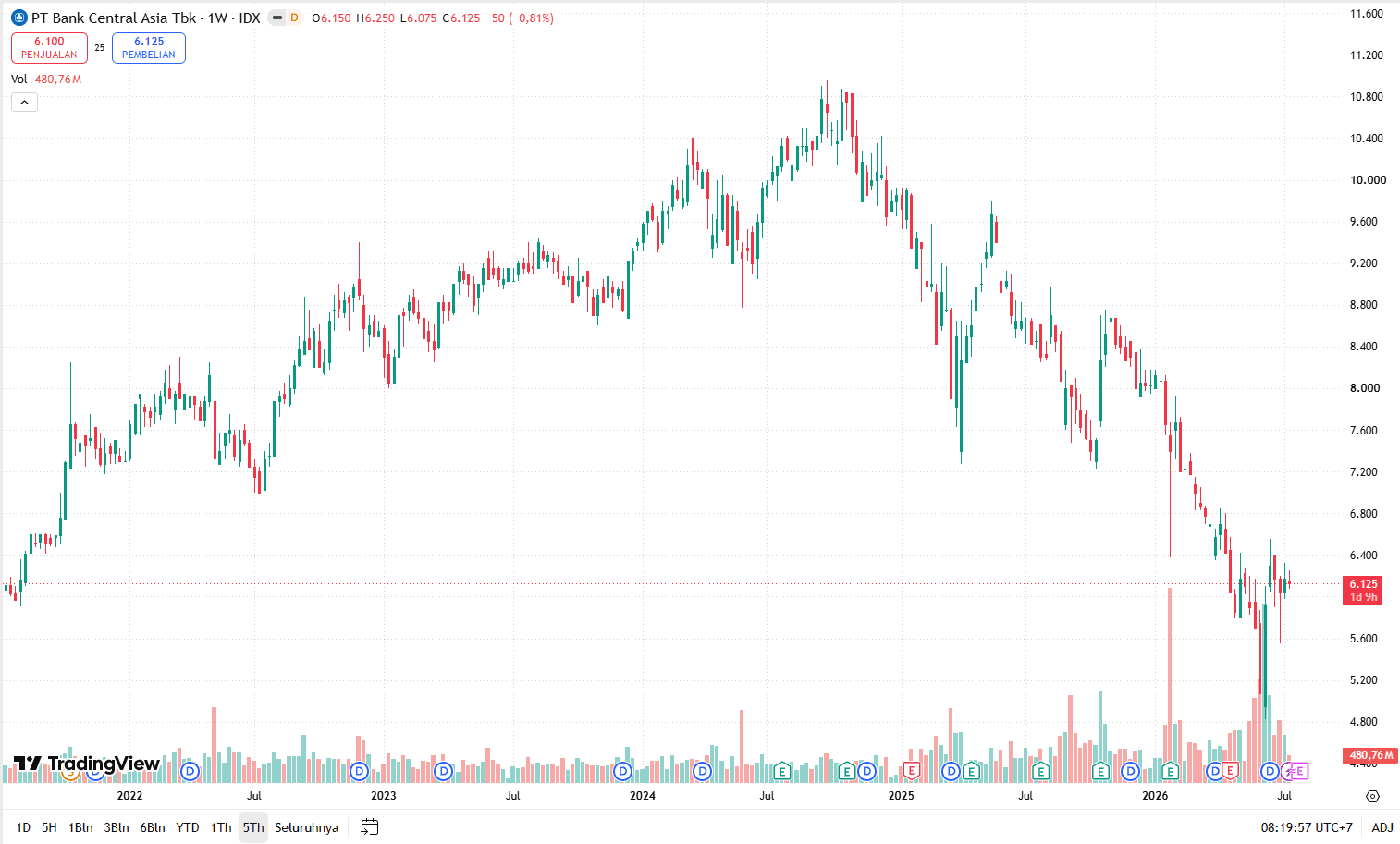
Source Tradingview | BBCA 5-Year Chart
Low-cost funds are important for banks because they help reduce funding costs. The greater the contribution of savings and checking accounts, the less dependent the bank is on high-cost deposits.
BCA's asset quality is also relatively well maintained. The gross non-performing loan ratio was around 1.8% in March 2026. This figure indicates that BBCA's credit risk remains lower than that of many other large banks.
BBCA's main advantages include:
- Very large and stable CASA.
- Strong credit quality.
- Loyal transactional customer base.
- High operational efficiency.
- Consistent profitability.
- Mature digital infrastructure and payment networks.
However, BBCA's moderate profit growth means investors should be mindful of their purchase price. Good-quality stocks can still generate low returns if purchased at overvalued prices.
Read also:Anomaly! RANS Shares Fall Despite 1.92% JCI Gain
BBRI Fundamentals: Profit Growth Begins to Strengthen
BBRI recorded a net profit attributable to owners of the parent entity of approximately IDR 15.5 trillion in the first quarter of 2026, an increase of approximately 13.7% compared to the same period the previous year.
BBRI's profit growth was higher than BBCA's during the period. This improvement was supported by increased net interest income, more manageable cost of funds, and strengthening commission-based income.
BRI has a net interest margin advantage because microcredit interest rates are generally higher than corporate loans. In its first-quarter 2026 performance presentation, BRI's consolidated NIM was around 7.9%.
Low-cost funds also showed positive growth. BRI's CASA grew by around 13.2% year-on-year, helping to alleviate funding cost pressures.
Nevertheless, credit quality remains a key consideration. BRI's gross NPL is around 3% in its consolidated performance report. In individual bank published reports, gross NPL is recorded at around 3.31%.
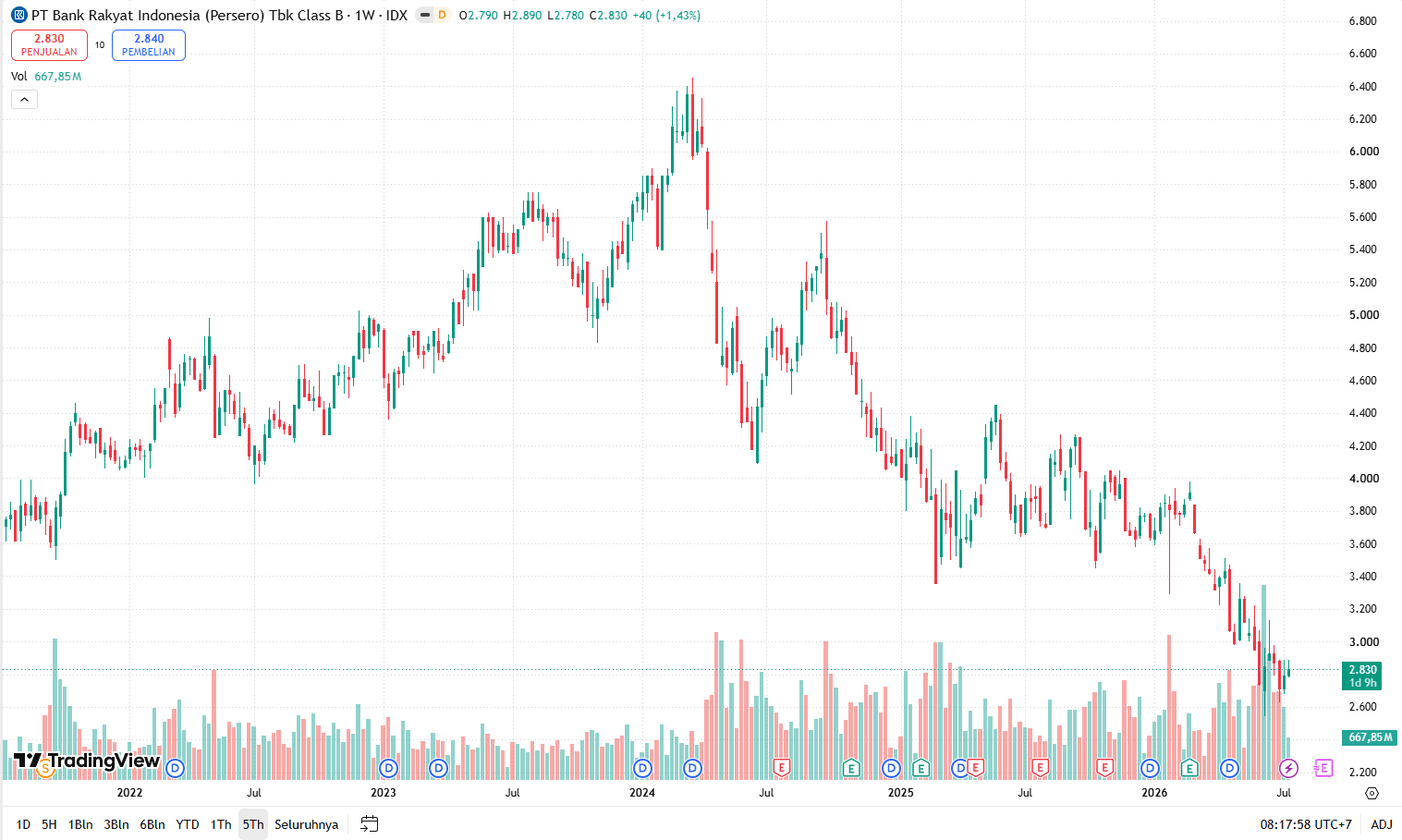
Source: Tradingview | BBRI 5-Year Chart
These differences may arise due to the scope of calculations and the reporting basis used. Investors should consistently compare consolidated ratios with consolidated ratios or bank-only ratios with bank-only ratios.
BBRI's main advantages include:
- Dominant position in the micro and MSME segments.
- High net interest margin.
- Extensive distribution network.
- Growth potential from financial inclusion.
- Relatively cheap valuation.
- High dividend contribution.
BBRI's main risks lie in the quality of its microcredit, high credit costs, sensitivity to economic slowdowns, and its large dividend distribution policy.
Read also:SK Hynix vs. Micron: Which AI Memory Stock Is More Attractive?
BBCA vs BBRI from a Valuation Perspective
Valuation is one of the most obvious differentiators between BBCA and BBRI in 2026.
Based on the closing price on July 15, 2026, BBCA shares were trading at around Rp6,125 per share, with a price-to-earnings ratio of around 13x. On the same date, BBRI was trading at around Rp2,830 per share, with a P/E ratio of around 7x.
Simply put, the market values each rupiah of BBCA's profit almost twice as much as BBRI's. This premium is due to BBCA's asset quality, low-cost funding, profit stability, and stronger operational track record.
BBRI is trading at a lower valuation as the market is factoring in several risks, such as:
- Micro and MSME credit risks.
- Higher credit costs.
- Uncertainty of asset quality recovery.
- Sensitivity to people's purchasing power.
- Risk of policy intervention as a state-owned bank.
- Pressure on foreign capital flows on state-owned banking shares.
A low valuation doesn't necessarily mean a stock will rise. A low price could reflect fundamental issues that haven't been fully resolved.
Conversely, a premium valuation doesn't necessarily mean a stock is overpriced. High-quality companies can maintain a premium if they maintain their return on equity, profit growth, and asset quality.
In the context of 2026, BBRI offers a greater margin of safety in terms of valuation. BBCA offers higher quality certainty, but investors pay a higher price for this advantage.
Read also:NVIDIA Stock vs NVDAX: The Advantages of Tokenized Stock on Bittime
Comparison of BBCA and BBRI Dividends
BBCA Dividends
For the 2025 financial year, BBCA distributed a total dividend of approximately Rp336 per share. This amount consisted of an interim dividend of Rp55 per share and a final dividend of Rp281 per share.
BBCA's dividend payout ratio is approximately 72% of its 2025 fiscal year profit. Using a share price of Rp6,125 on July 15, 2026, its historical dividend yield is around 5.5%.
This yield is quite attractive for a stock with high fundamental quality. However, BBCA doesn't have the highest dividend yield among the large banks.
BBCA's dividend advantage lies in its potential for sustainability. Profit quality, capital, low-cost funding, and asset quality provide the company with the capacity to maintain dividend distribution without unduly burdening its balance sheet.
BBRI Dividends
BBRI distributed a total dividend of approximately Rp346 per share from its 2025 financial year profit. This amount consists of an interim dividend of Rp137 and a final dividend of approximately Rp209 per share.
At Rp2,830 per share, BBRI's historical dividend yield is around 12.2%. This yield is significantly higher than BBCA's.
However, investors need to understand that high yields are influenced by two factors:
- BBRI's dividend payments are indeed large.
- BBRI's share price is under pressure, causing the yield ratio to increase.
A high dividend yield does not guarantee a positive total return. If the stock price falls by more than the value of the dividend received, investors can still suffer losses.
BBRI's high payout ratio also needs to be evaluated from a sustainability perspective. The greater the profits distributed as dividends, the less retained earnings are required to support credit growth and strengthen capital.
For dividend hunters, BBRI is more attractive. For investors prioritizing profit sustainability and balance sheet quality, BBCA offers a more defensive profile.
Read also:7 Biggest US Dividend Stocks in 2026: A Passive Income Strategy for the Long Term!
BBCA Investment Prospects in 2026
BBCA's investment prospects are supported by the growth of digital transactions, a large CASA base, asset quality, and BCA's ability to maintain customer loyalty.
BBCA also has the opportunity to expand consumer, commercial, corporate, and vehicle financing through its subsidiaries. A growing transaction ecosystem can increase commission-based revenue without directly increasing credit risk.
However, there are some risks to be aware of:
- Credit growth is slower than target.
- NIM pressure due to declining asset yields.
- Premium valuations are being de-rated.
- Slowdown in consumption and investment.
- Foreign investor sales.
- Market expectations are too high.
BBCA typically becomes more attractive when its valuation declines without fundamental deterioration. Investors need to distinguish between price declines driven by market sentiment and declines due to deteriorating business quality.
Read also: The US Stock Market Dominates the World, Surpassing Four Asian Countries
BBRI Investment Prospects in 2026
BBRI's prospects depend on the recovery of the micro segment, growth in low-cost funds, a decline in credit costs, and the bank's ability to maintain interest margins.
If credit quality improves and credit costs decrease, BBRI's profit growth could accelerate. A low valuation also opens up the opportunity for a rerating when sentiment toward state-owned bank stocks improves.
In addition, the ultra-micro ecosystem and digitalization through BRImo can expand BRI's access to retail customers and small businesses.
Risks to be aware of include:
- Increase in micro segment NPL.
- High write-off.
- People's purchasing power is weakening.
- Subsidized credit policy.
- The dividend payout ratio is too large.
- Pressure on the rupiah and foreign capital flows.
- Slowing economic growth.
BBRI has greater upside potential than BBCA if fundamentals recover and valuations rerate. However, this scenario also carries greater uncertainty.
Read also:Best US Stocks to Buy in July 2026
BBCA or BBRI, Which is More Attractive?
There is no single answer that applies to all investors.
Choose BBCA when:
- Prioritize asset quality and profit stability.
- Have a long-term investment horizon.
- Don't chase high dividend yields too much.
- Willing to pay premium valuation.
- Want bank stocks with a relatively defensive profile.
- More comfortable with low fundamental volatility.
Choose BBRI when:
- Prioritize cheap valuations.
- Looking for high dividend yield.
- Believe in the recovery of the micro and MSME segments.
- Be prepared to face greater price volatility.
- Able to accept credit quality risks.
- Pursue rerating and capital gain opportunities.
If the question is which stock looks cheaper in mid-July 2026, the answer is BBRI.
If the question is which bank has more consistent fundamental quality, the answer is BBCA.
For value investors willing to accept risk, BBRI looks more attractive at its current valuation. For conservative investors who prioritize quality and long-term compounding, BBCA remains a more solid choice.
Investors might also consider owning both. BBCA can be a defensive asset, while BBRI offers exposure to high dividends and potential valuation recovery.
Read also:How to Buy Tokenized US Stocks in Indonesia: Legal, Safe, & Practical 2026!
Monitor Market Sentiment via Bittime
Bank stock movements are also influenced by interest rates, the rupiah exchange rate, foreign capital flows, and sentiment towards risky assets.
You can register at Bittime to monitor the digital asset market and read the latest economic and crypto news. To purchase BBCA or BBRI shares, always use a securities company licensed and supervised by the Indonesian capital market regulator.
Also available at Bittime market Tokenized Stock for developments in other digital assets, monitor the Tokenized Stock market to stay up-to-date on the latest news.
Don't base your decision solely on a low price or high dividend yield. Use recent financial reports, valuations, asset quality, and investment objectives as the basis for your analysis.
Keep an eye on other stock tokens like AMZON, AMDON, TSLAX and NFLXON, as well as MSFTON, and then you can start trading on the most comprehensive crypto exchange, Bittime.
Conclusion
A comparison of BBCA and BBRI in 2026 reveals two distinct investment characteristics. BBCA excels in asset quality, low-cost funding, profit stability, and efficiency. BBRI offers a lower valuation, higher quarterly profit growth, and a double-digit dividend yield.
At mid-July 2026 prices, BBRI appears more attractive to value investors and dividend hunters willing to face credit quality risks and volatility. BBCA is more suitable for investors prioritizing business quality and long-term consistency.
The final choice should be tailored to your risk profile, return target, investment horizon, and purchase price. Make purchases gradually and update your analysis when the next financial report is released.
This article is educational in nature and is not a personal recommendation to buy or sell shares.

Bittime is a licensed and regulated Digital Financial Asset Trader (PAKD) supervised by Indonesia’s Financial Services Authority (OJK) — where you can buy Bitcoin in Indonesia and hundreds of other crypto assets starting from just Rp10,000. The registration process is fast, secure, and you can get started today.
Track USDT to IDR conversions and monitor your favorite crypto assets in real time. Everything is available in one crypto investment app that you can download for free on the Play Store
Ready to start? Register now on Bittime and execute your investment strategy with a platform trusted by millions of users in Indonesia.
FAQ
Is BBCA better than BBRI?
BBCA has stronger asset quality and earnings stability. However, BBRI offers a more attractive valuation and dividend yield, making it more suitable for investors with a higher risk tolerance.
Which has a bigger dividend, BBCA or BBRI?
BBRI offers a higher dividend yield at the mid-July 2026 share price. The total dividend for the 2025 fiscal year is approximately IDR 346 per share, compared to BBCA's approximately IDR 336 per share.
Are BBRI shares still attractive to buy in 2026?
BBRI is attractive due to its low valuation and potential for profit recovery. Investors should continue to monitor NPLs, credit costs, microcredit growth, and the sustainability of the payout ratio.
Are BBCA shares too expensive?
BBCA is trading at a higher premium to BBRI. This premium reflects its superior asset quality, CASA, profitability, and consistent performance.
Is it better to buy BBCA and BBRI at the same time?
Owning both can diversify the character of bank stocks. BBCA can function as a defensive-quality stock, while BBRI provides exposure to high dividends and rerating potential.
Disclaimer: The views expressed belong exclusively to the author and do not reflect the views of this platform. This platform and its affiliates disclaim any responsibility for the accuracy or suitability of the information provided. It is for informational purposes only and not intended as financial or investment advice.

.png)