CFTC Proposes New Crypto Rules, How About Regulation in Indonesia?
2026-10-07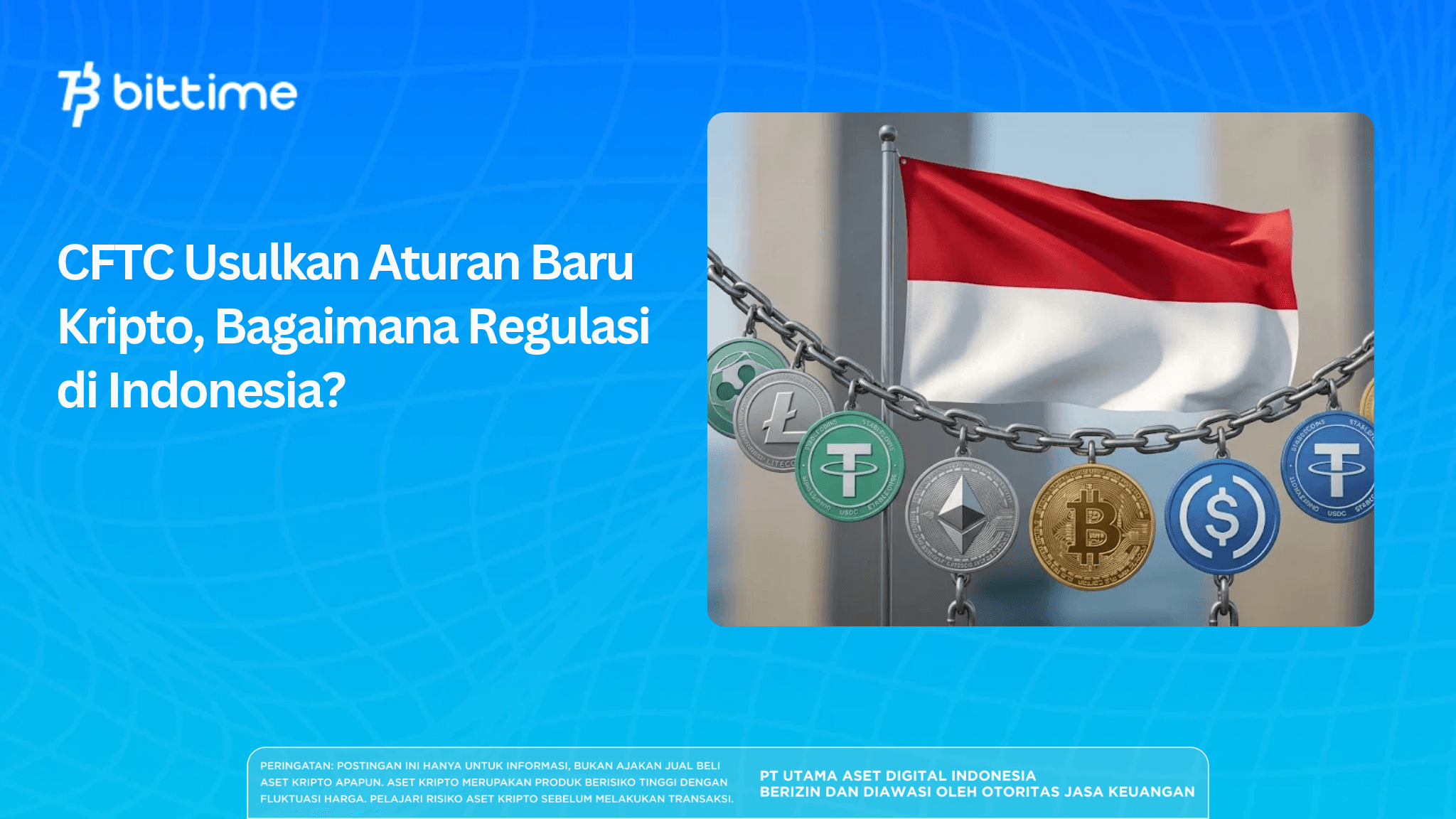
Since 2014, CFTC has stated that crypto assets fall within its jurisdiction. Nevertheless, this United States commodity regulator still does not have final rules on how leveraged retail crypto transactions must be conducted.
That gap is what the CFTC crypto rules announced on October 5, 2026, are trying to fill. The form is still an Advance Notice of Proposed Rulemaking (ANPRM), namely an initial notice to request public input.
For readers in Indonesia, the practical question is: does Indonesian crypto regulation already have an equivalent for this idea? Some of the concepts already exist in POJK 23 of 2025, but the two rules cannot be equated.
Key Takeaways
- The CFTC has only filed an ANPRM, not a final rule. The public comment period is 60 days from publication in the Federal Register.
- The ANPRM contains two frameworks: Regulation CTX (leveraged retail transactions) and Regulation CAM (a new crypto exchange category).
- Indonesia already has rules for digital financial asset derivatives through POJK 23/2025. The content is similar in concept, but the legal systems are different.
Contents of the CFTC Proposal for the US Crypto Market
Still at the Input Request Stage
According to the CFTC press release, this ANPRM contains a planned regulatory framework for retail crypto asset transactions. Comments must be submitted within 60 days of the ANPRM’s publication in the Federal Register and will be published on Regulations.gov.
The CFTC will use that input to determine next steps, such as drafting official rules.
Regulation CTX: Leveraged Retail Transactions
CTX stands for Crypto Asset Transactions. This framework is based on Section 2(c)(2)(D) of the Commodity Exchange Act, which governs retail commodity transactions with leverage, margin, or financing.
In the ANPRM document, such transactions generally must take place on a registered exchange (designated contract market/DCM), unless they fall under an exception such as actual delivery of the asset within 28 days.
Coinpedia reported that crypto purchased and then sent to a non-custodial wallet within 28 days will be considered actual delivery. This means ordinary purchases that are self-custodied are not burdened by heavy exchange rules.
Read Also: Bittime Futures: Complete Guide to Crypto Derivatives Trading in Indonesia
Regulation CAM: New Crypto Exchange Category
CAM stands for Crypto Asset Markets. The CFTC wants to create a DCM subcategory called a crypto asset market designed specifically for crypto transactions.
According to Coinpedia, this federal license is optional. Exchanges that choose it do not need to obtain licenses one by one in each state and can offer leverage or margin to retail users.
Currently, according to the ANPRM document, crypto exchanges in the US generally rely on state-level money transmitter licenses and FinCEN registration. The CFTC considers that regime not designed for financial market risk.
Why the CFTC Is Moving Now
CFTC Chairman Michael Selig said these rules are designed to prevent fraud like the FTX case before it happens, not just to act after the fact.
On August 20, 2026, he already stated that the CFTC is ready to use its existing authority if the CLARITY Act is stalled in the Senate, as reported by Decrypt. According to him, the legislative path is still preferable because it is harder for the next administration to overturn.
Concerns about this also come from practitioners. Industry lawyers, according to Coinpedia, warn that rules like this can change as leadership changes at the CFTC or the White House.
If you want to start getting to know digital assets from a local platform, you can register on Bittime and learn about the product first before trading.
Comparison with Indonesian Crypto Regulations
Indonesia regulates crypto asset trading through POJK 27/2024, which was amended by POJK 23/2025 and has been in effect since November 10, 2025, according to OJK and DDTCNews. This regulation divides digital financial assets into crypto assets and other digital financial assets, including their derivatives.
Who Supervises
Through the P2SK Law, crypto assets in Indonesia are no longer categorized as commodities, but as digital financial assets, according to Pajakku. Supervision lies with OJK.
In the US, the ANPRM states that most crypto assets may fall under the definition of commodities, so the CFTC also plays a role. The division of territory with the SEC refers to the joint taxonomy of both agencies published in March 2026.
Leverage, Margin, and Derivatives
In Indonesia, POJK 23/2025 already provides a legal basis for digital financial asset derivatives trading. According to OJK, the provisions are as follows:
- Exchanges that wish to organize derivatives trading must first request OJK approval.
- Traders may trade derivatives on customer mandates on an approved exchange, after there is a cooperation agreement with the exchange and written notification to OJK.
- Operators must have a mechanism to place margin in a special account.
- Consumers must take a knowledge test before trading derivatives.
The CFTC proposal has a similar direction: retail leverage is brought to supervised trading venues. The difference is that Indonesia’s rules are already in effect, while the CFTC proposal is still in the consultation stage.
Understanding Futures and leverage. Regulatory developments in the US and Indonesia show increasing attention to risk management in digital asset trading. In Indonesia, Bittime has a 3-in-1 platform that provides Spot, Staking, and Futures in one ecosystem.
Bittime Futures was launched in July 2026 after receiving approval from PT Central Finansial X (CFX). This product provides long and short positions, up to 49 trading pairs, and leverage up to 25x through cross and isolated margin mechanisms.
Leverage magnifies exposure as well as potential losses, while crypto asset prices can move sharply in a short time. In general, isolated margin limits the funds used on a single position, while cross margin uses the available margin balance.
Therefore, understand how margin works and risk limits before opening a position. Bittime applies KYC/KYT/AML processes and provides a questionnaire/test to help users understand the characteristics and risks of products before trading. This information is educational, not an invitation to use leverage.
Read Also: 10+ Best AI Coins 2026: Here’s the List of Artificial Intelligence-Themed Cryptos!
Market and Platform Supervision
Indonesia divides roles among several parties: exchanges, clearing institutions, custodians, and traders. As of November 2025, OJK approved licenses for 29 entities in this ecosystem, consisting of 1 exchange, 1 clearing institution, 2 custodians, and 25 traders, according to Ketik citing an OJK release.
The list of tradable assets is determined by the exchange, and operators are prohibited from trading assets outside that list.
In the US, DCM exchanges bear the obligation to supervise their own markets, including monitoring deviant trading practices. According to the ANPRM, crypto exchanges under state licenses do not have a similar mechanism.
So in both countries, exchanges are the frontline of market supervision, but through different legal structures.
Read Also: 10 Largest RWA Crypto Asset Tokenizations in the World
Consumer Protection
In Indonesia, consumer protection for derivatives is contained in the two requirements mentioned earlier: margin in a special account and a knowledge test. In the US, the CFTC states that the purpose of this framework includes preventing abusive practices and consumer protection. The details of the rules are not yet final, so they cannot yet be compared one by one.
Similarities and Differences
Similarities:
- Retail leverage is directed to exchanges supervised by regulators.
- Exchanges hold a market supervision role.
- Consumer protection is the main reason the rules are made.
Differences:
- Status: The CFTC ANPRM is not yet in effect, POJK 23/2025 is already in effect.
- Legal framework: The CFTC uses commodity authority, OJK uses the digital financial asset regime.
- Content: technical requirements in the US are still being discussed, while in Indonesia they are already clearly written.
With these differences, the CFTC rules and POJK 23/2025 cannot be considered the same, let alone copies of each other.
Read Also: 9 Advantages of Profitable Digital Gold Investment 2026 (XAUT & PAXG)
Conclusion
The latest CFTC rules are still in the form of an ANPRM and still leave room for change through public input. In Indonesia, crypto asset regulation is already one step ahead for derivatives because POJK 23/2025 is already in effect.
Both emphasize platform supervision and consumer protection, but are built on different legal systems. Anyone interested in Futures should first understand margin, leverage, and their risks.
Check the prices of Bitcoin (BTC), Ethereum (ETH), XRP, Solana (SOL), GRAM, and BNB as well as leading memecoin DOGE. You can trade directly on Bittime!
Bittime is a Digital Financial Asset Trader (PAKD) platform licensed and supervised by the Financial Services Authority — where you can buy Bitcoin in Indonesia and hundreds of other crypto assets starting from IDR 10,000. The registration process is fast, secure, and can be started today.
Monitor the conversion USDT to IDR and the price movements of your favorite crypto assets in real time. Everything is available in one crypto investment app that can be downloaded for free on the Play Store.
Ready to start? Register now on Bittime and execute your investment strategy with a platform trusted by millions of users in Indonesia.
FAQ
Are the CFTC crypto rules already in effect?
Not yet. It is only an ANPRM that opens a 60-day comment period from publication in the Federal Register.
What are Regulation CTX and Regulation CAM?
CTX regulates retail crypto transactions with leverage, margin, or financing. CAM is a proposed subcategory of registered exchanges specifically for crypto transactions.
Is Indonesian crypto regulation the same as the CFTC rules?
No. Indonesia uses POJK 27/2024, amended by POJK 23/2025, and it is already in effect, while the CFTC proposal is not yet final.
Do crypto derivatives already have a legal basis in Indonesia?
Yes. POJK 23/2025 regulates digital financial asset derivatives as of November 10, 2025, including OJK approval for exchanges, margin in special accounts, and a knowledge test for consumers.
What is the main risk of trading with leverage?
Leverage magnifies potential losses to the same extent as potential profits, while crypto prices are highly volatile. Understand the margin mechanism and risk limits before trading.
Disclaimer: The views expressed belong exclusively to the author and do not reflect the views of this platform. This platform and its affiliates disclaim any responsibility for the accuracy or suitability of the information provided. It is for informational purposes only and not intended as financial or investment advice.

.png)