What Is USDT? A Guide to Buying, Selling, and Converting Tether to Rupiah
2026-07-23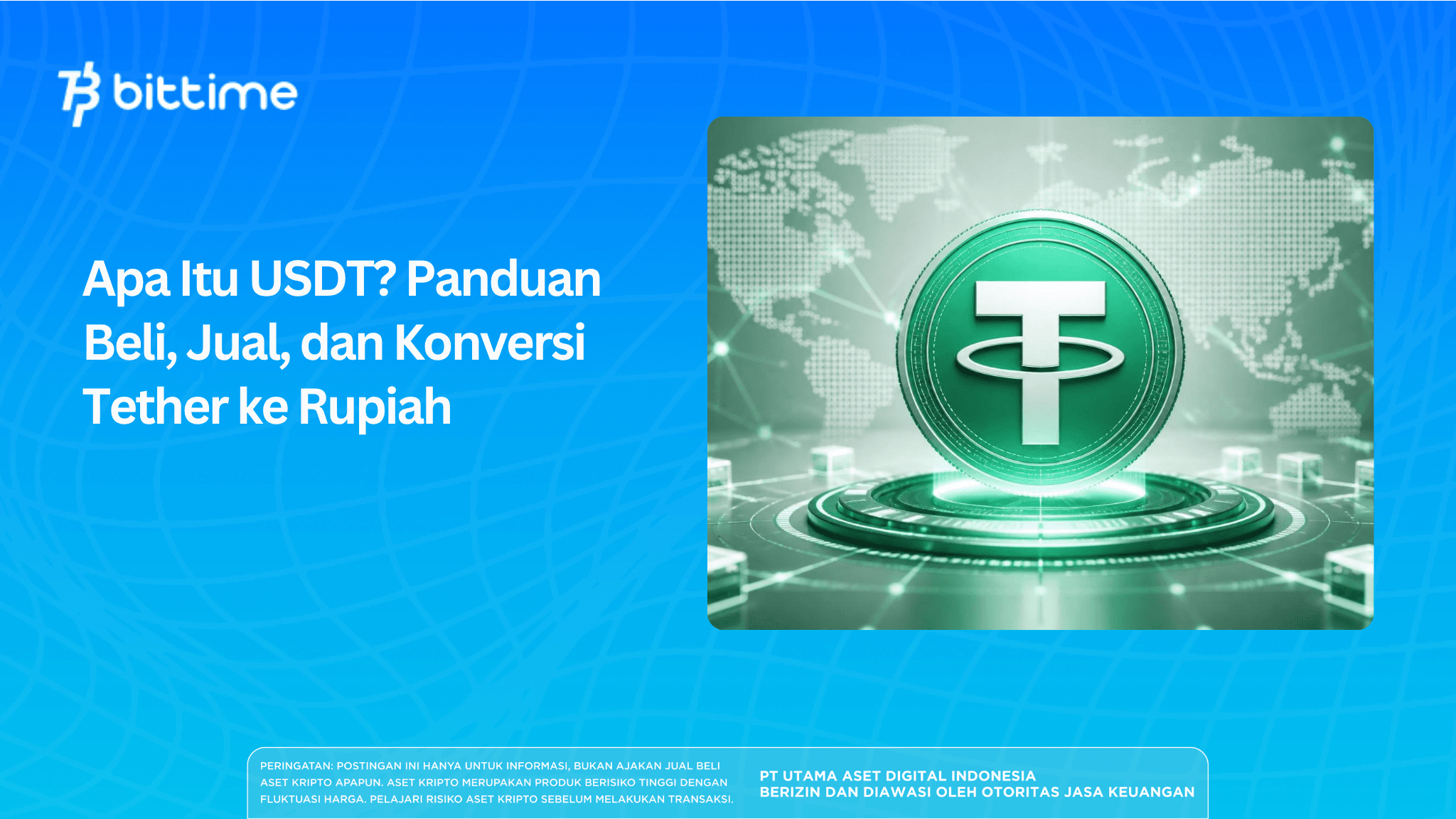
What is USDT? USDT or Tether USDT is a stablecoin designed to maintain its value close to one US dollar. In Indonesia, users can buy USDT with rupiah, use it for trading, and then sell it back to IDR before withdrawing the funds to a bank account.
Key Takeaways
- USDT is a stablecoin designed to have a value close to US$1, but the USDT/IDR price can differ from the bank's dollar rate.
- Buying and selling can be done through the USDT/IDR pair using market orders or limit orders.
- Users should check the transfer network, spread, trading fees, and withdrawal fees to avoid sending the wrong amount or receiving less rupiah than expected.
What is USDT or Tether?
USDT is a digital asset classified as a stablecoin, issued with the aim of maintaining the value of each token at approximately one U.S. dollar.
Unlike Bitcoin and altcoins, which can experience sharp fluctuations against the dollar, USDT is designed to have lower volatility. Its issuer states that each token is pegged 1:1 to the corresponding fiat currency and is backed by a reserve portfolio that is reported on a regular basis.
Sumber: AI Generated Image
Simply:
- 1 USDT is targeted to be worth around US$1.
- USDT can be sent via blockchain.
- USDT can be stored in a crypto wallet.
- USDT can be traded with rupiah or other crypto assets.
- USDT is not a stock or ownership of a company.
- USDT is not a dollar balance in a user's bank account.
The price of USDT can fluctuate slightly above or below US$1 due to market demand, liquidity, exchange conditions, and stablecoin risks.
Read also:Tether (USDT) is in danger of disappearing from European exchanges. What's the reason?
Why is USDT Important in the Crypto World?
USDT acts as a bridge between the dollar and the digital asset market. Traders no longer need to transfer assets to a bank account to reduce their exposure to Bitcoin or altcoin volatility.
Some uses of USDT include:
- Become a crypto asset trading partner.
- Hold funds temporarily when the market is volatile.
- Transferring value between exchanges.
- Become a transaction tool in the blockchain ecosystem.
- Used as collateral for certain services.
- Pay for the needs in Web3 applications that support it.
- Be a unit for recording profits and losses.
For example, a trader might sell Bitcoin for USDT when predicting a market correction. The funds remain within the crypto ecosystem without being directly converted into rupiah.
However, holding funds in USDT still carries risks. Its price stability depends on the issuing mechanism, reserves, liquidity, exchange access, and market confidence.
Read also:USDT Trades 8.5% Higher in India, What's the Reason?
How Does USDT Work?
USDT doesn't have a single blockchain. It's issued on multiple networks, so users may encounter USDT in different formats depending on the blockchain they use.
The simple flow is:
- Verified customers purchase tokens from the issuer.
- New tokens are issued upon request that meets the procedure.
- USDT circulates and is transferred via the blockchain.
- Retail users buy or sell it through exchanges.
- Tokens can be returned through an exchange process that meets the requirements.
- Redeemed tokens can be removed from circulation.
The issuer states that new tokens are only issued when requested and purchased by customers who have undergone an identity verification process.
For Indonesian users, purchases are typically not made directly with the issuer. A more practical approach is to use a licensed digital financial asset trader and purchase through the marketplace USDT/IDR.
Read also:What Is a Tether Wallet? Here's a Complete Explanation of Tether's Official Crypto Wallet
Why is the USDT/IDR Price Different from the USD/IDR Rate?
USDT is not the same as cash dollars.
The USD/IDR exchange rate indicates the value of the US dollar against the rupiah on the foreign exchange market. Meanwhile, USDT/IDR is the price of the digital asset USDT against the rupiah on the crypto market.
The prices of both may differ due to:
- Local supply and demand.
- Order book depth.
- Buy and sell spreads.
- Liquidity conditions.
- Transaction fees.
- Cross-platform transfer requests.
- Stablecoin risks.
- Movement of the rupiah and the dollar.
- Price differences between exchanges.
Therefore, when the dollar exchange rate is Rp16,500, the price of one USDT doesn't have to be exactly Rp16,500. The USDT/IDR market could be slightly higher or lower.
Read also:How to Cash Out USDT to Rupiah on Bittime: A Complete Guide 2026
What are the Benefits of Using USDT?
Relatively Stable Prices
USDT is designed to have a more stable value than most cryptocurrencies. This stablecoin can be used to reduce exposure to market volatility.
High Liquidity
USDT is widely used as a trading pair, making it easy for users to buy or sell various assets without having to use fiat currency.
Blockchain-Based Transfers
USDT can be sent between wallets and platforms via blockchain networks. Transfer times and fees depend on the network used.
Easy to Convert
On platforms that provide the USDT/IDR market, users can convert USDT directly into rupiah.
Perfect for Waiting for Opportunities
Traders can temporarily hold funds in USDT before purchasing other assets when they find a price they deem attractive.
Read also:Tether Launches USAT Stablecoin on Rumble Wallet, Here's How It Benefits Creators!
What are the Risks of Using USDT?
Depeg Risk
The price of USDT could fall below the US$1 target if there is market pressure or concerns about the issuer and its reserves.
Issuer Risk
USDT depends on the issuer's ability to manage reserves, fulfill conversions, and maintain market confidence.
Risk of Wrong Network
USDT is available on multiple networks. Sending tokens using a network the recipient doesn't support may result in funds not arriving or being difficult to recover.
Risk Platform
Users who store USDT on exchanges face operational risks, account security risks, withdrawal freezes, and service disruptions.
Phishing Risks
Fake sites, apps, and support accounts can steal credentials or ask users to approve malicious transactions.
Price Risk against Rupiah
Although USDT is relatively stable against the dollar, its value in rupiah can still change depending on local exchange rates and market conditions.
Read also:Tether Launches USA₮: Everything You Need to Know
How to Buy USDT with Rupiah?
Purchasing USDT with rupiah can be done through the USDT/IDR trading pair.
1. Create and Verify Account
Register on a legal digital asset platform and complete an identity check.
Bittime is listed as one of the licensed digital financial asset traders on the OJK whitelist.
2. Deposit Rupiah
Enter balance via available methods, such as:
- Transfer bank.
- Virtual account.
- E-wallet.
- Pinch.
- Other methods supported by the platform.
Fees and minimum limits may vary for each payment channel.
3. Search for USDT/IDR Pair
Open the market menu and select the USDT/IDR trading pair. This pair allows you to use your rupiah balance to purchase USDT.
4. Select Order Type
There are two types of orders that are commonly used.
Market Order
A market order buys USDT directly using the best available price in the order book.
The advantage is a fast process. The downside is that the final price can differ from the estimate when volatility or spreads are high.
Limit Order
Limit orders allow users to set their own purchase price.
Orders will only be executed if the market reaches the selected price. This method provides greater control, but orders may not be filled immediately.
5. Enter the Purchase Amount
Enter the amount of Rupiah you wish to use. Check the estimated USDT received, price, and transaction fees.
6. Transaction Confirmation
Double-check the order details and complete security verification. Once the order is fulfilled, USDT will be credited to your account wallet.
Read also:How to Save USDT and Get High Interest? Try Bittime?
How to Sell USDT to Rupiah?
The selling process is the opposite of buying.
The general steps are:
- Login to a verified account.
- Open the trading menu.
- Select the USDT/IDR pair.
- Select market order or limit order.
- Enter the amount of USDT.
- Check prices and fees.
- Press the sell button.
- Wait until the order is complete.
- Check the IDR balance received.
Market orders are suitable when users prioritize speed. Limit orders are suitable when users want to set their own selling price.
Once the transaction is complete, the rupiah will be credited to your IDR wallet on the platform. The funds won't automatically be credited to your bank account.
Read also:USDT IDR Price Prediction 2026: What Investors Should Know
How to Convert USDT to Rupiah?
Converting USDT to rupiah has two possible paths.
USDT is Now on the Platform
Users can directly open the USDT/IDR market and sell tokens.
USDT Is in Another Wallet or Platform
Users need to send USDT first.
The flow is:
- Open the USDT deposit menu.
- Select the network to use.
- Copy the deposit address.
- Open your original wallet or platform.
- Select the same network.
- Paste the destination address.
- Enter the amount of USDT.
- Double check the network and address.
- Send a token.
- Wait for blockchain confirmation.
- Sell USDT through the USDT/IDR market.
- Withdraw rupiah balance to bank account.
Bittime lists deposit support via networks like TRC20, BEP20, and ERC20 in its withdrawal guide. Network availability is subject to change, so users should check the deposit menu before sending tokens.
Read also:USDT IDR Price Prediction 2026: What Investors Should Know
Example of Calculating USDT Conversion to Rupiah
For example, a user has 100 USDT and the market price is at IDR 16,500 per USDT.
Gross sales value:
100 × Rp16.500 = Rp1.650.000
The net value received will be lower after deducting trading costs.
If the USDT price changes to Rp16,450 before the order is executed, the gross value will be:
100 × Rp16.450 = Rp1.645.000
This difference shows why users should look at actual market prices, rather than simply multiplying USDT by the dollar rate from a search engine.
Read also:How to Withdraw USDT to an Indonesian Bank: Easy Steps for Beginners!
How to Withdraw Rupiah to a Bank Account?
After USDT is sold:
- Open the wallet menu.
- Select IDR balance.
- Press withdraw.
- Select a bank account.
- Enter the nominal amount.
- Check the owner's name and account number.
- Confirm withdrawal.
- Wait for funds to be processed.
USDT cannot be sent directly as rupiah to a regular bank account. The tokens must first be sold for IDR, and then the rupiah balance can be withdrawn through the banking system.
Read also:How to Easily Withdraw USDT to ShopeePay Through Bittime
Where Can You Buy and Sell USDT?
USDT can be traded through:
Exchange Indonesia
The local platform allows users to buy with rupiah, sell to IDR, and withdraw the proceeds to a bank account.
Use providers listed on the official OJK whitelist and regularly check their licensing status. Oversight of digital financial asset and crypto asset trading in Indonesia falls under the OJK's purview.
Exchange Global
International platforms may offer a wider range of trading pairs. However, users should check regulations, regional access, verification processes, withdrawal methods, and consumer protection.
Decentralized Exchange
USDT can be exchanged directly through wallets on certain blockchains. Users need to understand gas fees, smart contracts, liquidity pools, slippage, and wallet security.
OTC Services
OTC is suitable for large transactions because prices are agreed directly without executing the entire order on the public order book.
The service can reduce price impact, but users should only communicate through official channels to avoid fraud.
To start buying USDT with rupiah, users can register at Bittime, complete verification, and check the USDT/IDR pairing. Also, monitor the latest news regarding stablecoins, network changes, fees, and regulations before making a transaction.
Read also:How to Transfer USDT to DANA Easily and Safely
Are There Any Fees When Transacting USDT?
Yes. Fees may arise at several stages.
Rupiah Deposit Fee
The amount depends on the payment method. Certain bank transfers may be free, while virtual accounts, e-wallets, or QRIS may incur a flat fee or a percentage.
Trading Fees
As of June 12, 2026, the cost of purchasing through the IDR market was recorded at approximately:
- 0.12% for the maker.
- 0.22% for takers.
Cost of sales to IDR was recorded at approximately:
- 0.33% for the maker.
- 0.43% for takers.
This figure represents the total cost, including trading components, taxes, and exchange fees. Rates are subject to change, so users should check the latest fees page before making a transaction.
Rupiah Withdrawal Fee
Bank transfer fees are recorded at around Rp2,522 or Rp4,500 per transaction, depending on the destination bank. The minimum IDR withdrawal is Rp20,000.
Blockchain Transfer Fees
When USDT is sent to another wallet, users pay a fee according to the network or platform withdrawal rates.
ERC20s can generally be more expensive when the Ethereum network is congested. Other networks may offer lower fees, but should only be chosen if they are supported by both the sender and recipient.
Spread then Slippage
The spread is not a separately charged fee, but the difference between the buy and sell prices can affect the outcome of a transaction.
Slippage can also cause the execution price to differ from the price shown, especially when using market orders or making large transactions.
Read also:How to Buy USDT with QRIS: Easy Steps for Beginners!
Safe Tips for Buying and Selling USDT
- Use a licensed platform.
- Enable two-factor authentication.
- Do not share your PIN, OTP, or seed phrase.
- Match the sending and receiving networks.
- Check some characters of the wallet address.
- Perform a test transfer with a small nominal amount.
- Avoid cheap USDT offers via private messages.
- Use limit orders if you want to control the price.
- Check fees before confirming.
- Save proof of transaction.
- Don't keep all your funds on one platform.
- Use funds according to risk tolerance.
Network errors are one of the biggest risks when transferring USDT. A valid-looking address isn't enough; the chosen blockchain must also be compatible.
Is USDT Suitable for Beginners?
USDT is relatively easy to understand because its value is pegged closely to the US dollar. This stablecoin can help beginners learn about trading pairs, blockchain transfers, and balance management without facing the volatility of smaller altcoins.
Sumber: AI Generated Image
However, beginners still need to understand that USDT:
- Not a bank savings account.
- No deposit guarantee.
- Not always exactly worth US$1.
- Has issuer risk.
- Has networking risks.
- Has platform risk.
- Can be lost due to incorrect address or fraud.
- Its value against the rupiah continues to change.
USDT is suitable for use once users understand the purpose of their ownership. Don't buy simply because it's perceived as safe or guaranteed to be profitable.
Conclusion
USDT is a stablecoin designed to maintain a value close to one US dollar. It is widely used as a trading pair, a blockchain-based transfer tool, and a temporary storage medium in the crypto market.
Indonesian users can purchase USDT through the USDT/IDR pair after depositing rupiah. To cash out, sell USDT for IDR and then withdraw the rupiah balance to a bank account.
Before making a transfer, carefully review the network. USDT on TRC20, BEP20, and ERC20 are tokens that run on different blockchains, even though they share the same symbol.
Also consider deposit, trading, blockchain transfer, spread, and bank withdrawal fees. USDT can be a convenient asset for beginners, but it still carries risks related to stablecoins, platforms, regulation, account security, and transaction errors.
Want to own assets whose value tracks the U.S. dollar? Check the price movements of USDT, USDC, USD1, and USDS, then start trading your favorite stablecoins on Bittime.
Bittime is a licensed and regulated Digital Financial Asset Trader (PAKD) supervised by Indonesia’s Financial Services Authority (OJK) — where you can buy Bitcoin in Indonesia and hundreds of other crypto assets starting from just Rp10,000. The registration process is fast, secure, and you can get started today.
Track USDT to IDR conversions and monitor your favorite crypto assets in real time. Everything is available in one crypto investment app that you can download for free on the Play Store
Ready to start? Register now on Bittime and execute your investment strategy with a platform trusted by millions of users in Indonesia.
FAQ
What is USDT?
USDT is a stablecoin designed to have a value close to one US dollar. This token can be stored and sent across multiple blockchain networks.
Is USDT the same as US dollar?
No. USDT is a digital asset pegged to the dollar, while USD is the official currency of the United States. The USDT/IDR price may differ from the USD/IDR exchange rate.
How to buy USDT with rupiah?
Deposit rupiah on a licensed platform, select the USDT/IDR market, and then place a market order or limit order. Once the transaction is complete, the tokens will be transferred to your account wallet.
How to withdraw USDT to bank account?
Sell USDT through the USDT/IDR market, then withdraw the rupiah balance to your bank account. USDT cannot be directly transferred to your account as rupiah without a conversion process.
Which USDT network is the cheapest?
Fees depend on network conditions and platform policies. Choose a network supported by both the sender and the recipient, not just the one with the lowest fees.
Disclaimer: The views expressed belong exclusively to the author and do not reflect the views of this platform. This platform and its affiliates disclaim any responsibility for the accuracy or suitability of the information provided. It is for informational purposes only and not intended as financial or investment advice.
.png)