What is UODF Coin? Get to Know the Solana Token and Claim Its Dividends
2026-11-05
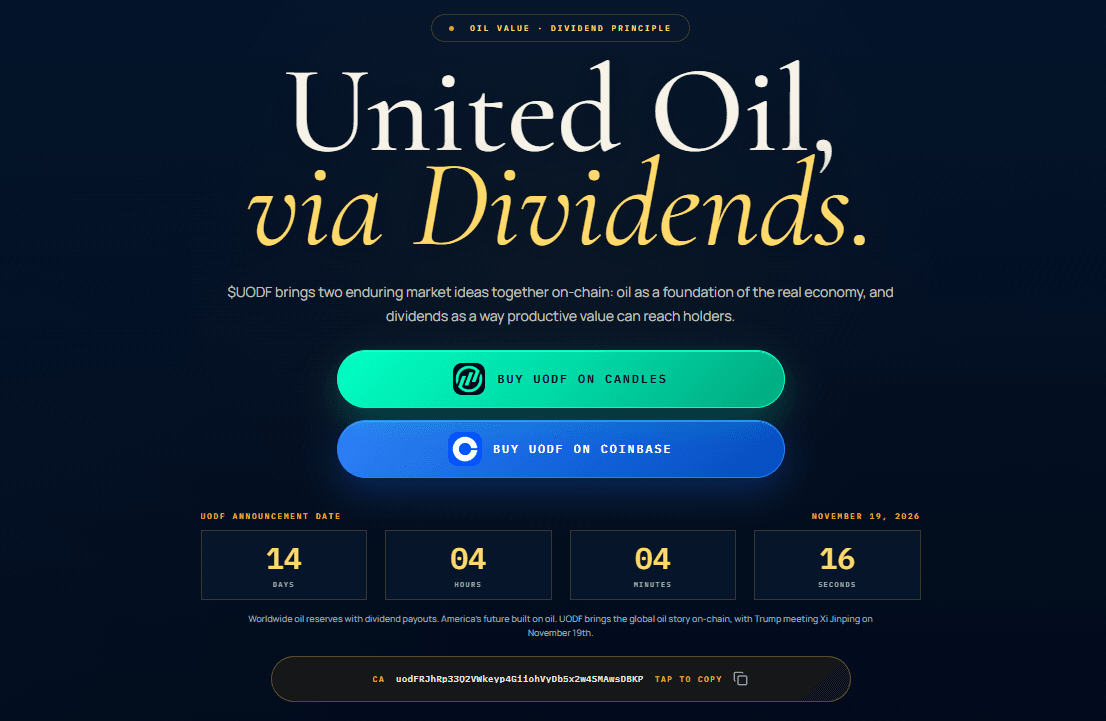
What is UODF coin? United Oil Dividend Fund (UODF) is a cryptocurrency token on the Solana network that promotes an oil-based profit-sharing model. The project has attracted attention by advertising USDC dividends every two weeks, claims of 1:1 oil ownership, and an APY of up to 250%.
Those figures may sound appealing, but one important question remains unanswered: where does the money to pay those dividends come from? As of November 5, 2026, the available information is insufficient to independently verify UODF's oil reserves or dividend payments. Before assessing its potential, it is worth understanding how the token works, the state of its market, and the risks that may be overlooked.
Key Takeaways
- UODF is a Solana token traded on decentralized exchanges, marketed around oil investment and dividends.
- Claims of a 250% APY, USDC payments, and oil ownership are not backed by sufficient independent evidence.
- UODF's liquidity is relatively small compared with its valuation, making volatility and slippage important risks to consider.
What Is United Oil Dividend Fund (UODF)?
United Oil Dividend Fund is a crypto project that seeks to connect the oil commodity market with a profit-sharing concept through blockchain.
The underlying idea is fairly simple. Oil plays a major role in economic activity, while dividends are one way of distributing profits to asset owners.
UODF uses those two ideas as its main selling points.
The token operates on the Solana network and can be traded through decentralized exchanges (DEXs). One of its trading pairs is UODF/USDC on Meteora.
Although its name contains the word Fund, there is not enough evidence to describe UODF as an officially established investment fund or a company that actually owns oil reserves.
A project's name and the existence of token trading do not automatically prove that an income-generating business stands behind it.
This is the first distinction to understand: UODF already has a tradable token, but its advertised economic benefits still need to be substantiated.
Read also: What Is Project Cortex (XTX)? Its AI Concept and Risks
How Does UODF Coin Work?
From a blockchain perspective, UODF works much like other Solana tokens.
The token has a contract address used to identify the asset. Users can store it in Solana-compatible wallets or trade it through available liquidity pools.
UODF's price is determined by buying and selling activity; it does not directly track global oil prices.
Meanwhile, the project promotes what it describes as a dividend-distribution mechanism for token holders.
Under the proposed model, UODF holders are said to be eligible to receive USDC through periodic distributions. USDC itself is a stablecoin designed to track the value of the US dollar.
For such a system to function in practice, the project needs a source of revenue, distribution rules, and a clear payment mechanism.
At present, those details cannot be confirmed from the published information alone.
In other words, holding UODF tokens is different from having an enforceable right to dividends from oil assets. The two should not be treated as equivalent without supporting documentation.
Does UODF Really Pay Oil Dividends?
This is one of the most important questions surrounding United Oil Dividend Fund.
The project refers to USDC distributions every two weeks and connects the proposed benefits to the economic value of oil. Its promotional materials even feature a claim of 1:1 oil ownership.
However, there is insufficient independent information about the company managing the reserves, where those assets are located, or the revenue intended to fund dividend payments.
In investments that genuinely distribute profits, the source of the money can usually be explained.
For example, a company earns revenue from its operations, calculates its profits, and distributes them according to investors' entitlements.
For UODF, the link between oil industry operations and USDC payments has not yet been adequately explained.
What About the 250% APY Claim?
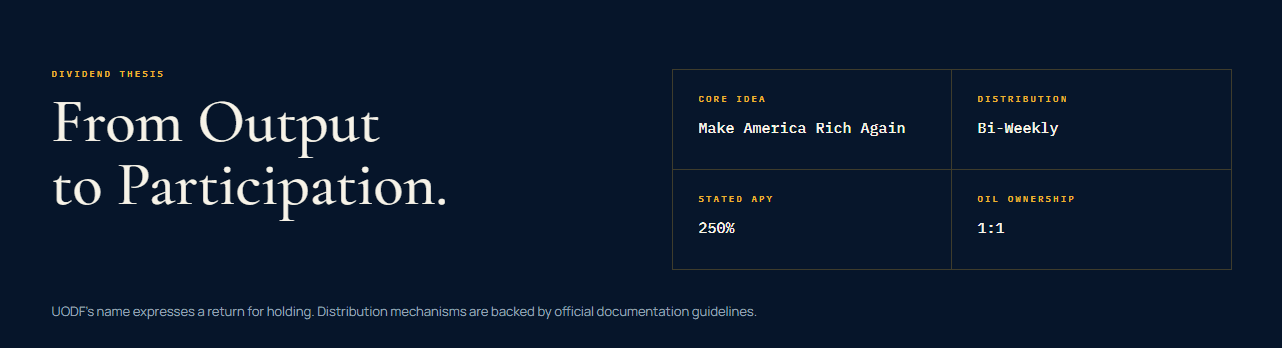
UODF also advertises a 250% APY in its marketing materials.
APY, or Annual Percentage Yield , describes annual returns that account for compounding under certain assumptions.
A 250% figure is exceptionally high. The problem is that there is insufficient evidence of the revenue source or mechanism that could sustain such a return over time.
Readers should also distinguish an advertised APY from profits that have actually been received.
Without a verifiable payment history and clear terms, the claim cannot be used as a reliable basis for estimating potential income.
What Evidence Should Be Available?
If UODF truly distributes proceeds from an oil business, at least the following key information should be verifiable:
- The identity of the party that owns or manages the oil assets.
- Ownership documents and the value of the reserves underlying the token.
- An explanation of the revenue source used to pay dividends.
- Rules governing token holders' rights and the payment schedule.
- A history of USDC distributions that can be traced on the blockchain.
Such evidence would help distinguish the project's plans from benefits that have already been delivered.
Notably, the disclaimer on UODF's own website states that its materials are not proof of oil ownership or reserves, government affiliation, or guaranteed dividends.
That statement is another reason not to treat its return claims as certain.
Read also: What Is an IAO Token? Understanding Ptah's Initial Agent Offering
Is UODF a Meme Coin or an RWA Token?
At first glance, UODF appears to follow a concept similar to real-world assets (RWAs).
RWA is a term for real-world assets represented using blockchain technology, such as bonds, real estate, or commodities.
However, an oil-themed token does not necessarily represent actual ownership of oil.
In RWA projects backed by verified assets, information is typically available about legal ownership, custodians, audits, and token holders' economic rights.
UODF has not yet presented sufficient independent evidence to meet those criteria.
On the other hand, its strong marketing narrative and reliance on market attention also resemble characteristics of speculative tokens.
For now, UODF is better understood as an oil-themed Solana token advertising a dividend concept, rather than automatically being classified as an RWA backed by verified reserves.
That classification could be revisited if the project publishes more comprehensive evidence.
Read also: What Is Forever (FOREVER)? Its AI Concept and On-Chain Fund
UODF Contract Address and How to Check It
There is one thing you should never overlook when searching for UODF coin: its contract address.
Multiple tokens can use the name United Oil Dividend Fund or the ticker UODF, even across different blockchain networks.
The Solana token discussed in this article has the following mint address:
UODF Contract Address (Solana):
uodFRJhRp33Q2VWkeyp4GiiohVyDb5x2w4SMAwsDBKP
This address is used to verify the token's identity on the blockchain and on trading trackers.
How to Verify the UODF Token
Before checking prices or making a trade, you can follow these steps:
- Copy the full contract address.
- Make sure the selected blockchain is Solana.
- Match the address against the token details published by the project.
- Check the trading pairs, supply, and distribution among holders.
- Review token minting permissions and available security information.
Do not rely on the logo or ticker alone when selecting a token.
Remember that a matching contract address only confirms that you are looking at the intended token. It does not prove the project's quality or validate its dividend claims.
Read also: What Is XTruth Oil (XTO) Coin? Price, Risks, and How to Claim
UODF Price Today and Current Market Conditions
What does UODF's market price look like?
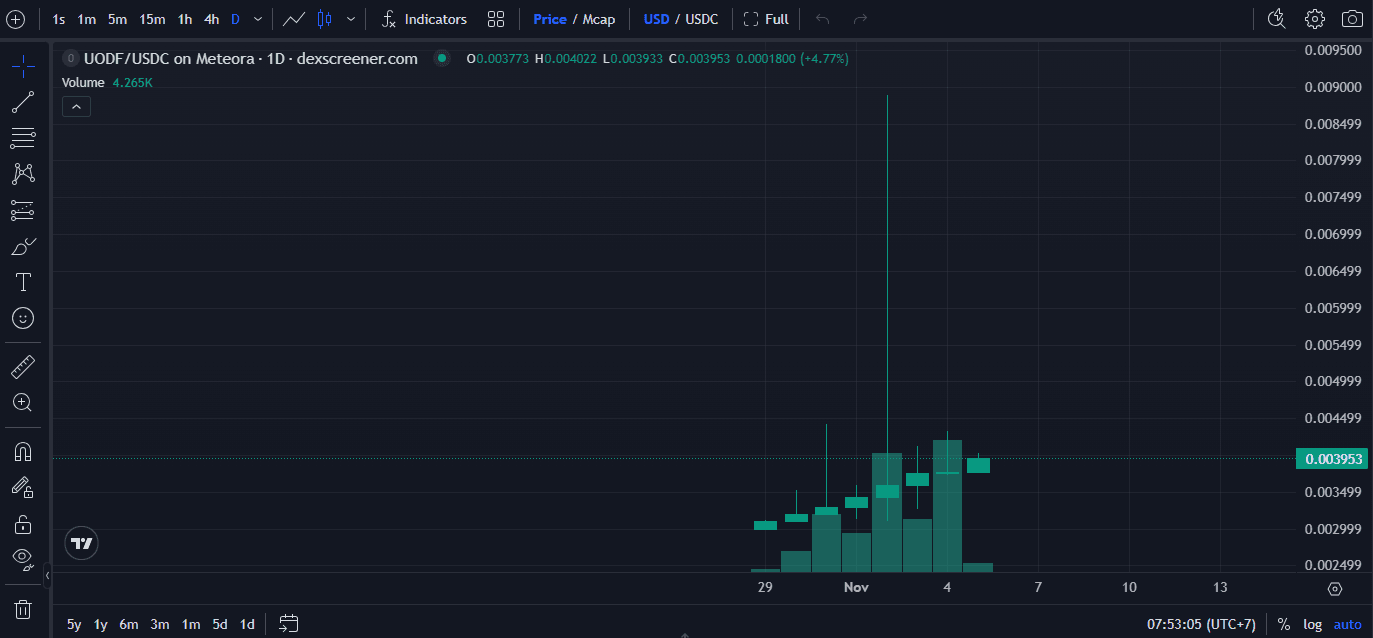
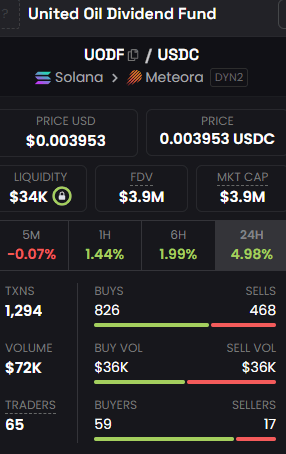
In a trading snapshot reviewed on November 5, 2026, UODF was priced at approximately 0.00395–0.00399.
The UODF/USDC pair on Meteora showed roughly $34,000 in liquidity, with 24-hour trading volume approaching $71,000.
Meanwhile, UODF's fully diluted valuation (FDV) was approximately $3.9 million.
These figures reveal a substantial gap between the token's theoretical valuation and the funds available in the observed trading pool.
Why Compare Valuation and Liquidity?
FDV reflects a token's value based on its current price and the supply used to calculate its fully diluted valuation.
Liquidity serves a different purpose. It describes the depth of funds in a pool available to facilitate trades.
For UODF, liquidity in the tens of thousands of dollars is relatively small compared with its FDV in the millions of dollars.
This means large trades could move the price significantly, particularly when buying and selling activity is unbalanced.
Such conditions can cause slippage, which occurs when the actual execution price differs from the price initially displayed.
For example, UODF's price may appear stable on a chart. However, if large quantities of tokens are sold around the same time, limited pool liquidity could cause the execution price to fall much further than expected.
This is why price increases in tokens with limited liquidity should be interpreted cautiously.
Market prices can also change at any time, so figures from November 5, 2026, should not be treated as live quotes when the article is read on another day.
Read also: What Is Elysium? Hyperliquid Layer 2 Mainnet on November 9
What Are UODF's Tokenomics?
Beyond price, the number and distribution of tokens are important factors when evaluating a crypto project.
For UODF, an FDV of roughly $3.9 million at a price near $0.00395 suggests that the valuation calculation assumes a supply of approximately one billion tokens.
However, that calculation is not enough to confirm how much circulating supply is actually available on the market.
Another factor to consider is ownership concentration.
If most tokens are held in a small number of wallets, decisions by major holders could put substantial pressure on the price.
It is also important to check whether authority to mint additional tokens remains active, how the initial distribution was structured, and whether any token unlock schedule exists.
Such information is more useful than simply looking at an apparently low price per token.
What Is Happening With UODF on November 19, 2026?
UODF lists November 19, 2026, as the date of its next project announcement.
That date features prominently in its promotional materials, including narratives about developments in the oil sector and connections to international political figures.
The UODF website even links the announcement to Donald Trump and Xi Jinping.
However, that information does not establish the existence of an official oil agreement, government backing, or involvement by either leader in the UODF project.
Because the date is still in the future, there are no announcement results to evaluate yet.
If the project releases new developments, the most important thing to examine will be the substance of the announcement.
Are there documents proving oil ownership? Is the USDC payment mechanism explained? Are there transaction records or audits that can be independently verified?
The answers to these questions will matter far more than the amount of social media attention surrounding the announcement date.
UODF Risks to Consider
The oil-and-dividend narrative makes UODF appear different from many new Solana tokens. However, several risks still need to be understood before assessing its prospects.
1. Limited liquidity
The funds in the observed liquidity pool are relatively small compared with the token's valuation, so large trades may cause slippage.
2. Uncertainty over economic benefits
There is insufficient independent evidence to verify the source of dividend payments or the oil reserves claimed by the project.
3. Risk of changes in token supply
Holder distribution, token minting permissions, and possible ownership concentration should be examined using on-chain data.
4. Volatility of a new token
A short trading history makes it harder to assess long-term trends than for assets with more established markets.
5. Token identity and information risks
Other tokens can use the same name or ticker, while the project's promotional materials may not provide a complete picture of its actual circumstances.
A normal result from an automated security scan is not equivalent to a comprehensive audit.
Technical security and the project's economic viability must therefore be evaluated separately.
What Should You Monitor About UODF?
To understand developments at United Oil Dividend Fund, several indicators are more useful than simply following daily price gains.
First, check whether liquidity and trading volume show consistent growth.
Second, monitor changes in holder distribution and token supply using blockchain data.
Third, look for USDC payments that have actually been recorded, including the distribution wallets and amounts received by token holders.
Fourth, watch for legal documents or independent audits that substantiate the project's oil asset claims.
Finally, evaluate the November 19 announcement based on the evidence provided, rather than community narratives or circulating price targets.
If you want to learn more about Solana tokens, RWA developments, and emerging crypto projects, you can also sign up for Bittime for market analysis and additional research before making decisions.
Conclusion
What is UODF? United Oil Dividend Fund is a Solana token bringing the concept of oil-based dividend distribution to the cryptocurrency market.
The project presents an appealing narrative through claims of USDC payments and a 250% APY. However, these benefits are not supported by sufficient independent evidence, while market data indicates relatively limited liquidity compared with its valuation.
For readers interested in following UODF, the priorities are to verify the contract address, examine the tokenomics, and seek evidence of asset ownership and dividend payments.
Ultimately, UODF's prospects should be assessed based on verifiable information, not simply the size of its promised returns.
Bittime is a Digital Financial Asset Trader (PAKD) platform licensed and supervised by Indonesia's Financial Services Authority (OJK) — where you can buy Bitcoin in Indonesia and hundreds of other crypto assets starting from Rp10,000. Registration is fast and secure, and you can get started today.
Track the conversion of USDT to IDR and real-time price movements of your favorite crypto assets. Everything is available in one crypto investment app that you can download for free from the Play Store.
Ready to get started? Sign up for Bittime now and put your investment strategy into action on a platform trusted by millions of users in Indonesia.
FAQ
What Is United Oil Dividend Fund (UODF)?
United Oil Dividend Fund, or UODF, is a Solana-based crypto token promoting an oil-and-dividend concept. It can be traded on DEXs, including through the UODF/USDC pair. However, claims of links to oil assets and the dividend payment mechanism still require independent verification.
Does UODF Really Pay Oil Dividends?
UODF promotes USDC distributions every two weeks and a 250% APY. There is not enough independent evidence to confirm that those payments have been made or are backed by a sustainable source of revenue. These claims should not be interpreted as guaranteed returns.
What Is UODF's Contract Address on Solana?
The UODF mint address discussed in this article is uodFRJhRp33Q2VWkeyp4GiiohVyDb5x2w4SMAwsDBKP. Use the complete address to verify the token's identity when checking blockchain or DEX data. Other assets may use the same name and ticker.
Is UODF a Meme Coin or an RWA Token?
UODF promotes an oil-related narrative that resembles the concept of real-world assets. However, there is insufficient evidence to establish that the token legally represents ownership of oil reserves. For now, UODF is better described as an oil-themed Solana token with unverified asset claims.
Is United Oil Dividend Fund Safe to Invest In?
UODF carries several risks, including limited liquidity, volatility, concentrated ownership, and uncertainty over its fundamental claims. Being listed on a DEX or passing an automated security check does not guarantee that the project is safe. Before making any decision, thoroughly verify the token's identity and the project's information.
Disclaimer: The views expressed belong exclusively to the author and do not reflect the views of this platform. This platform and its affiliates disclaim any responsibility for the accuracy or suitability of the information provided. It is for informational purposes only and not intended as financial or investment advice.

.png)