What Is Elysium? Layer 2 Hyperliquid Mainnet November 9th
2026-11-09
What is Elysium? Hyperliquid is set to welcome a new Layer 2 network called Elysium on November 9, 2026. Developed by Kinetiq, the network is designed to speed up transaction processing and provide more capacity for trading and decentralized finance (DeFi) applications that require high performance.
Elysium is attracting attention for its target block time of just 100–200 milliseconds, significantly faster than HyperEVM. The network also uses HYPE for transaction fees and offers more flexible infrastructure for developers. So how does it work, what sets it apart from HyperEVM, and which features are being prepared ahead of mainnet?
Key Takeaways
- Elysium is a Layer 2 network developed by Kinetiq to support trading and DeFi applications in the Hyperliquid ecosystem.
- The network uses Arbitrum Orbit, settles transactions on HyperEVM, and uses HYPE as its gas token.
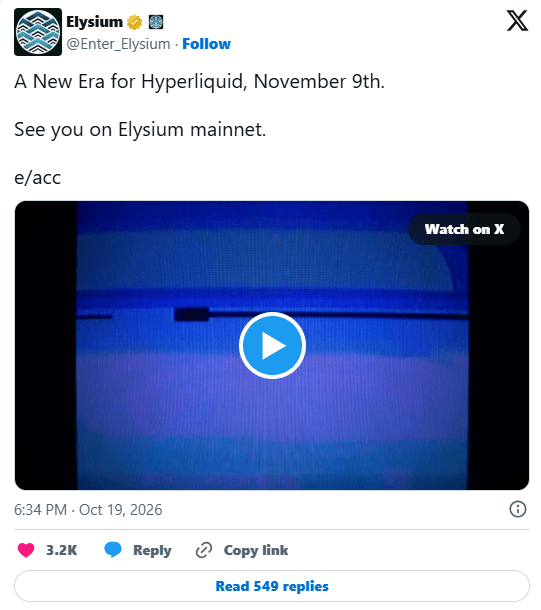
- Elysium mainnet is scheduled to launch on November 9, 2026, while direct integration with HyperCore is planned for a later phase.
What Is Elysium and Why Is It Coming to Hyperliquid?
Elysium is a Layer 2 blockchain network built by Kinetiq to expand Hyperliquid's capabilities. The project focuses on applications that process large volumes of transactions, particularly decentralized exchanges (DEXs), trading platforms, and automated market makers (AMMs).
Hyperliquid has primarily been known for its perpetual futures trading service, which uses infrastructure called HyperCore. The ecosystem also includes HyperEVM, where developers can deploy smart contracts and build blockchain applications.
The challenge is that HyperEVM is not designed to accommodate all high-frequency computing activity. Its block capacity is deliberately limited to remain aligned with the HyperCore trading system.
These limitations may be barely noticeable for simple applications. However, platforms that must update prices multiple times per second require greater capacity.
Elysium aims to meet that need. Developers can run applications on a dedicated network with more computing capacity while maintaining connections to the Hyperliquid ecosystem.
Read also: What Is Forever (FOREVER)? Its AI Concept and On-Chain Fund
When Will Elysium Mainnet Launch?
Kinetiq has scheduled the Elysium mainnet launch for November 9, 2026. The announcement follows the opening of its public testnet in September 2026, which gave developers an opportunity to try the network.
Mainnet is an important milestone because the blockchain begins operating in a production environment, including transactions involving assets with real-world value.
Previously, testing took place on the testnet. In that environment, developers can check smart contracts, test application connections, and identify technical issues without using mainnet funds.
Ahead of the launch, several projects have also announced plans to support Elysium.
However, the mainnet launch date does not mean that every feature on the roadmap will be available on day one. Some important integrations will still require network upgrades after launch.
How Does Elysium Layer 2 Work?
Elysium uses Arbitrum Orbit, technology that allows developers to build blockchains with their own configurations. The network uses Arbitrum Nitro software to execute smart contracts and transactions.
What distinguishes it from many other Layer 2 networks is where its transactions are settled.
While some Arbitrum networks settle on Ethereum or Arbitrum One, Elysium uses HyperEVM as its parent network.
Simply put, transactions are executed on Elysium, while their recording and settlement are connected to HyperEVM.
Here is an overview of the process:
- Users submit transactions through a wallet or application that supports Elysium.
- The sequencer receives transactions and determines their order.
- The Elysium network processes transactions using Arbitrum Nitro.
- The necessary information is forwarded to HyperEVM through the settlement mechanism.
- Transaction results can be checked through a blockchain explorer.
With this architecture, applications do not need to process all their activity directly on HyperEVM.
What Is the Role of the Sequencer?
A sequencer is the component that determines transaction order before transactions are included in blocks.
Initially, Elysium uses a single sequencer through Conduit infrastructure. This system helps the network process transactions in a coordinated manner.
Although it supports fast processing, using a single sequencer also means the network still depends on a particular operator.
Sequencer decentralization and validation mechanisms will be important considerations as Elysium develops.
Why Does Elysium Use HYPE?
Elysium uses HYPE as its native gas token, meaning it is the asset used to pay transaction fees.
This means users do not need to purchase a new gas token simply to interact with the network.
HYPE is designed to be transferable from HyperEVM to Elysium through a supported bridge at a 1:1 value ratio.
Using an asset already familiar to the Hyperliquid ecosystem can make it easier for users to move their activity. However, bridge fees and cross-chain transfer risks must still be considered.
Read also: Is Project Cortex (XTX) Legitimate? Check Its Token Risks and Security
How Fast Is Elysium Compared with HyperEVM?
One reason Elysium has drawn attention is its performance targets.
Kinetiq has designed the network for block production times of approximately 100–200 milliseconds. By comparison, HyperEVM has a fast-block interval of around one second.
In tests conducted on October 21, 2026, Elysium recorded block times of approximately 129–136 milliseconds.
These results show that the network was able to achieve its targeted range under the testnet conditions at the time of measurement.
However, block production time is not the same as transaction finality. A transaction may be included in a block quickly but still require additional steps before its settlement is considered final.
What About Transaction Capacity?
In addition to faster block production, Elysium targets an execution capacity of 300 million gas per second, or 300 Mgas/s.
In this context, gas measures the computational work a blockchain can perform, not the number of transactions directly.
The greater the computing capacity, the more smart contract activity can potentially be processed in a given period.
However, the 300 Mgas/s target is not the same as a result already demonstrated under mainnet conditions.
Testnet measurements in October 2026 recorded an actual load of approximately 3.3 Mgas/s. That figure was much lower because the network had not yet received enough activity to test its capacity limits.
Community testing discussed ahead of the launch also showed transaction inclusion times of approximately 0.27 seconds, compared with 1.7 seconds on HyperEVM. Transaction fees were reportedly about 5.8 times lower in that comparison.
These results offer an early indication of Elysium's potential but do not guarantee performance when the network is widely used.
Read also: What Is Project Cortex (XTX)? Its AI Concept and Risks
What Are Elysium's Advantages for Traders and Developers?
For crypto users, a network's advantages are not measured solely by speed. What matters more is how that performance benefits applications.
Elysium aims to offer three main benefits.
1. Supporting High-Activity Trading
Trading applications often need to update data and process transactions quickly.
For example, market makers must continually update bid and ask prices in response to market conditions.
With greater processing capacity, Elysium could support such activity without placing excessive load on HyperEVM.
Of course, network speed does not guarantee that orders will always be filled at the desired price. Liquidity and slippage still determine transaction outcomes.
2. Creating Room for New DeFi Applications
Developers can build DEXs, token launch platforms, and other financial applications using smart contracts compatible with the Ethereum Virtual Machine (EVM).
This compatibility makes it easier to use programming languages and development tools already familiar within the Ethereum ecosystem.
As a result, development teams do not have to start the entire development process from scratch.
3. Enabling Integration Opportunities with HyperCore
Elysium is also designed to let applications access trading information from HyperCore more directly.
In the future, smart contracts may be able to read data such as order books, prices, balances, and trading positions through dedicated network features.
These capabilities could support trading strategies and liquidity management that require up-to-date market information.
However, this direct integration remains part of the development planned for after mainnet.
What Should You Prepare Ahead of the Elysium Mainnet Launch?
Ahead of the Elysium mainnet launch on November 9, 2026, users should prepare network access and transaction funds first, rather than immediately buying newly launched tokens.
There are several steps that can reduce the risk of transfer errors, unexpected fees, and fake applications.
1. Prepare a Dedicated Wallet for Elysium
Use a wallet compatible with EVM networks, such as Bitget Wallet or another wallet that supports Elysium once integration becomes available.
Bitget Wallet has announced plans to support Elysium from the first day of mainnet.
When interacting with new, untested tokens, consider using a dedicated wallet with a limited balance, separate from the main wallet where you hold long-term assets.
This helps limit the value of assets exposed if you accidentally grant permissions to a malicious contract.
Never share your seed phrase or private key with websites claiming to help activate the network.
2. Prepare HYPE on the HyperEVM Network
HYPE is the main asset to prepare because it is used to pay transaction fees on Elysium.
Before launch, users can check whether they already hold HYPE on the HyperEVM network.
Make sure the assets are on the correct network, especially if HYPE was previously held on another service or blockchain.
When bridging, leave some HYPE in your balance to cover transaction fees and subsequent activity.
For example, some community guides suggest keeping approximately 0.1 HYPEin reserve, but this is not an official minimum requirement and may exceed the gas actually needed.
Actual gas requirements should be checked in the application being used.
3. Confirm That Mainnet Is Officially Available
Once your wallet is ready, the next step is to confirm that Elysium mainnet has opened to the public.
Do not immediately enter RPC details from links shared in private messages or social media comments.
Cross-check network information against official Kinetiq announcements or verifiable wallet integrations.
If you use Bitget Wallet, check whether Elysium is available in the official network list.
This matters because some community applications have offered early access before the public launch, while official support may follow a different schedule.
4. Learn How to Bridge HYPE to Elysium
Bridging is the process of moving assets from one blockchain network to another.
In this case, users need to move HYPE from HyperEVM to Elysium to pay gas fees and use applications on the new network.
The general steps are as follows:
- Open a verified bridge service.
- Connect the wallet holding HYPE on HyperEVM.
- Select HyperEVM as the source network and Elysium as the destination.
- Enter the amount of HYPE to transfer.
- Check the fees, destination address, and estimated time.
- First, make a small test transfer.
- Make sure the assets have actually arrived before transferring additional funds.
Several third-party bridge providers have prepared services for Elysium, but their availability and support should be checked again when mainnet officially opens.
Do not use a bridge button still labeled testnet to send mainnet assets without clear confirmation.
5. Be Aware That Withdrawals Can Take Up to Six Days
There is an important difference between depositing assets into Elysium and withdrawing them.
HYPE deposits to the network can be processed relatively quickly through supported routes.
However, withdrawing through the canonical rollup bridge requires approximately six days because of the challenge period and the claim process on the destination network.
This means funds transferred to Elysium may not be immediately available to return to HyperEVM when needed.
Therefore, avoid depositing funds needed for daily expenses or funds that must remain accessible in the near term.
Some third-party services may offer faster liquidity routes, but their fees and provider-related risks may differ.
6. Get to Know the Upcoming DEXs and Launchpads
Elysium is designed to support trading and token launches.
Projects included in the early ecosystem include:
- Boxa: A token launch and trading platform.
- Montra: A launchpad supporting mechanisms for launching new tokens.
- Nest: A DEX planning to support Elysium.
- Dawn: A trading platform in the early ecosystem.
- Citadel: Infrastructure for token issuance.
- Kalos: An NFT and community activity project.
This list indicates the direction of ecosystem development; it does not guarantee that all features will be available in the first hour of mainnet.
Before using an application, check its token contracts, pool liquidity, transaction fees, and actual launch status.
7. Understand Trading Fees and Anti-Sniping Mechanisms
New token launches often attract bots attempting to buy assets faster than ordinary users.
Some launchpads may implement anti-snipingmechanisms, including very high initial purchase fees to discourage such activity.
Therefore, do not look only at a token's price before clicking the buy button.
Also check the buy fee, sell fee, slippage, and estimated number of tokens you will receive.
Applicable fees may vary between projects and change depending on the launch period.
Trading without understanding the fee mechanism can lead to substantial losses even if the token's price has not changed.
8. Do Not Treat Rewards as Guaranteed Profits
Some projects in the Elysium ecosystem discuss incentives, revenue sharing, referrals, or rewards for early users.
However, program conditions may vary, including based on activity, calculation periods, and claim schedules.
Weekly rewards do not necessarily arrive immediately after the first transaction.
The same applies to token allocations that can only be claimed after a specified period.
Make sure reward information comes from genuine project announcements, that the terms remain valid, and that participation does not require transactions whose fees outweigh the potential benefits.
Avoid making repeated transactions solely to earn points if the value of the rewards is unclear.
9. Set Risk Limits Before Trading on Day One
The first day of mainnet may see intense activity, but liquidity for new tokens is often still thin.
Prices can change rapidly, while transactions may experience substantial slippage.
Before trading, determine how much capital you can afford to put at risk, your maximum transaction size, and the conditions under which you should stop.
Do not buy a token simply because its name or ticker appears popular.
Match its contract address to the project's official identity, especially as imitation tokens begin to emerge.
Avoid mint links sent through direct messages, comments, or unknown accounts.
The best preparation for day one is not being the fastest buyer, but ensuring transactions use the correct network and token and are made with a clear understanding of the fees.
Which Applications Are Being Prepared for Elysium?
Ahead of the mainnet launch, several projects have announced plans to introduce services on Elysium.
Their focus varies, from asset trading to new token issuance.
Announced projects include:
- Nest: A decentralized exchange planned for the Elysium network.
- Dawn: A DEX platform that is part of the early ecosystem.
- Speculate: A prediction market application.
- Montra: A token launch platform, or launchpad.
- Citadel: A launchpad supporting new token issuance.
Banana Gun has also announced plans to support trading on Elysium from its mainnet launch.
These projects reflect the network's development focus on trading and DeFi.
However, the list of announced partners does not automatically mean that all their applications are already running in production. Feature availability should still be checked when mainnet officially goes live.
Read also: What Is the IAO Token? Understanding Ptah's Initial Agent Offering
How Is Elysium Connected to Kinetiq and KNTQ?
Kinetiq is the developer behind Elysium. The project was previously known for its liquid staking service and DeFi products in the Hyperliquid ecosystem.
In addition to using HYPE for transactions, Elysium has an economic connection to the KNTQ token.
The distinction is clear: HYPE serves as the network's gas token, while KNTQ is associated with the Kinetiq ecosystem.
Kinetiq has announced the following proposed distribution of sequencer revenue:
- 25% for builders, meaning application developers who use the network's capacity.
- 25% for the Kinetiq treasury, to support operating needs.
- 50% for the KNTQ mechanism, through a plan to purchase tokens on the market and then transfer them to the Hyperliquid Assistance Fund to permanently reduce supply.
This structure is designed to allow growth in network activity to generate economic benefits for application developers as well.
The more activity taking place on Elysium, the greater the potential sequencer revenue.
However, actual revenue can only be determined after the network is operating. The KNTQ buyback and supply-reduction mechanism also does not guarantee that its price will rise.
When Will Elysium's HyperCore Integration Be Available?
Direct integration with HyperCore is an important part of the Elysium roadmap.
Kinetiq plans a network upgrade approximately four weeks after mainnet through an Arbitrum Operating System (ArbOS) upgrade.
The upgrade is designed to provide two main capabilities.
First, smart contracts on Elysium will be able to read HyperCore market data directly through dedicated features.
Second, applications will be able to send trading instructions to HyperCore using a mechanism designed to limit transaction permissions.
This creates opportunities for applications that need to combine smart contract logic with trading data.
For example, an application could use order book information to update prices automatically.
While promising, Elysium transactions and order execution on HyperCore do not always occur as a single indivisible process. Developers must still account for situations in which one step succeeds but the next fails.
Therefore, testing applications is essential before using these features with real funds.
How to Explore Elysium Before Mainnet
If you want to learn about the network before November 9, you can start with the testnet that is already available.
There is no need to use real funds immediately or try unfamiliar trading applications.
Several simple steps can help.
1. Read the Official Documentation
Start by reading Elysium's documentation to understand how the network processes transactions and connects to HyperEVM.
This information helps distinguish features that are already available from those planned for future development.
2. Examine the Elysium Testnet
The Elysium testnet uses Chain ID 99801 and HYPE as its native gas token.
Make sure the network details match the official documentation before connecting a wallet.
This matters because there is another blockchain named Elysium associated with Vulcan Forged. They are not the same network.
3. Use a Blockchain Explorer
An explorer lets you view blocks, transaction history, and smart contracts deployed on the testnet.
This allows you to understand network activity without making transactions yourself.
4. Follow Application Announcements
Pay attention to projects that have announced support for Elysium, including their respective testnet status and mainnet readiness.
For developers, this stage is also useful for checking development tools, RPC connections, and integration documentation.
Read also: What Is Duino-Coin (DUCO)? How It Works and Mining for Beginners
What Are the Risks of Using Elysium Layer 2?
Elysium offers interesting technology, but a new network still carries several risks.
First, dependence on the sequencer. If the sequencer experiences an outage, normal transaction activity may be disrupted until service is restored or an alternative mechanism is used.
Second, the data availability model. Elysium uses AnyTrust, which involves a committee that maintains the availability of transaction data. This design is more efficient but still relies on trust assumptions about the parties managing the data.
Third, network validation. Initially, the validation system is permissioned, or restricted to certain parties. Kinetiq plans to increase decentralization in subsequent development stages.
Fourth, bridge and smart contract security. Users still face risks from transfer errors, faulty contracts, or vulnerabilities in applications built on the network.
Fifth, ecosystem liquidity. The arrival of new DEXs and launchpads does not automatically guarantee that markets have sufficient liquidity for large trades.
These considerations are especially important if you plan to use DeFi applications involving assets with real value.
What Should Be Monitored After Elysium Mainnet Launches?
The mainnet launch will be the starting point for assessing whether Elysium can meet its technical targets.
For users and developers, several indicators are worth monitoring:
- Network stability: Can Elysium operate without major disruptions as activity increases?
- Actual speed: Do block times remain within the targeted range?
- Transaction fees: How high are gas fees as the network handles more activity?
- Application growth: How many projects are genuinely active and being used?
- HyperCore integration: Are the data-access and trading-instruction features released according to the roadmap?
Beyond performance, liquidity growth and user numbers are also important for evaluating the ecosystem's development.
If you want to follow developments in Hyperliquid, HYPE, and other blockchain projects, you can sign up for Bittime to monitor market information and read the latest crypto news.
Conclusion
What is Elysium? Elysium is a Layer 2 network developed by Kinetiq to expand transaction capacity and support trading and DeFi applications within the Hyperliquid ecosystem.
The network uses Arbitrum Orbit, settles on HyperEVM, and uses HYPE as its gas token. With a target block time of 100–200 milliseconds, Elysium offers a promising approach for applications that require fast processing.
Mainnet is scheduled to launch on November 9, 2026, while several important capabilities, including direct integration with HyperCore, are planned for after launch.
Its eventual success will depend not only on network speed but also on security, stability, application growth, and user activity.

Bittime is an authorized Digital Financial Asset Trader (PAKD) platform licensed and supervised by Indonesia's Financial Services Authority (OJK) — where you can buy Bitcoin in Indonesia and hundreds of other cryptocurrencies starting from Rp10,000. Registration is fast and secure, and you can get started today.
Track conversions from USDT to IDR and the real-time price movements of your favorite crypto assets. Everything is available in one crypto investment app that you can download for free from the Play Store.
Ready to get started? Register with Bittime now and put your investment strategy into action on a platform trusted by millions of users in Indonesia.
FAQ
What Is Elysium in the Hyperliquid Ecosystem?
Elysium is a Layer 2 network developed by Kinetiq to support trading and DeFi applications on Hyperliquid. It uses Arbitrum Orbit and settles on HyperEVM. Its purpose is to provide greater processing capacity for blockchain applications.
When Will Elysium Mainnet Launch?
Elysium mainnet is scheduled to launch on November 9, 2026. Before launch, developers can already test the network through its public testnet. The schedule should still be checked against the official launch status when the date arrives.
What Is the Difference Between Elysium and HyperEVM?
HyperEVM is Hyperliquid's smart contract environment, while Elysium is a Layer 2 that executes transactions on a separate network. Elysium is designed to offer greater computing capacity and then settle transactions on HyperEVM.
Does Elysium Use the HYPE Token?
Yes. Elysium uses HYPE as its native gas token to pay transaction fees on the network. Therefore, the announced design does not require a new gas token for Elysium.
Does Elysium Have Its Own Cryptocurrency Token?
In the documentation released ahead of mainnet, Elysium has not introduced a separate gas token. HYPE is used for transactions, while KNTQ is connected to Kinetiq's economic mechanisms. Information about any new Elysium token or airdrop should be verified through official announcements.
Disclaimer: The views expressed belong exclusively to the author and do not reflect the views of this platform. This platform and its affiliates disclaim any responsibility for the accuracy or suitability of the information provided. It is for informational purposes only and not intended as financial or investment advice.

.png)