What is United States Oil Vault ($USOV) and How to Buy It?
2026-08-04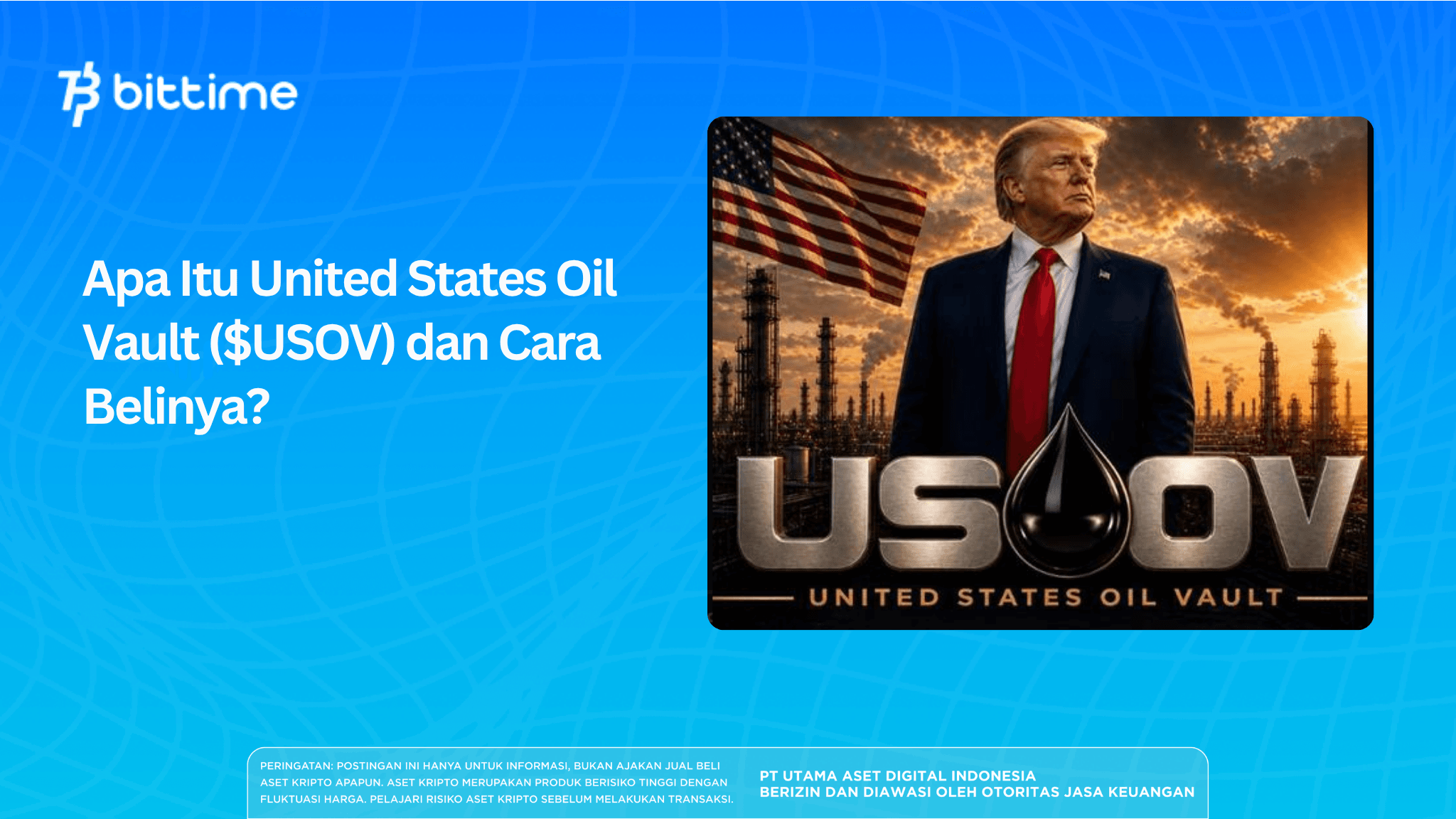
What is United States Oil Vault ($USOV)? $USOV is an SPL token on the Solana network that claims to provide fractional exposure to the United States Strategic Petroleum Reserve.
The project website states that each token is linked to exposure to oil reserves held through institutional custodians. However, prospective buyers need to distinguish between the project’s narrative and the available independent evidence before purchasing this token.
Key Takeaways
- $USOV is a Solana token built around the narrative of tokenizing United States oil reserves.
- Its official contract address is USoVyFCK2MTnnU4R1K7CLvTC8qoAt2N4EfyDYV13BVB.
- The oil-backing claim should not be considered verified until reserve reports, the custodian’s identity, and the legal rights of token holders are available.
What Is United States Oil Vault ($USOV)?
United States Oil Vault, or $USOV, is a crypto asset issued using the SPL token standard on the Solana blockchain. The project markets $USOV as a “tokenized oil vault” designed to bring oil exposure to digital markets.
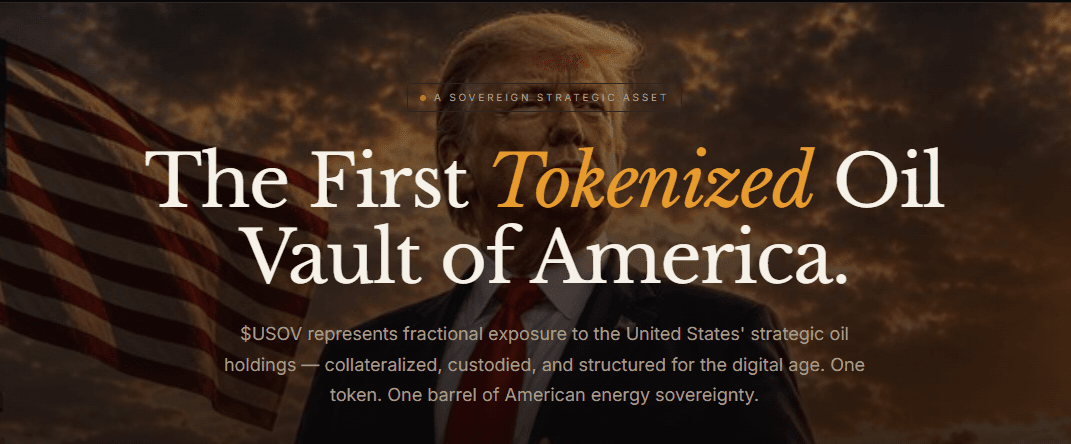
According to its official website, $USOV has several key characteristics:
- Issued on the Solana network.
- Claimed to be backed by oil reserves.
- Uses an institutional custody framework.
- Can be traded globally 24 hours a day.
- Planned for use as collateral in the DeFi ecosystem.
- Positioned as a tokenized real-world asset.
The project website uses the slogan “one barrel, one token” and describes $USOV as an on-chain claim on a strategic United States commodity. The project also states that its oil holdings are neither synthetic exposure nor a derivative product.
These statements sound appealing, but their meaning requires critical examination. A token with an oil-related theme does not automatically provide legal ownership of one barrel of oil.
Such rights require a clear legal structure, custodian, reserve reports, audits, and redemption mechanism.
Also read: What Is RobinVista? Understanding the Fixed-Fee DEX on Robinhood Chain
How Does the $USOV Token Work?
Technically, $USOV works like other Solana tokens. It can be stored in a wallet, sent to another address, or traded through a decentralized exchange that provides a liquidity pool.
The price of $USOV is determined by interactions between buyers and sellers in the pool. When demand increases, the price may rise. When more holders sell the token, the price may fall.
This market mechanism does not mean that the price of $USOV will always track global oil prices. For the token to maintain a value aligned with oil, the project would need an economic mechanism connecting the token to its underlying asset, such as:
- The purchase and storage of physical oil.
- Periodic reserve valuations.
- Attestations from independent auditors.
- A token issuance and burn mechanism.
- The right to redeem tokens for money or oil.
- Arbitrage to maintain price alignment.
The project website has not explained all these mechanisms in detail. Therefore, the current price of $USOV is better understood as a price formed by token trading activity, not the definitive price of one barrel of oil.
Also read: What Is Hood Stocks ($HSTOCKS)? How It Works and Its Risks
What Are the Functions and Uses of $USOV?
The currently observable functions of $USOV are mainly limited to on-chain transactions. Users can buy, store, transfer, and sell the token through applications that support Solana.
1. A DEX trading asset
$USOV is traded through pools on Meteora. The pair with the highest liquidity identified was USOV/USDC, while the USOV/SOL pair in the provided link had extremely low liquidity.
2. Exposure to the oil-tokenization narrative
The token provides exposure to the real-world asset and on-chain commodity narrative. However, exposure to a market narrative is different from legal ownership of physical oil.
3. Transfers through the Solana network
Users can transfer $USOV between wallets, with network fees paid in SOL.
4. Potential use as DeFi collateral
The project roadmap includes plans for payment integration, use as DeFi collateral, cross-chain liquidity, and institutional partnerships. These features remain on the roadmap and should not be treated as active utilities.
5. Participation in the project ecosystem
Token holders can follow community developments through the official website and X account. However, token ownership does not necessarily provide voting rights, revenue sharing, or a legal claim against the company because these terms have not been fully explained.
Also read: Robin Hood (FOX): A New Meme Coin on Robinhood Chain—What Is Its Potential?
Is $USOV Really Backed by Oil Reserves?
The $USOV website claims that each token has a one-barrel backing ratio and uses institutional custodians.
The project also states that real-time proof of reserves is available. However, the website does not yet disclose the custodian’s name, storage location, oil type, audit report number, or legal documents explaining token holders’ rights.
The project scheduled a “Vault Attestation & Phase II Launch” for September 15, 2026. Because this article uses a data snapshot from August 4, 2026, that event was still in the future. The promised attestation cannot be treated as evidence until the document is actually published and can be verified.
Claims concerning the United States strategic reserve also need to be examined against government information. The United States Department of Energy states that the Strategic Petroleum Reserve is a federally owned oil stockpile managed through a network of official facilities.
Oil is released from the reserve under legal authority, government decisions, competitive sales, or regulated exchanges.
The official Department of Energy sources reviewed do not mention $USOV or any mechanism for tokenizing ownership of the Strategic Petroleum Reserve. Therefore, there is no independent basis for concluding that purchasing $USOV grants rights to oil owned by the federal government.
The project may instead refer to private reserves or another commercial structure. However, such a claim would still require evidence including:
- The identity of the issuing legal entity.
- The name of the custodian company.
- The address and jurisdiction of the storage facility.
- The quantity of oil controlled.
- An independent audit report or attestation.
- An asset insurance policy.
- A redemption mechanism.
- An explanation of token holders’ rights if the issuer defaults.
Keep track of developments regarding USOV and other crypto assets by signing up to Bittime and following the latest market updates.
What Is the Official $USOV Contract Address?
The $USOV contract or mint address on the Solana network is:
USoVyFCK2MTnnU4R1K7CLvTC8qoAt2N4EfyDYV13BVB
This address matches across the official website, the token page on Solscan, and the trading pairs displayed on DEX Screener.
The cited USOV/SOL pair has the following pool address:
ES4YmjLcN4en61xjQZauxCuC8mwCGJesPnyS8kyzEfwx
Meanwhile, the USOV/USDC pair with greater liquidity has the following pool address:
DKMZJ4zzKMp8RTYHdUmGHMdHrN5euDJMMngmoz8mkC3Q
Do not search for the token using only the name “United States Oil Vault” or the symbol “USOV.” Other parties can create tokens with the same name and ticker. Always paste the complete mint address and compare several characters at the beginning and end before making a swap.
Read Also: What Is Cardtopia (CARDTOPIA)? How to Open TCG Packs and Collect Cards
What Are the Current Price and Liquidity of $USOV?
Based on a DEX Screener snapshot from August 4, 2026, the USOV/USDC pair on Meteora showed a price of approximately US$0.003399. Liquidity was around US$114,000, while its market capitalization and fully diluted valuation were displayed at approximately US$3.3 million.
Over a 24-hour period, the USOV/USDC pool recorded:
- Approximately US$46,000 in volume.
- Approximately 5,702 transactions.
- 105 traders.
- Approximately 2,862 buy transactions.
- Approximately 2,840 sell transactions.
- A price increase of approximately 7.43%.
At the time of the check, the pool held approximately 16.95 million USOV and 56,649 USDC. DEX Screener also displayed approximately 115 holders.
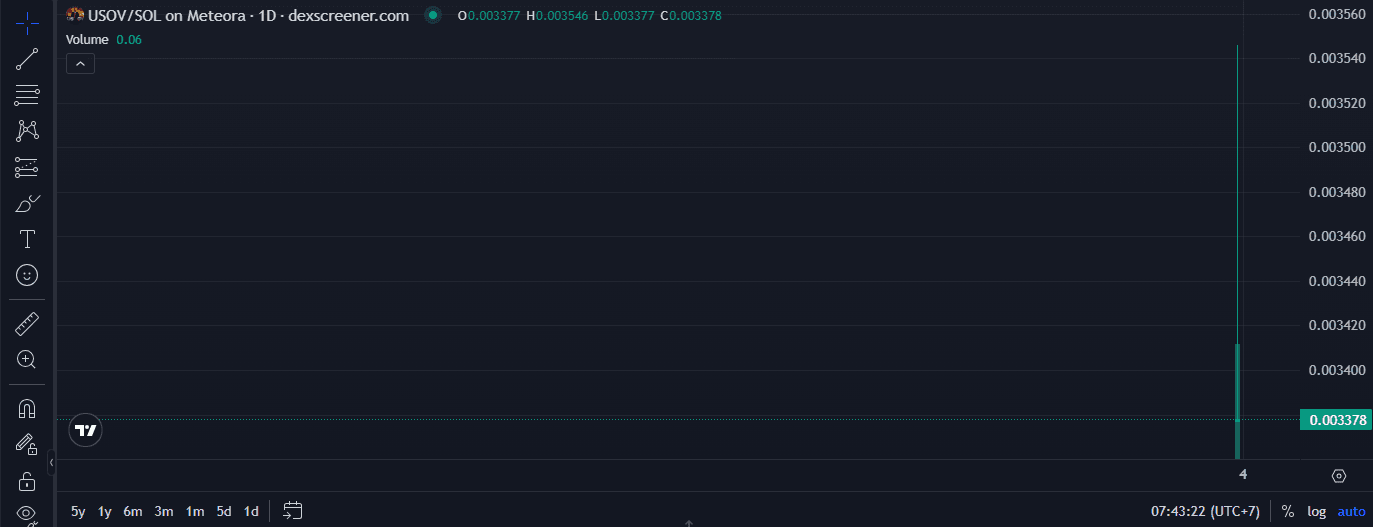
However, the provided USOV/SOL link showed different conditions. That pool had only around US$1 in liquidity, less than US$1 in volume, and four transactions during the displayed period. DEX Screener even warned that the pair had very little liquidity.
This difference is important. The price in the USOV/SOL pool may appear close to the market price, but the available funds are too limited to support normal buying or selling. Users should review all pools and select a route with adequate liquidity rather than simply opening the first pair they find.
Price, volume, and liquidity figures can change within minutes. The data should be updated immediately before the article is published.
Read Also: What Is HyperBull (HBULL)? How It Works and Its Yield Potential
How to Buy $USOV on Solana
$USOV may not be available on every centralized exchange. The token can be purchased through wallets and swap applications that support the Solana network.
1. Set up a Solana wallet
Use a wallet that supports SPL tokens, such as Phantom, Solflare, or another trusted Solana wallet . Install the application only from an official website or app store.
2. Fund the wallet with SOL or USDC
Send SOL or USDC to the wallet address through the Solana network. Do not use Ethereum, BNB Smart Chain, or another network.
Keep a small amount of SOL available to pay transaction fees, even when swapping from USDC.
3. Open a swap application
Use the wallet’s built-in swap feature, a Solana DEX aggregator, or a Meteora pool. An aggregator can compare multiple routes to find a better exchange result.
4. Enter the official $USOV contract address
Paste the following mint address into the destination-token field:
USoVyFCK2MTnnU4R1K7CLvTC8qoAt2N4EfyDYV13BVB
Recheck the token name, symbol, and contract address before proceeding.
5. Prioritize routes with adequate liquidity
In the August 4, 2026 snapshot, the USOV/USDC pool had approximately US$114,000 in liquidity, far more than the USOV/SOL pool, which had only around US$1 in liquidity.
Do not use a pool with almost no liquidity because the price impact can be extremely high.
6. Check slippage and the token amount
Before approving the transaction, review:
- The amount of $USOV you will receive.
- The price impact.
- The slippage tolerance.
- The network fee.
- The swap route.
- Security warnings from the wallet.
7. Conduct a test transaction
Start with a small amount. After receiving the tokens successfully, consider testing a partial sale to confirm that the token can be swapped back.
Start trading SOL/IDR with Bittime here!
How to Store $USOV Tokens Safely
After the swap is completed, $USOV will be deposited into the Solana wallet used for the transaction. The token may not appear immediately if the wallet has not yet recognized its metadata. You can search for it using the official mint address.
Apply the following security measures:
- Never share your seed phrase.
- Store your seed phrase offline.
- Avoid storing your seed phrase in screenshots or cloud storage.
- Do not connect your main wallet to unfamiliar websites.
- Use a separate wallet when trying new tokens.
- Check the domain before signing a transaction.
- Revoke permissions for applications you no longer use.
- Consider a hardware wallet for large amounts.
No administrator, developer, or support representative needs your seed phrase. Anyone requesting it is almost certainly attempting to take control of your wallet.
Read Also: What Is VEIL? A Private DePIN Network on Robinhood Chain
Risks of Buying $USOV You Need to Understand
The reserve claim has not been adequately verified
The website states that each token is backed by one barrel, uses institutional custodians, and has proof of reserves. However, the scheduled attestation document was not due to be published until September 15, 2026.
There is no evidence of rights to federally owned oil
The Strategic Petroleum Reserve is owned and managed by the United States federal government. The government sources reviewed do not state that $USOV provides a claim on this reserve.
Liquidity varies dramatically between pools
The USOV/USDC pool had more than US$100,000 in liquidity, while the USOV/SOL pool from the cited link had only around US$1. Users who select the wrong pool could face extreme slippage.
The market is still very new
The USOV/USDC pool was less than three days old when checked. Its short price history is insufficient for evaluating market stability, distribution patterns, or the project’s resilience.
The token price does not automatically track oil prices
Without transparent redemption and arbitrage mechanisms, the price of $USOV may move based on community speculation rather than changes in oil prices.
Risk of holder concentration
The displayed number of holders was still around 115. Prospective buyers should examine the distribution among top holders, the deployer wallet, liquidity-pool accounts, and relationships between wallets before purchasing.
Automated audits are not a guarantee
DEX Screener displays a “No issues” indicator, but it also explains that automated checks are not always 100% accurate. Such checks do not replace a contract audit or an independent reserve analysis.
Read Also: What Is Global Digital Water Reserve (GDWR) on Solana?
Conclusion
United States Oil Vault ($USOV) is a Solana token built around the concept of tokenizing oil reserves. Its contract and trading activity can be verified on-chain, with the primary market identified in the USOV/USDC pair on Meteora.
However, the claim that one token represents one barrel of oil is not yet supported by sufficient public documentation. The website does not disclose the custodian’s identity, a reserve audit report, a redemption mechanism, or a legal structure granting token holders rights to oil. The attestation was not scheduled until September 15, 2026.
Prospective buyers should also avoid the USOV/SOL pool, which had only around US$1 in liquidity at the time of the check. Use the official mint address, choose a route with greater liquidity, review holder distribution, and start with a small amount.
$USOV is better treated as a high-risk speculative token until its oil-backing claims receive independent verification. Monitor the latest news and do not use money needed for essential expenses, emergency funds, or borrowed money to purchase a new token.
Check out other popular Solana meme coins such as BONK, TRUMP, WIF, and PENGU, available on the Bittime market
Bittime is a licensed Digital Financial Asset Trader (PAKD) supervised by the Financial Services Authority— platform where you can buy Bitcoin in Indonesia and hundreds of other crypto assets starting from Rp10,000. Registration is fast and secure, and you can get started today.
Monitor the USDT-to-IDR conversion and real-time price movements of your favorite crypto assets. Everything is available in a single crypto investment application that can be downloaded for free from the Play Store.
Ready to get started? Register with Bittime now and execute your investment strategy on a platform already trusted by millions of users in Indonesia.
FAQ
What is United States Oil Vault?
United States Oil Vault is an SPL token on the Solana network that claims to provide exposure to oil reserves. The project uses the $USOV ticker and is traded through Solana DEXs.
Is one $USOV really equivalent to one barrel of oil?
The project website states a one-token-to-one-barrel ratio. However, this claim is not yet supported by a publicly available attestation report, custodian identity, or redemption mechanism.
What is the official $USOV contract address?
The official $USOV mint address is USoVyFCK2MTnnU4R1K7CLvTC8qoAt2N4EfyDYV13BVB. Always verify the contract before making a swap because other tokens may use a similar name and symbol.
Where can $USOV be purchased?
$USOV can be traded through Solana swap applications and liquidity pools on Meteora. In the August 4, 2026 check, the USOV/USDC pair had significantly greater liquidity than USOV/SOL.
Is $USOV safe to buy?
There is not yet enough evidence to consider $USOV completely safe. The token carries liquidity, volatility, holder-concentration, and independently unverified oil-reserve claim risks.
Disclaimer: The views expressed belong exclusively to the author and do not reflect the views of this platform. This platform and its affiliates disclaim any responsibility for the accuracy or suitability of the information provided. It is for informational purposes only and not intended as financial or investment advice.
.png)