What Is STXB? Seagate's Stock Token, Price, and Risks
2026-11-09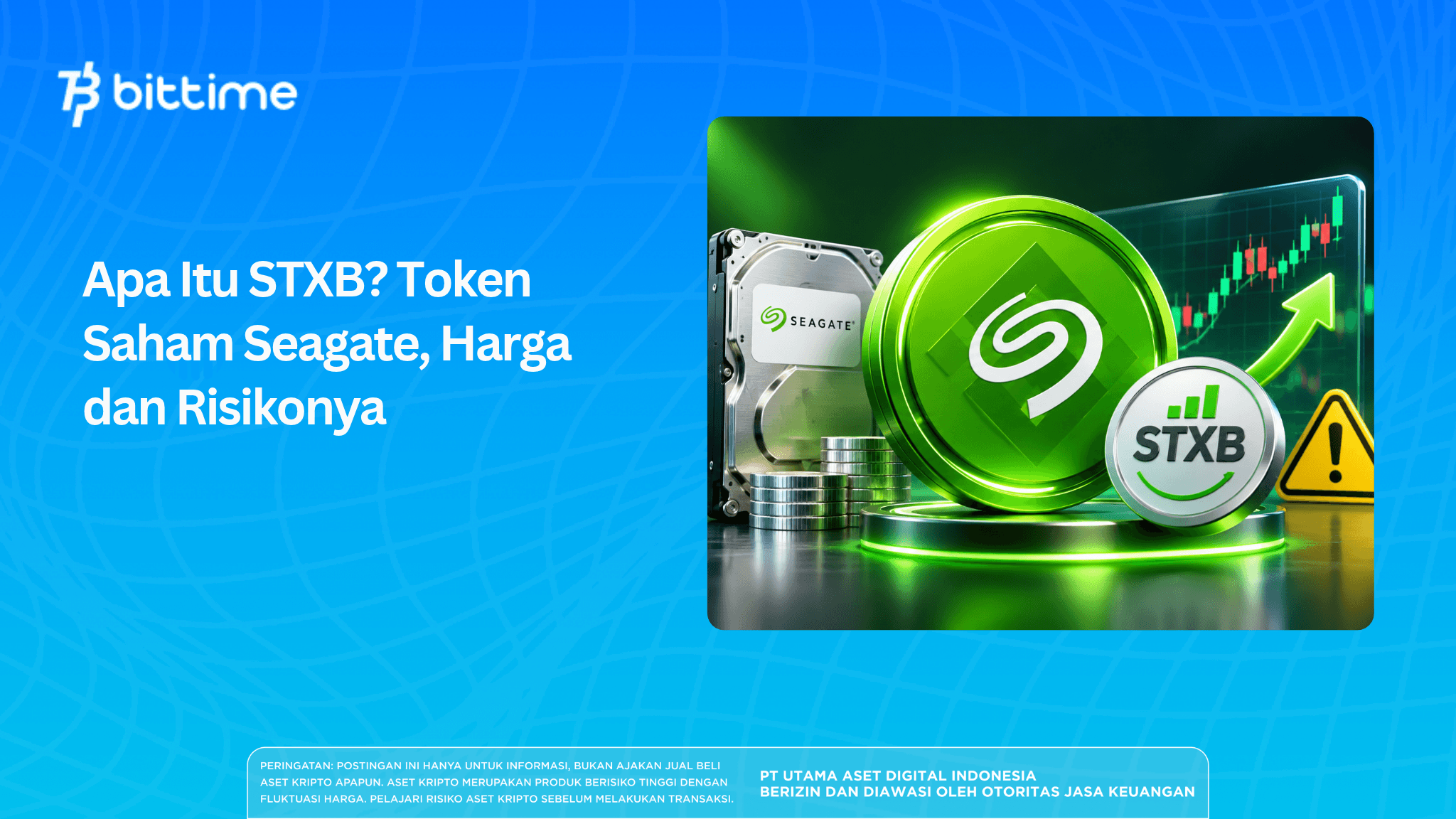
What is STXB? Seagate Tokenized bStocks (STXB) is a blockchain-based token that allows investors to gain exposure to movements in the value of Seagate Technology shares. It tracks STX shares traded on Nasdaq but takes the form of a token that can be bought and sold on supported platforms.
Although both are linked to Seagate, STXB and STX shares are not identical instruments. Buying STXB does not automatically make you a Seagate shareholder, particularly when it comes to voting rights and direct ownership. So how exactly does this token work, what happens when Seagate pays dividends, and what risks should investors consider?
Key Takeaways
- STXB is a tokenized security on BNB Smart Chain that provides economic exposure to Seagate Technology (STX) shares.
- STXB holders do not directly own Seagate shares and do not receive the voting rights of ordinary shareholders.
- STXB's price reflects the economic value of its underlying shares but is also affected by liquidity, issuer terms, and token trading mechanisms.
What Is STXB (Seagate Tokenized bStocks)?
STXB is a tokenized stock product within the bStocks.
In simple terms, a tokenized stock is an instrument that uses blockchain technology to represent exposure to a particular stock or security. Investors can trade the token on platforms that support the product.
For STXB, the underlying stock is Seagate Technology Holdings plc, a technology company listed on Nasdaq under the ticker STX.
Unlike Bitcoin or other crypto assets whose values are primarily driven by network dynamics and token markets, STXB is designed to track the economic value of its underlying shares.
STXB therefore falls into the category of Real World Assets (RWA), which involves using blockchain to represent instruments or assets from the traditional financial system.
Although it takes the form of a token, STXB has its own issuance structure and terms. Investor rights are determined by the product documentation, not simply by the fact that the token is held in a blockchain wallet.
Read also: What Is TSMB? How the TSMC Stock Token Works, Its Dividends, and Risks
Understanding Seagate Technology and STX Shares
Seagate Technology is one of the major companies in the data storage industry.
The company develops a range of storage technologies, particularly hard disk drives (HDDs), used in computers, servers, and large-scale data centers.
Seagate's role has become increasingly relevant as demand for data storage grows. The expansion of cloud services and AI infrastructure has also made storage capacity an important part of the technology industry's development.
Seagate shares trade on Nasdaq under the symbol STX.
Like other company stocks, STX's price is influenced by business performance, financial reports, product demand, industry competition, and stock market conditions.
These developments also matter to STXB holders because the token's economic value is linked to Seagate shares.
However, buying STXB tokens is still different from buying STX shares through a stockbroker.
How Does the Seagate Stock Token Work?
STXB uses the concept of securities tokenization, providing exposure to a financial instrument through a blockchain token.
Behind the token is an issuance structure that links the product to its underlying shares.
In other words, Seagate shares do not directly turn into cryptocurrency. Instead, a tokenized instrument is issued with its own economic and legal terms.
Who Issues STXB?
STXB is part of the bStocks product range issued by BTech Holdings Limited, a company affiliated with the Binance group.
The product uses a tokenized certificate structure designed to provide exposure to specified securities.
This means Seagate Technology remains the issuer of STX shares, while BTech Holdings is the issuer of the tokenized product.
This distinction matters because a share issuer and a token issuer do not have the same responsibilities.
If problems arise with token management, conversion mechanisms, or custody of the underlying assets, they are addressed under the terms of the bStocks product.
Is STXB Backed by Actual Seagate Shares?
Under the bStocks structure, the issuer states that its tokenized instruments are backed by the underlying shares or by assets that meet the product's collateral requirements.
These assets are managed through custody arrangements, while the token represents an economic interest under the issuance documents.
However, the existence of backing assets does not eliminate every risk.
STXB holders still need to understand how the assets are held, which parties are responsible, and what rights apply if the issuer or custodian encounters difficulties.
Collateral transparency and product terms are therefore important when evaluating STXB.
Which Blockchain Does STXB Use?
STXB is listed on BNB Smart Chain (BSC).
The token's contract address is:
0x2e065f65f1699964f4092de1d39a8efe6c8d6f32
This address can be used to verify the token's identity when reviewing blockchain information or making transfers through compatible services.
Checking the contract is important because other tokens can imitate the names and tickers of digital assets. A matching name does not guarantee that a token is the official product you intended to buy.
Read also: What Is MUB? Understanding Micron's Tokenized Stock and How It Works
STXB vs. STX Shares: What's the Difference?
STXB and STX are both linked to Seagate Technology, but they represent different forms of ownership.
When investors buy STX shares through a broker, they own company shares under the applicable capital market rules and securities custody arrangements.
By contrast, STXB buyers hold a tokenized instrument that provides economic exposure under the bStocks terms.
The differences can be seen in the following areas.
These differences mean STXB should not be treated as a substitute for conventional shares with exactly the same rights.
STXB may offer flexibility through blockchain infrastructure, but investors also depend on the issuance mechanisms and the services that support the product.
Read also: What Is Marvell Technology Tokenized bStocks (MRVLB)?
Does STXB Pay Dividends?
Seagate shares have a dividend distribution mechanism for eligible shareholders. But how does this work for STXB, which provides only economic exposure to those shares?
In bStocks products, the economic benefits of dividends may be reflected through an adjustment mechanism rather than always being paid to holders in cash.
For example, for the September 2026 distribution, STXB holder eligibility was determined using a holdings snapshot taken on September 24, 2026, at 00:00 UTC.
After applicable taxes, fees, and other deductions were taken into account, the net economic benefit was processed through the product's mechanism.
How Are STXB Dividends Processed?
One mechanism used by bStocks is dividend reinvestment , or reinvesting dividends. Under this approach, the economic value derived from dividends can be used to increase exposure to the underlying asset.
For tokens held on-chain, this adjustment may be implemented through a multipliersystem. A multiplier is an adjustment factor that reflects certain changes in the economic benefits of a tokenized product.
As a result, holders will not always see dividends arrive as a cash balance in their wallets. The form of the adjustment may also depend on where STXB is held and the terms of the service being used.
If your goal is to earn dividend income, it is therefore important to understand how bStocks handles these distributions first.
Read also: What Is SNDKB? Understanding SanDisk Tokenized bStocks
STXB Price Today and the Factors Influencing It
STXB's price is linked to Seagate shares, but it is still determined through token trading activity on platforms where it is available.
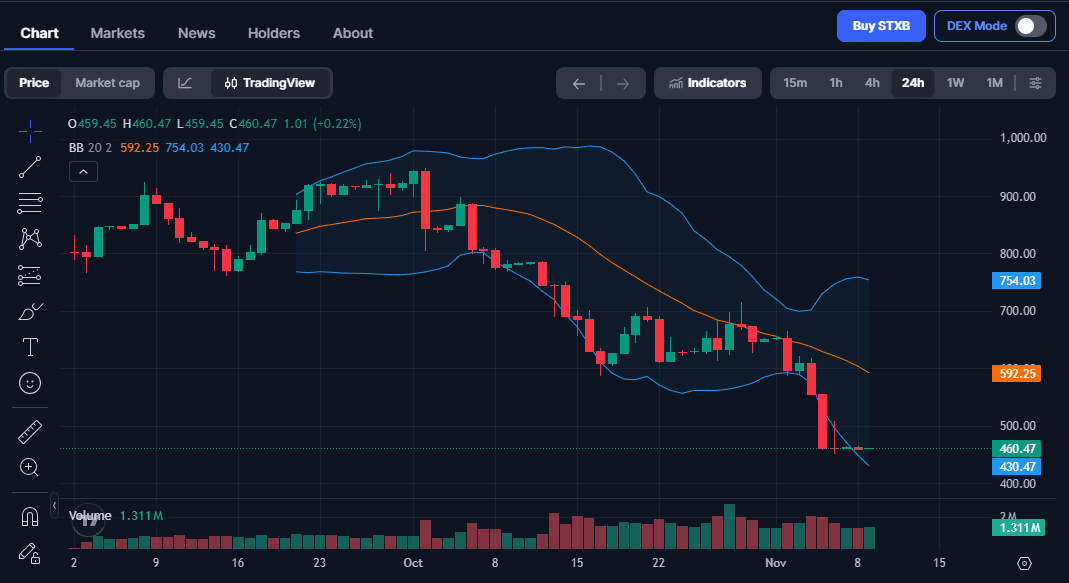
As of November 9, 2026, STXB was trading at approximately $460 per token. At that time, its market capitalization was around $474,000, with a circulating supply of approximately 1,030 STXB.
This circulating token supply should not be confused with the total number of Seagate shares outstanding in the stock market.
The same applies to STXB's market capitalization. The $474,000 figure reflects the market value of circulating tokens under the data provider's methodology, not the valuation of Seagate as a whole.
STXB trading volume data also varies across market-tracking platforms.
In observations taken around the same time, one data provider reported daily trading volume of approximately $1.3 million, while another showed about $684,000.
These differences may result from different update times or market coverage. Before using volume figures for analysis, check when the data was collected and which markets were included.
Why Can STXB's Price Differ from Seagate Shares?
Because they reference the same underlying stock, STXB and STX prices would generally be expected to have a close economic relationship. However, they do not necessarily display identical prices at every moment.
In one observation on November 9, 2026, STXB traded at approximately $460.16, while the STX price shown for comparison was around $462.07.
That difference alone is not enough to conclude that STXB is undervalued or overvalued. One reason prices may differ is trading hours.
Nasdaq operates during specified trading hours, while tokenized stocks on some platforms can be traded outside regular sessions. When the stock exchange is closed, token prices may still move in response to ongoing trades.
Liquidity is another factor. If STXB's order book is thinner, large trades can cause sharper price movements than trades in STX shares.
Transaction fees, spreads, and product adjustments can also affect the comparison. Therefore, a price gap between STXB and STX does not automatically represent a risk-free arbitrage opportunity.
Read also: Tokenized U.S. Stocks: Rights and Risks Investors Should Understand
What Are the Benefits of Tokenized Stocks Like STXB?
Tokenization provides another way to gain exposure to traditional financial assets.
For users already familiar with holding and trading cryptocurrencies, STXB offers an experience that is more closely integrated with the blockchain ecosystem.
Several potential benefits make the concept appealing.
Access Through Blockchain Infrastructure
STXB can be recorded and transferred over a blockchain network using supported services. This enables integration with wallets and digital asset infrastructure.
However, not all blockchain features are automatically available without restrictions. Token use remains subject to issuer and platform terms.
More Flexible Trading Hours
U.S. stock markets do not operate around the clock and are closed on weekends.
By contrast, some tokenized stock platforms offer extended trading hours.
For Indonesian users, this flexibility may make it easier to monitor markets without always having to follow regular Nasdaq trading sessions.
Nevertheless, longer trading hours do not mean there will always be substantial numbers of buyers and sellers.
Exposure to Traditional Assets
STXB also illustrates the development of the Real World Assets sector within the blockchain industry. Through tokenization, assets such as shares and other financial instruments can be represented in digital form.
This concept expands the range of products accessible through certain platforms, provided users meet the applicable requirements. However, easier access does not automatically make a product safer than conventional shares.
Read also: MSCI Proposes Changes to Indonesia's Classification: Could Tokenized U.S. Stocks Be an Alternative?
Five STXB Investment Risks to Understand
STXB has two main sources of risk: changes in the value of its underlying shares and the structure of the tokenized product. Assessing STXB solely by looking at Seagate's share price is therefore insufficient.
1. Seagate Share Price Risk
If STX shares fall due to company performance or industry sentiment, STXB's economic value may also be affected.
For example, weaker demand for storage devices or changes in Seagate's earnings forecasts could affect its share valuation.
Tokenization does not protect investors from the business risks of the underlying company.
2. Issuer Risk
STXB is issued by a party other than Seagate Technology.
This means token holders depend on the issuer's ability to meet its obligations under the product terms.
If the issuer experiences operational or financial difficulties, the consequences may differ from the risks faced by direct STX shareholders.
3. Custody Risk
The assets backing the product are held under custody arrangements. This creates dependence on the parties responsible for managing and safeguarding those assets.
Investors need to understand how collateral is treated, the custody procedures, and the terms that apply if services are disrupted.
4. Liquidity Risk
STXB trades in a market separate from Seagate shares on Nasdaq. Although its reference value comes from STX shares, the number of token buyers and sellers may be more limited.
In a quiet market, spreads may widen and trade execution prices may differ from the displayed price.
5. Regulatory Risk
Tokenized securities are financial products subject to specific legal requirements.
bStocks uses an issuance structure in Abu Dhabi Global Market (ADGM), but access to its products remains subject to the rules of each jurisdiction.
Product approval or documentation in one jurisdiction does not automatically mean the instrument can be freely offered to all investors in Indonesia.
Before using STXB, make sure the platform is legally permitted to offer the product and that you meet the applicable requirements.
Can STXB Be Converted into Actual Shares?
One feature described in the bStocks ecosystem is the possibility of converting tokens into the underlying securities through certain services.
However, conversion is not always available to every holder. Requirements may include identity verification, the user's jurisdiction, platform terms, fees, and operational procedures.
Conversion facilities may also be temporarily adjusted during corporate actions. For example, STXB conversion was temporarily suspended during the dividend distribution process in September 2026.
Therefore, do not assume that STXB can be exchanged for Seagate shares at any time simply because the product has underlying assets. If conversion is important to your investment decision, check the terms directly before buying.
How to Buy STXB on Bittime
If you are looking for ways to buy STXB on Bittime, the first step is to check whether the token is available for trading.
Bittime offers tokenized stock services, but the availability of a specific STXB trading pair has not been confirmed through the public information reviewed.
Therefore, you should not assume STXB/IDR is already active without checking directly.
To check availability, follow these steps:
- Register or log in to your Bittime account.
- Complete identity verification in accordance with the requirements.
- Open the markets page or trading menu.
- Search for STXB or Seagate Tokenized bStocks.
- Check whether the asset and its trading pair are available.
- If available and you meet the requirements, review the price, fees, and order details before trading.
If STXB is not listed, that does not automatically mean the token will become available soon.
An official listing announcement remains the appropriate reference for confirming whether the product can be traded.
You can register on Bittime to follow developments in tokenized stocks, learn about RWA assets, and read the latest crypto market updates.
Conclusion
What is STXB? STXB is a tokenized security that provides economic exposure to Seagate Technology shares through the bStocks ecosystem on BNB Smart Chain.
Although it tracks STX shares, buying STXB is not the same as directly owning Seagate shares. Token holder rights, dividend treatment, and conversion facilities are governed by the product terms.
STXB offers a different way to gain exposure to share price movements through blockchain, but it also carries additional issuer, custody, liquidity, and regulatory risks.
For investors interested in Seagate's tokenized stock, understanding the product structure is far more important than simply tracking STXB's price.
Before making a decision, review the issuer's documents and make sure your chosen service actually supports trading the asset.
Bittime is a licensed Digital Financial Asset Trader (PAKD) supervised by Indonesia's Financial Services Authority (OJK) — where you can buy Bitcoin in Indonesia and hundreds of other crypto assets starting from IDR 10,000. Registration is fast and secure, and you can get started today.
Track the conversion rate for USDT to IDR and monitor the price movements of your favorite crypto assets in real time. Everything is available in one crypto investment app that you can download for free from the Play Store.
Ready to get started? Sign up for Bittime now and put your investment strategy into action on a platform trusted by millions of users in Indonesia.
FAQ
What is STXB and how does it work?
STXB, or Seagate Tokenized bStocks, is a tokenized security that provides economic exposure to Seagate Technology shares. The token operates on BNB Smart Chain, and its value is linked to STX shares on Nasdaq. However, holding STXB does not mean directly owning Seagate shares.
Is STXB the same as Seagate shares on Nasdaq?
No. STX represents ordinary shares in Seagate Technology, while STXB is a tokenized instrument issued under the bStocks structure. STXB holders do not automatically receive the voting or direct ownership rights held by STX shareholders.
Does STXB pay dividends to holders?
STXB has a mechanism for adjusting economic benefits linked to dividends on its underlying shares. During the September 2026 distribution, net dividend benefits were processed through reinvestment and multiplier adjustments for eligible holders. This is not the same as paying cash dividends directly to ordinary shareholders.
Is STXB safe to invest in?
STXB carries risks related to fluctuations in Seagate's share price, the issuer, the custodian, and token market liquidity. Investor access and rights may also be affected by product rules and jurisdictional requirements. Its safety and suitability should therefore be assessed using the issuer's documentation and prevailing market conditions.
How can I buy STXB on Bittime?
First, check whether STXB is available as an active trading pair on Bittime. If it is available and you meet the product requirements, you can purchase it through a verified account after reviewing the price and transaction fees. If it is not listed, do not assume it can be bought simply because Bittime offers other tokenized stocks.
Disclaimer: The views expressed belong exclusively to the author and do not reflect the views of this platform. This platform and its affiliates disclaim any responsibility for the accuracy or suitability of the information provided. It is for informational purposes only and not intended as financial or investment advice.
.png)