What Is SMHB? VanEck Semiconductor ETF Tokens and Their Risks
2026-11-09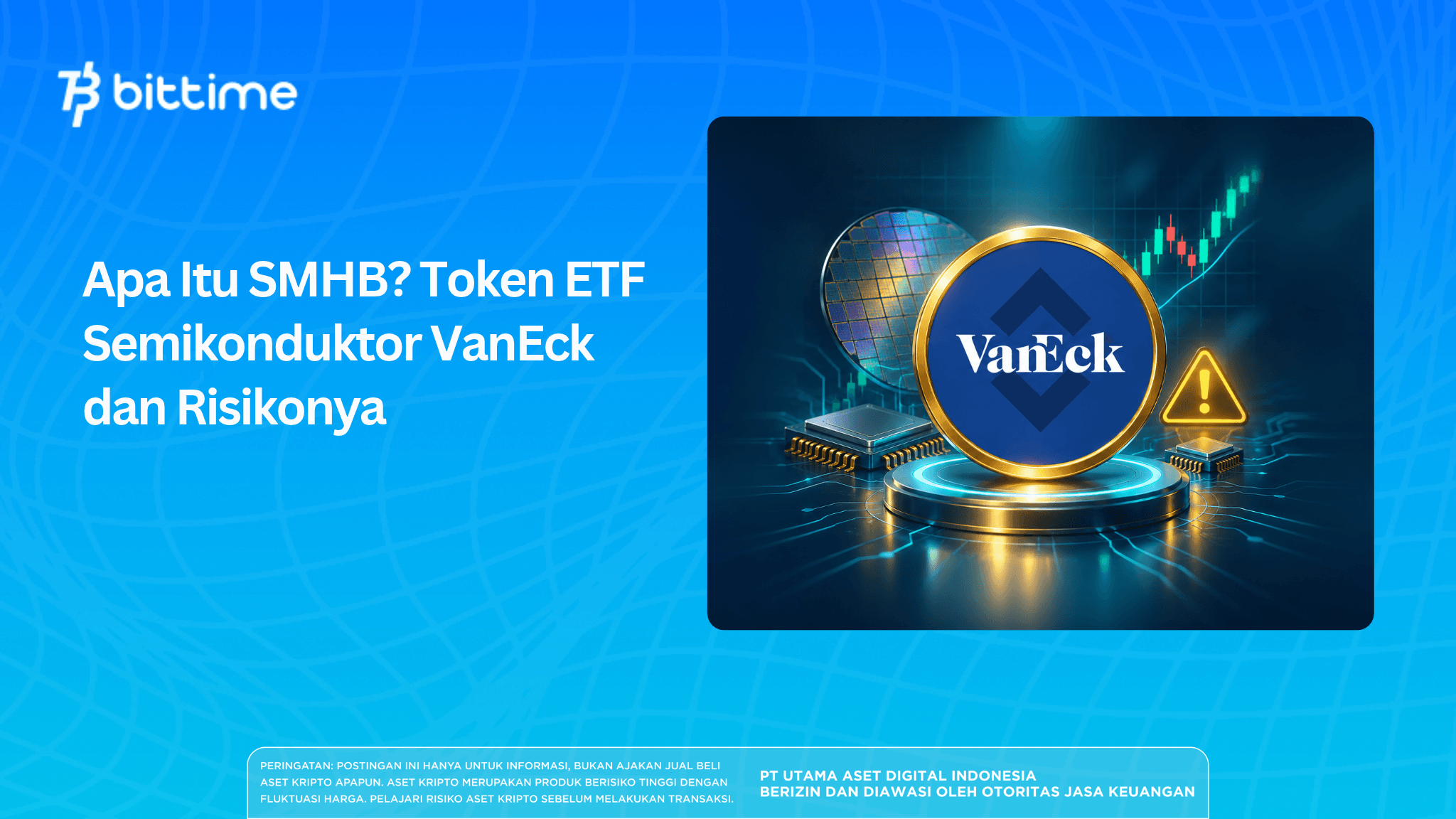
What is SMHB? VanEck Semiconductor ETF Tokenized bStocks (SMHB) is a token that allows crypto users to track changes in the value of VanEck's semiconductor ETF through blockchain. The underlying ETF holds shares of global chip companies, including NVIDIA, TSMC, Broadcom, and AMD, which play important roles in the development of artificial intelligence (AI).
However, there is an important distinction to understand before buying this token. Holding SMHB is not the same as purchasing units of the VanEck Semiconductor ETF (SMH) directly on the stock market. Although the two are economically linked, they differ in ownership, profit distributions, and the risks investors bear.
Key Takeaways
- SMHB is a tokenized ETF on BNB Smart Chain that provides exposure to the VanEck Semiconductor ETF (SMH).
- The SMH ETF invests in several global chip companies but has a relatively high concentration in certain stocks, particularly NVIDIA.
- SMHB's price tracks the economic value of its underlying ETF, while investor rights and distribution mechanisms depend on the bStocks issuer's terms.
What Is SMHB (VanEck Semiconductor ETF Tokenized bStocks)?
SMHB is a tokenized ETF product within the bStocks.
Unlike cryptocurrencies such as Bitcoin or Ethereum, SMHB is not designed to be the native asset of a blockchain network. Instead, it represents economic exposure to a financial instrument that already exists in the capital markets.
Its underlying asset is the VanEck Semiconductor ETF (SMH), an investment fund focused on companies in the semiconductor industry.
Through SMHB, users can track changes in the ETF's value in the form of a digital token traded on supported platforms.
This concept is part of the growth of Real World Assets (RWA), an approach that connects traditional financial instruments with blockchain technology.
However, tokenization does not change the legal status of the underlying asset. SMHB holders have rights under the bStocks product terms, not direct ownership of SMH ETF units.
Read also: What Is TSMB? How the TSMC Stock Token Works, Dividends, and Risks
Understanding the VanEck Semiconductor ETF (SMH)
To understand SMHB, we first need to understand the ETF that underlies it.
The VanEck Semiconductor ETF, or SMH, is an exchange-traded fund that invests in semiconductor companies. An ETF is an investment fund traded on a stock exchange, allowing investors to gain exposure to multiple companies through a single product.
The semiconductor industry encompasses much more than manufacturers of computer processors.
Companies in this sector design chips, manufacture semiconductors, develop memory products, and supply the equipment used in semiconductor production.
These technologies underpin modern devices, from smartphones to data centers running AI models. That is why developments in artificial intelligence have also drawn attention to semiconductor stock ETFs such as SMH.

Which Stocks Are Included in the SMH ETF?
According to portfolio data as of November 3, 2026, the U.S. version of the VanEck Semiconductor ETF held 26 investment positions.
Its five largest holdings were:
- NVIDIA (NVDA) — 20.57%: Known for its GPUs and computing technologies used in AI and data centers.
- TSMC (TSM) — 9.62%: A chip manufacturer serving a wide range of global technology companies.
- Texas Instruments (TXN) — 5.97%: A developer of analog chips and processing technologies for industrial applications.
- Broadcom (AVGO) — 5.77%: A semiconductor company whose businesses include networking and technology infrastructure.
- AMD (AMD) — 5.17%: A manufacturer of processors and computing accelerators for computers, servers, and AI.
The SMH portfolio also includes companies such as Micron Technology, ASML, KLA, and SK Hynix.
Each plays a different role in the semiconductor supply chain. Some manufacture memory, develop production equipment, or provide technologies that support chip manufacturing.
This mix allows SMH to capture developments across several parts of the semiconductor industry rather than through just one company.
However, the weighting of each stock may change as the ETF manager rebalances its portfolio.
Is the SMH ETF Diversified?
Holding several stocks within a single ETF helps reduce reliance on one company, but SMH's diversification still has limits.
In early November 2026, its five largest holdings accounted for approximately 47.1% of the total portfolio, with NVIDIA alone representing more than 20%.
This means movements in NVIDIA shares can have a substantial impact on the ETF's overall performance.
Furthermore, the companies within SMH operate in closely related industries. When the semiconductor sector comes under pressure, many of these stocks may decline at the same time.
Therefore, SMH offers diversification across companies, but not broad diversification across different sectors of the economy.
Read also: What Is MUB? Understanding Micron's Tokenized Stock and How It Works
How Does the SMHB Semiconductor ETF Token Work?
SMHB connects an ETF traded in the capital markets with blockchain infrastructure. The process involves an issuer offering a tokenized instrument based on the economic value of the underlying asset.
Broadly speaking, the mechanism involves several steps:
- The SMH ETF trades on the stock market as a conventional financial instrument.
- The bStocks issuer prepares a tokenized product linked to that ETF.
- The underlying assets or eligible collateral are managed through a custody arrangement.
- SMHB tokens are issued on a supported blockchain network.
- Eligible users can trade SMHB through platforms that offer the token.
- Distributions and ETF-related adjustments are processed according to the product terms.
Under this mechanism, SMHB's price is economically linked to the SMH ETF.
However, token trading takes place through infrastructure that differs from conventional ETF markets. This creates distinct characteristics, particularly in liquidity and price formation.
Who Issues SMHB?
SMHB is issued through the bStocks program by BTech Holdings Limited, a company affiliated with the Binance group. It is important to distinguish the token issuer from the manager of the underlying ETF.
VanEck manages the SMH portfolio, while BTech Holdings issues the tokenized instrument under the established product structure.
Therefore, tokenholder rights, collateral, and conversion terms are governed by the bStocks documentation.
Which Blockchain Does SMHB Use?
SMHB is available on the BNB Smart Chain (BSC).
The recorded token contract address is:
0xbe1fced7047fdce935f45700727845df2c76877a
This address identifies the token when users review blockchain activity or make transfers through compatible services.
Before trading, make sure the contract and network are correct. Tokens with similar names or symbols are not necessarily the same asset.
Read also: What Is Marvell Technology Tokenized bStocks (MRVLB)?
SMHB vs. SMH: What Is the Difference?
Although they reference the same underlying asset, SMHB and SMH are not instruments that can simply be used interchangeably.
SMH represents ETF units traded in the capital markets, while SMHB is a tokenized product that provides economic exposure under the issuer's agreement.
The differences are outlined in the following table.
The most important distinction concerns ownership rights.
Investors who purchase SMH units hold a direct interest in the ETF through the capital markets system. By contrast, SMHB holders obtain exposure through tokenized certificates issued by a separate entity.
As a result, investor protections and dispute resolution mechanisms may also differ.
Read also: What Is SNDKB? Understanding SanDisk Tokenized bStocks
Does SMHB Pay Dividends?
Semiconductor ETFs such as SMH may make distributions to unitholders in accordance with the fund manager's policy. However, SMHB holders do not necessarily receive these benefits as cash payments into their wallets.
Within the bStocks structure, the economic benefit of distributions may be processed through reinvestment. The net amount after applicable taxes, fees, and deductions may be used to increase exposure to the underlying asset.
How Does the Multiplier Mechanism Work?
One mechanism used by bStocks is the multiplier. A multiplier is an adjustment factor that allows changes in economic benefits to be reflected in token holdings.
For example, when a distribution is reinvested, the calculated amount of exposure may increase without any new tokens being transferred to the user's wallet.
Balances displayed in certain interfaces may also reflect such adjustments, depending on how a platform presents holdings.
Therefore, SMHB dividends should not be understood as guaranteed periodic cash income. The form and amount of any benefit received depend on actual ETF distributions and the issuer's terms.
Read also: Tokenized U.S. Stocks: Rights and Risks Investors Should Understand
SMHB Price Today and Market Conditions
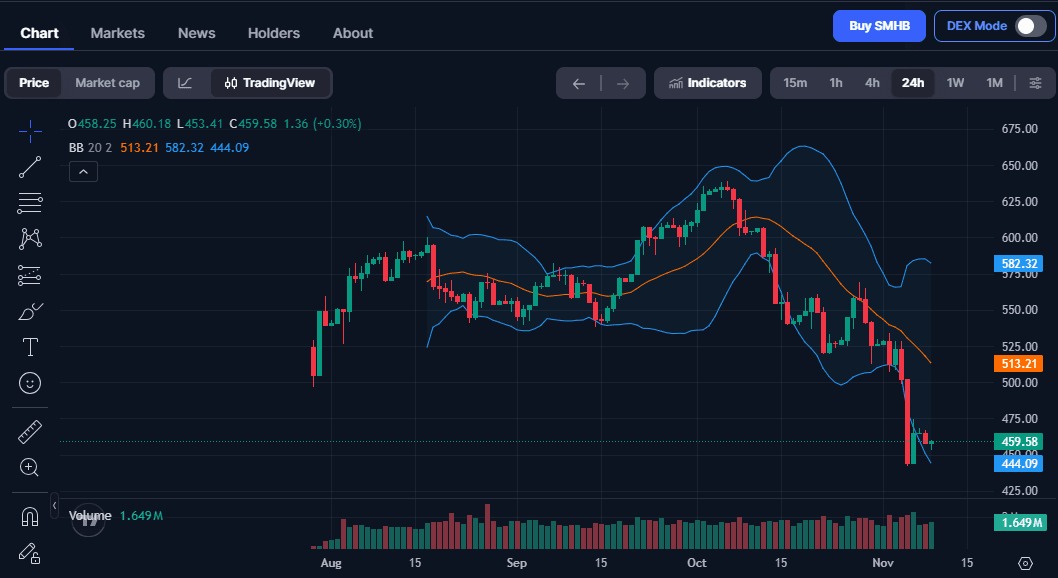
In addition to understanding the product, users typically want to know how SMHB's market price is determined. In an observation on November 9, 2026, SMHB traded in the range of 459–460 per token.
At that time, its market capitalization was approximately $1.78 million, with a circulating supply of around 3,870 SMHB. One data provider reported a 24-hour trading volume of approximately $806,000.
These figures provide a snapshot of token market activity, not the total value of assets managed by the VanEck Semiconductor ETF.
SMHB's market capitalization reflects only the value of circulating tokens under a data provider's calculation methodology. Likewise, its token supply is not the same as the total number of SMH ETF units outstanding in the stock market.
These prices and volumes represent a snapshot taken on November 9, 2026, not permanently valid real-time data.
Why Can SMHB's Price Differ from the SMH ETF?
Because SMHB is designed to track the ETF's economic value, SMHB and SMH prices should be closely related. However, this does not mean they will always be identical.
In one observation on November 9, 2026, SMHB was priced at approximately $460.06, while the comparative SMH price was around $466.02.
Several factors may explain this difference. First, ETF trading follows stock exchange hours, while tokenized ETFs on some platforms may trade outside regular market sessions.
Second, token markets have their own liquidity and spreads. When the number of buyers or sellers is limited, prices can move further away from the underlying asset's value.
Third, the product structure must also be considered, including fees, corporate actions, and multiplier adjustments. Price comparisons must also use the same observation time.
Without considering these factors, a price gap between SMHB and SMH cannot yet be treated as a discount or a profitable arbitrage opportunity.
Why Do AI and Semiconductor Stocks Affect SMHB?
One of SMHB's attractions is its underlying ETF's exposure to the semiconductor industry. This industry plays a vital role in AI development because modern computing systems require processors, GPUs, memory, and high-speed networking technology.
This demand creates business opportunities for several companies in SMH's portfolio. NVIDIA and AMD, for example, develop computing technologies used in a wide range of AI applications.
TSMC plays a major role in chip manufacturing, while companies such as ASML provide technology supporting advanced semiconductor production.
However, the growth of the chip industry is not determined by AI demand alone.
Several other factors also deserve attention:
- Data center investment: Infrastructure spending by technology companies can increase demand for chips.
- Manufacturing capacity: The construction of production facilities affects semiconductor availability and costs.
- Memory market cycles: Changes in DRAM and HBM prices can affect memory manufacturers.
- Technology competition: New products can change companies' market positions and profit margins.
- Trade policy: Export restrictions and geopolitical tensions can disrupt global supply chains.
These factors affect companies in different ways.
Therefore, rising demand for AI does not guarantee that all stocks in the SMH ETF will increase at the same time.
Share prices can also fall even while a company's business continues to grow, particularly when market valuations have already priced in exceptionally high growth expectations.
What Are the Advantages of Tokenized ETFs Like SMHB?
Tokenization offers another way to access the economic value of traditional financial instruments. For users already familiar with crypto markets, SMHB has several potentially appealing characteristics.
Exposure to Multiple Chip Companies
Through a single token, users gain economic exposure to an ETF holding several semiconductor companies. This differs from buying a tokenized share of a single company, whose value depends more directly on that one issuer's performance.
However, spreading exposure across multiple companies does not eliminate semiconductor industry risk.
More Flexible Trading Hours
Some tokenized securities platforms allow trading outside regular U.S. stock exchange hours. This flexibility can benefit users in different time zones.
Nevertheless, longer trading hours do not necessarily mean active markets. When liquidity decreases, spreads and slippage may actually increase.
Blockchain Integration
SMHB uses BNB Smart Chain as one of its infrastructures for recording and transferring tokens. This allows the product to be accessed through compatible digital asset services.
However, the available features still depend on issuer requirements, platform support, and the rules in the user's jurisdiction.
Five SMHB Investment Risks to Know
Before considering SMHB, it is important to understand that this token carries risks on two fronts: the underlying ETF and the tokenized product itself.
The following are five of the most relevant risks.
1. Semiconductor Industry Cycle Risk
The chip industry is known for cycles of growth and slowdown. When demand weakens or production exceeds market needs, semiconductor companies' revenue and profit margins may decline.
This situation could put downward pressure on the stocks held by the SMH ETF.
2. Portfolio Concentration Risk
NVIDIA's substantial weighting makes SMH's performance sensitive to movements in that stock. A sharp correction in a heavily weighted company can have a significant impact on the entire portfolio.
Therefore, holding many stocks does not necessarily mean that every company has an equal influence on performance.
3. Token Issuer Risk
SMHB is issued by an entity separate from the manager of the underlying ETF. Tokenholders depend on the issuer's ability to fulfill its product obligations, including the administration of economic rights and operational processes.
If the issuer encounters problems, the consequences may differ from the risks faced by investors who hold ETF units through a traditional broker.
4. Custody and Liquidity Risk
Assets backing SMHB are managed through custody arrangements, while the token trades in a market with its own liquidity conditions.
Disruptions in the management of underlying assets can introduce additional risks. On the trading side, a thin order book can also cause execution prices to differ substantially from displayed prices.
5. Regulatory and Access Risk
SMHB is a tokenized security subject to legal requirements and issuer conditions. The bStocks program uses an issuance structure in the Abu Dhabi Global Market (ADGM), but access to its products may vary by country and platform.
Therefore, a token's availability in global markets does not mean that every investor in Indonesia can trade it without restrictions.
Can SMHB Be Converted into Actual ETF Units?
Within the bStocks ecosystem, certain products offer a conversion mechanism that allows tokens to be exchanged for the underlying securities through designated services.
However, this facility is subject to requirements that may include jurisdiction, identity verification, user eligibility, transaction fees, and availability of conversion services.
The process may also be temporarily restricted during corporate actions or operational disruptions. Therefore, it would be unwise to buy SMHB on the assumption that it can always be exchanged for SMH ETF units.
If directly owning ETF units is your primary goal, first check whether conversion services are actually available to you.
How to Buy SMHB on Bittime
For readers looking to buy SMHB on Bittime, the first step is to confirm that the asset is actually available on the platform.
Bittime already offers various tokenized stocks and products related to the semiconductor industry.
However, based on the public listing information reviewed, the availability of an SMHB/IDR trading pair has not been confirmed.
Therefore, you should check directly before attempting a transaction.
Here are the steps you can take:
- Register or sign in to Bittime. Use an account that meets the platform's requirements.
- Complete identity verification. Follow the KYC process in accordance with applicable requirements.
- Open the markets page. Search for SMHB or VanEck Semiconductor ETF Tokenized bStocks.
- Check the trading pair. Make sure the asset is available and accessible through your account.
- Review the product information. Check the price, fees, and risks before placing an order.
- Place a trade if available. Review the amount and purchase details before confirming.
If SMHB is not listed, there is no reason to assume the token will necessarily be listed soon.
Official announcements from Bittime remain the reference point for confirming the availability of new assets.
You can also register with Bittime to follow market updates, learn about tokenized stocks, and read analyses of the semiconductor sector and other RWA assets.
Conclusion
What is SMHB? SMHB is a tokenized security providing economic exposure to the VanEck Semiconductor ETF, an ETF focused on leading global chip companies.
Through its underlying ETF, SMHB is linked to the business developments of NVIDIA, TSMC, AMD, and other companies involved in the semiconductor industry.
However, this exposure is not the same as directly owning units of the SMH ETF.
In addition to chip sector risks and portfolio concentration, SMHB holders face risks related to the token issuer, custodian, liquidity, and legal requirements.
For users interested in semiconductor stock ETFs and RWA assets, understanding the product structure is an important step before evaluating its investment potential.

Bittime is an OJK-licensed and supervised Digital Financial Asset Trader (PAKD) platform — where you can buy Bitcoin in Indonesia and hundreds of other crypto assets starting from IDR 10,000. Registration is fast and secure, and you can get started today.
Monitor the USDT to IDR conversion rate and the real-time price movements of your favorite crypto assets. Everything is available in one crypto investment app that you can download for free from the Play Store.
Ready to get started? Register with Bittime now and put your investment strategy into action on a platform trusted by millions of users in Indonesia.
FAQ
What Is SMHB and How Does It Work?
SMHB stands for VanEck Semiconductor ETF Tokenized bStocks, a tokenized instrument providing economic exposure to VanEck's semiconductor ETF. It operates on BNB Smart Chain, and its value is linked to the SMH ETF. SMHB is not an ETF unit held directly through a stockbroker.
Is SMHB the Same as the VanEck Semiconductor ETF (SMH)?
No. SMH is an ETF traded in the capital markets, while SMHB is a tokenized product issued through the bStocks program. SMHB holders have rights under the token issuer's terms, rather than direct ownership of SMH ETF units.
Which Semiconductor Stocks Are in the SMH ETF?
SMH's portfolio includes companies such as NVIDIA, TSMC, Texas Instruments, Broadcom, AMD, Micron, and ASML. According to data from November 3, 2026, NVIDIA had the largest weighting at approximately 20.57%. Portfolio composition may change as the ETF manager rebalances its holdings.
Is SMHB Safe, and Does It Pay Dividends?
SMHB carries price, sector concentration, issuer, custody, and liquidity risks. The economic benefits of ETF distributions may be processed through bStocks mechanisms, including reinvestment and multiplier adjustments after applicable deductions. However, this does not guarantee direct cash dividend payments or investment profits.
How Can I Buy SMHB on Bittime?
You need to check whether SMHB is available as an active trading pair on Bittime. If it is available and you meet the product requirements, you can make a purchase through a verified account after reviewing the price, fees, and transaction details. If it is not yet available, refer to official listing announcements for confirmation.
Disclaimer: The views expressed belong exclusively to the author and do not reflect the views of this platform. This platform and its affiliates disclaim any responsibility for the accuracy or suitability of the information provided. It is for informational purposes only and not intended as financial or investment advice.

.png)