Reserve Right (RSR): Definition, Withdrawal Limits, and Reasons Its Price Strengthened
2026-10-12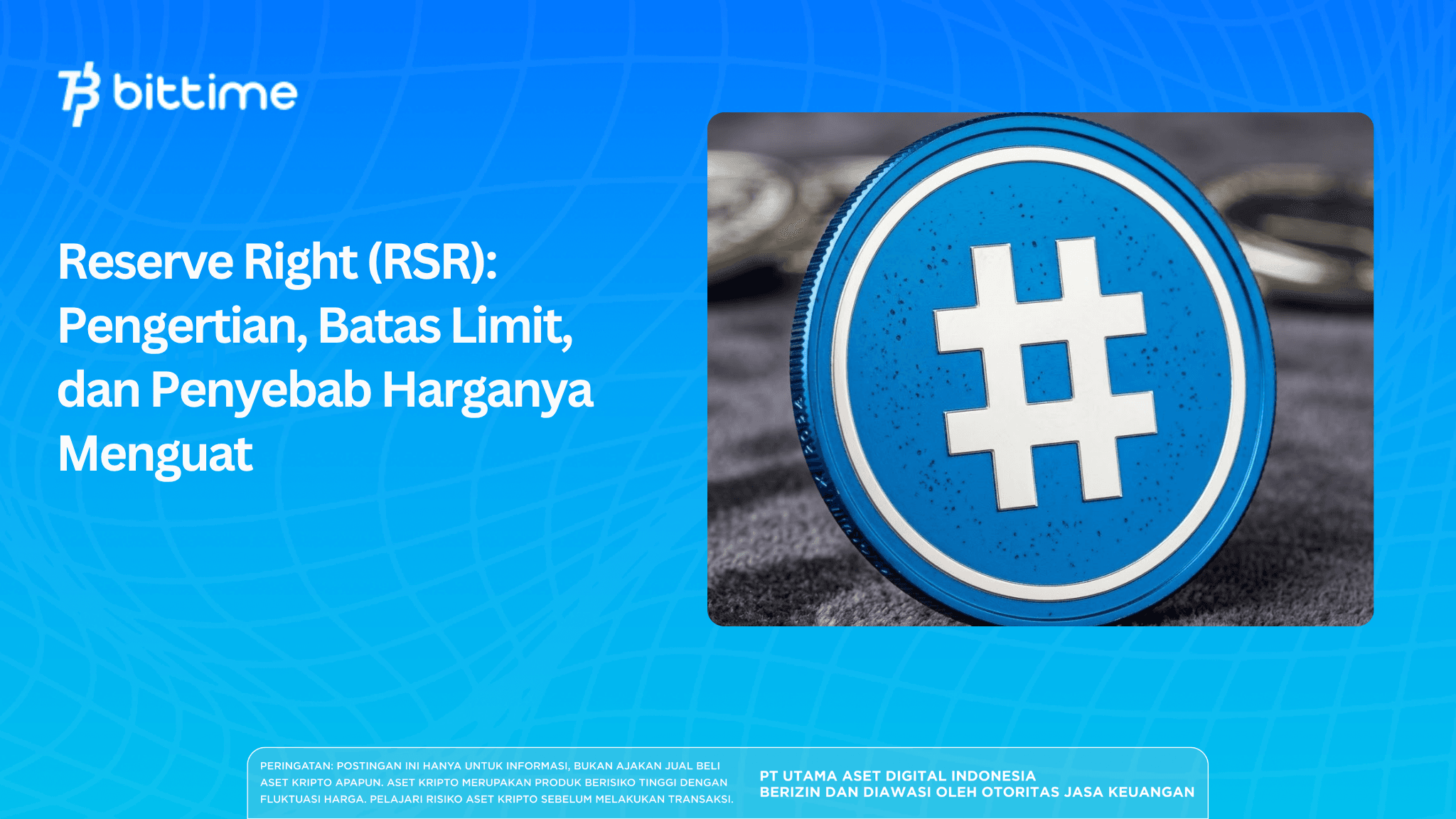
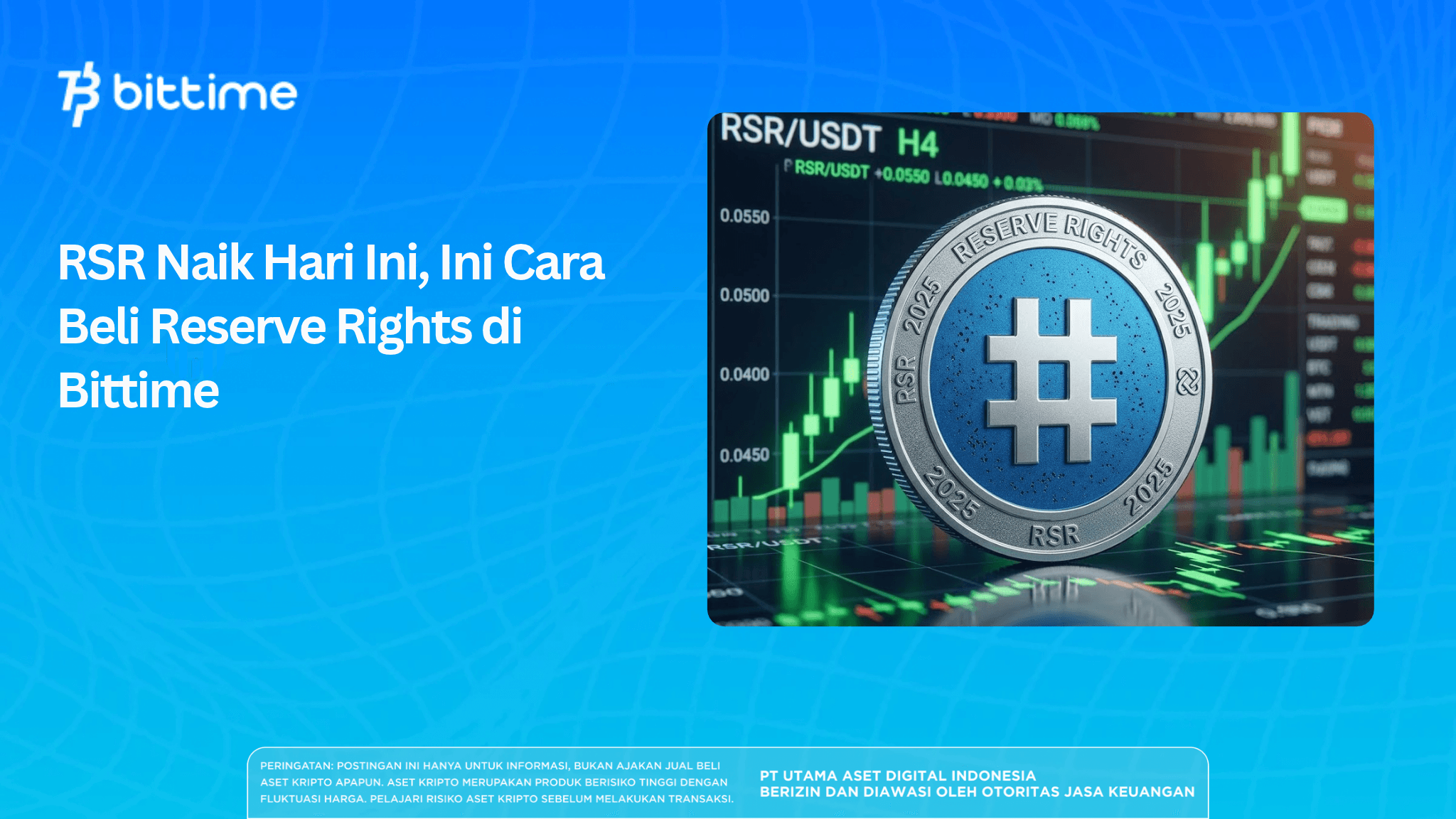
On October 12, 2026, RSR coin listed on one of the leading crypto exchanges with the RSR/KRW and RSR/USDT trading pairs. In just 15 minutes, RSR's price surged more than 66%, according to TokenPost.
The surge prompted many people to find out what RSR token is, and what role the reserve right RSR token plays behind the Reserve project. Here is an explanation of its function, how it works, and its tokenomics.
Key Takeaways
- RSR is an ERC-20 token for governance, staking, and risk absorption in the Reserve ecosystem, which now focuses on DTF.
- A portion of Index DTF fees is used to buy and burn RSR, while stakers bear slashing risk.
- Supply is fixed at 100 billion with about 62.55% circulating, and thin liquidity makes the price prone to volatility.
Understanding Reserve Right (RSR) Token and How It Works
Reserve Rights (RSR) is an ERC-20 token that combines governance, risk management, and value creation functions in the Reserve ecosystem, according to Reserve Documentation.
The project now focuses on DTF (Decentralized Token Folio), a tokenized index that lets you buy a portfolio of assets as a single token, according to Reserve's website.
One example is the Magnificent 7 DTF on the Base network, which provides equivalent exposure to seven major technology companies.
Read Also: BIS Reveals New Potential for XRP Ledger for the Digital Financial System
How the RSR token works is divided into three roles, according to Reserve Documentation:
- Staking in Yield DTF. Stakers deposit RSR as first-loss collateral. The reward is a portion of DTF revenue. If the collateral defaults, staked RSR can be seized to cover losses for DTF holders. Unstaking also requires a delay of around 7 to 30 days.
- Vote-locking in Index DTF. RSR becomes the built-in governance token to manage basket composition, parameters, and updates. Tokens are locked for at least one week. For DTFs that enable revenue sharing, lockers receive a share of fees.
- Burning. A portion of mint fees and locked value for each Index DTF is used to buy RSR on the market, and those tokens are then burned. Circulating supply decreases.
Every proposed change goes through three stages: submission, voting, then execution via timelock. The recommended default configuration for Yield DTF takes a total of eight days.
Want to get to know crypto assets further in a more focused way? Register an account at Bittime and monitor market movements calmly.
RSR Reserve Right Withdrawal Limits
RSR supply is fixed at 100 billion tokens. CoinMarketCap records around 62.55 billion tokens in circulation, or 62.55%, as of October 12, 2026. The non-circulating supply is held in the Slow Wallet and Slower Wallet, according to Reserve Documentation.
The Slow Wallet imposes a four-week withdrawal delay. The Slower Wallet, managed by Confusion Capital, adds a maximum withdrawal limit of 1% of supply per four weeks. Future emissions follow a deterministic schedule that mimics Bitcoin's emission curve.
Reasons RSR Price Is Rising
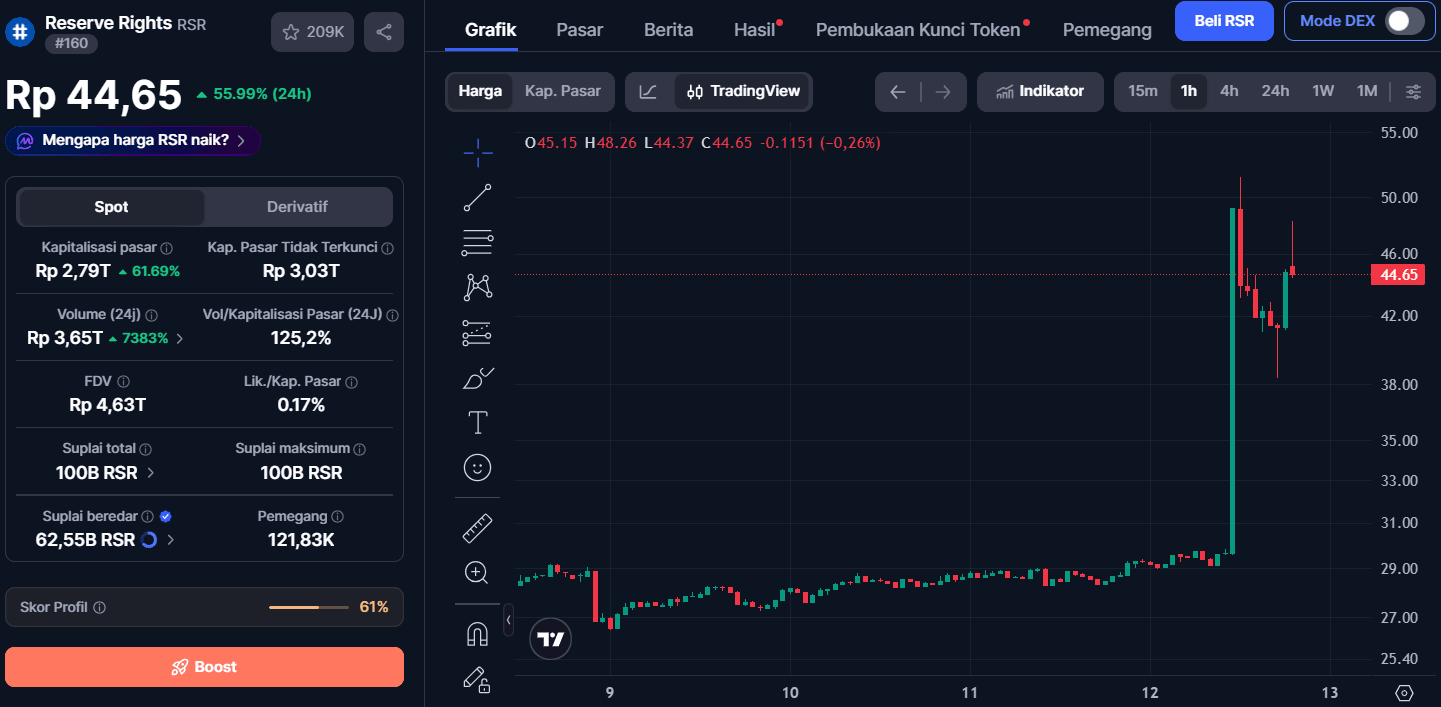
From the market side, CoinMarketCap records RSR price at IDR 46.12, up 61% in 24 hours, with a market cap of IDR 2.88 trillion at rank #162. That price is still around 97.9% below its all-time high of IDR 2,135.15 on April 16, 2021.
As for the cause of the October 12 surge, the Upbit announcement is the recorded catalyst. Speculation about ETF flows that also circulated has no confirmed catalyst, according to TokenPost.
Read Also: Popular Tokenized Stocks 2026: Technology Stocks Become Investors' Favorite
Is RSR Coin Risky?
The risks need to be read seriously. RSR's liquidity-to-market-cap ratio is only 0.17%, while 24-hour volume reaches around 128% of market cap, according to CoinMarketCap. That combination makes the price prone to sharp swings.
Reserve itself warns about smart contract bugs, stablecoin depegs, and third-party protocol failures that could cause partial or total loss of funds, according to Reserve's website. Stakers also bear slashing risk.
Read Also: 10+ Best AI Coins 2026: Here's the List of Artificial Intelligence-Themed Cryptos!
Conclusion
RSR is a governance and risk-absorbing token for the Reserve DTF protocol, with interconnected staking, vote-lock, and burn mechanisms. Its supply is fixed, but thin liquidity makes its price vulnerable to volatility. Study its official documentation and buy only with funds whose risk you are prepared to bear.
Check the prices of Bitcoin (BTC), Ethereum (ETH), XRP, Solana (SOL), GRAM, and BNB as well as the leading memecoin DOGE. You can trade directly on Bittime!
Bittime is a licensed Digital Financial Asset Trader (PAKD) platform supervised by the Financial Services Authority — where you can buy Bitcoin in Indonesia and hundreds of other crypto assets starting from IDR 10,000. The registration process is fast, secure, and can be started today.
Track the USDT to IDR conversion and the price movements of your favorite crypto assets in real time. Everything is available in one crypto investment app that can be downloaded for free on the Play Store.
Ready to start? Register now on Bittime and execute your investment strategy with a platform trusted by millions of users in Indonesia.
FAQ
Is RSR the same as a stablecoin?
No. RSR is a governance and risk-absorbing token. The one that is a basket-of-assets token is DTF, created on top of the Reserve protocol.
What network does RSR run on?
RSR is an ERC-20 token on Ethereum. DTFs in the Reserve ecosystem are available on other networks, such as BNB and Base, according to Reserve's website.
Who develops Reserve?
Reserve's website is operated by ABC Labs, which contributes to protocol development but does not control its use. Since January 2024, Confusion Capital has managed ecosystem funding, according to Reserve Documentation.
What should be checked before buying RSR?
Besides price, check the emission and unlock schedule on CoinMarketCap's token unlock page. Also read the official documentation at docs.reserve.org.
Disclaimer: The views expressed belong exclusively to the author and do not reflect the views of this platform. This platform and its affiliates disclaim any responsibility for the accuracy or suitability of the information provided. It is for informational purposes only and not intended as financial or investment advice.
.png)