What Is LiquidX (LQX)? How It Works, Tokenomics, and the Potential of This Digital Platform
2026-09-03
Every request to an AI model requires computation, energy, and cooling systems working behind the scenes. It is this physical need that LiquidX LQX uses as the foundation of its narrative. The LiquidX crypto project connects the growth of AI with water, real-world assets (RWA), and the XRP Ledger as a digital settlement framework.
The LQX token runs on the Solana network and is traded through the LQX/SOL pair on PumpSwap. However, understanding the LiquidX platform should be done with caution. LQX is not a token representing ownership of water, water rights, data centres, or any specific real-world asset.
This project is more accurately understood as a narrative-based token that positions physical resources as an important issue in the AI era.
Key Takeaways
- LiquidX (LQX) is a Solana token that uses the connection between AI, water, RWA, and the XRP Ledger as its core thesis.
- LQX does not automatically represent ownership of water, commodities, water rights, RWA assets, or securities.
- The official LiquidX diagram positions AI compute, H₂O, RWA markets, and XRP rails as four interconnected parts.
What Is LiquidX (LQX)?
LiquidX is a crypto token project that brings a “resource narrative for the AI era”. Its official website positions the project at the intersection of artificial intelligence, water systems, real-world assets, and XRPL.
The core idea is simple. AI does not work only as an application or software. AI models require physical computing capacity running in data centres. Those data centres use chips, electricity, networking, hardware, and cooling to keep systems stable.
From that point, LiquidX connects AI with water. Data centre cooling systems can require water, and water availability is not an unlimited resource. As computing demand grows, the need for supporting infrastructure and resources also becomes part of the digital economy discussion.
LiquidX then extends this narrative toward RWA and XRP Ledger. However, readers need to distinguish between the project's conceptual direction and proven products.
Based on its official page, LiquidX displays AI, water, RWA, and XRP rails as an ecosystem narrative framework; that does not automatically prove that the project has carried out water tokenisation, holds physical assets, or is directly integrated with data centre operators or the XRP Ledger.
Read Also: Nvidia's $500 Billion AI Funding, AI Crypto Tokens Also Benefiting?
Which Network Does LiquidX Run On?
The LQX token is traded on the Solana network through the LQX/SOL pair on PumpSwap. This can be seen via the DexScreener page that directs users to the LiquidX/SOL pair on Solana.
On the other hand, the official LiquidX diagram mentions XRP rails or XRP Ledger as a fast crypto-native settlement path. The mention of XRP Ledger in the diagram does not mean that the LQX token is issued on XRP Ledger. Solana is the LQX token's network, while XRPL appears as part of the project's settlement thesis.
How LiquidX Works: AI, Water, RWA, and XRP Ledger
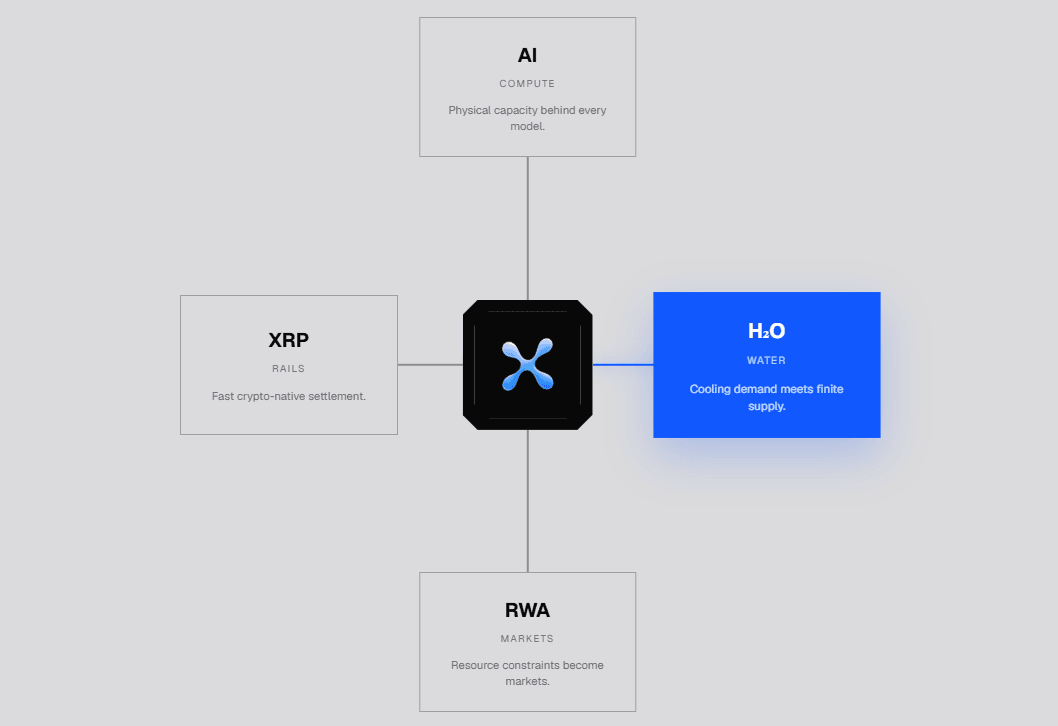
The LiquidX ecosystem diagram places the project logo at the centre with four components around it: AI compute at the top, H₂O or water on the right, RWA markets at the bottom, and XRP rails on the left. This structure shows how the project builds its story.
1. AI Compute: The Physical Capacity Behind AI Models
The first component is AI compute. In the official diagram, this part is described as the physical capacity behind every AI model.
AI models require computing infrastructure to be trained and run. This includes servers, computing accelerators, data centres, connectivity, power supply, and cooling systems. The higher the demand for AI services, the greater the need for physical computing capacity.
LiquidX uses this fact as a starting point for its narrative. The project wants to remind us that AI technology, even when used in the form of digital applications, still depends on real‑world material resources.
2. H₂O: Water and Cooling Needs
The next component is H₂O or water. In the LiquidX diagram, the water section comes with a note that cooling demand meets limited supply.
Data centres generate heat when computing devices operate. Therefore, cooling systems are an important part of AI infrastructure. In several data centre operational models, water can be used as a cooling element, though the technical methods vary according to facility design and location.
For LiquidX, water is not just an additional commodity in the narrative. Water is positioned as a reminder that AI expansion has a resource footprint. Even so, the LQX token does not grant ownership rights over physical water, water rights, or any specific water management project. The LiquidX site also emphasises that its token is not an automatic representation of commodities or securities.
3. RWA Markets: Resource Scarcity and Digital Markets
The third part is RWA markets. RWA stands for real‑world assets, a category of physical assets that can be represented, traded, or accessed through blockchain technology.
The LiquidX diagram conveys the idea that resource scarcity can become a market. In this context, the scarcity of water, energy, data centre capacity, or AI‑supporting resources can be viewed as an increasingly important economic theme.
However, the term RWA in LiquidX should be read proportionally. Available materials show RWA as part of the project's narrative framework. There is not yet sufficient basis to state that LQX is already an RWA token backed by physical assets, is tokenising water, or grants token holders legal rights to real‑world assets.
This distinction is important for investors. A token themed around RWA does not always mean that the token has direct RWA backing.
Read Also: BIS Reveals New Potential of XRP Ledger for Digital Financial Systems
4. XRP Rails: Digital Settlement Framework
The fourth component is XRP rails. The LiquidX diagram describes XRP rails as fast crypto‑native settlement, a transaction settlement framework designed for the crypto asset world.
In the LiquidX thesis, the XRP Ledger is positioned as one possible settlement path for digital markets related to resources and real‑world assets.
That idea completes the narrative chain: AI needs compute, compute is related to cooling, cooling makes water a strategic issue, and resource scarcity can be linked to markets and digital settlement.
But users still need to distinguish between concept and implementation. The LQX token is on Solana, not on XRP Ledger. The mention of XRP rails in the LiquidX model cannot be directly interpreted as technical integration, an official partnership, or active use of XRPL by the LQX token.
If you want to buy crypto assets through a local platform, you can create an account on Bittime.
LiquidX Tokenomics and Trading Status
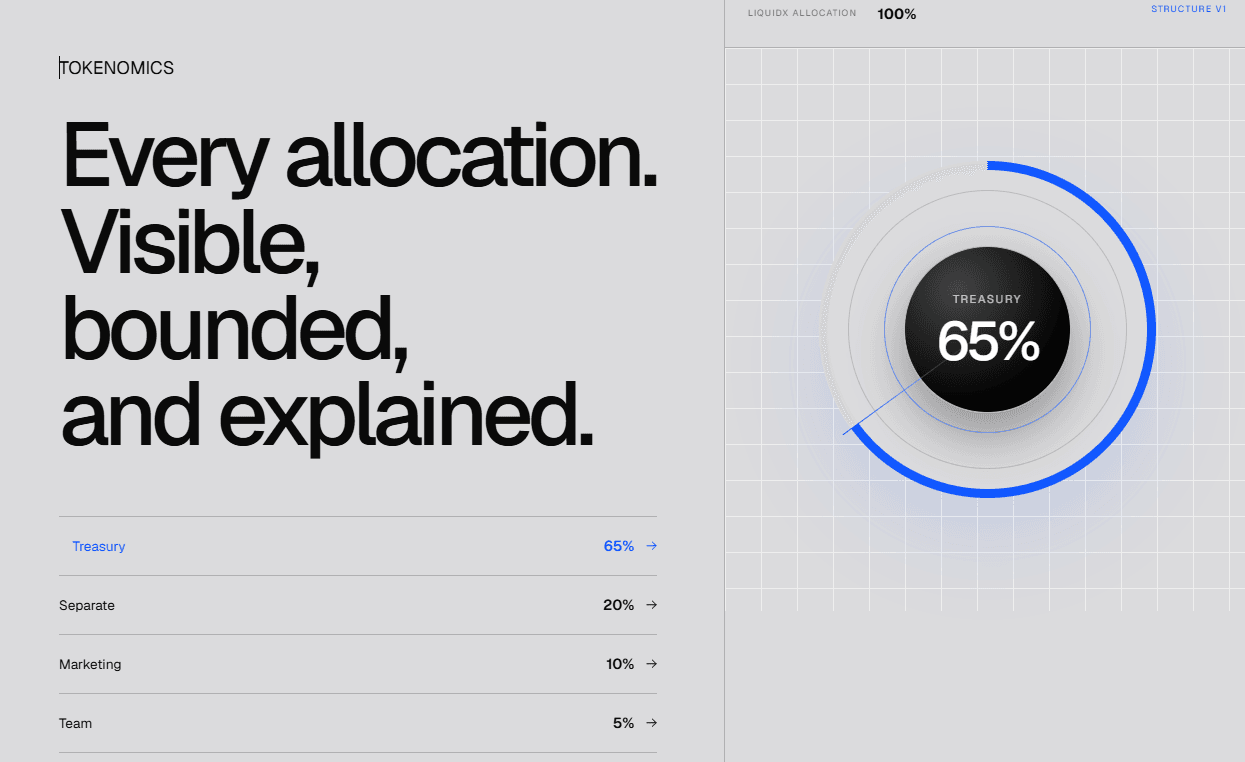
Based on information published by LiquidX, the project’s token allocation is divided into several main categories. The largest portion is held by the project treasury.
A 65% treasury allocation makes the governance of project wallets a factor to monitor. Investors should pay attention to treasury address transparency, token movement patterns, vesting schedules if available, and official updates regarding fund usage.
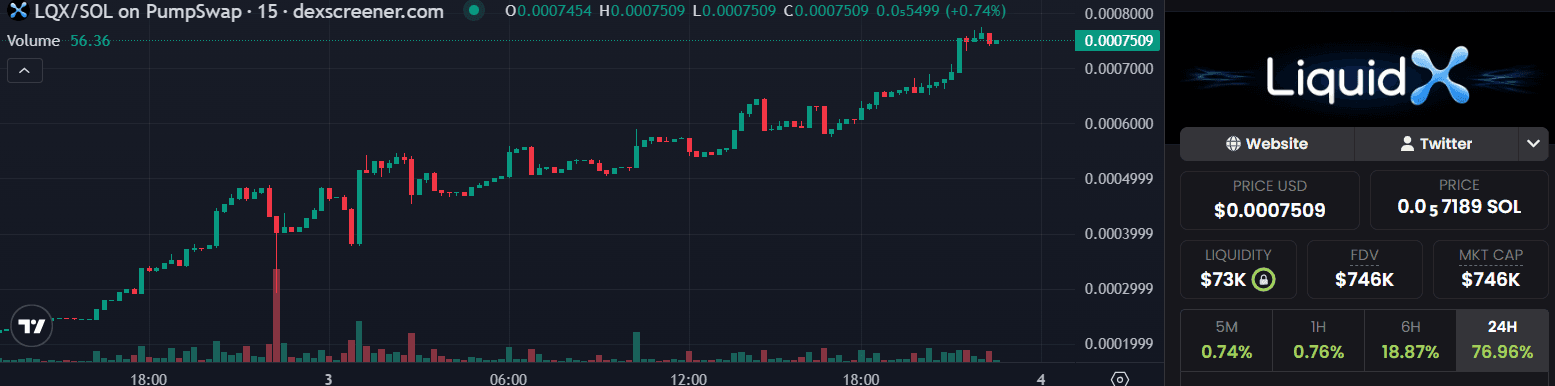
Meanwhile, the LiquidX/SOL pair is recorded on PumpSwap on Solana via DexScreener. Price data, market capitalisation, volume, and DEX liquidity can change quickly, especially for new projects. Therefore, market data should be re‑checked immediately before any transaction.
Read Also: Top 10 RWA Crypto Asset Tokenisations in the World
How to Verify the LQX Token
Users should not buy tokens just because the name looks similar. On Solana, tokens with the same ticker or name can be created by anyone. Safer verification steps include:
- Take the contract address only from the official LiquidX website and channels.
- Match that contract address with the pair page on DexScreener or CoinMarketCap.
- Check the token's network and ensure it is on Solana.
- Review liquidity, holder distribution, transaction activity, and token authority status through a blockchain explorer.
- Avoid sending SOL to addresses shared through private messages, comments, or unverified sites.
The provided DexScreener link directs to the LiquidX/SOL pair on PumpSwap, but contract address verification should still be done before buying because market conditions and token listings can change.
Potential and Risks of the LQX Token
The potential of the LQX token rests on the strength of its narrative. LiquidX brings together several themes that have great appeal in the crypto industry: AI, computing infrastructure needs, water, RWA, Solana, and XRP Ledger.
These themes could become relevant if discussions about energy consumption, cooling, water availability, and data centre needs continue to intensify along with the growth of AI usage. In the crypto market, a narrative that is easy to grasp and aligned with industry trends often fuels community attention.
However, a strong narrative is not the same as proven utility. The value of LQX can be influenced by market sentiment, community activity, DEX liquidity, ownership concentration, and the team’s ability to deliver on its roadmap. New tokens can also experience extreme volatility, wide spreads, and rapid price changes due to low trading volume.
Read Also: Futures Trading for Beginners: How It Works, Tips, and Risks
What Investors Should Consider
Before considering the LQX token, investors should assess the following:
- Whether the contract address to be bought matches the official project channels.
- Whether the project has shown verifiable products, integrations, or partnerships.
- Whether the treasury and reserve wallets are transparent and can be monitored on‑chain.
- Whether the LQX/SOL pair liquidity is sufficient to support your buy and sell strategy.
- Whether token distribution is concentrated in a few wallets.
- Whether you understand that LQX does not represent ownership of water, RWA assets, or any security instrument.
For investors, the safest approach is to treat LiquidX as a high‑risk, narrative‑based crypto asset. Only use funds you are prepared to lose, conduct your own research, and do not make decisions solely based on potential price increases.
Conclusion
LiquidX (LQX) is a Solana token that carries a thesis about the relationship between AI, computing needs, cooling water, RWA markets, and the XRP Ledger as a settlement framework.
The project diagram helps explain that relationship, but LQX should still be understood as a narrative‑based token, not proof of ownership of water or real‑world assets. Its potential depends on community strength, tokenomics transparency, market liquidity, and evidence of project execution in the future.
Check the prices of Bitcoin (BTC), Ethereum (ETH), XRP, Solana (SOL), GRAM, and BNB, and also top memecoins DOGE. You can trade directly on Bittime!
Bittime is a Digital Asset Trading Platform (PAKD) licensed and supervised by the Financial Services Authority — where you can buy Bitcoin in Indonesia and hundreds of other crypto assets starting from Rp10,000. The registration process is fast, secure, and can be started today.
Monitor the USDT to IDR conversion and real-time price movements of your favourite crypto assets. All are available in one crypto investment app that can be downloaded for free on the Play Store.
Ready to start? Register now at Bittime and execute your investment strategy with a platform trusted by millions of users in Indonesia.
FAQ
What is LiquidX (LQX)?
LiquidX is a crypto token on the Solana network that carries a narrative about the relationship between AI compute, water, RWA markets, and the XRP Ledger. This token does not automatically represent ownership of physical assets or commodities.
Does LiquidX run on the XRP Ledger?
No. The LQX token is traded on the Solana network, while the XRP Ledger appears in the LiquidX diagram as a settlement framework or digital rails.
What is LiquidX's connection to water?
LiquidX links water to the cooling needs of AI computing infrastructure. However, LQX is not a token that grants ownership over physical water or water rights.
What is the tokenomics of LiquidX?
The published allocation includes 65% treasury, 20% reserve, 10% marketing, and 5% team. Investors should still monitor wallet transparency and the use of those allocations.
Where is the LQX token traded?
LiquidX has an LQX/SOL trading pair on PumpSwap on the Solana network. Always verify the contract address through official channels before trading.
Is the LQX token a safe investment?
No crypto asset is risk‑free, especially new tokens traded on DEXs. The price of LQX can be highly volatile and its value depends on market conditions, liquidity, sentiment, and project development.
Disclaimer: The views expressed belong exclusively to the author and do not reflect the views of this platform. This platform and its affiliates disclaim any responsibility for the accuracy or suitability of the information provided. It is for informational purposes only and not intended as financial or investment advice.

.png)