The Law of Demand: Definition, Curve, Factors & Explanation by Economists
2025-10-08
Bittime - The law of demand is one of the most basic and important concepts in microeconomics.
It explains how consumers respond to price changes of goods or services by adjusting the quantity demanded.
This article will discuss in detail the definition, function, statement, curve, influencing factors, examples, and expert reviews so your understanding becomes comprehensive.

What Is the Law of Demand?
Simply put, the law of demand states that when the price of a good rises, the quantity demanded will fall, and conversely, when the price falls, demand increases — assuming other factors remain constant (ceteris paribus).
According to OCBC NISP, the law of demand is the rule that explains that the quantity purchased is inversely related to the price level.
Several sources also express this as the principle that lower prices cause demand to rise and higher prices cause demand to fall.
Some economists define demand as consumers’ willingness to buy a good at various price levels over a period of time, where the ability to pay (purchasing power) is also a requirement.
Read Also: Understanding Crypto Lending: Interest, Collateral & How to Borrow Correctly
Statement, Function & Formula of the Law of Demand
Statement of the Law of Demand
“The higher the price of a good, the smaller the quantity demanded; conversely, the lower the price, the more the good is demanded.”
Demand Function & Formula
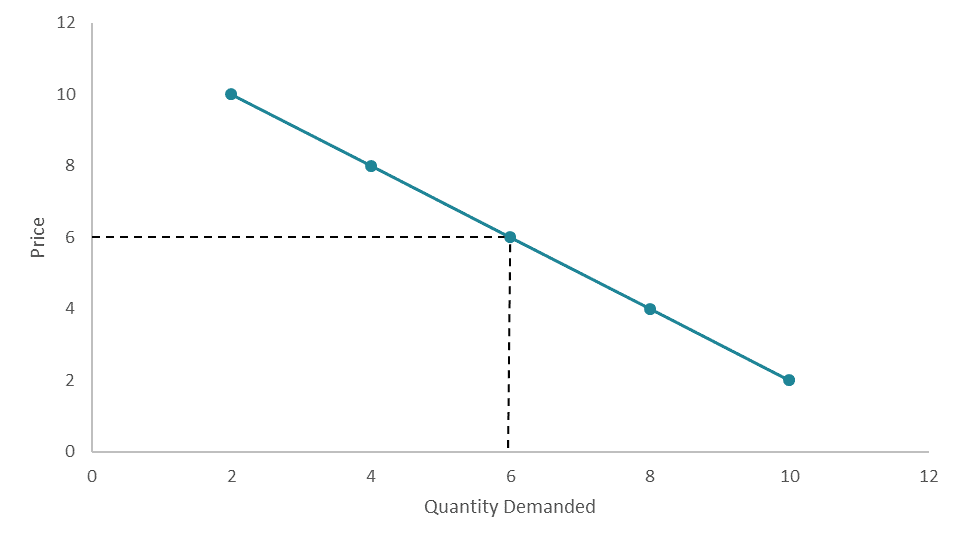
The demand function describes the mathematical relationship between price (P) and the quantity demanded (Q). The common formula is:
- Q = a – bP
- Or in another form: P = a – bQ
Where a = constant, and b = slope of the demand curve.
This function helps project how demand will change when price changes.
Demand Curve Illustration
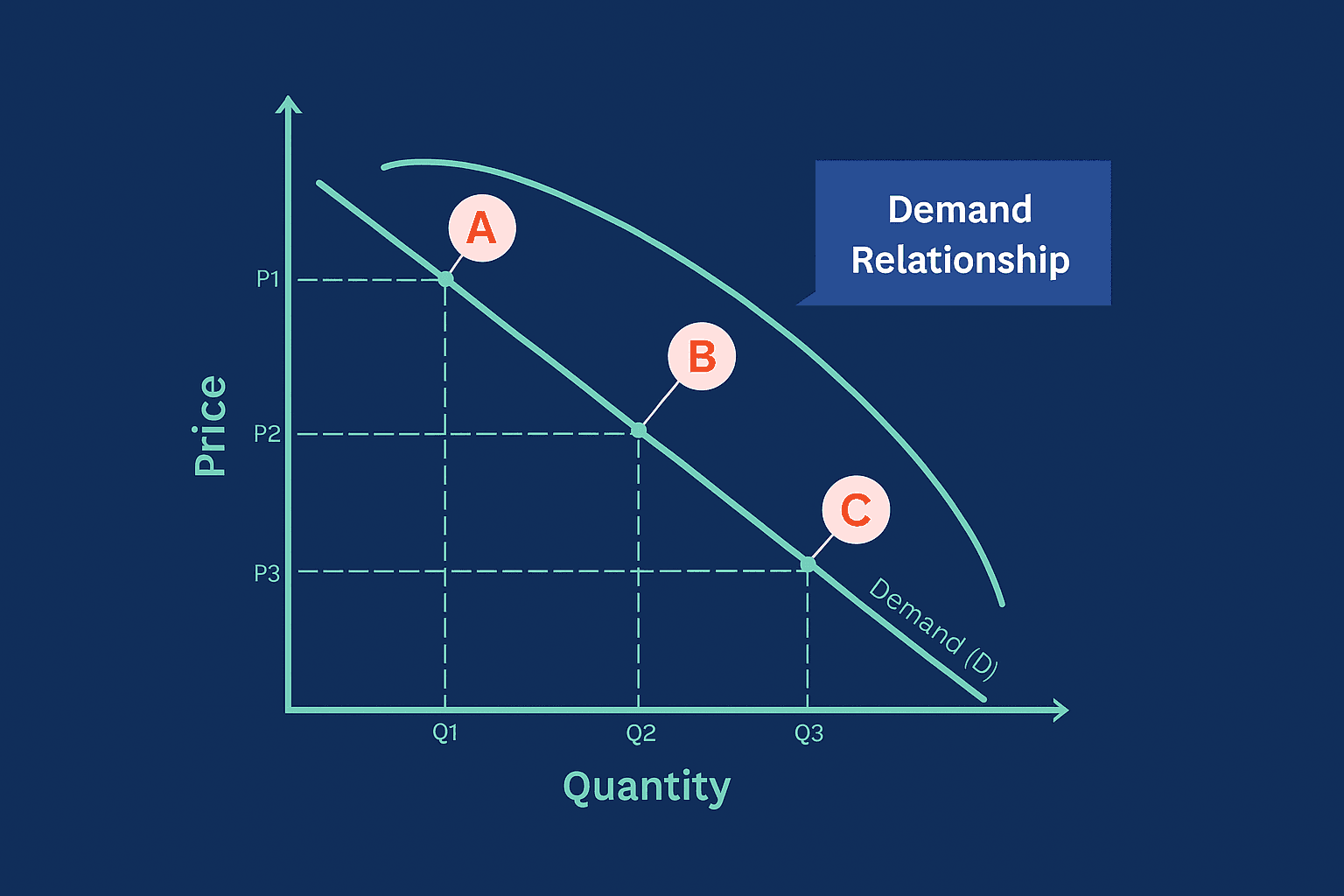
The demand curve graphically shows the negative relationship between price and quantity demanded — the line slopes downward from the top left to the bottom right.
The graphic illustrates that at price P1 the quantity demanded is Q1; when price falls to P2, demand increases to Q2.
Such graphs are used in international economic literature to illustrate the law of demand.
Read Also: What Is Winrate: Definition and Formula for Calculation
Factors Affecting Demand
Besides price, many other factors can shift the demand curve or change the quantity demanded:
- Consumer Income: When income rises, demand for normal goods increases, and vice versa.
- Prices of Related Goods: Substitute and complementary goods affect demand. If the price of a substitute falls, demand for the main good may decline.
- Tastes / Preferences: Changes in consumer preferences can shift demand up or down.
- Expectations of Future Prices: If consumers expect prices to rise, they tend to buy now, increasing current demand.
- Number of Consumers / Market Size: Population growth or new consumers entering the market will raise total demand.
- Social & Demographic Factors: Age, lifestyle, and culture can affect purchasing desires.
Changes in these factors cause the demand curve to shift right (demand increases) or left (demand decreases).
Don’t confuse a price change (movement along the curve) with a change in demand (shift of the curve).
Explanations from Economists
Various classical and modern theories and economists explain the law of demand using different approaches:
- Marshall introduced the concept of marginal utility — as more units are consumed, the additional benefit per unit decreases, so consumers are reluctant to buy large quantities at high prices.
- In modern economic literature (such as Standard Microeconomics), the law of demand is assumed with caveats that marginal utility falls, income is constant, preferences are fixed, and prices of other goods remain unchanged.
- Price Elasticity of Demand in many theories explains how responsive quantity demanded is to price changes — goods with high elasticity are very price-sensitive.
- Some exceptions (like Veblen or Giffen goods) are special cases where the law of demand may not “hold” according to traditional theory.
Read Also: What Is a Duopoly Market: Explanation, Types, and Examples
Examples & Applications of the Law of Demand
- Simple example: If the price of apples rises from IDR 10,000 to IDR 15,000, consumers may buy fewer apples or switch to other fruits.
- In transportation, an increase in ride-hailing fares can reduce usage and push people to public transport.
- Companies can use this theory to set an optimal price to maximize revenue — pricing too high may kill demand.
Conclusion
The law of demand is a fundamental concept in microeconomics that shows the negative relationship between price and the quantity demanded (ceteris paribus).
The demand curve, demand function, and influencing factors are essential to understand consumer behavior and market shifts.
Combined with views from classical and modern economic theories, the law of demand helps economic actors — consumers, firms, and policymakers — make rational decisions.
How to Buy Crypto on Bittime

Want to trade or buy beli Bitcoin and invest in crypto easily? Bittime is ready to help! As an Indonesian crypto exchange officially registered with Bappebti, Bittime ensures every transaction is safe and fast.
Start by registering and verifying your identity, then make a minimum deposit of IDR 10,000. After that, you can immediately buy your favorite digital assets!
Check rates BTC to IDR, ETH to IDR, SOL to IDR and other crypto assets to see the crypto market trend today in real time on Bittime.
Also visit Bittime Blog for interesting updates and educational information about crypto. Find trusted articles on Web3, blockchain technology, and digital asset investment tips designed to enrich your crypto knowledge.
FAQ
What is the difference between demand and quantity demanded?
Demand refers to the entire curve that depicts the relationship between price and quantity, whereas quantity demanded is a specific point on the curve showing the amount demanded at a particular price.
Does price always up → demand down?
In basic theory, yes, but there are exceptions such as Veblen goods (status goods) or Giffen goods which can violate this pattern in certain cases.
How do firms use the law of demand?
Firms can set optimal prices based on demand elasticity: if a product is elastic, a price cut can trigger a large enough increase in demand to raise total revenue.
Disclaimer: The views expressed belong exclusively to the author and do not reflect the views of this platform. This platform and its affiliates disclaim any responsibility for the accuracy or suitability of the information provided. It is for informational purposes only and not intended as financial or investment advice.

.png)


