What Is Gno.land (GNOT)? A Go-Based Layer-1 Blockchain for Smart Contracts
2026-07-21
What is Gno.land? Gno.land is blockchain Layer-1 to build smart contracts using Gno, a programming language developed from Go. The project features human-readable on-chain code, application composability, and GNOT as a token for transaction fees and data storage.
Key Takeaways
- Gno.land uses Gno and GnoVM to make it easier for Go developers to build blockchain applications.
- The Beta Mainnet is live, but GNOT transfers are still restricted until the full Mainnet is enabled through network governance.
- The GNOT public sale will take place from July 20–27, 2026, while the final TGE date has not been announced yet.
What is Gno.land?
Gno.land is a Layer-1 smart contract platform that uses the Gno language. The network is designed to allow developers to write blockchain applications with code structure similar to Go, a popular programming language for systems and infrastructure development.
Smart contracts on Gno.land are published as complete source code. Users and developers can read, inspect, reuse, or improve upon the code already available on the network.
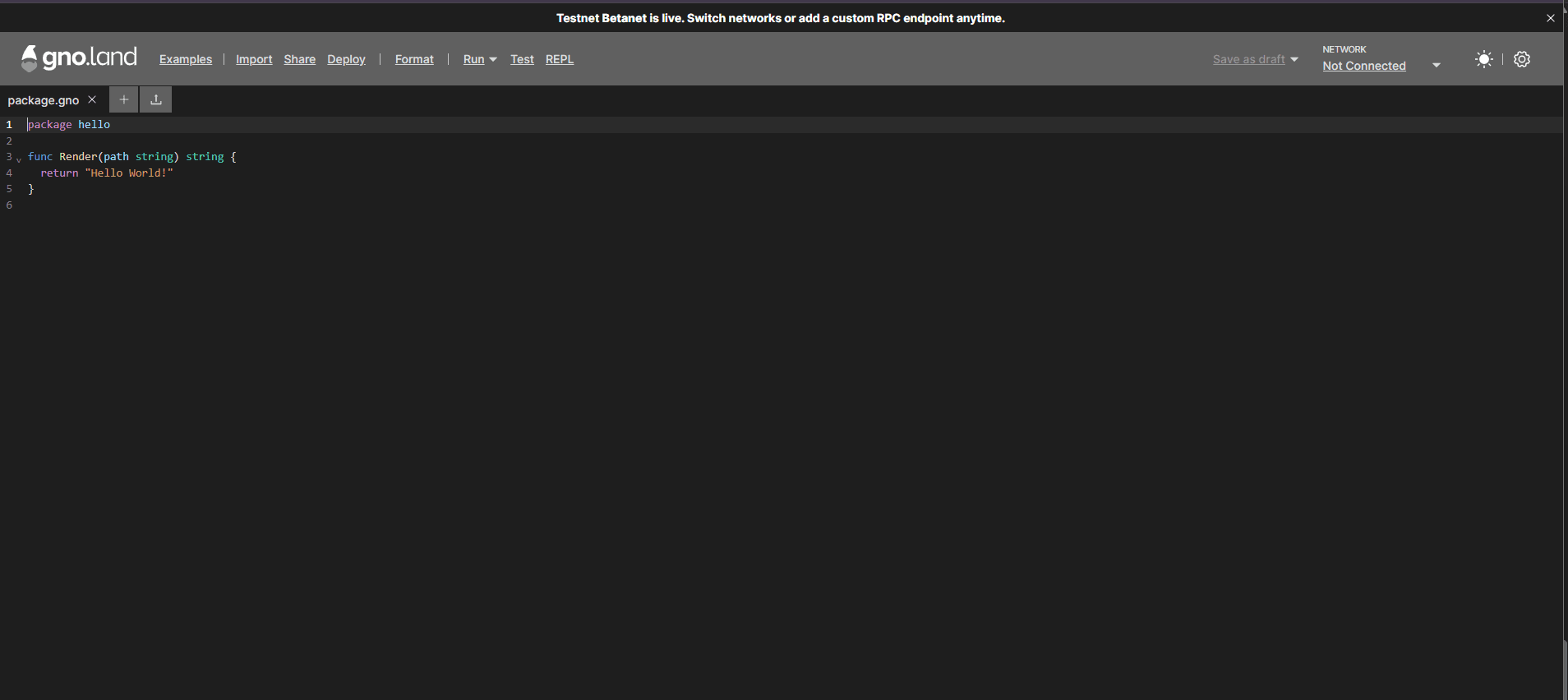
Source play.gno.land
This approach differs from platforms that rely more on bytecode so that application code is not always easy to read directly.
Gno.land organizes the code into two main components:
- Packages, which is a reusable code library.
- Realms, namely smart contracts or applications that have persistent data and can interact with users.
This structure makes the ecosystem resemble an open code repository. Developers can examine existing packages, use them as components, and then build new applications without always starting from scratch.
Read also:What Is RobinVista? Getting to Know the Fixed-Fee DEX on Robinhood Chain
Who Develops Gno.land?
Gno.land is developed by a team led by Jae Kwon, a key figure in the development of Tendermint and Cosmos. Initial development of GnoVM and Tendermint-based nodes began in 2021, and has continued through several testnets, developer tool updates, governance testing, and virtual machine optimizations.
The project incorporates several concepts from the Cosmos ecosystem, but Gno.land is a standalone blockchain network. Its roadmap also includes connecting with other networks through Inter-Blockchain Communication (IBC).
The team's background gives Gno.land relevant technical experience. However, a developer's reputation doesn't eliminate the risks of a new network. Users still need to objectively assess network stability, developer activity, code security, token distribution, and application growth.
Read also:What Are Hood Stocks ($HSTOCKS)? How They Work and the Risks
What is Gno Language?
Gno is a programming language developed as a variation of Go for blockchain applications. Its syntax and writing patterns are closely aligned with Go, so developers don't have to learn a completely different smart contract language.
Gno's main characteristics include:
- Go-like syntax.
- A type system that helps detect errors.
- Deterministic execution for blockchain consensus.
- Support for reusable packages.
- Automatic persistent data management.
- Source code that can be checked directly on the network.
Deterministic execution means a smart contract produces the same result when executed by all nodes with the same inputs and conditions. This characteristic is important because blockchains require agreement between nodes on the outcome of each transaction.
What is the Difference Between Gno and Go?
Gno isn't just an application written in Go. It's a language tailored to execute programs deterministically in a blockchain environment.
Go is commonly used to build servers, cloud services, network applications, and system software. Gno retains many Go patterns but adds the necessary rules for state management, smart contract execution, and network consensus.
This approach can lower the barrier to entry for Go developers. However, developers still need to understand blockchain concepts, gas fees, smart contract security, transactions, and on-chain data storage.
Read also:Robinhood (FOX): A New Meme Coin on Robinhood Chain, What's Its Potential?
What is GnoVM?
GnoVM is a virtual machine that runs Gno programs. It interprets abstract syntax trees directly, rather than converting smart contracts into traditional bytecode before execution.
GnoVM has several important functions:
- Execute smart contracts deterministically.
- Manage application state changes.
- Storing smart contract data.
- Measuring resource usage.
- Ensures execution results are consistent across nodes.
- Supports Go-like programming patterns.
Automatic state management is one of the highlighted features. Developers can focus on application logic while the virtual machine handles object and variable persistence according to network rules.
Despite its attractive design, GnoVM is still undergoing strengthening and optimization. The Beta Mainnet can now be used to test realms and packages, but changes that could impact features and contracts are still possible during the beta phase.
Read also:What Is Pon (PONS)? The Robinhood Coin Meme That's Going Viral
How Does the Gno.land Blockchain Work?
Developers write Gno code in packages or realms. This code is then published to the blockchain so that other users can inspect the source code and available functions.
In simple terms, the process goes as follows:
- Developers write and test Gno code.
- Packages or realms are sent to the network.
- Validators process publication transactions.
- Application code and state are stored on-chain.
- Users call realm functions through transactions.
- GnoVM executes the function.
- State changes are recorded after the network reaches consensus.
Developers can also use the browser-based environment to write, test, and run code without setting up a local environment. The ecosystem includes a wallet, block explorer, DEX, on-chain forum, and various development tools.
Read also:What Is Cardtopia (CARDTOPIA)? How to Open TCG Packs and Collect Cards
What is GNOT Coin?
GNOT is the native coin of Gno.land. This token is used to pay for transactions and support various on-chain operations.
GNOT functions include:
- Pay gas fee.
- Executing smart contracts.
- Sending transactions.
- Supports cross-network interactions.
- Locking data storage deposits.
- Support the economic activities of the Gno.land application.
Every transaction on the network uses micro denominations called ugnot. One GNOT is equal to one million ugots.
GNOT as Gas Token
GNOT is used to pay for computation when users send tokens, call realm functions, or publish packages. The fee mechanism also helps prevent spam, as users cannot execute transactions without incurring resource costs.
GNOT sebagai Storage Deposit
Gno.land implements deposit storage for persistent data. When a transaction adds data to the realm, a certain amount of GNOT is locked as a deposit.
If the data is subsequently deleted and storage usage decreases, the deposit can be refunded. However, the gas fee paid to process the transaction will not be refunded.
This mechanism attempts to correlate costs with actual storage usage. Applications that store large amounts of data need to provide more GNOT than applications with smaller state requirements.
Read also:What Is HyperBull (HBULL)? How It Works and Its Potential Yield
Status Beta Mainnet Gno.land
The Gno.land Mainnet Beta launches in the first quarter of 2026. The launch includes a GnoVM-based smart contract network, an initial distribution of GNOT, and an on-chain governance system.
Sumber AI Generated Image
However, the Beta Mainnet is not yet the same as the full Mainnet. GNOT transfers are still disabled during the beta phase, although the token can be used for supported on-chain functions. Transfer activation will be proposed and decided through the network's governance system.
Beta Mainnet may also still experience:
- Network disruption.
- Restart chain.
- Changes affecting the contract.
- Feature adjustments.
- GnoVM Update.
- Reset data in the development process.
Therefore, users should not treat the Beta Mainnet as a product with all its features finalized. This phase is used to test contracts, validator behavior, network stability, and system performance limits.
Read also:What is the Global Digital Water Reserve (GDWR) on Solana?
Kapan GNOT TGE?
As of July 21, 2026, the project has not yet set a final date for the GNOT TGE. Current information suggests a TGE around September 2026, but this schedule is still approximate and subject to change.
The full mainnet is targeted for launch in the third quarter of 2026. This phase is planned to enable GNOT transfers at the protocol level and improve network interoperability.
Users need to distinguish between the following dates:
- July 20, 2026: GNOT public sale begins.
- July 27, 2026: public sale is scheduled to end.
- Q3 2026: full Mainnet launch target.
- Around September 2026: TGE estimate, not yet a final date.
Don't assume the end of the public sale equates to the start of token trading. Participants should wait for the sale's completion, distribution, transfer activation, and verifiable market announcement.
Read also:What Is VEIL? The Private DePIN Network on Robinhood Chain
Tokenomics GNOT
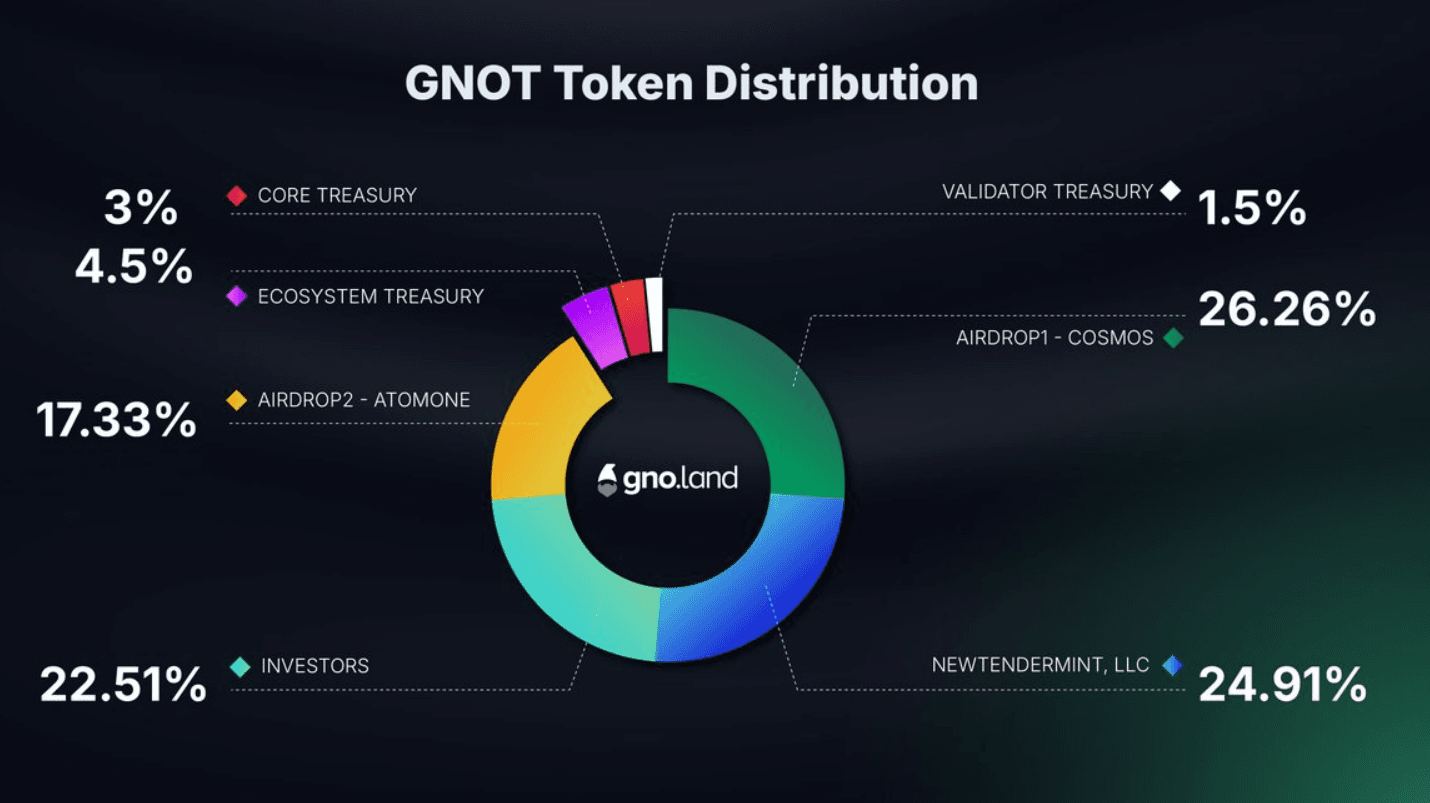
Source: x.com/@_gnoland
The latest tokenomics information sets the total supply at 1.333 billion GNOT. This figure differs from the previous Beta Mainnet announcement, which stated a supply of 1 billion tokens. For the current analysis, the 1.333 billion GNOT structure serves as the more recent reference.
The latest token distribution includes:
- 26.26% for airdrop recipients based on Cosmos snapshot.
- 24.91% for development companies.
- 22.51% for existing and future investors.
- 17.33% for AtomOne airdrop recipients.
- 4.50% for ecosystem treasury.
- 3% for core development treasury.
- 1.50% for the treasury validator.
The circulating supply at the TGE is estimated at around 197.32 million GNOT, or 14.8% of the total supply. The remainder is still locked up or not yet in circulation.
Changes in supply figures require attention because they impact diluted valuation, allocation percentage, and future selling pressure. Investors should also review the final tokenomics document and unlock schedule before assessing a reasonable price.
How to Buy GNOT through Public Sale
The GNOT public sale will run from July 20 to July 27, 2026. A total of 38.76 million GNOT, or approximately 2.9% of the supply, will be allocated for this sale.
Sales use a uniform-price auction format. Participants enter the maximum price they are willing to pay. After the bidding period ends, the system determines the clearing price based on total demand.
All winners pay the same final price. Participants who bid below the clearing price receive no allocation, while participants who bid at or above the clearing price receive tokens proportionally if demand exceeds availability.
The main terms of sale include:
- The starting price is US$0.0645 per GNOT.
- Bid increase of US$0.0215.
- Minimum commitment US$100.
- Payment using USDC or USDT.
- Payment assets reside on Ethereum Mainnet.
- Participants must complete identity verification.
- Bidding is done via desktop browser.
Steps to Follow GNOT Sales
- Go to the official sales page through the project channel.
- Complete the identity verification process.
- Connect a compatible wallet.
- Make sure the wallet has USDC or USDT on Ethereum.
- Prepare ETH for gas fees.
- Determine the maximum bid price.
- Check transaction details.
- Confirm commitment via wallet.
- Monitor the bid position until the auction ends.
- Wait for allocation, return of excess funds, and token distribution.
Don't send assets to addresses shared via private messages. Avoid sites that promise special discounts, guaranteed allocations, or GNOT sales without official verification.
Read also:Is Show Token (SHOW) Safe or a Scam? Check the Facts
Is GNOT Available for Purchase on Exchanges?
The public sale is underway, but this does not automatically mean GNOT can be freely traded on the spot market. Token transfers on the Beta Mainnet are still restricted, and the TGE has no final date.
Tokens with the GNOT name may be created by other parties on different networks. Therefore, don't buy based solely on the name or symbol. Ensure the network, contract address, transfer status, and listing announcements come from verified project channels.
To keep up to date with TGE updates, listings, and digital asset developments, you can register at Bittime and check the latest crypto news. Ensure GNOT is officially available before purchasing through a trading platform.
Gno.land's advantages
Go Developer Friendly
Gno uses syntax and patterns similar to Go. Developers already familiar with Go can adapt without learning an entirely new language.
Transparent Source Code
Smart contracts are published in readable code, making them easier to inspect, reuse, and develop applications.
Package-Based Composability
Developers can use existing packages to build new realms. This structure supports collaboration and modular development.
Storage Deposit
Users pay for storage usage through locked GNOT. Tokens can be returned upon data deletion, allowing for more scalable storage usage.
Interoperability
Gno.land's roadmap includes connections with other ecosystems through IBC and related interchain technologies.
Read also:What Is WISHBONE? Getting to Know the Memecoin from the Robinhood Chain Ecosystem
Risk Gno.land and GNOT
Beta Network Risk
The Beta Mainnet is still subject to outages, contract changes, and data resets. Users should understand that its stability is not yet comparable to a mature network.
TGE Risks and Mainnet Schedule
The TGE date is not final. Delays to the Mainnet or transfer activation may impact token access and market expectations.
Tokenomics Risk
Most tokens are not yet in circulation at the TGE. Unlocking by investors, treasury, and other groups could create selling pressure in the future.
Volatility Risk
The listing price can differ significantly from the public sale price. Initial demand, liquidity, and speculation can trigger extreme price swings.
Risks of New Technologies
GnoVM and Gno offer a new approach. However, developer adoption, application security, network performance, and ecosystem growth remain to be proven.
Fraud Risk
Fraudsters may create fake sales websites, fake tokens, or fake social media accounts. Never give your seed phrase or private key to anyone.
Is GNOT Worth Buying?
GNOT has utilities directly linked to network usage, particularly for gas, contract execution, data storage, and cross-chain interactions. Gno's close approach to Go may also be an advantage in attracting developers.
However, the feasibility of purchasing GNOT still depends on your risk tolerance. The network is still in the Mainnet Beta stage, token transfers are not yet fully live, and the TGE date is still not finalized.
Before purchasing, evaluate the following indicators:
- Number of active realms and applications.
- Developer activities.
- Mainnet Stability.
- Transaction growth.
- Validator distribution.
- Token unlock schedule.
- Liquidity after TGE.
- Real demand for storage deposits.
- IBC integration progress.
- Transparency of governance.
GNOT is more suitable for users who understand the risks of early-stage tokens and can wait for the network to develop. It's less suitable for those who need immediate liquidity or expect guaranteed returns after the TGE.
Conclusion
Gno.land is a Layer-1 blockchain based on Gno, a language developed from Go for deterministic smart contract execution. The GnoVM executes human-readable code, while its package and realm structure supports transparent and reusable application development.
GNOT is the native coin for gas fees, contract execution, storage deposits, and cross-chain interactions. The Mainnet Beta is live, but GNOT transfers are still restricted until the network enters full Mainnet.
The public sale will take place from July 20–27, 2026, while the TGE is expected to take place around September with no final date. Prospective participants should understand the auction mechanism, tokenomics, unlock schedule, and beta network risks before purchasing.
Bittime is a licensed and regulated Digital Financial Asset Trader (PAKD) supervised by Indonesia’s Financial Services Authority (OJK) — where you can buy Bitcoin in Indonesia and hundreds of other crypto assets starting from just Rp10,000. The registration process is fast, secure, and you can get started today.
Track USDT to IDR conversions and monitor your favorite crypto assets in real time. Everything is available in one crypto investment app that you can download for free on the Play Store
Ready to start? Register now on Bittime and execute your investment strategy with a platform trusted by millions of users in Indonesia.
FAQ
What is Gno.land?
Gno.land is a Layer-1 blockchain for building smart contracts using the Gno language. The code is stored on-chain for readability, auditability, and reusability.
What is the function of GNOT coin?
GNOT is used for gas fees, smart contract execution, data storage, and cross-chain operations. This token is the primary asset in Gno.land's economic activity.
When GNOT TGE ?
The final TGE date has not yet been announced. Current information suggests it will be around September 2026, while the full mainnet is targeted for launch in the third quarter.
How to buy GNOT?
GNOT can be acquired through a public sale from July 20–27, 2026, in an auction format. Participants must undergo identity verification and use USDC or USDT on the Ethereum Mainnet.
Is GNOT available on exchanges yet?
The public sale is underway, but transfers on the Beta Mainnet are still restricted. Wait for the official listing announcement and avoid counterfeit tokens using the GNOT symbol.
Disclaimer: The views expressed belong exclusively to the author and do not reflect the views of this platform. This platform and its affiliates disclaim any responsibility for the accuracy or suitability of the information provided. It is for informational purposes only and not intended as financial or investment advice.
.png)