What is Canton (CC)? Layer 1 for Institutions and RWAs
2025-12-15
Canton (CC)is starting to be frequently discussed among financial institutions and real world asset (RWA) players.
Unlike most public blockchains, Canton offers a more user-friendly approach to institutional needs without sacrificing interoperability and scalability.
So, what is Canton (CC) actually, how it works, and why is this project considered interesting for the future of institutional blockchain? Here's a complete discussion.
What is Canton Network?

Canton Network (CC) is blockchain Layer 1 specifically designed to support blockchain adoption by traditional financial institutions (TradFi) and the RWA ecosystem.
This network offers smart contracts with configurable levels of privacy and flexible controls, making it suitable for the needs of large enterprises, banks, and global financial service providers.
The uniqueness of Canton lies in its architecture which uses two-tier consensus mechanismThis system allows the network to expand horizontally without limits, while maintaining full interoperability between smart contracts.
In other words, the more applications and subnets that join, the more stable and interconnected the network performance remains.
As the backbone of the ecosystem, Canton Network relies onGlobal Synchronizer, the core component that functions as a connector and coordinator for all network activities.
Read Also:What is Codatta (XNY)? AI & Big Data Token Listing on Bittime
Canton Coin (CC)
Canton Coin or CC is the primary utility token in the Canton Network ecosystem. It is used to pay for the costs of applications and infrastructure running on Global Synchronizer, while also providing incentives for all network contributors.
Unlike many other crypto projects, Canton has no pre-mine, pre-sale, or initial distribution to investors. CC token earned purely from real contributions to the network.
Read Also: What is DeAgentAI (AIA)? An AI Token Now Available on Bittime!
Function of Canton Coin (CC)
Here are some of the main functions of Canton Coin (CC):
1. Network Fee Payment
CC is used to pay various operational costs in Global Synchronizer. Interestingly, all of these costs are burned, thus supporting the mechanism.Burn Mint Equilibrium (BME)for more efficient price discovery based on utility.
2. Incentives for Validators and Super Validators
Cantons have two important roles in the network:
- Super Validator, which runs Global Synchronizer as the network backbone.
- Validator, which runs a full node and provides network access.
Both of them get CC rewards according to their contribution.
3. Rewards for App Developers
Developers building applications and services on the Canton Network are also eligible to earn CC rewards. This encourages sustainable ecosystem growth.
Meanwhile, sAll Canton Coins (CC) are earned through utility activities on the network. Reward distribution is determined by a custom mining curve that includes a halving mechanism and proportional distributions to three main groups (super validators, validators, application and service providers).
Read Also: What is Palapa Token (PLPA) from Bittime Platform?
Canton Coin (CC) Circulation Number
Canton Network and CC officially launched in July 2024. As of February 2025, the number of CCs in circulation reached approximately 22 billion tokens.
In the first ten years, the total mineable CC was set at around 100 billion tokens. After that period, a fixed reward of 2.5 billion CC per year.
However, the total future supply of CC Coin is highly dependent on the number of tokens burned as transaction fees.
Read Also: What is Recall (RECALL)? Function, Tokenomics, and Pricing
Canton (CC) Price Today
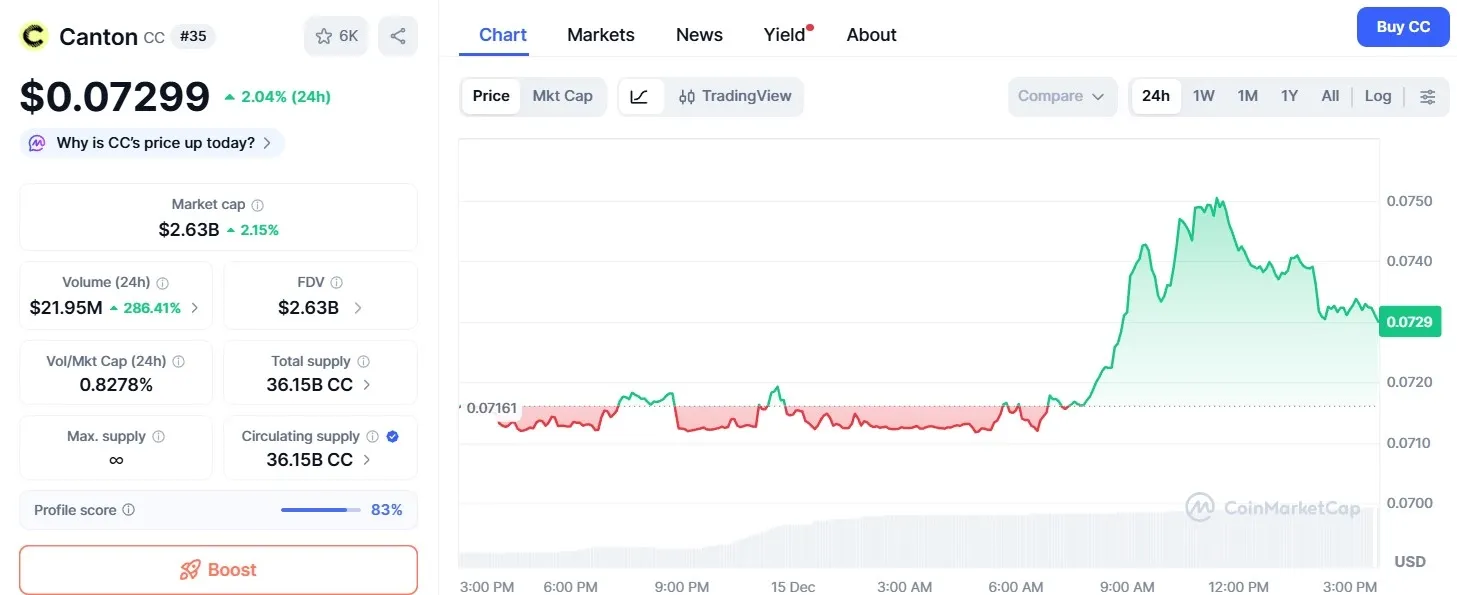
Based on the latest chart, CC Coin price todayit is traded in the rangeUS$0,07with relatively stable daily movements, but showing an increase in transaction volume.
This surge in volume indicates growing market interest, as attention is drawn to institutional blockchain solutions and RWA.
Read Also: What is a Semantic Layer (42)? Tokenomics and Price Analysis
Conclusion
Canton (CC) offers a different approach than most public blockchains. With its institutional focus, configurable privacy, and pure utility-based economic model, the project has the potential to become critical infrastructure for blockchain adoption in the TradFi sector.
Meanwhile, Canton Coin (CC) isn't just a speculative asset, but rather a token that truly reflects activity and contributions to the network. For investors and industry observers, Canton is a project worth monitoring for the long term.
FAQ
What is Canton (CC)?
Canton is a Layer 1 blockchain for institutions and RWAs, while CC is a utility token used within its network.
Does Canton Coin have a pre-sale or pre-mine?
No. All CC is earned through real contributions to the network.
What is CC used for?
CC is used to pay network fees, reward validators, and incentivize app developers.
What is the total supply of Canton Coin?
There is no fixed maximum limit. Supply depends on the annual reward and the number of tokens burned as fees.
Is Canton suitable for financial institutions?
Yes. Canton is specifically designed for institutional needs, with high privacy, massive scalability, and full interoperability.
Disclaimer: The views expressed belong exclusively to the author and do not reflect the views of this platform. This platform and its affiliates disclaim any responsibility for the accuracy or suitability of the information provided. It is for informational purposes only and not intended as financial or investment advice.

.png)